Anthony Licciardello | October 22, 2026
Union County
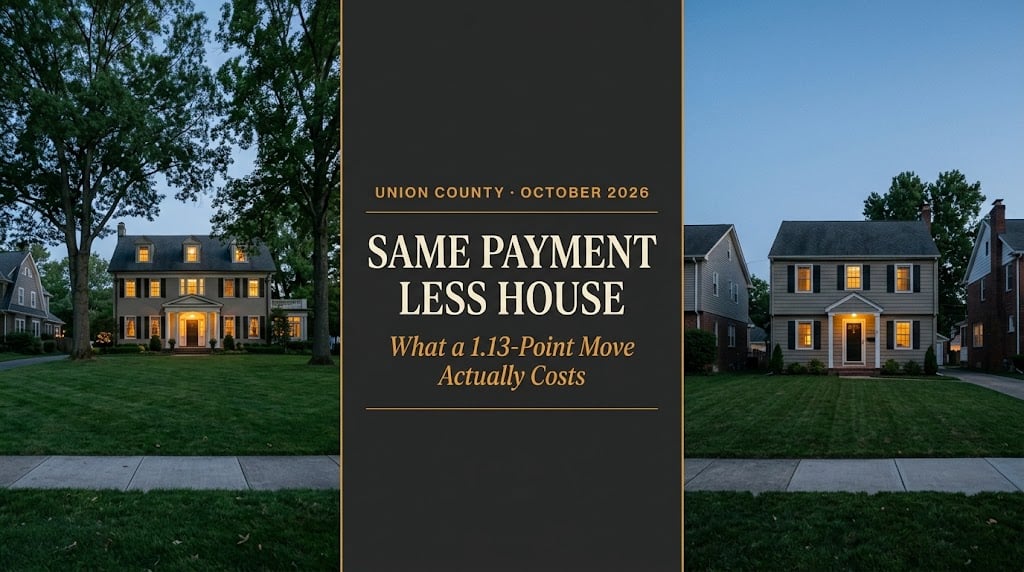
On October 15 the thirty-year fixed averaged 7.40%. A year earlier it averaged 6.27%. That gap of 1.13 points is worth exactly 12.2% more principal and interest every month, on any loan of any size — and it means the same monthly payment now buys 10.9% less house. Here is that arithmetic at four Union County price points, including what it leaves out.
A rate change is usually reported as a change in rates. For a buyer it is a change in one of two numbers: the monthly payment, or the price they can reach. At 7.40% against 6.27% a year ago, a Union County buyer holding the same budget has lost 10.9% of purchasing power — $71,676 at the county’s $658,526 median. A buyer holding the same house pays $4,764 more a year in principal and interest on that median purchase. Neither figure is a forecast. Both are arithmetic. Both also exclude the property-tax escrow, which in this county deserves checking town by town before any two houses are compared on payment.
By Anthony Licciardello, Broker · The Prodigy Team · Published October 20, 2026 · Rate data through October 15, 2026
What the survey says The payment The price What it omits Not a cause FAQ
A rate quoted in the news is an average of quotes, not an offer. It is still the number that moves every pre-approval letter in the county within a week of printing, and on October 15 it printed at 7.40%. The release carried its own comparison: a year earlier, the same survey averaged 6.27%.
What follows is the full consequence of that 1.13-point move, worked through at four price points, with the assumptions stated and the omissions named. There is no forecast in it. Every figure below is arithmetic on two interest rates.
The figure is the Freddie Mac Primary Mortgage Market Survey, the weekly average of thirty-year fixed-rate quotes to well-qualified borrowers putting twenty percent down. It is the most widely cited rate in American housing, and it is not a rate anyone is necessarily offered.
A borrower’s actual quote moves with credit score, down payment, loan size, property type, whether points are paid, and the lender. Jumbo pricing in this county — relevant across much of the Westfield, Summit, Mountainside and New Providence price range — runs on its own curve and does not track the survey point for point.
The year-over-year comparison is like for like: the same survey, the same borrower profile, twelve months apart. Whatever premium or discount an individual borrower carries, they carry it in both years, so the change transfers even when the level does not. The percentages below hold for any borrower whose own rate moved 6.27% to 7.40%.
Principal and interest on a thirty-year fixed scale linearly with the loan. That means the percentage increase from 6.27% to 7.40% is identical on a $200,000 loan and a $2,000,000 one: 12.214%. Only the dollars change.
At twenty percent down, here is the monthly difference at four Union County price points.
$500,000 purchase — $2,468 at 6.27%, $2,770 at 7.40%. +$302 a month, +$3,624 a year.
$650,000 purchase — $3,208 at 6.27%, $3,600 at 7.40%. +$392 a month, +$4,704 a year.
$800,000 purchase — $3,949 at 6.27%, $4,431 at 7.40%. +$482 a month, +$5,784 a year.
$1,000,000 purchase — $4,936 at 6.27%, $5,539 at 7.40%. +$603 a month, +$7,236 a year.
At the Union County median sale price of $658,526, twenty percent down puts the loan at $526,821. Principal and interest goes from $3,251 to $3,648 — $397 more a month, $4,764 more a year, for the identical house.
Over a full thirty-year term and with no refinance, the 1.13-point difference on that median purchase comes to roughly $142,900 in additional interest. Few loans run their full term and rates are not fixed features of the world, so treat that as the outer bound of the arithmetic rather than a prediction.
The same arithmetic read from the other end is the one buyers feel. Hold the monthly payment fixed at what it would have bought a year ago, and the rate move takes 10.884% off the purchase price that payment reaches.
A buyer whose budget supported the Union County median of $658,526 last October — a $526,821 loan at $3,251 a month in principal and interest — now reaches $586,850 at the same payment. The loan falls to $469,480. The house they can buy is $71,676 smaller, and in this county that figure crosses section lines and sometimes town lines.
At the county median it is the difference between the top and the middle of most sections. In the higher-priced boroughs it is larger in dollars and smaller in consequence: 10.9% off a $1,500,000 budget is $163,500, which in Westfield or Summit frequently buys the same street with a different lot or a different decade of renovation. The percentage is constant; what it costs you depends on how steep the price ladder is where you are shopping.
This is also why a rate move and a price cut are not interchangeable. A 10.9% reduction in what a buyer can reach does not become a 10.9% reduction in what sellers accept. It becomes fewer buyers at the top of each price band, which shows up first in how long a listing takes and whether its first asking price holds — not in the closed median, which lags it by months.
Every number in this piece is principal and interest. That is the part the rate controls, and it is not the whole payment. Four things sit outside it, and in New Jersey the first is routinely the largest.
Property taxes. Escrowed monthly, set by the municipality, and in much of Union County a line that rivals or exceeds the entire rate-driven increase computed above. It varies by town by a wide margin and is the single figure most worth checking before you compare two towns on payment.
Homeowners insurance. Rising independently of rates and faster in flood-exposed and older housing stock.
Mortgage insurance. Applies below twenty percent down, which is the assumption used throughout this piece. A buyer at ten percent down carries both a larger loan and a PMI premium on top of these figures.
Association fees. Relevant to the condominium and townhouse stock across the county’s transit corridors.
The practical consequence is that two Union County houses at the same asking price can carry monthly costs hundreds of dollars apart before a single rate is quoted. Any serious comparison runs on the all-in figure, not the sticker. Town-level tax detail is in the county revaluation and director’s ratio map, and in the individual town pieces for Cranford, Kenilworth, Scotch Plains and Berkeley Heights.
One discipline matters more than any of the numbers above. The 7.40% print is dated October 15, 2026. The most recent complete Union County market data runs through September. Nothing in that month’s figures can have been caused by a rate that had not yet been published.
This is worth stating plainly because the temptation runs the other way. September showed a rising share of listings cutting price across most of the county, and it is an easy sentence to write that rates did it. The dates do not permit that sentence. September also showed twelve of nineteen Union County markets as fast or faster than a year earlier, which is not what a rate shock looks like on arrival.
The rate move is measured and its arithmetic is exact. Its effect on Union County transactions is not yet measurable, because the first month of closings that could reflect it has not been reported. October and November data will begin to answer it. Anyone claiming to know the answer today is estimating, and should say so.
If you are buying, the number to ask a lender for is not the rate — it is the all-in monthly payment at the specific address, with that town’s actual tax assessment in the escrow line. Two houses at $750,000 in two Union County towns can differ by more per month in taxes than the entire 1.13-point rate move costs you. Buyers who shop on list price and then discover the escrow are the ones who withdraw late, which is the most expensive way to find out.
“Twelve percent more on the payment is a real number and I am not going to talk anybody out of feeling it. What I will say is that the buyers who got hurt this year were not the ones who paid 7.40%. They were the ones who shopped at a budget set in a different rate environment and found out at the mortgage commitment stage.”
Anthony Licciardello · Broker, The Prodigy Team
We run buyers on an all-in monthly figure at the specific address — principal, interest, that town’s assessed taxes and insurance — before the first showing, not after the offer. It is the difference between a budget and a guess.
A payment breakdown for the towns you are actually considering — principal, interest, taxes and insurance, at today’s rate and at the address level.
Request a payment breakdown
How much does a mortgage payment go up from 6.27% to 7.40%?
Principal and interest rise 12.214% on a thirty-year fixed, and that percentage is identical at every loan size. At twenty percent down it works out to roughly $302 a month more on a $500,000 purchase, $392 on $650,000, $482 on $800,000 and $603 on $1,000,000. At the Union County median sale price of $658,526 it is $397 a month, or $4,764 a year, for the same house.
How much purchase power does a buyer lose at 7.40%?
Holding the monthly payment constant, 10.884%. A Union County buyer whose budget reached the $658,526 county median a year ago reaches $586,850 at the same payment today — $71,676 less house. The loan supported falls from $526,821 to $469,480.
Is 7.40% the rate I will actually be offered?
Not necessarily. The figure is the Freddie Mac Primary Mortgage Market Survey average for well-qualified borrowers putting twenty percent down on a conforming thirty-year fixed. An individual quote moves with credit score, down payment, loan size, property type, points paid and lender. Jumbo pricing, which applies across much of Union County's higher price range, runs on its own curve. The year-over-year percentage change still transfers to any borrower whose own rate moved between those two levels.
Do these figures include property taxes and insurance?
No. Every figure here is principal and interest only, because that is the part the interest rate controls. Property taxes, homeowners insurance, mortgage insurance below twenty percent down, and any association fee sit on top. In much of Union County the monthly property-tax escrow rivals or exceeds the entire rate-driven increase described here, and it varies widely by town, so compare houses on the all-in payment rather than the asking price.
Did the rate increase cause the rise in Union County price cuts?
The dates do not support that claim. The 7.40% figure was published on October 15, 2026, and the most recent complete Union County market data runs through September 2026 — before the print. September also showed twelve of nineteen Union County markets selling as fast or faster than a year earlier, which is not the signature of a rate shock. Whether the move affects transactions will begin to show in October and November closings.
What is the total interest difference over the life of the loan?
On a $526,821 loan — twenty percent down on the Union County median — total interest over a full thirty-year term runs about $643,400 at 6.27% and about $786,300 at 7.40%, a difference of roughly $142,900. Few mortgages run their full term and rates change, so treat that as the outer bound of the arithmetic rather than a forecast.
Union County towns by price · Revaluation and director’s ratio map · Berkeley Heights effective tax rate · Cranford property taxes 2026 · Kenilworth property taxes · Scotch Plains taxes and the 2027 revaluation · Westfield Q3 2026 sales report · Cranford Q3 2026 sales report · Clark Q3 2026 sales report · Union County rental concessions
Sources and method. Mortgage rates are the Freddie Mac Primary Mortgage Market Survey thirty-year fixed-rate average published October 15, 2026, at 7.40%, together with the year-earlier comparison of 6.27% carried in the same release. Payment figures are standard amortization on a thirty-year fixed-rate loan at twenty percent down, principal and interest only, computed independently rather than taken from any published table; monthly amounts are rounded to the dollar and annual and lifetime figures follow from the rounded monthly values. The Union County median sale price of $658,526 is the September 2026 figure read from Redfin’s Union County housing-market page and verified in-browser on October 20, 2026. Nothing here is a rate quote, a lending commitment, or personalized financial advice; an individual borrower’s rate and payment will differ.
Prodigy Real Estate is an innovative real estate company offering high-end video production, home valuation services, purchasing, and home sales. Serving New York and New Jersey.