
Anthony Licciardello | April 18, 2026
Scotch Plains
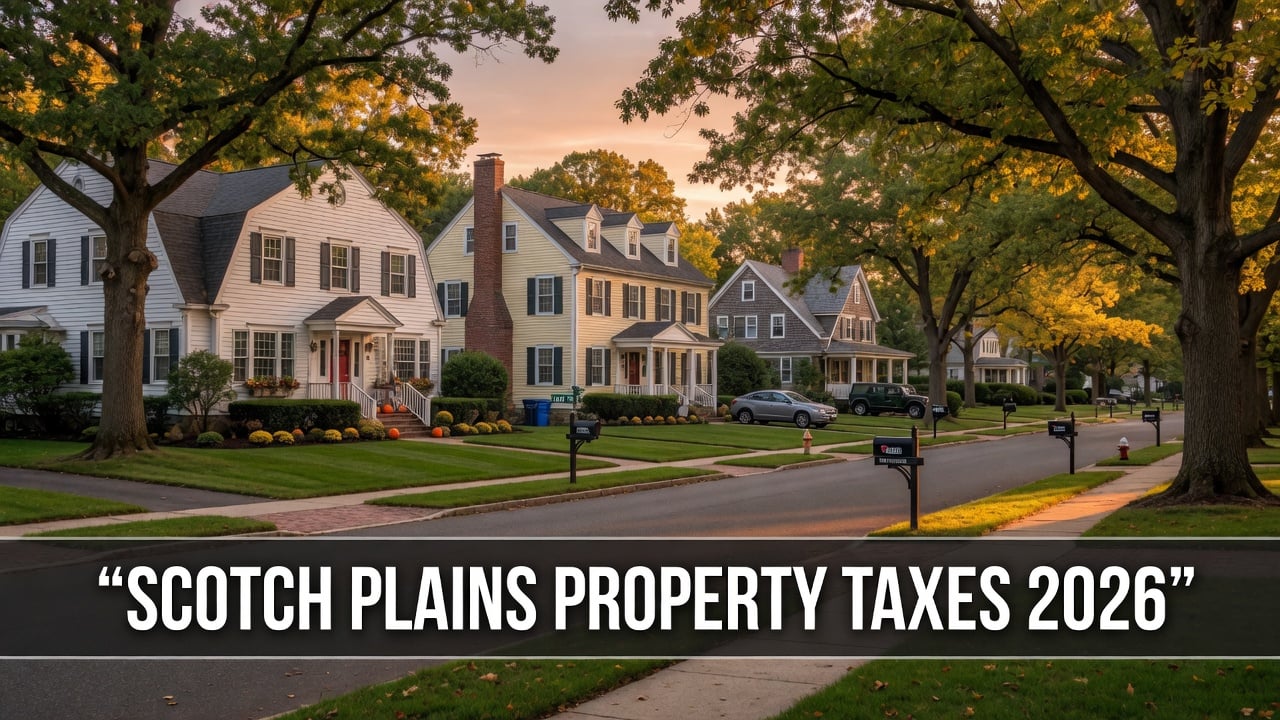
Scotch Plains carries a tax rate of $12.350 per $100 — a number that looks absurd until you learn the assessments it applies to sit at 15.65% of market value. A contracted revaluation now closes a $5.62 billion gap, effective for the 2027 tax year. Here is what you pay, who sets it, and what the reset actually does.
Three numbers explain the Scotch Plains tax picture. The certified 2025 general rate is $12.350 per $100 of assessed value. The 2026 Chapter 123 ratio of assessed to true value is 15.65%. Multiply the 2025 rate by the 2025 ratio and you get the certified effective rate of 2.138% — the only figure that can be compared against another town. The rate looks extreme solely because the base it applies to is compressed. That compression is now being corrected: the township has contracted Professional Property Appraisers, Inc. for a municipal-wide revaluation, notification letters went out December 29, inspections run through 2026, and new values are certified to the Union County Tax Board on January 10, 2027. The county board has quantified what is being closed — aggregate assessed value of $1.04 billion against aggregate true value of $6.66 billion, a difference of $5.62 billion. A revaluation does not raise the levy. It redistributes it. Some bills fall, many barely move, and some rise — and which group you land in depends on how your property's value has moved relative to the township, not on anything the Council decides.
Most tax explainers stop at the rate. That's the least useful number available in New Jersey, because it means nothing without the ratio beside it. This guide runs the full chain — the rate, the ratio, the effective rate, the three authorities that set your bill, the 2026 budget drivers, the deadlines and the penalties, the relief you may be entitled to, and the revaluation now underway. Figures come from the certified Union County abstract and equalization tables and from published township budget documents, with each attributed. For the township's market picture, see our Scotch Plains market update.
An automated estimate leans on your assessment — which here sits at roughly 15.65% of market value. With a revaluation certifying new values in January 2027, knowing your real number now is worth more than it was last year. See what yours is actually worth →
The certified 2025 general tax rate is $12.350 per $100 of assessed value. Set against neighbouring towns — Westfield at $2.292, Fanwood at $3.120 — that looks catastrophic. It isn't. It is arithmetic.
A general rate is meaningless without the ratio beside it. Scotch Plains assessments sit far below market value, so a high rate is required to raise the same money. Multiply the certified 2025 rate by the certified 2025 ratio of 17.31% and you get the effective tax rate of 2.138% — the burden expressed against true market value, and the only figure that can honestly be compared between municipalities. On that measure Scotch Plains sits below Fanwood's 2.251% and above Westfield's 1.813%, which is nothing like what the headline rates suggest. Our Scotch Plains versus Fanwood comparison works that inversion through in full.
The ratio has kept falling. The 2025 Chapter 123 certification put it at 17.31%. The 2026 certification, confirmed in the Final Equalization Table for Union County, puts it at 15.65%. Use the 2026 figure for anything you are doing now — but pair each rate with the ratio from its own year, or the arithmetic breaks.
This is a county-wide condition, not a Scotch Plains peculiarity. Nineteen of Union County's twenty-one municipalities sit below New Jersey's 85% compliance threshold, and Scotch Plains has the second-lowest ratio in the county behind Union Township's 8.89%. Our full Union County ratio map sets out every municipality.
Per the 2026 Final Table of the Union County Board of Taxation, real property exclusive of Class II railroad property, hearing held March 12, 2026. True value is roughly 6.4 times the assessed value currently on the roll. The revaluation does not create this value — it records value that already exists.
The single most persistent misconception about New Jersey property taxes is that the mayor and council set the bill. They set a minority of it. The certified 2025 abstract breaks the average Scotch Plains residential bill of $15,818 into its statutory components, and the arithmetic is stark.
The Scotch Plains-Fanwood Regional School District takes $10,538 — 66.6%. That is set by the Board of Education, bound by state funding formulas, and apportioned between Scotch Plains and Fanwood by equalized valuation. Union County takes $2,558 plus $110 in open space — 16.9%, set by the Board of County Commissioners. Municipal purposes take $2,340 — 14.8%, which is the only slice the Mayor and Council directly control, with the library at $246 and municipal open space at $26 riding on top.
The practical consequence is about where to direct pressure. A resident objecting to a rising bill at a Township Council meeting is addressing roughly one dollar in seven. The school portion requires the Board of Education; the county portion requires the County Commissioners. Both hold public budget hearings, and both are considerably less attended than township meetings.
Distribution of property taxes for the average residential property per the certified 2025 Abstract of Ratables, Union County Board of Taxation, certified December 31, 2025. Components sum to $15,818. The corresponding rate components are regional school $8.228, county $1.997, county open space $0.086, municipal purposes $1.827, library $0.192 and municipal open space $0.020, totalling the $12.350 general rate.
The introduced 2026 municipal budget comes in around $40.9 million, against roughly $38.84 million in 2025 and $34.2 million in the 2024 Annual Comprehensive Financial Report. On the average residential property that translates to roughly $243 in additional annual municipal tax.
Very little of the increase is discretionary. Personnel and police account for the largest single jump at $1.43 million, with staffing moving from 115 to 118 full-time equivalents. General government adds $444,164. Municipal insurance adds $267,006 against a hardening statewide market. Solid waste and landfill add $258,000 on regional tipping fees. Education and library add $220,370 under statutory minimums tied to equalized valuation. Debt service adds $198,946, and public works $175,386.
Health benefits are the quieter pressure. Active-employee coverage rose roughly $455,550 to about $2.45 million, with retiree benefits adding another $220,000 — some $678,000 in a single cycle, none of it optional if the township intends to keep its workforce insured.
And the debt ledger expanded. Net municipal debt moved from about $22.33 million to $27.96 million, with outstanding notes rising from $13.9 million to $18.34 million. That reflects capital investment pushed onto the bond ledger rather than funded directly — a legitimate choice, but one that shows up as debt service in every subsequent budget.
Quarterly due dates are set by statute: February 1, May 1, August 1 and November 1. The township grants a standard ten-calendar-day grace period, making the effective last day the tenth of each month, rolling to the next business day if it falls on a weekend or holiday. One consolidated bill goes out each July covering the current third and fourth quarters plus the following year's first two estimated quarters. When the state is late striking the final rate, the August grace period sometimes extends.
The penalty structure has no give in it. Under N.J.S.A. 54:4-66 a tax collector has no discretion to waive late-payment interest. Not receiving a bill is not a defence — the obligation to know what is due sits with the owner. Scotch Plains does not honour postmarks; payment must be physically received before the grace period closes. Interest runs at 8% on the first $1,500 of delinquency and 18% above that, calculated back to the statutory due date rather than the end of the grace period. Sustained delinquency leads to a tax sale, where the municipality auctions a Tax Sale Certificate and the lien holder collects redemption interest until the debt clears — with foreclosure as the endpoint.
For sellers, delinquency surfaces in the title work and has to be cured. The same applies to the municipal certifications the township requires at sale — see every certificate you need before closing in Scotch Plains and what can kill a Scotch Plains sale before it starts.
On the relief side, New Jersey has consolidated most major programmes behind one application — the PAS-1 — which routes applicants to the appropriate track. The local $250 deductions are handled separately by the Township Assessor, and the detail below matters because the two $250 programmes are routinely conflated.
Requires qualifying wartime service. There is no income cap on this deduction — a point frequently confused with the senior programme below, which does have one. Filed with the Township Assessor.
Age 65 or over, or permanently and totally disabled. Income limit of $10,000, excluding Social Security and certain pension income. Filed with the Township Assessor.
Direct property tax benefit subject to income thresholds. Replaced the former Homestead Benefit. Accessed through the consolidated PAS-1 application.
For eligible residents 65 and over, reimbursing the difference between current taxes and the amount paid in the applicant's base year. Income tested. Via PAS-1.
Targets up to 50% property tax relief for senior homeowners under specified income caps as the programme phases in. Accessed through PAS-1.
Programme terms, income thresholds and application deadlines are set by the State of New Jersey and change. Confirm current eligibility with the New Jersey Division of Taxation and the Scotch Plains Township Assessor before relying on any figure here.
The township has contracted Professional Property Appraisers, Inc., an independent state-certified firm, to execute a municipal-wide revaluation. A notification letter was mailed to every property owner on December 29, and PPA established a toll-free homeowner line at 1-866-957-1388. Inspections and data collection run through 2026, the revaluation completes around November–December 2026 with preliminary values issued to owners, and new assessments are certified to the Union County Tax Board on January 10, 2027. Owners disputing a new value have until May 1, 2027 — the revaluation-year extension of the usual April 1 deadline.
The inspectors are credentialed and you should check. PPA representatives carry photo identification on a lanyard, wear branded shirts, and display a company placard on the vehicle dashboard. Both a New Jersey State Police criminal history check and a sex offender registry screening are required of field staff. If someone presents at your door claiming to be the revaluation and cannot produce those credentials, do not admit them and call the township.
A revaluation does not raise the levy. The municipal, school and county budgets determine how much is collected; the revaluation determines how that total is divided. As assessments rise toward market, the general rate falls proportionally. The $12.350 rate will drop sharply — that is arithmetic, not a tax cut. The figure to watch is the effective rate, which is the burden expressed against what your property is actually worth.
Outcomes tend to follow what assessors informally call the rule of thirds. Roughly a third of taxpayers see a decrease, because their property was effectively over-assessed relative to today's market. Roughly a third see little change. Roughly a third see an increase — typically where market value has outrun the township average, which in Scotch Plains means completed renovations, newer construction, and the teardown-and-rebuild activity our analysis of lot size versus new construction traces. Homes with recent additions, pools, or substantial kitchen and bath work cluster in that third.
Calculated as ±15% of the 2026 common level of 15.65% per N.J.S.A. 54:3-22. Divide your assessment by an honest estimate of market value: above 18.00% you have reduction grounds, below 13.30% the county board is obliged to increase your assessment. The 2025 range was 14.71% to 19.91% — if you are working from an older figure, you are testing against the wrong numbers. Ratios recertify annually and the revaluation will reset this entirely for 2027.
Let the inspector in, and be there when they come. Owners who refuse entry get assessed from the exterior and from whatever the record card already says — which in a township that hasn't revalued in decades is frequently wrong, and rarely wrong in your favour. An inspector who sees an unfinished basement, a dated kitchen, or a functional problem can record it. One standing on the pavement guessing cannot. This is the one moment in the whole process where you have direct, free influence over the number, and a surprising share of owners decline it.
"Rising taxes in Scotch Plains aren't usually the story of one bad budget. They're the story of contractual obligations — labour, healthcare, insurance, debt — doing what they always do. The revaluation is a separate thing entirely, and people keep conflating the two. One decides how much gets collected. The other decides who pays which share of it. Get those straight and the whole picture stops being frightening and starts being something you can plan around."
— Anthony Licciardello, Broker, The Prodigy Team
Reading certified county tax records before advising a client is not optional at this point in Scotch Plains. I'm Anthony Licciardello, Broker of The Prodigy Team, dual-licensed in New York and New Jersey, a member of the Staten Island Growth Management Task Force, and a former Director of Community Affairs in the Bloomberg Administration.
Our Above the Streets cinematic drone series extends that reach — aerial storytelling that markets entire towns rather than single listings.
Anthony Licciardello · Broker, The Prodigy Team · 718-873-7345
Values are certified to the county in January 2027. Between now and then, your current tax line is a marketing asset — and a renegotiation risk if a buyer raises it first. We price from certified records and put the carrying-cost picture on the table in week one.
What is the property tax rate in Scotch Plains, NJ?
The certified 2025 general tax rate is $12.350 per $100 of assessed value. That figure looks high only because Scotch Plains assesses at a fraction of market value. The certified effective rate — the burden against true market value, and the only figure comparable between towns — is 2.138%, derived by applying the 2025 general rate to the 2025 ratio of 17.31%. The 2026 Chapter 123 ratio has since fallen to 15.65%. The revaluation will reset both: the general rate drops sharply while assessments rise, which is arithmetic rather than a tax cut.
When is the Scotch Plains revaluation and who is conducting it?
The township has contracted Professional Property Appraisers, Inc. A notification letter was mailed to all property owners on December 29 and a toll-free homeowner line is available at 1-866-957-1388. Inspections and data collection run through 2026, the revaluation completes around November to December 2026 with preliminary values issued, and new assessments are certified to the Union County Tax Board on January 10, 2027 for the 2027 tax year. The appeal deadline is May 1, 2027 — extended from the usual April 1 in a revaluation year.
Will the revaluation make my Scotch Plains taxes go up?
Not in aggregate. A revaluation is revenue-neutral at the municipal level — it redistributes the existing levy across updated values rather than raising the total collected. Outcomes tend to follow the rule of thirds: roughly a third see a decrease, a third see little change, and a third see an increase. Properties whose market value has outrun the township average — recent renovations, additions, pools, newer construction — are most likely to land in the last group.
What is the Common Level Range for Scotch Plains?
Based on the 2026 common level of 15.65%, the range runs from a lower limit of 13.30% to an upper limit of 18.00% — the statutory ±15% under N.J.S.A. 54:3-22. Divide your assessment by an honest estimate of market value: above 18.00% and the county board must reduce your assessment; below 13.30% and it is obliged to increase it. The 2025 range was 14.71% to 19.91%, so anyone working from an older figure is testing against the wrong numbers.
Is there an income limit on the $250 veterans property tax deduction?
No. The $250 Veteran and Surviving Spouse deduction requires qualifying wartime service and carries no income limit. It is routinely confused with the separate $250 Senior Citizen and Disabled Person deduction, which does have an income limit of $10,000 excluding Social Security and certain pension income. Both are filed directly with the Township Assessor, and eligible veterans are sometimes discouraged from applying by descriptions that merge the two.
Why is my Scotch Plains tax bill going up in 2026?
The introduced 2026 municipal budget rises to roughly $40.9 million from about $38.84 million in 2025, translating to around $243 in additional annual municipal tax on the average residential property. The drivers are personnel and police costs up $1.43 million with staffing from 115 to 118 FTEs, combined health and retiree benefit increases near $678,000, a hardening insurance market, landfill tipping fees, statutory library minimums, and expanded debt service. Note also that municipal purposes account for only 14.8% of the average bill — the regional school district takes 66.6%.
Selling in Scotch Plains Before the Revaluation — how to position now
Why Scotch Plains' Biggest Lots Aren't Its Biggest Prices
Scotch Plains vs Fanwood — Same Schools, Different Everything Else
The Scotch Plains North–South Divide
Union County Revaluation — 19 of 21 Towns Below Compliance
Scotch Plains Homes for Sale
Certified 2025 general tax rate of $12.350 per $100, effective tax rate of 2.138%, equalization ratio of 17.31%, average residential tax bill of $15,818 and its components (regional school $10,538; county $2,558; county open space $110; municipal purposes $2,340; municipal library $246; municipal open space $26), together with rate components (regional school $8.228; county $1.997; county open space $0.086; municipal purposes $1.827; library $0.192; municipal open space $0.020), per the certified 2025 Abstract of Ratables for Union County, filed by the Union County Board of Taxation and certified December 31, 2025. The 2026 Chapter 123 average ratio of 15.65%, aggregate assessed value of $1,042,655,900, aggregate true value of $6,662,338,019 and required increase of $5,619,682,119 per the 2026 Final Table of the Union County Board of Taxation, hearing held March 12, 2026. Common Level Range calculated as ±15% of the common level per N.J.S.A. 54:3-22; the 2025 range was 14.71% to 19.91% and the 2026 range is 13.30% to 18.00%. Effective rates must pair a general rate with the ratio from the same year. Comparative effective rates of 2.251% (Fanwood) and 1.813% (Westfield) per the same 2025 abstract. Municipal budget figures — approximately $40.9 million introduced for 2026, $38.84 million adopted for 2025, $34.2 million per the 2024 Annual Comprehensive Financial Report, an average residential municipal impact near $243, and the category increases, health benefit, and debt figures cited — are drawn from introduced and published township budget documents and are subject to final adoption. Revaluation details, including the contracting of Professional Property Appraisers, Inc., the December 29 notification mailing, the toll-free homeowner line, the 2026 inspection period, the November–December 2026 completion, the January 10, 2027 certification to the Union County Tax Board and the May 1, 2027 revaluation-year appeal deadline, per Township of Scotch Plains revaluation notices and Mayor's messages. Quarterly due dates, the ten-day grace period, the prohibition on waiving interest and the 8% and 18% interest tiers per N.J.S.A. 54:4-66 and related statute. Relief programme terms are set by the State of New Jersey and change. The "rule of thirds" is an informal characterisation of typical revaluation outcomes, not a guarantee. Rates, ratios, budgets, programme terms and revaluation schedules all change. This is general information, not legal, tax, appraisal, or financial advice — confirm all figures with the Scotch Plains Township Assessor, the Scotch Plains Tax Collector, the Union County Board of Taxation, the New Jersey Division of Taxation, and a licensed New Jersey professional before relying on any of it.
Prodigy Real Estate is an innovative real estate company offering high-end video production, home valuation services, purchasing, and home sales. Serving New York and New Jersey.