
April 20, 2026
Berkeley Heights
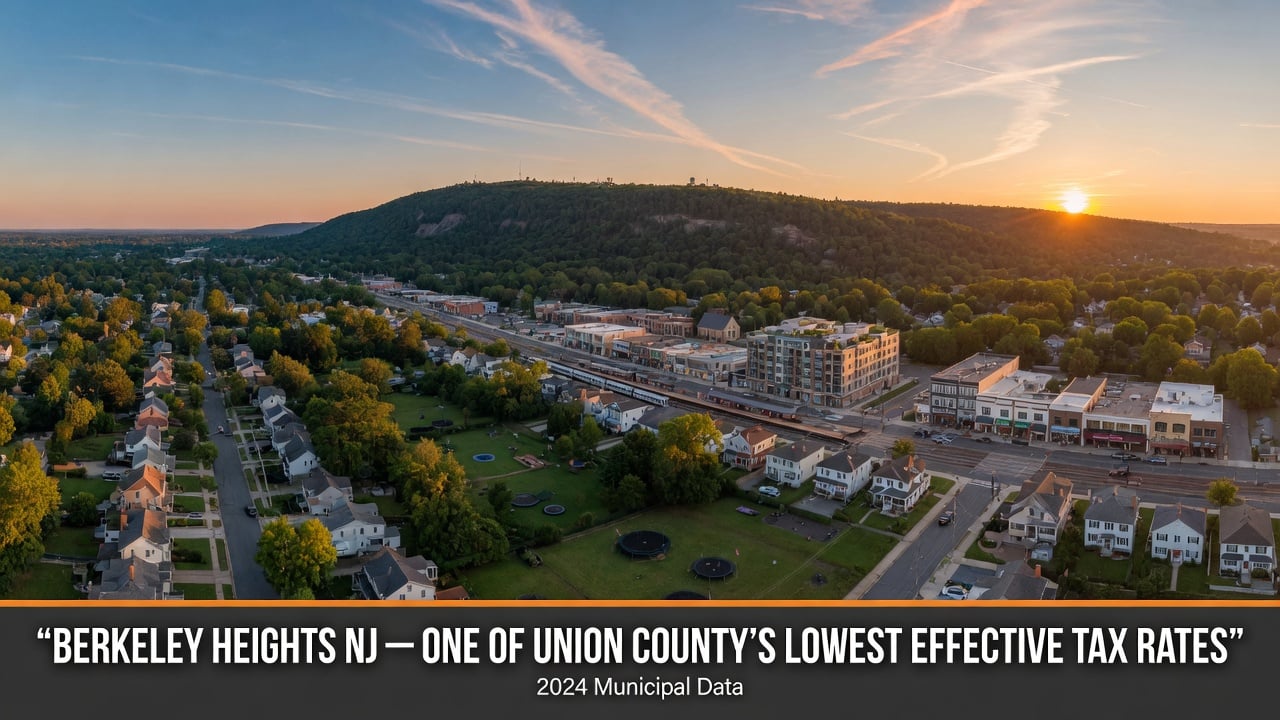
For buyers shopping Union County in 2026, the property tax math is rarely the fun part of the conversation — but it's often the deciding one. A $1 million home in Scotch Plains carries a materially different annual tax burden than the same home in Berkeley Heights, even though the two towns sit roughly ten miles apart. The effective tax rate is what drives that gap, and Berkeley Heights' 1.820 number is an outlier for the county.
The 2026 municipal budget — formally introduced April 7, 2026 — proposes a modest 2.1% tax levy increase, amounting to roughly $57.46 annually for the average household. That's at the edge of the state-imposed cap and well below what many Union County peers are passing this year. Meanwhile, Berkeley Heights' 2026 assessment-to-sales ratio sits at 35.73%, a number that tells its own story about where the tax base is headed.
Here's the full breakdown of how Berkeley Heights achieves its lower effective rate, what the PILOT structure means for long-term tax stability, how the town compares against its neighbors, and the forward signals every buyer and homeowner should be watching.
The Headline Number
The New Jersey Division of Taxation publishes a General Tax Rates table each year showing two rates per municipality: the nominal general rate and the effective rate. The general rate is applied to the assessed value on the tax roll, which in a town like Berkeley Heights sits well below market value. The effective rate normalizes that nominal rate to what it would be if assessments equaled full market value — which is the apples-to-apples comparison a buyer actually needs.
Berkeley Heights' 2025 effective tax rate is 1.820 per $100 of true market value. Translated to dollars: a home with a true market value of $750,000 carries an all-in annual tax bill of roughly $13,650. A $1 million home is looking at approximately $18,200 a year. A $1.5 million home is around $27,300. These figures represent the combined municipal, county, and school district tax burden — the total number the homeowner actually writes checks against four times a year.
What makes 1.820 an outlier is the comparison set. The New Jersey statewide average effective rate is 2.23%. Union County as a whole runs higher than the state average. Most Berkeley Heights peers — New Providence, Scotch Plains, Cranford, Plainfield — sit in the 2.05 to 2.46 range. The only Union County towns with effective rates materially lower than Berkeley Heights are Summit (1.475), Mountainside (1.566), and, narrowly, Westfield (1.810). For a buyer comparing Midtown Direct and Gladstone Branch commuter towns, that difference compounds into real money year after year.
The Current Year
On April 7, 2026, the Berkeley Heights Township Council formally introduced the 2026 municipal budget. The headline figure was a 2.1% increase in the municipal tax levy — roughly $57.46 per year for the average household, bringing the municipal portion of the total tax bill to approximately $2,742. For context, the municipal levy is only one of three components of a New Jersey property tax bill; the other two — the Union County levy and the school district levy — are determined separately and typically make up the larger share of the total.
The 2.1% figure is significant because it sits at or near the state-imposed 2% property tax cap, but the township absorbed cost pressures on healthcare premiums, insurance, sewer operations, and debt service that in most comparable Union County towns have produced larger levy increases this year. The NW Financial presentation accompanying the budget introduction walked the council through the township's debt stack and flagged that PILOT payments from several redevelopment projects are flowing directly to debt service, reducing pressure on the conventional tax levy.
What the budget doesn't change is the effective tax rate structure. The nominal general rate will adjust marginally, but the underlying 1.820 effective rate is a function of the denominator — the total assessed value of the tax base — which doesn't move meaningfully without a revaluation. For buyers underwriting a Berkeley Heights purchase in 2026, the bill they'll see in July is a close cousin of the bill the previous owner paid in 2025, adjusted up by the levy increase and whatever changed at the county and school district level.
The Structural Subsidy
PILOT stands for Payment In Lieu Of Taxes. It's a state-authorized financial arrangement used extensively in New Jersey redevelopment to attract private investment to underutilized sites. Instead of a developer paying conventional property taxes under the municipal tax rate, the developer and the municipality negotiate a fixed payment schedule — typically a set dollar amount or a percentage of project gross revenue — that runs for the term of the redevelopment agreement, often 30 years.
The structural feature that matters for Berkeley Heights' effective tax rate is where those PILOT payments go. At the township's April 7 budget presentation, the financial team disclosed that PILOT payments from several older redevelopment projects are flowing directly to debt service until the year 2048. That means for the next 22 years, the carrying cost of a significant portion of Berkeley Heights' outstanding bonded debt is being covered by redevelopment payments rather than by the conventional property tax levy.
Why This Matters for Your Bill
When PILOT revenue covers debt service, the township can fund operations and capital projects without having to raise the conventional tax levy to service that same debt. That translates directly into a lower effective rate for every property in Berkeley Heights that isn't under a PILOT agreement — which is the vast majority of residential homes.
This is a mechanism most Union County towns don't have at the same scale. Scotch Plains, Cranford, Fanwood, and New Providence have redevelopment activity too, but Berkeley Heights' combination of a multi-project PILOT portfolio paired with aggressive conventional-tax new construction at Connell and The Carriages at Berkeley is distinctive. It's why the effective rate comparison isn't just a random data point — it's the measurable output of a specific long-run financial strategy.
The New Conventional Tax Base
While the older redevelopment PILOT portfolio services debt, two more recent Berkeley Heights projects are operating on a different track: they pay conventional property taxes, which flow to all three taxing jurisdictions — municipal, county, and school district. The Carriages at Berkeley Heights is expected to contribute approximately $837,000 to the Berkeley Heights school district in 2026. The Connell redevelopment is projected to contribute approximately $900,000 to the school district in 2027.
Combined, that's roughly $1.7 million per year in net-new school district revenue once both projects are fully paying into the tax roll. For a school district of Berkeley Heights' size, that's material capacity relief — funding that would otherwise have to come out of the existing residential and commercial tax base. In a county where school levies routinely outpace budget caps, adding that amount of recurring conventional tax revenue without requiring a levy increase is a structural win for existing homeowners.
The broader Berkeley Heights market context, including how the development activity is reshaping specific pockets of the township, is covered in more depth in the Berkeley Heights market trends report. For the purposes of this analysis, the tax-relevant takeaway is that newer conventional-tax construction is building a larger denominator — more properties paying into the tax base — which mechanically keeps the effective rate from climbing as fast as it otherwise would.
The Comparison
The clearest way to understand the Berkeley Heights tax advantage is to line it up against the other Union County towns a buyer might realistically be cross-shopping. The table below uses the 2025 New Jersey Division of Taxation General Tax Rates and 2026 Chapter 123 ratios, with revaluation status drawn from municipal announcements and the Union County Board of Taxation.
2025 – 2026 Tax Snapshot — Union County, NJ
| Town | 2025 Effective Rate | 2026 Ch. 123 Ratio | Revaluation Status |
|---|---|---|---|
| Summit | 1.475 | — | No reval ordered |
| Mountainside | 1.566 | 71.29% | No reval ordered |
| Westfield | 1.810 | — | No reval ordered |
| Berkeley Heights | 1.820 | 35.73% | No reval ordered |
| New Providence | 2.049 | 34.32% | Revaluation 2027 |
| Cranford | 2.106 | 26.04% | Not ordered (ratio low) |
| Scotch Plains | 2.137 | — | Revaluation 2027 |
Two things stand out. First: Berkeley Heights' effective rate is materially lower than the rates in the adjacent towns most Union County buyers cross-shop — New Providence, Scotch Plains, Cranford — by between 0.23 and 0.32 points. On a $1 million home, that's $2,300 to $3,200 per year in tax differential. Second: the two towns with effective rates above Berkeley Heights and comparable Chapter 123 ratios (New Providence, Scotch Plains) have both been ordered to revaluate for the 2027 tax year. That matters for the forward analysis in section 07.
The Dollar Math
Buyers evaluating a Union County purchase rarely translate the effective rate difference into dollars on the page. It's worth doing, because the gap isn't trivial and it compounds. On a $750,000 home, Berkeley Heights at 1.820% carries roughly $13,650 in annual taxes. The same home in Scotch Plains at 2.137% carries roughly $16,028 — a delta of about $2,378 per year. On a $1 million home, the annual difference grows to about $3,170. Over a ten-year ownership hold, that's more than $30,000 in cumulative tax differential on the seven-figure property.
On a $1 million purchase with a ten-year hold, the effective rate gap between Berkeley Heights and Scotch Plains is worth roughly $31,700 in after-tax dollars — more than a year's worth of mortgage principal for most borrowers at current rates.
Where this math matters most is for Midtown Direct and Gladstone Branch commuters. The Berkeley Heights NJ Transit station sits on the Gladstone Branch, connecting to the Morris & Essex Lines at Summit for direct service to Newark Penn and New York Penn. NYC-based buyers evaluating a move to Union County typically narrow their short list to Summit, Chatham, Westfield, Berkeley Heights, and New Providence based on commute time. On that commuter short list, Berkeley Heights currently offers the second-lowest effective tax rate after Summit — and at a meaningfully lower entry price point than Summit's single-family market.
For homeowners considering a sale, the tax math is an underused listing asset. Listing agents in adjacent towns don't typically lead with a comparative tax analysis because in most cases it works against them. For Berkeley Heights sellers it works in their favor, and featuring it in pricing conversations and buyer packets gives the property an advantage most cross-shopped comps can't match. For the full closing math that goes with a sale, see the 2026 guide to New Jersey closing costs.
The Forward Signals
Berkeley Heights' 2026 Chapter 123 equalization ratio is 35.73%, with a Common Level Range running from 30.37% on the low end to 41.09% on the high end. In 2025 the ratio was 41.70%. The downward movement of nearly six points in a single year reflects the fact that Berkeley Heights home values have been appreciating faster than the assessments on the tax roll — a gap that only widens as time passes without a revaluation.
That trajectory matters because of what happened to Berkeley Heights' closest ratio peer. New Providence's 2026 ratio sits at 34.32%, barely a point below Berkeley Heights, and New Providence has already been ordered by the Union County Board of Taxation to conduct a full revaluation with implementation for the 2027 tax year. The pattern is clear: when a Union County town's ratio drops into the mid-30s and stays there, a state-ordered revaluation tends to follow within a tax cycle or two.
Market Watch
Berkeley Heights has not been ordered to revaluate — yet. But the 35.73% ratio and the downward-trending trajectory put it in the same zone as New Providence, which was ordered for a 2027 reset. A similar order for Berkeley Heights — likely targeting a 2028 or 2029 implementation — is consistent with the Union County Board of Taxation's recent pattern.
A reset wouldn't raise the total tax revenue collected in Berkeley Heights — revaluations are revenue neutral. What it would do is redistribute the burden based on current market values, which means homes that have appreciated faster than the township-wide average would see larger bill increases.
The practical implication for buyers is straightforward: the 1.820 effective rate is real today, but it isn't permanent. A buyer underwriting a ten-year hold on a Berkeley Heights home should model at least one revaluation event within that window, with the understanding that the distributional outcome depends on how the specific property has appreciated relative to the town-wide average. Homes in the most appreciated pockets — typically the newer construction and the premium-renovated inventory near the train station — carry the most reset exposure.
For context on how Union County's other in-progress revaluations are proceeding and what homeowners in those towns are navigating right now, see the coverage of the Scotch Plains 2027 revaluation and current tax landscape. When and if the Board of Taxation orders Berkeley Heights to reset, the process will follow the same calendar — inspections, certification in January of the implementation year, and a May 1 appeal deadline.
FAQ
Q
What is the effective property tax rate in Berkeley Heights, NJ?
Berkeley Heights' 2025 effective property tax rate is 1.820 per $100 of true market value, according to the New Jersey Division of Taxation General Tax Rates table. That translates to approximately $18,200 in annual property taxes on a home with a $1 million market value, or roughly $13,650 on a $750,000 home. The effective rate is a more accurate comparison metric than the nominal general tax rate because it adjusts for the gap between assessed values and actual market values. Berkeley Heights' effective rate is the third-lowest in Union County, behind only Summit (1.475) and Mountainside (1.566).
Q
Is Berkeley Heights getting a property tax revaluation in 2026 or 2027?
Berkeley Heights has not been ordered to conduct a property tax revaluation as of April 2026. The township's 2026 Chapter 123 equalization ratio is 35.73%, which is close to the level at which the Union County Board of Taxation has historically ordered resets — New Providence, with a 34.32% ratio, was ordered to revaluate for the 2027 tax year. A revaluation order for Berkeley Heights in the 2027 or 2028 tax cycle is a reasonable forward expectation but is not currently scheduled. Homeowners will receive advance notice if and when an order is issued.
Q
What are PILOT payments and how do they affect Berkeley Heights taxes?
PILOT stands for Payment In Lieu Of Taxes. It's a financial agreement in which a redevelopment project pays a fixed, negotiated amount to the municipality instead of paying property taxes at the conventional municipal rate. In Berkeley Heights, PILOT payments from several older redevelopment projects are designated to flow directly to township debt service until 2048. That structure reduces the pressure on the conventional property tax levy, which helps keep Berkeley Heights' effective tax rate lower than it would otherwise be. Newer projects like The Carriages at Berkeley and the Connell redevelopment are paying conventional taxes rather than PILOT, and their contributions flow to municipal, county, and school district levies.
Q
How does Berkeley Heights compare to Summit, Westfield, and New Providence on property taxes?
On 2025 effective tax rates per $100 of true market value: Summit 1.475, Mountainside 1.566, Westfield 1.810, Berkeley Heights 1.820, New Providence 2.049, Cranford 2.106, Scotch Plains 2.137. For a $1 million home, that means Summit carries the lowest effective annual tax at about $14,750 and Scotch Plains the highest at about $21,370. Berkeley Heights sits near the low end of the Union County range. Both New Providence and Scotch Plains have been ordered to revaluate for the 2027 tax year, which will reset their effective rates; Berkeley Heights has not been ordered to revaluate as of April 2026.
Sources: New Jersey Division of Taxation 2025 General Tax Rates table; New Jersey Division of Taxation 2026 Certification of Average Ratios and Common Level Ranges (Chapter 123, Laws of 1973); Township of Berkeley Heights 2026 Municipal Budget announcement (April 7, 2026); Berkeley Heights Township Council meeting materials; NW Financial presentation on township debt service and PILOT structure; Union County Board of Taxation equalization reports; reporting by Berkeley Heights Township on PILOT and redevelopment tax contributions. Closing-cost and revaluation cross-references: Prodigy Real Estate research on Union County tax cluster.
Prodigy Real Estate is an innovative real estate company offering high-end video production, home valuation services, purchasing, and home sales. Serving New York and New Jersey.