Anthony Licciardello | April 24, 2026
Union County
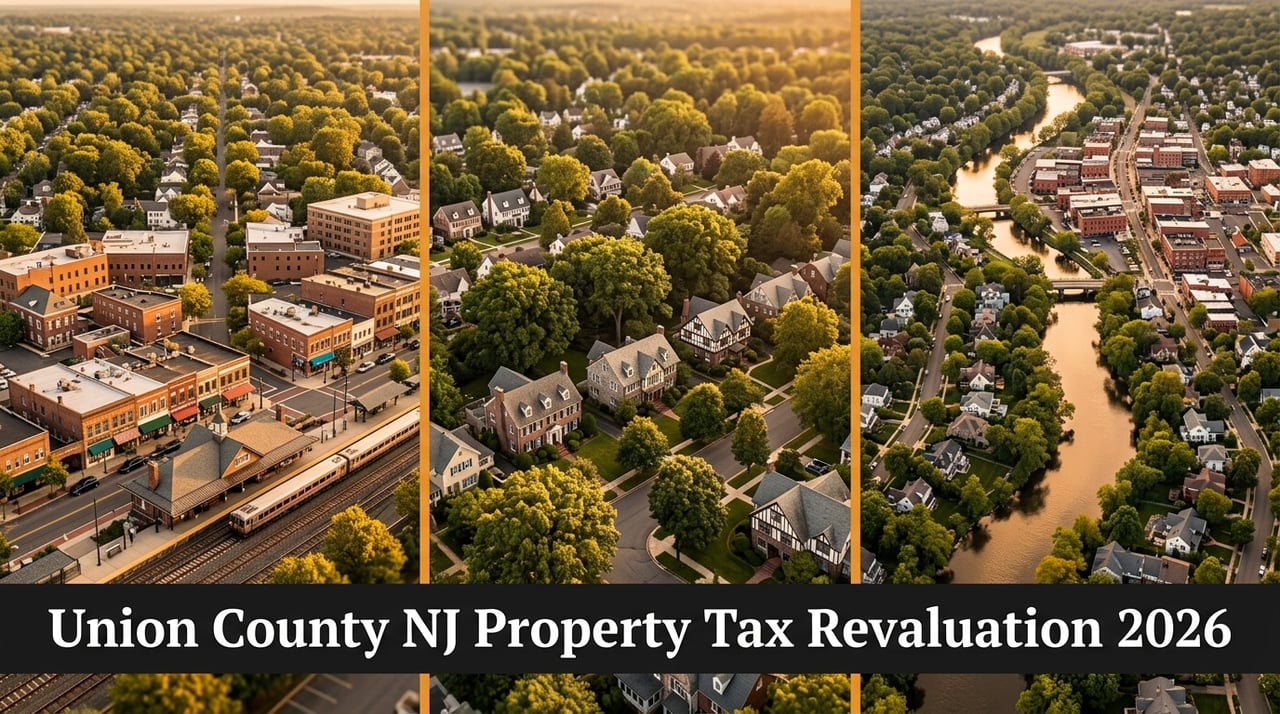
Nineteen of Union County's 21 municipalities sit below the 85% Director's Ratio line that New Jersey's revaluation rules treat as a general marker of noncompliance. Twelve of them sit below 35%. Union Township is at 8.03%, Scotch Plains at 14.69% — and only Winfield and Elizabeth clear the line for 2027. Here is every town's ratio from the 2027 Chapter 123 certification, where the gaps are largest, and what it means for buyers and sellers.
The NJ Division of Taxation certified Union County's 2027 Director's Ratios on September 22, 2026 — the table that governs 2027 tax appeals. Only Winfield Township (100.10%) and Elizabeth (86.98%) clear the 85% line; the other 19 sit below it, and 12 of those sit below 35%. Union Township's 8.03% and Scotch Plains' 14.69% are the extreme outliers. A low ratio does not mean a town is under-taxed — it means the levy is no longer divided among its properties in line with what they are worth today, and a revaluation would redistribute it. New Providence is the live example, with its revaluation underway and its implementation year still to be confirmed. For buyers, the bill shown at closing may not be the bill you inherit; for sellers in low-ratio towns, today's bill can be a pricing argument — until a revaluation is ordered.
Union County's assessment picture is not subtle. Of the county's 21 municipalities, 19 sit below the 85% Director's Ratio line that New Jersey's revaluation rules treat as a general marker of noncompliance, and 12 of those 19 sit below 35%. Union Township's 2027 Director's Ratio, certified by the NJ Division of Taxation on September 22, 2026, is 8.03%. Scotch Plains is at 14.69%. These are not numbers that describe gentle drift. They describe assessment rolls that have fallen far out of step with the market they are supposed to measure. Below, we map every Union County town's ratio from the 2027 Chapter 123 certification, identify where the gaps are largest, explain what this means for buyers and sellers in 2027, and flag which towns look most likely to be revalued next. For what to do if a revaluation letter lands in your mailbox, see our NJ revaluation letter guide.
New Jersey law requires property to be assessed at its true market value, at the percentage level set by the county board of taxation — which is 100% in Union County, as in most of the state. Each year the Director of the Division of Taxation measures how close each town actually comes by comparing assessments to usable sales. That average ratio is the Director's Ratio.
Under N.J.A.C. 18:12A-1.14, a Director's Ratio of 85% or lower generally denotes noncompliance where the county's adopted assessment level is 100%. In Union County, only two municipalities clear that line for 2027: Winfield Township (100.10%) and Elizabeth City (86.98%). Springfield Township (82.10%) is close. Everyone else is below it, which works out to roughly 90% of the county's municipalities.
Winfield Township and Elizabeth City.
Springfield Township, at 82.10%, is the closest.
Berkeley Heights, at 33.97%, down to Union Township.
Union Township (8.03%) and Scotch Plains (14.69%) are the extreme outliers.
A low ratio does not automatically trigger a revaluation. The same regulation treats a coefficient of deviation above 15% as a general indicator of need, and the county board may weigh other criteria. Any revaluation order also requires the Director's approval.
Here is every Union County municipality, ranked from the highest 2027 Director's Ratio to the lowest. Winfield sits at full value; Union Township sits at 8.03% — and Springfield, at 82.10%, is borderline. New Providence's 32.42% reflects a roll whose revaluation is underway but not yet implemented.
Amber bars clear the 85% line; oxblood bars sit below it. Source: NJ Division of Taxation, Chapter 123 Average Ratios for Tax Year 2027 (certified September 22, 2026), applicable to 2027 tax appeals. Ratios above 100% are treated as 100%.
For perspective, the 2027 certification covers 564 New Jersey municipalities. In Ocean County, the lowest 2027 ratio is Beach Haven's 45.81%. In Union County, twelve towns sit below that mark.
Twelve Union County municipalities sit below a 35% Director's Ratio — from Berkeley Heights at 33.97% down through New Providence, Summit, Kenilworth, Roselle, Rahway, Cranford, Plainfield, Hillside, Linden and Scotch Plains to Union Township at 8.03%.
The bottom five for 2027 are Union Township, Scotch Plains, Linden, Hillside and Plainfield, with Cranford close behind. These are high-volume residential municipalities whose post-2015 appreciation never made it onto the assessment rolls, and they are the towns with the longest stretch since a formal revaluation.
The county's lowest ratio.
The second-lowest in the county.
Large industrial and commercial assessment base.
Large industrial and commercial assessment base.
A meaningful appreciation cycle since 2020.
Close behind the bottom five.
Union Township (8.03%). The county's lowest ratio reflects an assessment base last calibrated under fundamentally different market conditions. Under the state's equalization math, a property assessed at $100,000 implies a market value of roughly $1.25 million, about twelve times the assessment.
That does not mean Union Township residents are underpaying. The county uses equalized values, built from the Director's ratios, to apportion the county levy among municipalities, so the township carries its share.
The real problem is internal: the way the levy is distributed among properties inside the township no longer matches what those properties are worth today. A revaluation would redistribute it.
Scotch Plains Township (14.69%). Scotch Plains holds the second-lowest ratio in the county. The township has seen sustained appreciation across its residential sections without matching assessment updates. A future revaluation would be complicated by how unevenly that appreciation has landed from one section of town to the next.
Linden, Hillside and Plainfield (22.9% to 23.7%). These three cities share dense residential bases, older housing stock, significant commercial ratables and no recent revaluation activity. Plainfield has had a meaningful appreciation cycle since 2020, driven by NYC-commuter buyer demand and access to NJ Transit's Raritan Valley Line. Linden and Hillside carry large industrial and commercial assessment bases, which complicate a future revaluation without removing the pressure for one.
New Providence is the county's live example of the process. The Borough contracted Professional Property Appraisers (PPA) to perform a borough-wide revaluation, and the goal is to finish the work by December 2026 so the new assessments can be used for the 2027 tax year.
Borough-wide revaluation.
So the new assessments can be used for the 2027 tax year.
Final assessments expected in late 2027.
In June 2026, Borough staff told the council that data-migration problems between PPA's system and the Borough's assessment database had paused the work, and that final assessments were expected in late 2027. New Providence's 2027 Director's Ratio of 32.42% confirms the new values are not yet on the roll. Check the Borough's revaluation page for the current implementation year. Our full New Providence revaluation post walks through it in detail.
The mechanics are the same everywhere. The firm values each property using the sales comparison approach as of October 1 of the pre-tax year, the assessing date set by N.J.S.A. 54:4-23. Owners receive a letter with the proposed assessment, can request an informal review with the firm, and can then file a formal appeal with the Union County Board of Taxation. In a year when a revaluation or reassessment has been implemented, the filing deadline moves from April 1 to May 1, and the common level range does not apply because the new assessments are meant to sit at 100% of value.
The county's high-value residential towns, with their NYC-commuter premiums, sit in the middle of the ranking: Mountainside at 68.56%, Westfield at 67.10%, Berkeley Heights at 33.97%, Summit at 30.44% and Cranford at 24.26%. Because home values are high, these towns carry some of the largest absolute dollar gaps between assessed and market value in the county.
Percentage points between each town's 2027 Director's Ratio and 85%. Source: NJ Division of Taxation, 2027 Chapter 123 certification.
For buyers, the issue is simple: the tax bill shown at closing may not be the bill you inherit after a future revaluation. As an illustration, a $1.4 million Summit home listed with an $18,000 current tax bill could see a materially different bill after a revaluation. That would not be because the city collects more. It would be because that property's share of the levy gets recalibrated. For more on the city itself, see our Summit NJ real estate page.
Summit (30.44%) and Cranford (24.26%) both sit below 31% on the ratio, with premium commuter access and years of sustained appreciation. Cranford's gap to the line is 60.74 points; Summit's is 54.56. The reval math on these towns, whenever it comes, is going to be substantial.
Nineteen of 21 towns sit below the 85% line. In a low-ratio town, your current tax bill can be a pricing argument — until a revaluation is ordered.
Union Township is at 8.03%, Scotch Plains at 14.69%, Summit at 30.44% — and the advantage a low-ratio bill gives a listing shrinks once a revaluation is ordered and implementation begins. We read your town's current Director's Ratio and revaluation status, translate your assessment into the state's implied market value, and price with the post-revaluation bill in view rather than the one on today's statement. Dual-licensed in New York and New Jersey.
Predicting the exact order of future revaluation orders is not possible. What we can do is lay out a probable priority order based on how far each town has drifted from compliance and the size of its assessment base.
Ratios of 8% to 24%; the largest gaps and residential bases.
Ratios of 24% to 34%; strong appreciation; extended deferral.
Ratios of 48% to 75%; closer to the line but still below it.
Compliant, borderline, or revaluation already underway.
This is analysis, not prediction. The actual order depends on county board and Division of Taxation review, municipal budgets for revaluation firms, and coefficient-of-deviation data that is not widely published at the municipal level. For a parallel look at how this plays out next door, see our Essex County revaluation status map.
The implications are different for buyers and sellers, and the stakes rise as the ratio falls. For buyers, the seller's current bill reflects a low-ratio assessment. Your future bill, after a revaluation, will reflect an assessment at 100% of market value. In a town with a ratio near 25%, that shift can change your bill meaningfully, because your property's share of the levy gets recalibrated.
Pull the town's current Director's Ratio and ask the assessor whether a revaluation has been ordered or is underway. If the ratio is below 35%, budget for a larger post-reval shift.
That gives the state's implied market value; compare it to your purchase price. A large gap signals revaluation risk.
A post-reval change can create an escrow shortfall that gets settled through the following year's payments.
As an illustration, a $22,000 annual tax bill on a $1.2 million Scotch Plains home may read as an affordability advantage next to comparable homes in towns closer to compliance.
That advantage shrinks once a revaluation is ordered and implementation begins, so the timing window matters.
The low-ratio environment is not permanent. We expect the county's 19 below-line towns to be revalued over the coming decade. In a county with ratios this extreme, the window for sellers in low-ratio towns may close faster than in counties where drift has been gradual.
Before you compare two Union County tax bills, convert both assessments into the state's implied market value — divide the assessment by the town's 2027 Director's Ratio. In Union Township, at 8.03%, a $100,000 assessment implies roughly $1.25 million, about twelve times the assessment. A bill that looks low next to a neighbouring town's may simply reflect a roll that has not been recalibrated. If your purchase price sits far above the implied value, that gap is the revaluation risk you are buying — and in a town below 35%, it is worth budgeting for before you close, not after the revaluation letter arrives.
"A low ratio is not a penalty or a windfall. Summit and Cranford both sit below 31% on the ratio, with premium commuter access and years of sustained appreciation. The reval math on these towns, whenever it comes, is going to be substantial."
— Anthony Licciardello, Broker, The Prodigy Team

Reading a municipal resolution and knowing what it means for the house across the street is what years inside local government teach you: I'm Anthony Licciardello, Broker of The Prodigy Team, dual-licensed in New York and New Jersey, a member of the Staten Island Growth Management Task Force, and a former Director of Community Affairs in the Bloomberg Administration.
We pair hyperlocal reporting like this with a digital reach built for the New York–to–New Jersey move: a YouTube channel with 400K+ views over the trailing year, a 26,500+ member relocation community on Facebook, and 17M+ Pinterest impressions. Our in-house drone series, Above the Streets, shows New Jersey towns from the air — the way relocating buyers first get to know them.
Anthony Licciardello · Broker, The Prodigy Team · 718-873-7345
We'll walk through your town's 2027 Director's Ratio, what a revaluation would mean for your property, and how to time a purchase or sale around implementation.
Why is Union Township's Director's Ratio so low?
The 8.03% ratio reflects a long gap since the last formal revaluation, combined with years of appreciation the assessment roll never captured. A low ratio is not a penalty or a windfall. The county uses equalized values to apportion the county levy across municipalities, so township residents are not under-taxed relative to other county taxpayers. What no longer matches current values is how the tax burden is divided among properties inside the township, and a revaluation would correct that.
Does a low Director's Ratio mean my property taxes will go up after a reval?
Not directly, and not necessarily. A revaluation does not change the total amount the town needs to raise. It changes how that amount is distributed. Homes that appreciated faster than the town average typically see their share rise, and homes that appreciated more slowly or stayed flat typically see their share fall.
When will the next Union County town be ordered to revalue?
The county board reviews each municipality's assessment data every year and issues orders, with the Director's approval, as the data and capacity allow. New Providence's revaluation is underway. The Borough is targeting the 2027 tax year, but staff reported a data-migration delay in June 2026, so confirm the current year with the Borough. Union Township, Scotch Plains, Linden, Hillside and Plainfield are the most statistically overdue.
Can I appeal my Union County property tax assessment outside of a reval year?
Yes. In a non-revaluation year, Chapter 123 sets a common level range of the municipality's average ratio plus or minus 15%. If your assessment ratio falls within that range, the assessment is presumed correct. If it falls above the upper limit, the county board adjusts the assessment. The filing deadline is April 1. Where a revaluation or reassessment has been implemented, the deadline is May 1 and the common level range does not apply.
What is a Director's Ratio?
New Jersey law requires property to be assessed at its true market value, at the percentage level set by the county board of taxation — 100% in Union County. Each year the Director of the Division of Taxation measures how close each town actually comes by comparing assessments to usable sales; that average ratio is the Director's Ratio. Under N.J.A.C. 18:12A-1.14, a ratio of 85% or lower generally denotes noncompliance where the county's adopted assessment level is 100%.
Which Union County towns are above the 85% line for 2027?
Only two: Winfield Township (100.10%) and Elizabeth City (86.98%). Springfield Township (82.10%) is close. The other 19 sit below the line, and 12 of them sit below 35%. A low ratio does not automatically trigger a revaluation — a coefficient of deviation above 15% is also a general indicator of need, the county board may weigh other criteria, and any order requires the Director's approval.
What happens when a New Jersey town is revalued?
The revaluation firm values each property using the sales comparison approach as of October 1 of the pre-tax year, the assessing date set by N.J.S.A. 54:4-23. Owners receive a letter with the proposed assessment, can request an informal review with the firm, and can then file a formal appeal with the Union County Board of Taxation. In the implementation year, the filing deadline moves from April 1 to May 1.
NJ Revaluation Letter — What to Do
New Providence Revaluation 2027 — What Homeowners Need to Know
Essex County Revaluation Status Map
Summit NJ Real Estate
Details as of publication, from the sources noted, and subject to change. Ratio data per the NJ Division of Taxation's Chapter 123 certification for tax year 2027 (certified September 22, 2026), applicable to 2027 tax appeals; ratios above 100% are treated as 100%, and gaps to the 85% line are simple differences in percentage points. The revaluation threshold language is from N.J.A.C. 18:12A-1.14, and the assessing date from N.J.S.A. 54:4-23. New Providence revaluation details are from the Borough of New Providence and public reporting on Borough council meetings; the implementation year should be confirmed with the Borough. Appeal deadlines and the common level range are from the NJ Division of Taxation. The tier-by-tier priority analysis and the seller-window view are the author's interpretation and do not reflect official Union County Board of Taxation plans. Tax-bill figures for Summit and Scotch Plains are illustrations, not quotes for specific properties. Individual situations vary, and homeowners considering an appeal should consult a licensed New Jersey attorney or tax professional. Nothing here is legal, tax or investment advice. School performance ratings, household income, crime statistics and demographic data have been deliberately excluded, as we exclude such material for every community we cover. No prediction is made about the timing, order or scope of any revaluation order, nor about any effect on any property's tax bill or value.
Prodigy Real Estate is an innovative real estate company offering high-end video production, home valuation services, purchasing, and home sales. Serving New York and New Jersey.