
Anthony Licciardello | September 1, 2026
Union County
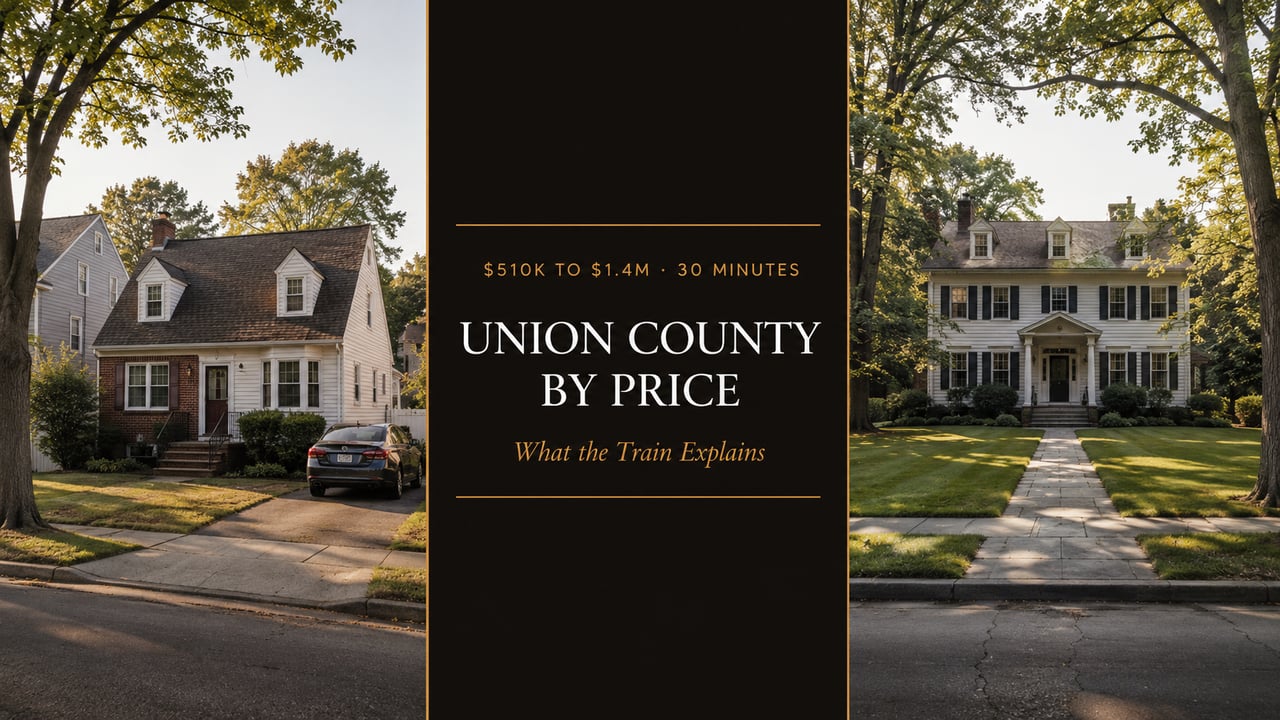
Union County runs from about five hundred thousand dollars to roughly one point four million — a spread of nearly three times, inside four hundred square miles. Which means the county's median of $750,000 describes almost nobody. What explains the spread is not what most buyers assume.
A single June 2026 county report tiers every Union County municipality on one methodology — which is the only way this comparison is honest. Entry ($400–600K): Linden $510K, Kenilworth $520K, Hillside $570K. Mid ($600–900K): Roselle Park $565K, Union Township $609K, Springfield $722K, Cranford $865K. Upper ($900K–1.5M): Scotch Plains, Berkeley Heights, with Westfield near $1.4M and Summit above it. The variable that best explains the ladder is walkability to a train station — not distance from Manhattan, which barely moves across the county. Kenilworth and Cranford border each other and sit $345,000 apart. One has a station.
The tier figures below come from one report, one month, one methodology — which matters more than it sounds. Mixing platforms across towns produces gaps that are partly artefacts of measurement, as our Kenilworth and Cranford comparison works through in detail. Figures are point-in-time and every parcel is different.
Linden $510,000 · Kenilworth $520,000 · Hillside $570,000
Where the county is still enterable. Smaller boroughs and townships, older housing stock, and — with one partial exception — no walkable rail.
Roselle Park $565,000 · Union Township $609,000 · Springfield $722,000 · Cranford $865,000
The widest band and the most competitive. Cranford sits at the top of it — 13 to 18 days on market at around 0.60 months of supply.
Scotch Plains · Berkeley Heights · Westfield near $1.4M, with Summit above it
The county's established addresses. Fanwood, adjacent to Scotch Plains with its own station, has run near $775,000 — the corridor's value position.
County-wide in that same month: 341 single-family closings, up 7.9% year over year, at a $750,000 median, alongside 42 townhouse and condominium sales at a $412,500 median. Note how far apart those two product medians sit — $337,500 — because it matters in the next chapter.
The ladder is steeper than most buyers expect. From Linden at $510,000 to Westfield near $1.4 million is a factor of roughly 2.7 — and every one of those towns is within about half an hour's drive of every other. You are not choosing between regions. You are choosing between blocks.
Distance from Manhattan explains almost nothing here. Union County is compact — the towns at the bottom of the ladder are not meaningfully further from the city than the towns at the top, and several of them are closer. Something else is doing the sorting.
It is the train, and more precisely whether you can walk to it. Union County is threaded by New Jersey Transit rail, and the price ladder tracks station access with remarkable consistency: a one-seat ride to Manhattan sits at the very top; a walkable Raritan Valley Line station and a downtown built around it sits in the upper-middle; and the entry tier is largely made up of towns where you drive to somebody else's station.
Kenilworth and Cranford share a border. Same county, same corridor, roughly three miles apart. On the June tiering they sit $520,000 and $865,000 — a gap of $345,000.
Cranford has a Raritan Valley Line station with a walkable downtown built around it. Kenilworth has no station — its nearest are Cranford and Roselle Park, a four-to-six-minute drive. Nearly everything in that $345,000 is contained in that difference, and the two towns are otherwise more alike than not.
Which produces the most useful question a Union County buyer can ask themselves, and it is not about towns at all: how many mornings a week will I actually board a train? Five, and the premium is buying something you use ten times a week for years. Two or three, and you are paying permanently for an inconvenience you experience twice. Zero, and you are paying a rail premium for a platform you will never stand on.
Two secondary variables move things at the margin. Housing stock — a town of larger, older houses on generous lots prices differently from one of compact post-war capes, regardless of transit. And whether a town has a real downtown, which is not the same as having a station: some Union County stations sit beside a village centre and some beside a parking lot. Both are worth walking before you decide.
First, the county median is not a benchmark for anything. A figure of $750,000 in a county that spans $510,000 to $1.4 million is an average of two very different markets. Nobody buys the county. Use the band, not the median.
Second, product mix distorts town medians badly. In that same June, Union County recorded 341 single-family closings at a $750,000 median and 42 townhouse and condominium sales at $412,500. Towns with a real attached-housing segment carry both inside one town median; towns that are almost entirely single-family do not. Cranford is the clearest case — a single-family median around $805,500 alongside a townhouse median near $372,000, both inside the same town figure. Compare like against like or the gap you calculate is partly an artefact.
New Jersey publishes two rates per municipality. The general rate calculates your bill and applies to assessed value. The effective rate exists to compare towns and assumes 100% valuation. They are not interchangeable, and Union County towns sit at wildly different assessment ratios.
Kenilworth is the worked example. Its general rate is $6.625 per $100 — apply that to a $602,000 purchase price and you get nearly $40,000 a year. The actual median bill is about $11,441, because the median assessment is $172,700. Its effective rate of 2.002% sits below the county median of 2.113%. Compare effective rates across towns; use the actual bill on the actual parcel for anything else. And note that assessment ratios vary enormously here — our Union County revaluation map ranks all 21 municipalities by Director's Ratio, with 19 of 21 municipalities below the state's 85% compliance threshold and New Providence already through its 2026 revaluation. The Kenilworth breakdown is in our Kenilworth property tax guide.
And a caution about the sources themselves. In researching these towns we found a national platform serving Manhattan and Jersey City neighbourhood names — Tribeca, the West Village, Journal Square, Weequahic — as "neighborhoods" of both Cranford and Kenilworth, and an aggregator reporting that 132.00% of properties in a Cranford ZIP were for sale. An impossible percentage is a reliable signal to stop reading. Check whether a source's other numbers survive scrutiny before you trust its headline.
Your buyer is cross-shopping four towns and comparing numbers that measure different things.
In a county spanning nearly three times from bottom to top, with town medians blending single-family and attached product and assessment ratios varying enormously between neighbours, an automated valuation is guessing — and in the entry tier it is guessing low by six figures. We comp within your product type and your municipality, present the actual tax bill rather than letting a buyer misapply a published rate, and market the specific advantage your address holds. Backed by the New York metro buyer pool we bring to every listing.
The mid and upper bands exist because of the station, and if you use it daily the premium is buying something real. Within those bands, the value positions are the towns adjacent to the famous ones — Fanwood beside Scotch Plains, at roughly $775,000 with its own station, is the corridor's clearest example.
This is the case that has changed most since 2020 and the one most buyers still underweight. A four-minute drive to a station twice a week is a different proposition from ten times a week, and the price difference is permanent.
You would be paying a rail premium for a platform you never use. Take the difference. Check Parkway and Route 22 access instead — several entry-tier towns have better road access than the towns above them.
Pull the actual tax bill on the specific parcel — never the published rate times your offer. Build the all-in monthly with real taxes and a live insurance quote. And drive to the station you would actually use, at the hour you would actually use it, and park. That last one takes fifteen minutes and answers the question the whole ladder rests on.
And one note on direction of travel. County-wide single-family volume was up 7.9% year over year in June 2026, and the entry tier has been appreciating faster than the top — Kenilworth's trailing-twelve-month average is up about 7% against Cranford's roughly 3%. The ladder is compressing, not widening. Nobody can tell you where that goes next, but a buyer choosing between bands today is choosing between different rates of change as well as different prices.
Take one Saturday and drive the county from Linden to Westfield — the whole ladder, bottom to top, in an afternoon. It is about half an hour end to end without stopping, which is the entire point: a factor of nearly three in price across a distance you could cover before lunch. Stop at each station and walk five minutes in every direction. What you are pricing is not the town, it is those five minutes — whether they contain a village centre or a parking lot, and whether you would make the walk in February. Buyers who do this drive stop asking which town is "better" and start asking which band their commute justifies, which is the only version of the question with an answer.
"Union County runs from about five-ten in Linden to one-four in Westfield. Nearly three times, and you can drive it in half an hour. So distance from the city isn't doing the work — the train is, and specifically whether you can walk to it. The proof is Kenilworth and Cranford. They border each other, they're three miles apart, and on the same report in the same month they're three hundred forty-five thousand dollars apart. Cranford has a station and a downtown around it. Kenilworth doesn't. That's the whole gap. So the question isn't which town's better, it's how many mornings a week you're actually getting on a train. Answer that honestly and the map picks the band for you."
— Anthony Licciardello, Broker, The Prodigy Team

Reading a county's price ladder — and telling a client which rung their actual commute justifies — is the work: I'm Anthony Licciardello, Broker of The Prodigy Team, dual-licensed in New York and New Jersey, a former Director of Community Affairs in the Bloomberg Administration, and a leading broker for cross-border New York–New Jersey transactions.
Anthony Licciardello · Broker, The Prodigy Team · 718-873-7345
We comp within your band and your product type, pull every tax bill, and build the all-in monthly before you choose.
What do homes cost across Union County, NJ?
A June 2026 county report tiering every municipality on one methodology puts the entry band ($400–600K) at Linden $510,000, Kenilworth $520,000 and Hillside $570,000; the mid band ($600–900K) at Roselle Park $565,000, Union Township $609,000, Springfield $722,000 and Cranford $865,000; and the upper band ($900K–1.5M) at Scotch Plains and Berkeley Heights, with Westfield near $1.4 million and Summit above it. County-wide: 341 single-family closings, up 7.9%, at a $750,000 median.
Why do Union County towns vary so much in price?
Walkability to a train station explains more of the spread than anything else — not distance from Manhattan, which barely varies across a compact county. A one-seat ride sits at the top; a walkable Raritan Valley Line station with a downtown around it sits in the upper-middle; the entry tier is largely towns where you drive to somebody else's station. Kenilworth and Cranford border each other and sit $345,000 apart on the same report. Cranford has a station.
Is the Union County median a useful benchmark?
No. A $750,000 county median in a county spanning roughly $510,000 to $1.4 million averages two very different markets. Use the band, not the median. Product mix compounds it — the same month saw 341 single-family closings at $750,000 against 42 townhouse and condominium sales at $412,500, and towns with a real attached segment carry both inside one town figure. Cranford's single-family median runs near $805,500 against a townhouse median near $372,000.
How should I compare property taxes between Union County towns?
Use the effective rate, never the general rate. The general rate calculates your bill from assessed value; the effective rate exists to compare municipalities at 100% valuation. Union County towns sit at very different assessment ratios, so general rates are not comparable. Kenilworth's general rate is $6.625 per $100 — applied to a $602,000 price that implies nearly $40,000 a year, while the actual median bill is about $11,441, because the median assessment is $172,700. Its effective rate of 2.002% sits below the county median of 2.113%.
An Investor Just Paid $5.26 Million to Sit Beside the Westfield Station
Kenilworth vs. Cranford — Three Answers to One Question
Westfield vs. Summit — The Honest Differences
Moving to Fanwood — 1.3 Square Miles With Its Own Station
Moving to Kenilworth — The Value Play With No Train Station
Kenilworth Property Taxes — Why the Rate Misleads
Union County Rental Market — Where the Concessions Are
Figures as of publication, from the sources noted, and subject to change. Tier figures derive from a June 2026 Union County market report published by a regional brokerage which tiers municipalities on a single methodology: entry-level $400,000–$600,000 including Linden ($510K), Kenilworth ($520K) and Hillside ($570K); mid-market $600,000–$900,000 including Roselle Park ($565K), Union Township ($609K), Springfield ($722K) and Cranford ($865K); and upper $900,000–$1.5M including Scotch Plains and Berkeley Heights. County-wide the same report records 341 single-family closings in June 2026, up 7.9% year over year, at a $750,000 median, and 42 townhouse and condominium sales at a $412,500 median. Note that Roselle Park at $565,000 appears in the mid-market listing despite falling numerically within the entry band; the tiering is reproduced as published. Westfield and Summit figures are drawn from our own Westfield and Summit comparison, which cites a Westfield median near $1.4 million with Summit running higher; Fanwood figures from our Fanwood housing market guide, citing a recent median near $775,000 with 18–27 days on market. Cranford supporting figures: a single-family median sale price of $805,500 with a townhouse median of $372,000, 13–18 days on market and approximately 0.60 months of supply (Homes.com data as reported by a regional brokerage). Kenilworth supporting figures: a median home price of $602,000 as of March 2026 with an average sale of $631,594 and a trailing-twelve-month average up approximately 7% (Homes.com); a 2025 general tax rate of $6.625 per $100 of assessed value, an effective rate of 2.002% against a Union County median effective rate of 2.113%, a median assessment of $172,700 and an estimated median annual bill of approximately $11,441 (NJTaxRecords.net drawing on NJ Division of Taxation and NJGIN MOD-IV data). Cranford's trailing-twelve-month median is reported up approximately 3%. Sources discarded: a national listing platform returning Manhattan and Jersey City neighbourhood names — including Tribeca, West Village, Journal Square and Weequahic — as "neighborhoods" of both Cranford and Kenilworth; and a foreclosure-data aggregator reporting that "the percentage of properties for sale in the zip code is 132.00%" for a Cranford ZIP. No ranking of these municipalities by desirability is offered or implied, and no representation is made about schools, safety or the characteristics of residents in any municipality; household income, age, household composition and crime data available for these towns have been deliberately excluded, as we exclude such material for every community we cover. Median and average figures are not appraisals and describe populations of transactions rather than any individual property; town medians blend product types that should be compared separately; general tax rates are struck against assessed value rather than market value and are not comparable across municipalities with differing assessment ratios. Tax bills, assessments, school assignments and transit schedules must be verified for any specific property. This is general information and market commentary, not legal, tax, or investment advice — verify all current details with the respective municipalities, NJ Transit and your own professionals before buying or selling.
Prodigy Real Estate is an innovative real estate company offering high-end video production, home valuation services, purchasing, and home sales. Serving New York and New Jersey.