
Anthony Licciardello | April 20, 2026
Cranford, NJ
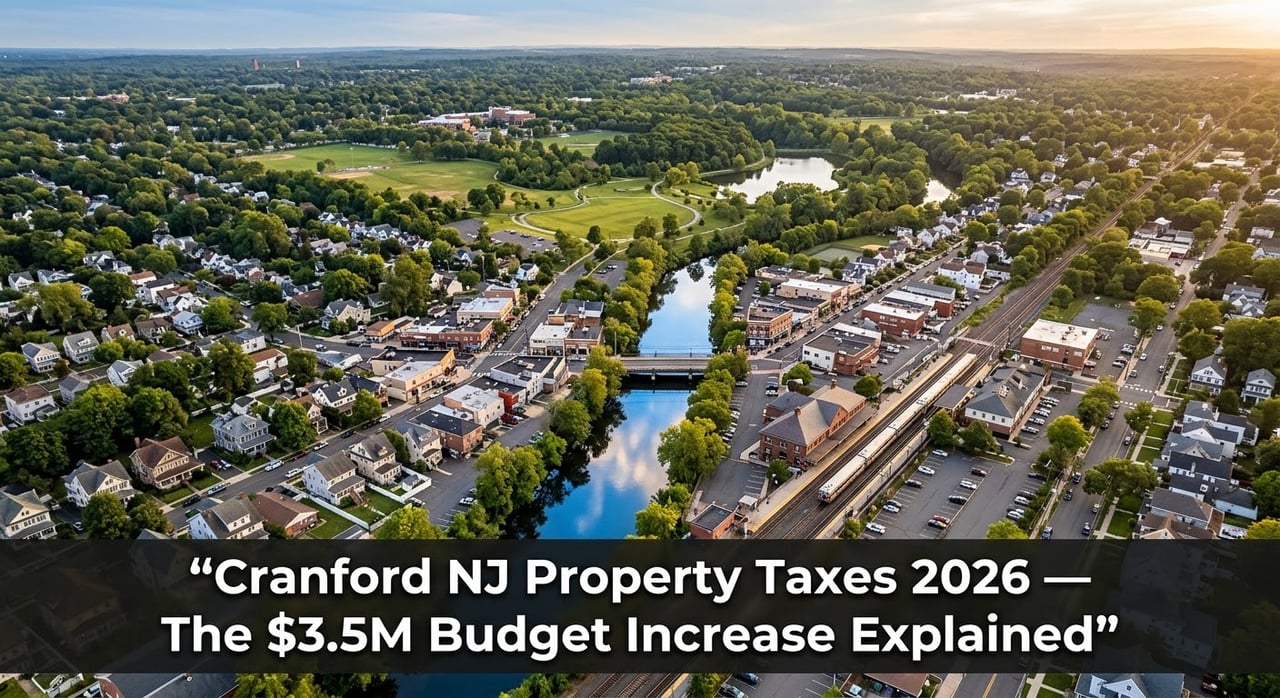
On April 7, 2026, the Cranford Township Committee introduced its 2026 municipal budget. The top-line number moves from $48.2 million in the 2025 adopted budget to approximately $51.3 million in the 2026 introduction — a ~$3.1 million increase. Underneath that, the Municipal Purpose Tax Levy rises by roughly $3.2 million, the minimum library tax climbs by about $238,000 to $2.17 million, and the combined tax ask from Cranford residents approaches $34.4 million, up nearly $3.5 million year-over-year. Surplus support drops by around $600,000, which means less cushion for taxpayers and a heavier reliance on recurring revenue.
The numbers don't exist in a vacuum. Cranford's 2026 Chapter 123 equalization ratio, published by the New Jersey Division of Taxation, sits at 26.04% — with a Common Level Range running from 22.13% on the low end to 29.95% on the high end. That's the lowest equalization ratio among every Union County peer in the current tax cluster, including New Providence at 34.32% and Berkeley Heights at 35.73%. Both of those towns have either been ordered to revaluate or are showing the same reset-risk pattern. Cranford's ratio is meaningfully below either.
The public hearing for the 2026 budget is scheduled for May 5, 2026 at 7:30 p.m. — the statutorily required minimum 28 days after introduction. That's the formal window for residents to object, propose changes, or press the Committee for additional detail. Here's the full breakdown of what's in the budget, what's driving it, where the flooding and infrastructure picture fits in, and what every Cranford homeowner and buyer should understand about the 26.04% ratio sitting behind all of it.
The Headline Number
The headline dollar figure for a municipal budget is the total general appropriations — what Cranford is spending across every department and line item in the year. For 2026, that number is roughly $51.3 million. But the figure homeowners actually pay against is the tax levy, which is the amount the township needs to raise from property taxes to balance the budget after all non-tax revenue sources are accounted for. For 2026, the municipal purpose tax levy is approximately $32.2 million, and adding the minimum library tax of $2.17 million brings the combined tax ask to about $34.4 million.
For comparison: the 2025 adopted budget raised roughly $30.9 million across the same two buckets. The $3.5 million increase represents an approximately 11% jump in what Cranford homeowners are paying to fund municipal operations year-over-year — well above the state's 2% property tax levy cap. The gap between what's legally allowed and what's actually being budgeted reflects cap exceptions available for health insurance premiums, certain insurance and sewer line items, and cap bank balances from prior years that can be used once.
What this translates to at the household level depends on the specific property's assessed value, and the final per-household impact isn't publicly specified in the introduced budget materials to date. Based on the 2025 precedent — where a smaller $3.07M budget increase produced roughly $20 per month in average household tax impact — a reasonable forward projection for the 2026 budget at current scale is a higher monthly increase, though the exact figure depends on how the Union County and school district levies move in parallel.
The Calendar
New Jersey municipal budget law requires a minimum 28-day interval between formal introduction and the public hearing where adoption is considered. Cranford introduced the 2026 budget on April 7 and scheduled the hearing for May 5. That four-week window is the statutory period during which residents can review the full introduced budget document, submit written comments, attend Township Committee meetings to raise questions, and formally object to specific appropriations at the hearing itself.
Residents who want to participate meaningfully should download the introduced budget document from the Cranford municipal website or request a copy via OPRA, and focus their review on three sheets: the Summary of Appropriations (which shows the total spending picture), the Summary of Revenues (which shows what's funding it), and the Tax Levy Cap Workbook (which shows how Cranford is using statutory cap exceptions and bank balances to accommodate the 11% levy increase).
At the May 5 hearing, members of the public have a formal right to speak on the record. The Township Committee is not obligated to adopt the budget as introduced — amendments can be made before adoption, though in practice most New Jersey municipal budgets pass largely as introduced. What the hearing produces more often than amendments is on-record explanation from the Committee about specific line items, which can be useful context for homeowners watching how budget pressure compounds year to year.
The Cost Structure
The most useful document for understanding what's pushing Cranford's budget upward year after year is the 2024 Annual Comprehensive Financial Report, which is the most recent audited financial statement available. The 2024 ACFR shows the largest operating appropriations clustered in three buckets. Police salaries at approximately $7.2 million are the single largest line item. Employee group health insurance runs about $5.2 million. Debt service was $4.9 million in 2025 and rises to approximately $5.1 million in the 2026 introduced budget — a $200,000 year-over-year increase on that line alone.
The group health insurance number deserves particular attention because it's where the 2% levy cap math becomes complicated. For calendar year 2026, the New Jersey Division of Local Government Services has set the State Health Benefits Plan cost increase at 36.2%. The 1977 cap law exception for group health insurance is 32.2%, and the 2010 levy cap exception is 34.2%. In plain language: Cranford can legally raise the tax levy beyond the 2% cap to cover the portion of health insurance cost growth that exceeds those exception thresholds. That's one of the structural reasons the 2026 levy increase can land at roughly 11% rather than being forced down to 2%.
The revenue side of the picture isn't helping absorb the pressure. Miscellaneous revenues — fines, fees, court costs, interest earnings — rose only about $31,000 between the 2025 adopted and 2026 introduced budgets. Anticipated surplus support dropped by about $600,000. Reserve for uncollected taxes held flat at $1.2 million. In aggregate, the 2026 budget is leaning harder on property taxes than the 2025 budget did, because there aren't enough other revenue streams moving in Cranford's favor to offset what's happening on the expense side.
What to Watch at the May 5 Hearing
The useful questions to raise at the public hearing aren't general "why is the budget so high" questions — they're specific. How much of the levy increase is being funded by cap bank balances that won't be available next year? What's the projected surplus position at year-end 2026 after the $600K drawdown? What's the five-year debt service trajectory given the rising line? Which capital projects are inside the debt service number, and which are being pushed into future years? Specific questions produce specific answers that compound into real buyer and seller insight.
The Structural Backdrop
Every municipal budget in New Jersey is shaped by local geography, and in Cranford's case the single biggest structural factor is the Rahway River. The river runs through the middle of the township, and during extreme rain events — most notably Hurricane Irene in 2011 and Hurricane Ida in 2021 — the Rahway has crested more than ten feet above its average level and four-plus feet above flood stage. During Hurricane Ida, Cranford received the highest rainfall total in Union County at just over nine inches. The flooding that followed produced FEMA designations for 14 Repetitive Loss and Severe Repetitive Loss properties on the northern reach of the river, which Cranford has been systematically elevating with federal mitigation funding.
The direct financial response sits across multiple buckets. Cranford received $3.67 million in federal funding under the Building Resilient Infrastructure and Communities and Flood Mitigation Assistance programs to elevate flood-prone buildings along the river. A separate $1.8 million in state funding supports the Southside Stormwater Improvement Project, which addresses repetitive flooding where High Street meets Chestnut Avenue and South Avenue. Ongoing stormwater infrastructure maintenance, portable pump deployments in the Balmiere Parkway neighborhood, riverbank and levee maintenance, and the township's active participation in the FEMA Community Rating System all sit in the municipal operating budget rather than in the federal grant funding.
The larger project on the horizon is the US Army Corps of Engineers Rahway River Basin Flood Risk Management Feasibility Study, which is evaluating five alternatives for regional flood control. The alternatives under review include a no-action control scenario, additional upstream detention in South Mountain Reservation, channelization to widen and deepen portions of the river, nonstructural measures including home elevations and flood property buy-outs, and a fifth option specifically advocated by Cranford: increased detention capacity in Lenape Park through a raised floodgate. A decision on which alternative proceeds will shape Cranford's capital expenditure picture for a decade or more.
For buyers and homeowners, the practical takeaway is that Cranford's tax picture carries an embedded flood-infrastructure premium that most comparable Union County towns — New Providence, Berkeley Heights, Scotch Plains — don't have at the same scale. That premium funds real risk mitigation that directly protects property values in flood-exposed pockets. It also means that any meaningful reduction in the tax trajectory would require either a federal/state cost-share on the Army Corps project or a deliberate policy choice to slow the mitigation pace, both of which come with their own tradeoffs.
The Reset Signal
The New Jersey Division of Taxation's 2026 Chapter 123 equalization table lists Cranford at 26.04%, with a Common Level Range running from 22.13% on the low end to 29.95% on the high end. That's a ratio substantially below the state's 85% non-compliance threshold. It's also lower than every Union County peer in the active tax cluster: New Providence (34.32%), Berkeley Heights (35.73%), Clark (80.01%), Mountainside (71.29%), Elizabeth (92.76%), Fanwood (65.63%). Among Union County towns a typical Cranford buyer might cross-shop, Cranford carries the lowest equalization ratio — and that number has been drifting downward, from 29.13% in 2025 to 26.04% in 2026.
Market Watch
Cranford has not been formally ordered to revaluate. But the 26.04% ratio sits well below the level at which the Union County Board of Taxation has historically issued reval orders. New Providence was ordered at 34.32%. Scotch Plains was ordered with a comparable ratio profile. Cranford's number is lower than either.
That doesn't mean a reval order is imminent — the Board weighs the Coefficient of Deviation (which measures uniformity within the town) alongside the ratio, and reval scheduling depends on Board capacity and contractor availability. But a reval order within the next two to three tax cycles is a reasonable forward expectation for Cranford homeowners to plan against.
What a revaluation would do is update every property assessment in Cranford to current market value. The process is revenue-neutral at the municipal level — the total tax levy collected doesn't change as a result of the reval itself. What changes is the distribution of that levy across properties. Homes that have appreciated faster than the township-wide average since the last reval — typically newer construction, substantially renovated properties, and homes in the most appreciated pockets — see their share of the tax burden increase. Homes that have appreciated more slowly see their share decrease.
For context on how a currently in-progress Union County revaluation is unfolding and what the homeowner experience actually looks like, see the coverage of the New Providence 2027 revaluation. The procedural calendar for a Cranford reval would follow the same template: inspections running 12 to 18 months, tax list certification in January of the implementation year, and a May 1 appeal deadline — rather than the standard April 1 date in non-reval years.
The Comparison
The effective property tax rate is the cleanest cross-town comparison metric because it normalizes for the gap between assessed values and actual market values. Cranford's 2025 effective rate is 2.106 per $100 of true market value — higher than Berkeley Heights (1.820), Westfield (1.810), Summit (1.475), and Mountainside (1.566), and slightly lower than Scotch Plains (2.137). On a $1 million home, that translates to roughly $21,060 in annual property taxes in Cranford versus $18,200 in Berkeley Heights — an annual differential of about $2,860, or roughly $28,600 over a ten-year ownership hold.
2025 – 2026 Union County Tax Snapshot
| Town | 2025 Effective Rate | 2026 Ch. 123 Ratio | Revaluation Status |
|---|---|---|---|
| Summit | 1.475 | — | No reval ordered |
| Mountainside | 1.566 | 71.29% | No reval ordered |
| Westfield | 1.810 | — | No reval ordered |
| Berkeley Heights | 1.820 | 35.73% | No reval ordered |
| New Providence | 2.049 | 34.32% | Revaluation 2027 |
| Cranford | 2.106 | 26.04% | Not ordered (ratio lowest) |
| Scotch Plains | 2.137 | — | Revaluation 2027 |
What the comparison shows is that Cranford's effective rate is in the mid-to-upper end of the Union County range, not the outlier position — but its equalization ratio is the lowest in the cluster, which makes its forward reset pressure the highest. For a buyer underwriting a ten-year hold, that combination is worth modeling carefully: a rate that's already above the Union County median, combined with an assessment base that almost certainly gets reset within the hold window, produces a different after-tax carrying cost picture than the current numbers suggest.
A 26.04% equalization ratio, a $3.5M budget-driven levy increase, and an active federal flood-mitigation infrastructure commitment aren't three separate issues for Cranford homeowners. They're the three variables in the same equation — and all three are moving in the same direction.
The Buyer-and-Seller Read
For buyers underwriting a Cranford purchase in 2026: the 2025 tax bill is a starting point, not an endpoint. Model the 2026 levy increase into your carrying cost projection, and model at least one revaluation event within a ten-year hold. For properties in the flood-exposed zones along the Rahway River — particularly the northern reach and the Balmiere Parkway, South Avenue, and High Street corridors — the underwriting should include elevation certificate review, FEMA flood zone verification, and NFIP insurance cost quotes before signing. The flood mitigation infrastructure in progress is real and protective, but it isn't complete, and insurance premiums and disclosure obligations will vary substantially depending on specific property location and elevation status.
For sellers: the Cranford market remains active, and Cranford's downtown, train access, school district, and walkability continue to drive buyer interest from New York and Jersey City. What's changed in 2026 is that informed buyers — and the agents representing them — are asking sharper questions about tax trajectory, flood zone status, and the reval horizon. Sellers who have current flood elevation certificates, recent tax receipts, and a clean accounting of any FEMA mitigation work on the property close cleaner deals than sellers who don't. For the full breakdown of what sellers are actually paying at New Jersey closings in 2026, including the Graduated Percent Fee that replaced the Mansion Tax, see the 2026 NJ closing costs guide.
For current Cranford homeowners: the May 5 hearing is genuinely worth attending or watching. The budget itself will likely pass largely as introduced, but the hearing produces on-record Township Committee explanation of line items that can inform how you plan against 2027 and 2028. Watch especially for any discussion of cap bank balance usage — if Cranford is burning through multi-year bank balances in the 2026 budget, the 2027 and 2028 budgets will structurally have less flexibility and will lean even more heavily on the conventional levy.
For context on how Cranford's tax profile compares with neighboring Berkeley Heights — which has introduced a much smaller 2.1% increase, a lower effective rate, and a structurally different debt service picture — see the Berkeley Heights property tax breakdown. For the Scotch Plains picture, including its 2027 revaluation and parallel budget pressures, see the Scotch Plains property tax post.
FAQ
Q
When is the Cranford 2026 budget public hearing?
The public hearing for the Cranford 2026 municipal budget is scheduled for May 5, 2026 at 7:30 p.m. The budget was formally introduced on April 7, 2026, and New Jersey budget law requires a minimum 28-day interval between introduction and the public hearing where adoption is considered. During that window, residents can review the full introduced budget document, submit written comments, attend Township Committee meetings, and raise specific objections at the hearing itself. The Township Committee can amend the budget before adoption, though most New Jersey municipal budgets pass largely as introduced.
Q
Is Cranford getting a property tax revaluation?
Cranford has not been formally ordered to conduct a property tax revaluation as of April 2026. The township's 2026 Chapter 123 equalization ratio is 26.04%, which is the lowest among Union County peer towns in the current tax cluster. The ratio has been drifting downward — from 29.13% in 2025 — which indicates that assessed values on the tax roll are falling further behind actual market values. Other Union County towns with higher ratios, including New Providence (34.32%) and Scotch Plains, have already been ordered to revaluate for the 2027 tax year. A reval order for Cranford within the next two to three tax cycles is a reasonable forward expectation, though timing depends on the Union County Board of Taxation and contractor capacity.
Q
Why is Cranford's 2026 tax levy increasing so much?
Cranford's combined 2026 tax levy is increasing by approximately $3.5 million year-over-year, or roughly 11%, which is well above the state's 2% property tax levy cap. The increase is driven by cost pressures outside the cap, primarily rising group health insurance premiums — for 2026, the State Health Benefits Plan cost increase is 36.2%, and cap law exceptions allow municipalities to raise the levy to cover the portion exceeding 32.2% to 34.2% thresholds. Other contributing factors include debt service (rising from $4.9M to $5.1M), police salaries (~$7.2M as the largest line item), and reduced surplus support (~$600K drop). Cap bank balances from prior years also enable some of the increase.
Q
How does flooding affect Cranford property taxes?
Cranford has active federal and state flood mitigation infrastructure commitments funded across multiple streams. The township received $3.67 million in federal funding under FEMA programs to elevate 14 Repetitive Loss and Severe Repetitive Loss properties along the Rahway River, plus $1.8 million in state funding for the Southside Stormwater Improvement Project. Ongoing stormwater operations, riverbank maintenance, pump deployments, and participation in the FEMA Community Rating System sit in the municipal operating budget. The US Army Corps of Engineers is studying five flood risk management alternatives for the Rahway River Basin that will shape Cranford's capital expenditure picture for a decade or more. This infrastructure commitment is structurally larger than what comparable Union County towns carry, which is reflected in Cranford's long-run tax trajectory.
Sources: Township of Cranford 2026 Introduced Municipal Budget materials (April 7, 2026); Township of Cranford 2025 Adopted Municipal Budget and Budget Update statements; Township of Cranford 2024 Annual Comprehensive Financial Report; NJ21st reporting on the 2026 Cranford budget introduction and cost structure analysis; New Jersey Division of Taxation 2025 General Tax Rates table; New Jersey Division of Taxation 2026 Certification of Average Ratios and Common Level Ranges (Chapter 123, Laws of 1973); New Jersey Division of Local Government Services 2026 budget cap guidance and State Health Benefits Plan cost increase data; NJ League of Municipalities CY2026 cap information bulletin; FEMA case study on Cranford Township Community Rating System and Repetitive Loss mitigation; US Army Corps of Engineers Rahway River Basin Flood Risk Management Feasibility Study materials; Township of Cranford Office of Emergency Management flooding and stormwater management resources. Budget timing and procedural cross-references: PKF O'Connor Davies 2026 NJ municipal budget seminar materials.
Prodigy Real Estate is an innovative real estate company offering high-end video production, home valuation services, purchasing, and home sales. Serving New York and New Jersey.