
May 8, 2026
Westfield, NJ
By Anthony Licciardello, The Prodigy Team
NYS/NJ Licensed Broker · Westfield, NJ Market Specialist
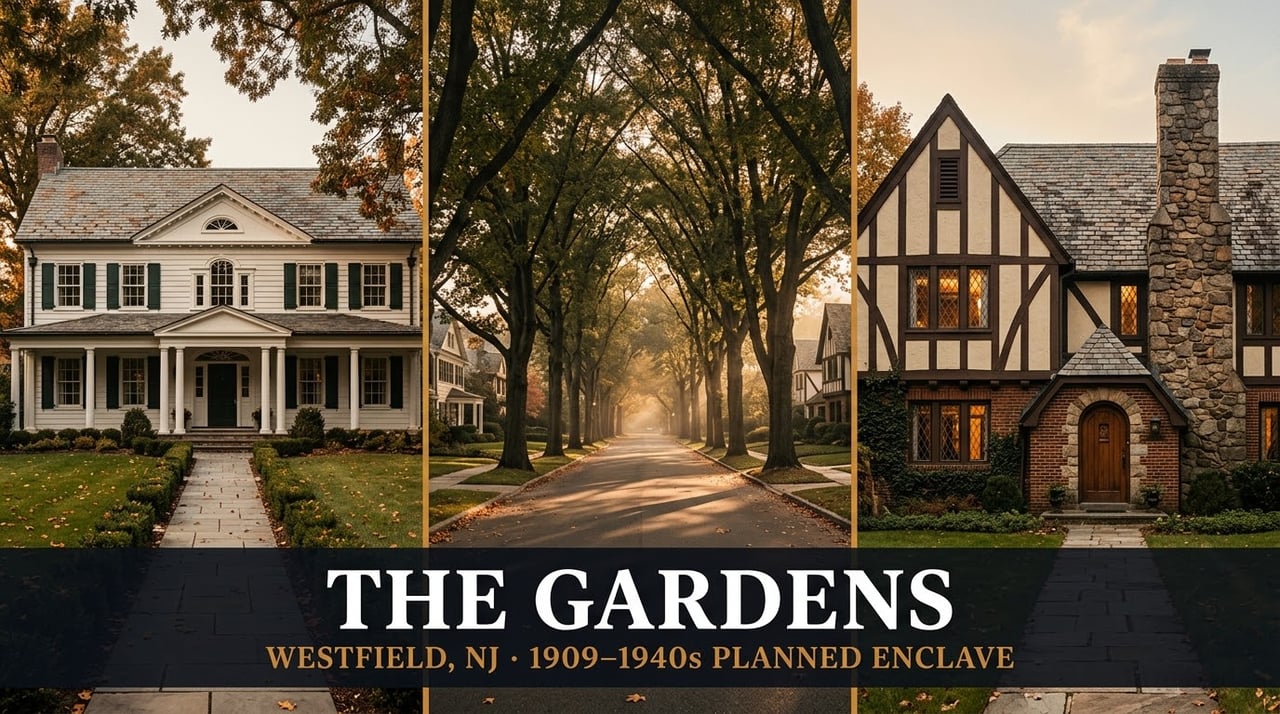
Drive west from downtown Westfield, cross the line into the planned residential pocket the Town's historic preservation plan calls Westfield Gardens, and the visual rhythm of the streetscape changes immediately. The blocks get longer. The setbacks deepen. The trees close overhead like a canopy over a cathedral nave. You have entered the Gardens — and if you know anything about Westfield real estate, you know the Gardens is not a neighborhood you stumble into. You plan for it. You save for it. You wait for it.
This is the third of Westfield's three great planned residential enclaves — chronologically the middle child, falling between Stoneleigh Park (1904) and Wychwood Manor (1920s). It is also the one most often cited by name in Westfield real estate listings, and the one with the most architectural variety. Here is what buyers, sellers, and curious neighbors need to know.
|
1909 Development Begins Mountain & Highland Aves |
1926 Welch Extensions Tudor & Norman peak |
$1.5–2M+ Typical Price Mid & upper tier |
Best in Tudor Collection Per 2024 Master Plan |
The Gardens occupies the western shoulder of Westfield's central residential core, west and south of the Westfield train station. It is roughly bounded by Mountain Avenue and Highland Avenue on its earliest blocks, with Alfred H. Welch's later 1926 extensions pushing the neighborhood's footprint outward into adjacent streets. Boundary lines are honest about being soft — the historic preservation planning narrative recognizes the district as cohesive, but Redfin's market polygon, the Master Plan's identified district, and resident usage all draw slightly different lines around the edges.
What everyone agrees on is the center. The Gardens is the planned residential community Westfield was building when it was in the middle of becoming itself — after the railroad arrived, before the post-war suburban expansion, during the period when the dominant question in American suburban planning was "what does the ideal residential neighborhood look like?" and developers were prepared to spend serious money answering it.
Inside Westfield's commuter-walkable second ring — roughly 0.5 to 1 mile from the train station, depending on which block you're on — the Gardens is also one of the most strategically positioned neighborhoods in the town. For the broader walkability and pricing context, see our walk-to-train premium analysis. For a complete map of how the Gardens fits among Westfield's other neighborhoods, see our neighborhood guide.
The Gardens was not built in a single moment. Development began around 1909 on Mountain Avenue and Highland Avenue, accelerated through the 1920s and 1930s, and continued in waves through World War II. The 2024 Westfield Master Plan documents this thirty-plus-year arc and identifies three distinct construction phases that are still legible in the streetscape today.
|
Phase 1 1909–early 1920s |
Mountain & Highland Foundation Era The earliest Gardens streets feature an unusually broad architectural palette for one neighborhood — Spanish Colonial Revival, Tudor, and notably a variation of the Prairie School. The 2024 Master Plan describes the period as "a pleasing variety of styles within the Colonial Revival motif." |
|
Phase 2 1926 onward |
The Welch Extensions Beginning in 1926, developer Alfred H. Welch built two extensions of the Gardens. The Master Plan describes these blocks as "the most distinguished collection of Tudor and Norman-style homes in Westfield and some of the finest of these styles in Union County." This is the architectural peak of the neighborhood. |
|
Phase 3 1930s–WWII |
Late Colonial Revival Infill Final infill construction during the late 1930s and early 1940s pulled the neighborhood back toward Colonial Revival as the dominant style. By the end of WWII, the Gardens was effectively built out at its current footprint. |
What makes this build-out remarkable is not the variety, but the cohesion. Three decades, multiple developers, four distinct architectural styles — and the neighborhood reads as one. The streets, setbacks, lot scale, and overall residential rhythm hold the whole composition together regardless of which decade any individual house comes from.
Most planned residential neighborhoods commit to a single architectural style and let the cohesion come from rigid uniformity. The Gardens went the other direction — variety contained by design discipline.
Colonial Revival is the foundation. Symmetrical facades, side-gabled roofs, centered entries with sidelights and pediments, classical detailing in the cornices. The 2024 Master Plan is explicit about Colonial Revival as the organizing motif — the developers extended that commitment into the street naming convention itself, with several Gardens streets carrying names drawn directly from American colonial history. Most pre-Welch and Phase 3 homes fall into this category.
Tudor Revival is the headline. The Welch extensions delivered what the Master Plan describes as the most distinguished Tudor collection in Union County — half-timbering against stucco and brick, steeply pitched cross gables, prominent stone chimneys, leaded casement windows, and the kind of heavy-material craftsmanship that gave the era its "Stockbroker Tudor" nickname. Buyers who specifically seek the English Tudor aesthetic in Westfield often start their search in the Gardens because the inventory is denser and better-preserved than anywhere else in the town except Wychwood Manor.
Norman Revival is the rare style. Cone-topped turrets, asymmetrical massing, rounded arches at the entry, and a more rustic stone texture than the Tudor. Norman Revival homes are scattered through the Welch extensions and they read as cousins of the Tudors rather than competitors — the same era, the same craftsmanship, a different French-influenced aesthetic vocabulary. Genuine Norman Revivals are uncommon in New Jersey generally; the Gardens has more of them than almost any comparable suburban neighborhood in the state.
Spanish Colonial Revival and Prairie School variants appear on the earliest 1909 blocks of Mountain Avenue and Highland Avenue. The Spanish Colonials are stucco-clad with low-pitched red tile roofs and arched openings. The Prairie School variants — rare in New Jersey, more associated with the Midwest — feature horizontal massing, wide overhanging eaves, and bands of casement windows. These are the architectural curiosities of the neighborhood, and they significantly outprice their style peers in less-celebrated locations.
For a complete walkthrough of every architectural style in Westfield — and how to identify them on a walking tour of the town — see our Westfield home styles guide.
Most neighborhood deep-dives in Westfield never get past the founding decade. The Gardens deserves a section on its second act because the 1926 extensions are arguably more architecturally significant than the original 1909 build-out.
⬢ The 2024 Master Plan's Assessment
"The most distinguished collection of Tudor and Norman-style homes in Westfield, and some of the finest of these styles in Union County."
— Westfield 2024 Master Plan, on the Welch extensions of Westfield Gardens
Alfred H. Welch was a residential developer working at the peak of the American Tudor and Norman Revival era. His two Gardens extensions, beginning in 1926, were not speculative builds — they were curated. The materials specifications were stricter, the craftsmanship was higher, and the design intent was explicitly to create a benchmark collection that would still be referenced a century later. By every public-record assessment, Welch succeeded.
For buyers, the practical implication is that "the Gardens" is not a single price tier. The Welch extension blocks command a measurable premium over the earlier 1909 blocks and the Phase 3 infill. When a Welch Tudor or Norman comes to market — and they don't often — the buyer pool is sophisticated, knowledgeable, and prepared to compete. These are the homes that consistently set Westfield neighborhood price records.
Pricing analysis for the Gardens carries the same caveat as Stoneleigh Park and Wychwood: small neighborhood, low turnover, thin transaction sample. A single sale can move the Redfin neighborhood median by hundreds of thousands of dollars in either direction. What follows is a directional read built from multiple data periods rather than any single snapshot.
"The Gardens is not a neighborhood you stumble into.
You plan for it. You save for it. You wait for it."
— Anthony Licciardello
Renovation status is one of the largest variables in Gardens pricing. Many of these homes have undergone multiple rounds of renovation since their original construction — kitchens reconfigured, primary suites added where attics used to be, mechanicals modernized through several eras. A Gardens home that's been renovated thoughtfully clears at a meaningful premium to one that hasn't. For the playbook on what those renovations cost and which ones actually deliver, see our renovating pre-1950 Westfield homes guide.
For broader Westfield market context, see our 2026 real estate update.
The single most-misunderstood feature of the Gardens is its regulatory status. The Westfield Master Plan identifies Westfield Gardens as a historically significant neighborhood. The 2024 Master Plan reaffirms that identification. Westfield's Historic Preservation Commission has documented the district's architectural and historical importance.
None of that is the same as legal protection.
|
▲ Identified Status (the Gardens today)
|
◆ Designated Status (Kimball Avenue only)
|
The 2024 Master Plan explicitly recommends boundary reexamination of the Gardens prior to potential local designation, given alterations and new construction since the original 2002 identification. In other words: the regulatory framework around the Gardens may evolve over the next decade, but as of 2026, owners retain meaningful renovation flexibility within the broader Westfield zoning framework. For the technical breakdown, see our Westfield zoning map explainer.
The Gardens is overwhelmingly single-family. There is no condo complex anchoring a corner here, no townhouse row breaking the residential rhythm. The neighborhood was built around the idea that the house is the unit of meaning, and the street is the social contract.
Walkability. Gardens residents are inside Westfield's commuter-walkable second ring — typically a 12 to 18 minute walk to the train station, downtown, and Mindowaskin Park. Many residents commute on foot daily, others walk on weekends to the Saturday farmer's market and the East Broad Street commercial district. Walkability here is a genuine quality of daily life, not a marketing claim.
Schools. The Gardens is served by Westfield Public Schools districtwide. Address-to-school assignment varies by exact location and should be verified with the district directly, particularly given periodic boundary adjustments.
Cultural identity. Westfield's broader identity as a New Jersey suburban benchmark has been amplified by everything from national rankings to a Netflix true-crime series set at a 1905 Dutch Colonial just blocks from the Gardens. The Gardens itself remains relatively quiet from a media-attention perspective — buyers come here for architecture and walkability, not for cultural buzz. That's by design.
Stewardship. Like Stoneleigh Park, the Gardens functions on an implicit understanding of stewardship. Owners renovate; they generally do not demolish. The cohesion of the neighborhood is maintained through the combination of period-appropriate renovation choices, mature landscaping, and a deep cultural commitment to architectural integrity. New owners who arrive with that frame of mind thrive here. Owners who don't tend not to last more than one or two cycles.
Westfield's three great planned residential enclaves — Stoneleigh Park, the Gardens, and Wychwood Manor — span a thirty-year arc from 1904 to the late 1920s. Each one is a different argument for what a planned suburban community should be. Here is the side-by-side.
| Neighborhood | Founded | Defining Feature | Typical Price |
|---|---|---|---|
| Stoneleigh Park | 1904 | National Register · no-fence covenant · 30 houses | $800K – $3.2M |
| The Gardens | 1909–1940s | Welch's 1926 Tudor & Norman peak · architectural variety | $1.0M – $3.0M+ |
| Wychwood Manor | 1920s | Curving streets, Echo Lake, larger lots | $1.25M – $4M+ |
| Indian Forest | Mid-20th c. | Largest lots, mature canopy, mid-century scale | $1.5M – $3.9M |
| Brightwood | Mixed | 44-acre Brightwood Park anchor, mixed stock | $700K – $2.5M+ |
The Gardens occupies a specific spot in this hierarchy. More architectural variety than Stoneleigh. More walkability than Wychwood. A larger inventory than either. And the Welch extensions deliver a Tudor and Norman concentration that no other Westfield neighborhood matches. For the deep dives on the other two trilogy members, see our guides to Stoneleigh Park and Wychwood Manor.
|
▲ For Buyers
|
◆ For Sellers
|
⬢ Selling a Gardens Home in 2026
The combination of architectural specificity, supply scarcity, and proximity to Westfield's strongest demand drivers — the train station, the downtown, and the broader walkability premium — makes Gardens listings some of the cleanest sell-side stories in the town. For the full transaction-cost breakdown, see our cost to sell a home in Westfield guide.
Q
The Gardens — formally Westfield Gardens in the Town's historic preservation planning — occupies the western shoulder of Westfield's central residential core, west and south of the train station. Earliest blocks center on Mountain Avenue and Highland Avenue. Alfred H. Welch's 1926 extensions pushed the neighborhood's footprint outward into adjacent streets. Boundary lines vary slightly between Master Plan documentation, Redfin's market polygon, and resident usage.
Q
Four primary styles spanning a 30-year build-out. Colonial Revival is the foundation across the entire neighborhood. Tudor Revival is concentrated heavily in Alfred H. Welch's 1926 extensions, which the 2024 Master Plan calls the most distinguished Tudor and Norman collection in Union County. Norman Revival appears alongside the Tudors in the Welch blocks. Spanish Colonial Revival and Prairie School variants are present on the earliest 1909 blocks of Mountain Avenue and Highland Avenue.
Q
No. The Gardens is identified in the Westfield Master Plan as a historically significant neighborhood and reaffirmed in the 2024 Plan, but it is not a locally designated historic district. The only locally designated historic district in Westfield is the Kimball Avenue Historic District. Gardens owners are not subject to Certificate of Appropriateness review for exterior changes. The 2024 Master Plan recommends boundary reexamination prior to any future local designation.
Q
Three tiers cover the bulk of Gardens transactions. Entry tier runs $1.0M–$1.4M for smaller, less renovated homes on the neighborhood's edges. Mid tier runs $1.5M–$2.0M for well-maintained Colonial Revivals and standard Tudors on representative Gardens lots. The Welch extension tier runs $2.0M–$3.0M-plus for renovated Tudors and Normans in the 1926 extension blocks. Westfield's 2026 townwide median sold sits at approximately $1.15 million for context.
The Gardens is one of the cleanest investment thesis neighborhoods in Westfield. Architectural specificity, supply scarcity, walkability to the train, and a regulatory framework that protects character without burdening owners — all in one footprint. The catch is that other buyers know it too, and quality Gardens homes don't sit. The buyer pool is sophisticated, knowledgeable, and prepared.
Prodigy Real Estate operates across New York and New Jersey with deep expertise in Union County and the Westfield market specifically. Whether you're evaluating a Welch Tudor, a 1909 Colonial Revival, or a Phase 3 infill home, reach out — we'll walk through the architectural phase, the renovation history, and the actual pricing implications for your specific opportunity.
About the Author
 |
NYS/NJ Licensed Broker · The Prodigy Team 20+ years and 5,000+ closed transactions across New Jersey and Staten Island. Anthony specializes in the Westfield and Union County corridor, with a focus on architectural micro-markets, planned residential enclaves, and the data-driven side of luxury suburban real estate. Reach out through ProdigyRE.com for buyer, seller, or market consultation inquiries. |
Prodigy Real Estate is an innovative real estate company offering high-end video production, home valuation services, purchasing, and home sales. Serving New York and New Jersey.