
Anthony Licciardello | May 7, 2026
Westfield, NJ
By Anthony Licciardello, The Prodigy Team
NYS/NJ Licensed Broker · Westfield, NJ
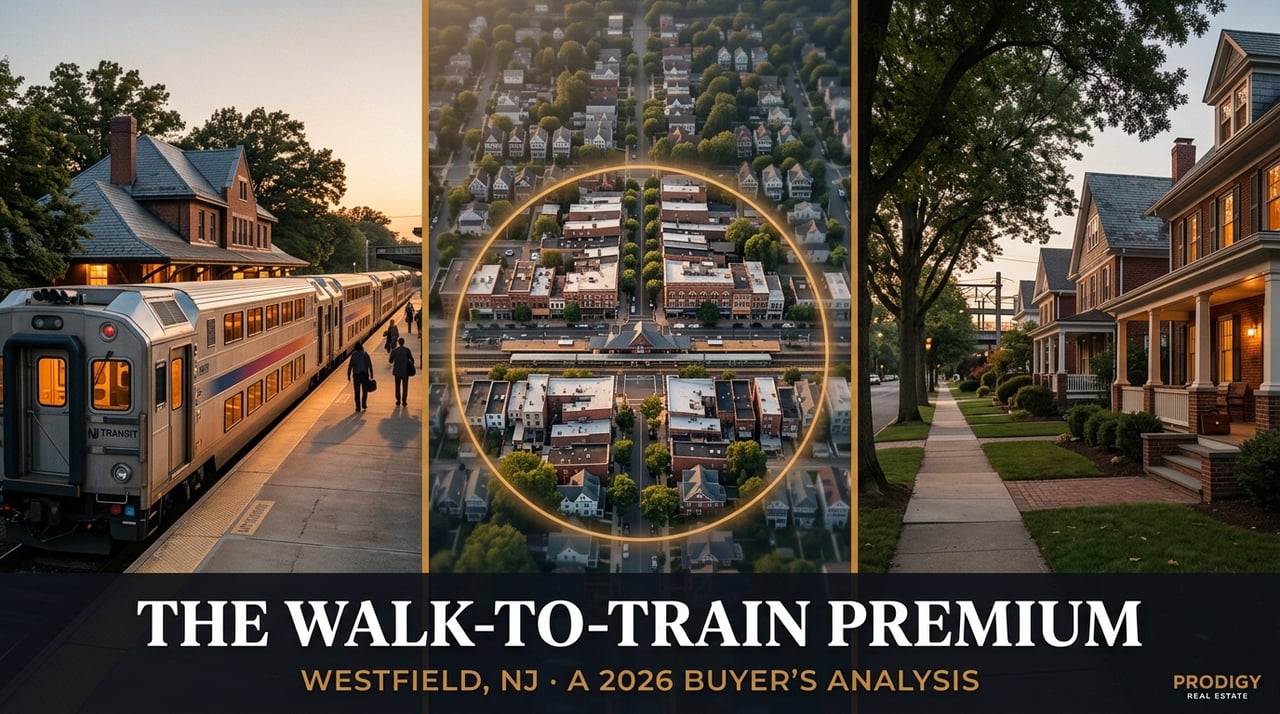
In Westfield, New Jersey, the most valuable square foot of land isn't on a one-acre lot in Wychwood Manor or behind a wrought-iron gate in Indian Forest. It's the patch of asphalt directly outside the NJ Transit station — and every home within a half-mile walk of it.
Regional data on New Jersey transit-oriented housing puts the absolute premium for homes within a half-mile of a station at roughly $34,000 over comparable homes two miles out. In Westfield specifically, that translates into something more important than a single dollar figure: it's the reason the dense grid streets near the historic core consistently outperform on price-per-square-foot, even when their lots are a third the size of homes farther from downtown. And it's about to be reshaped by the largest downtown redevelopment project in the town's modern history — One Westfield Place.
|
$34K Half-Mile Premium Per regional NJT data |
364 New Parking Spaces One Westfield Place |
170+ Luxury Units At the station |
55–70 Min to NYC Newark transfer |
Westfield was incorporated in 1798, but the town as it exists today was built by the railroad. The Central Railroad of New Jersey reached Westfield in the late nineteenth century, and within a generation the entire street pattern of the historic core had reorganized itself around the station. Tight grid blocks. Narrow lots. Houses built close enough to walk briskly to the platform with a leather briefcase and a folded copy of the morning paper. That layout still exists, almost unchanged, more than a century later.
Today, the Westfield train station sits on NJ Transit's Raritan Valley Line, with service to New York Penn Station via a transfer at Newark Penn. Peak commute time runs roughly 55 to 70 minutes door-to-door for Manhattan workers — competitive with nearly any commuter town within sixty miles of the city. Monthly passes run approximately $220–$250. Off-peak service offers occasional one-seat rides; peak service requires the Newark transfer that has become a non-issue for the regulars who do it five days a week.
The economic implication is the central fact of Westfield real estate: every home in the town has an implicit relationship to the train station. The closer you are, the more that relationship is worth.
Statistical analysis of NJ Transit communities consistently identifies a measurable price premium for homes within walking distance of a station. The headline figure for the half-mile radius is approximately $34,000 in absolute premium over comparable homes located further out — narrowing to roughly $23,000 at the two-mile threshold, and converging toward zero beyond that. Regional data also documents 2.3% to 7.5% additional appreciation for transit-proximate homes over multi-year periods.
⚠ An Important Caveat About Averages
The $34,000 figure is a regional average across NJ Transit communities. In a town like Westfield where downtown walkability is genuinely high, the actual premium for the best-positioned homes can run materially higher. Conversely, individual homes with offsetting drawbacks — backing up to commercial parcels, busy roads, or compromised lots — can show no premium at all. The number is a baseline, not a ceiling.
In Westfield's current 2026 market — where the median sold price sits near $1.15 million, price per square foot is approximately $468 (up 4.92% year-over-year), and inventory is functionally tight at 0.91 months of supply with homes selling at 4.22% over asking on average — the walk-to-train premium expresses itself most visibly through price-per-square-foot rather than total sale price. A 2,000-square-foot home three blocks from the station and a 3,200-square-foot home a mile away can clear at similar absolute prices. The smaller home is being valued differently, and the difference is the train.
For broader market context — sale-to-list ratios, days on market, recent appreciation — see our 2026 Westfield real estate update.
Standing on the platform at Westfield station, draw four concentric rings outward. Each ring is a different version of the town.
|
Ring 1 Inside 0.5 mi Walk: instant |
Historic Core · RS-6 / RS-8 Dense grid, smallest lots in town (6,000–8,000 sq ft). Victorians, Colonial Revivals, early Tudors. Highest Walk Scores. Westfield's only meaningful condo inventory: The Savannah, Cowperthwaite Square, Trinity Gardens. |
|
Ring 2 0.5–1 mi Walk: 12–18 min |
Transition Ring · RS-12 12,000 sq ft minimum lots. The Gardens, Stoneleigh Park, Dudley Park. Walkable but no longer instant. The 1920s park-like neighborhoods that define Westfield's mid-tier luxury character. |
|
Ring 3 1–2 mi Walk: 25–40 min |
Car Ring · RS-16 / RS-24 Suburban-spacious. Brightwood, closer Wychwood, parts of Tamaques and Jefferson zones. Buyers drive, bike, or rideshare to the station. Premium narrows to ~$23K. |
|
Ring 4 2+ mi Walk: not practical |
Estate Ring · RS-24 / RS-40 Wychwood Manor interior, Indian Forest, Echo Lake-adjacent streets. Walk-to-train premium has dissolved. Buyers pay for space, privacy, lot size, and architectural integrity instead. |
The transition between Ring 2 and Ring 3 — the line at one mile from the station — is where the experience of Westfield changes most sharply. Inside that line, you live a downtown-walkable life. Outside it, you live a car-suburban life. The price data reflects that.
For the deep-dive on the estate end of the spectrum, see our Wychwood Manor buyer's guide. For the technical breakdown of how RS-zoning shapes density across these rings, see our Westfield zoning map explainer.
In 2024, the Town of Westfield approved One Westfield Place — the largest downtown redevelopment project in the town's modern history. The project covers parcels immediately surrounding the train station and will deliver three things that, taken together, materially change the math of the walk-to-train premium.
◆ What One Westfield Place Delivers
|
364 Public parking spaces addressing Westfield's chronic commuter parking shortage at the station. |
170+ Luxury residential units adding for-rent and for-sale density at the train. |
100K Sq ft of office & retail strengthening the downtown's daytime economic base. |
Most coverage of One Westfield Place focuses on the residential and retail components — the visible additions to the streetscape. But the contrarian read on this project is that the parking is the part nobody is talking about, and it's the part that will most directly affect home values.
"The parking is the part nobody talks about
— and it's the part that's about to change everything."
— Anthony Licciardello
Here's the mechanism. Westfield has long had more commuters than parking spaces at and near the station. The waiting list for permitted spots can run years. That shortage has functioned as a silent constraint on the walk-to-train premium for homes between roughly 0.75 and 2 miles from the station — because buyers in that band can't actually drive to the station and reliably park. They have to walk, bike, or get a ride. For many commuters, that limitation pushes them inside the half-mile ring or out of Westfield entirely.
When 364 new parking spaces come online, the effective walking radius of the train station expands. Homes that were once "too far to walk reliably and impossible to park near" become workable commuter properties. The premium for the inside ring may compress slightly relative to the second ring as parking constraints loosen. Buyers in the 0.75-to-1.5-mile band are likely the largest beneficiaries.
The retail and office components matter for a different reason. They strengthen the downtown's daytime economy, which feeds the walkable-lifestyle premium that exists independently of the train (covered below). And the 170 new residential units add a small but meaningful supply of luxury inventory at the station — most of which will be rental-tier, not directly competing with single-family stock.
Five neighborhoods sit close enough to the project that their values will move in some way as it delivers. Here is the street-level read.
|
The Gardens Sits inside the half-mile-to-one-mile band. Already the highest-walkability planned neighborhood in town. Benefits from a stronger downtown but has the least room to grow on the walkability metric — it's already there. |
|
Stoneleigh Park Similar profile to The Gardens. The 1904 deed-restricted enclave with its no-fence covenant and Colonial Revival inventory will see modest premium support from a stronger downtown core, but its existing pricing already captures most of the walk-to-train value. |
|
Dudley Park & Kimball Avenue Historic District Larger lots than the standard grid streets, with a distinct historic character. Likely to see meaningful uplift as buyers who want walkability and architectural distinction shift attention here. |
|
The Dense Grid Streets Around the CBD RS-6 and RS-8 zoning. Smallest lots in town. Already command per-square-foot premiums and likely to sustain them. The new condo inventory will absorb some downsizer demand that historically went into these blocks. |
|
★ The 0.75–1.5 mi Second Ring The biggest beneficiary in percentage terms. Buyers who couldn't reliably park at the station before may now find these homes workable for commuter life. The premium expansion here is the most under-priced opportunity in the 2026 Westfield market. |
For the canonical guide to all Westfield neighborhoods and how they fit into the broader pricing hierarchy, see our Westfield neighborhood guide.
Not every buyer paying the walk-to-train premium is actually riding the train. A meaningful and growing percentage of Westfield's downtown buyers are remote workers, hybrid professionals, retirees, or NYC transplants who simply value the walkability for its own sake.
Westfield's downtown supports that premium because of what's actually there: a nationally recognized commercial district along East Broad Street, the Saturday farmer's market, the AMC Westfield 7 cinema, Mindowaskin Park, summer concerts on the green, and a deep restaurant ecosystem that includes everything from white-tablecloth Italian at Mojave Grille to weeknight pizza at Joe's. For buyers comparing Westfield to its peer towns, this density of walkable amenities is what separates it from places like Chatham or Madison that have strong train service but thinner downtowns.
The implication for valuation is important: even when remote work expanded after 2020 and many predicted suburban-train towns would lose their premium, Westfield's downtown-walkable inventory held its pricing. The premium had decoupled from the train. One Westfield Place will reinforce that decoupling.
Westfield is one of three towns most often referenced together for the walk-to-train premium discussion in central and northern New Jersey: Summit, Millburn, and Westfield. Here's the side-by-side.
| Town | NJT Line | Median Sold | Premium Profile |
|---|---|---|---|
| Westfield | Raritan Valley | ~$1.15M | ~$34K · 2.3–7.5% appreciation uplift |
| Summit | Morris & Essex / Gladstone | ~$1.9–2.0M | Higher absolute · similar % range |
| Millburn / Short Hills | Morris & Essex (Direct) | ~$2.5–3M+ | Highest absolute · direct-train advantage |
The takeaway: the walk-to-train premium expressed as a percentage is broadly similar across the three towns. The difference is the absolute price level. Westfield's median sold sits roughly $700,000–$800,000 below Summit and more than a million below Millburn. For buyers who want the walk-to-train benefit at a more accessible entry point — and who can accept the Newark transfer for peak service — Westfield is the value play in the triangle.
|
▲ For Buyers
|
◆ For Sellers
|
⬢ The 2026 Macro Pattern Worth Watching
Two of New Jersey's most consequential 2026–2030 real estate catalysts are infrastructure-driven: One Westfield Place at the Westfield train station, and Netflix's billion-dollar studio campus at Fort Monmouth. Both anchor demand to specific geographic radii. For the parallel analysis on the Monmouth County side, see our Netflix Effect on Monmouth County analysis.
Q
Regional analysis of NJ Transit communities estimates approximately $34,000 in absolute price premium for homes within 0.5 miles of a station, narrowing to roughly $23,000 at 2 miles. Transit-proximate homes also show 2.3% to 7.5% additional appreciation over multi-year periods. In Westfield specifically, the premium most often expresses itself through price per square foot rather than total sale price — smaller homes near the station can clear at similar absolute prices to larger homes a mile out.
Q
One Westfield Place is the largest downtown redevelopment project in Westfield's modern history, anchored at the train station. It will deliver 364 new public parking spaces, 170+ luxury residential units, and 100,000 square feet of office and retail. The project is being built in phases; specific delivery timelines have shifted across approval and construction milestones. Buyers and sellers should consult current municipal updates for exact completion targets, as schedules continue to evolve.
Q
Net positive for almost every nearby pocket, with the largest beneficiary being homes in the 0.75-to-1.5-mile band where current parking constraints have suppressed the walk-to-train premium. Inside-the-half-mile homes will see continued strong demand but may experience some compression of their relative premium as the second ring becomes more workable for commuters. The retail and office components strengthen the downtown's daytime economy, supporting the broader walkable-lifestyle premium across all nearby pockets.
Q
Approximately 55 to 70 minutes door-to-door from Westfield station to New York Penn Station via NJ Transit's Raritan Valley Line. Peak service requires a transfer at Newark Penn Station; off-peak and evening service occasionally offers one-seat rides. Monthly passes run roughly $220–$250, and one-way fares are typically $12–$14.
The walk-to-train premium is one of the most economically significant features of the Westfield market — and one of the most poorly understood. Buyers routinely overpay for homes outside the effective walking radius assuming they're getting transit value, and sellers routinely under-price homes that should command premium positioning because of their proximity to the station.
Prodigy Real Estate operates across New York and New Jersey with deep expertise in Union County and the Westfield market specifically. Whether you're evaluating a half-mile-radius Colonial, a Gardens Tudor, or a second-ring property positioned to benefit from One Westfield Place, reach out — we'll walk through the actual pricing implications for your specific block.
Related reading: What it really costs to sell a home in Westfield NJ.
About the Author
 |
NYS/NJ Licensed Broker · The Prodigy Team 20+ years and 5,000+ closed transactions across New Jersey and Staten Island. Anthony specializes in the Westfield and Union County corridor, with a focus on architectural micro-markets, transit-oriented development, and the data-driven side of luxury suburban real estate. Reach out through ProdigyRE.com for buyer, seller, or market consultation inquiries. |
Prodigy Real Estate is an innovative real estate company offering high-end video production, home valuation services, purchasing, and home sales. Serving New York and New Jersey.