
Anthony Licciardello | May 6, 2026
Westfield, NJ
By Anthony Licciardello, The Prodigy Team
NYS/NJ Licensed Broker · Westfield, NJ Market Specialist
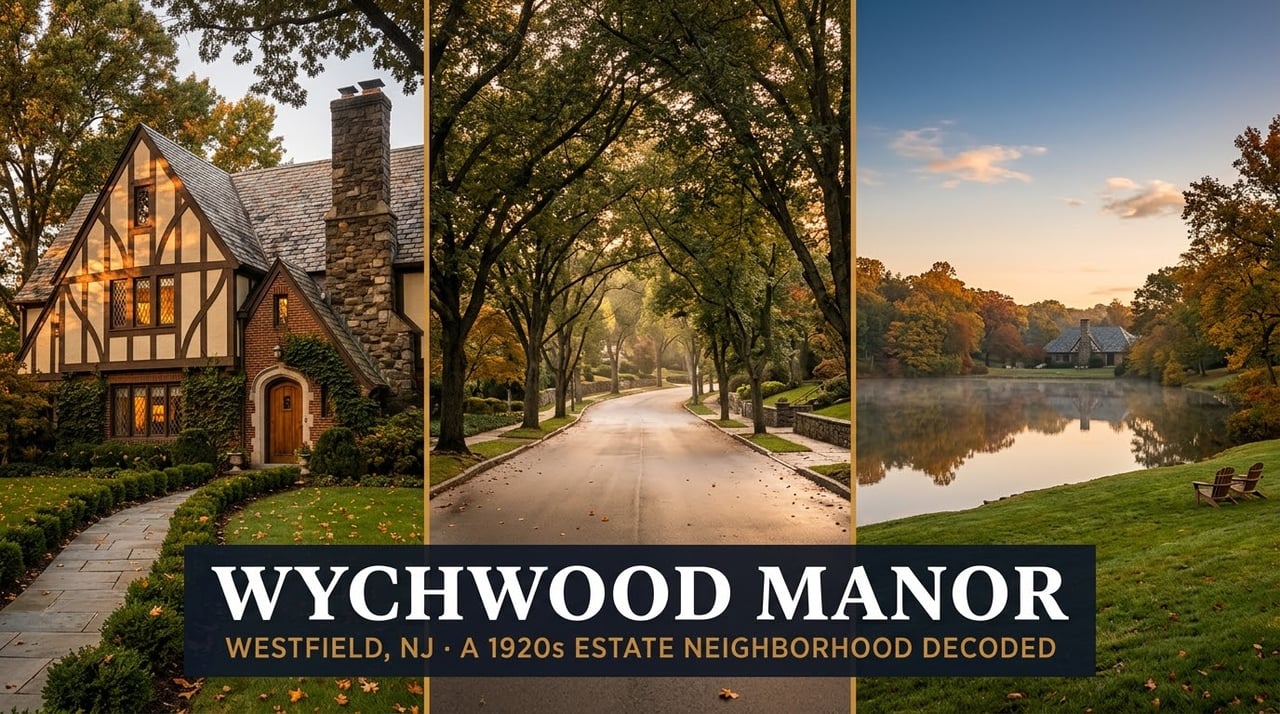
Wychwood Manor is the most expensive neighborhood in Westfield, New Jersey — and the only one where the streets were deliberately curved to make you forget you're sixteen miles from Manhattan. Lots run from a third of an acre to over an acre. Top-tier estates trade for $3 million to $4 million. The canopy is so dense that from above, Wychwood looks like a forest that happens to have houses in it, not a neighborhood that happens to have trees.
Here's what buyers, sellers, and curious neighbors need to know about the enclave on Westfield's northeast border — including the cooperative housing arrangement on Sandra Circle that almost no competing broker writes about.
Wychwood Manor at a Glance
Developed: 1920s · Lot size: ⅓ to 1+ acre · Entry price: ~$1.25M · Top tier: $3M–$4M+ · Adjacent to: 139-acre Echo Lake Park & Echo Lake Country Club · Westfield median sold: ~$1.15M (for context)
Westfield was incorporated in 1798, but Wychwood Manor wasn't carved out until the 1920s — a century into the town's existence and at the height of the country-estate movement that reshaped suburban planning across the Northeast. The neighborhood occupies the northeastern corner of town, bordered by Echo Lake Park and Echo Lake Country Club to the north and the Mountainside line to the east.
Within Westfield's neighborhood ladder, Wychwood typically trades at two to three times the townwide median. That premium isn't accidental. It's the product of three deliberate choices made a hundred years ago: oversized lots in an era when the rest of Westfield was being platted for commuter density, a curving street pattern that breaks the rail-era grid, and an architectural standard that drew the wealthy executives who could afford the Central Railroad of New Jersey's first-class fare.
For buyers comparing Wychwood to the rest of Westfield, see our complete Westfield neighborhood guide.
Drive into Wychwood from any direction and the first thing you notice is what's missing: the grid. The streets curve, taper, and double back. Sight lines are deliberately broken. Front lawns vary in setback. Mature oaks and maples form a near-continuous canopy that filters the light differently in every season.
This was the design intent. The 1920s developers of Wychwood were responding to a moment in American suburban history when the dense, walkable, train-station-anchored grid that defined the rest of Westfield had become — for the wealthy — too dense and too walkable. They wanted privacy, tree cover, and the visual sensation of being in the country while remaining a short drive from the train. The curving street pattern wasn't an accident of topography. It was a product positioning decision.
What "Identified Historic Neighborhood" Actually Means for You
Westfield's 2024 Master Plan recognizes Wychwood as one of the town's identified historic neighborhoods — meaning the area is documented as architecturally significant but is not locally designated. Translation for buyers: you get the prestige and cohesion of a planned 1920s enclave without the Certificate of Appropriateness review process that constrains renovations elsewhere in town. Only Kimball Avenue carries that regulatory burden today.
Zoning-wise, Wychwood sits primarily in Westfield's RS-24 single-family district, which mandates a 24,000-square-foot minimum lot — roughly four times the minimum in the dense grid streets near downtown. For a deeper read on how zoning shapes Westfield's character, see our Westfield zoning map explainer.
Wychwood's housing stock is dominated by three architectural traditions, in roughly this order of prevalence: Tudor Revival, Colonial Revival, and post-1950s custom builds that respect the scale of the original neighborhood while accommodating modern floor plans.
Tudor Revival is the signature Wychwood style. Half-timbering against stucco or brick, steeply pitched cross gables, prominent stone chimneys, and beamed interior ceilings are common. Wychwood's Tudor concentration is denser than anywhere else in Westfield except The Gardens.
Why It's Called a "Stockbroker Tudor"
The 1920s timing of Wychwood's development overlapped almost exactly with the peak of what architectural historians call the "Stockbroker Tudor" era — so named because the materials required (stone, brick, heavy timber, slate) made the style prohibitively expensive for anyone outside the wealthiest commuter class. The same Wall Street executives riding the Central Railroad of New Jersey home each evening were the buyers commissioning these houses. Almost a century later, the inventory still trades at a premium for the same reason: you can't fake the materials, and you can't replicate the era.
Colonial Revival homes — symmetrical facades, side-gabled roofs, centered entries with pediments and sidelights — form the second major style cohort. Many were built slightly later than the Tudors, in the late 1920s and 1930s, as the Colonial Revival style overtook the Tudor as the dominant American suburban aesthetic.
Custom builds from the 1960s onward fill in the remaining inventory. The best of these were designed by architects who understood the neighborhood's scale — six-bedroom houses on one-acre lots that read as belonging rather than imposing. The worst are the 1980s "McMansion" anomalies that occasionally come to market and almost always sell at a discount to comparable Tudor or Colonial Revival stock.
For a complete walkthrough of every architectural style found in Westfield — including how to identify each one and what it signals about price tier — see our Westfield home styles guide.
The Insider Option Most Buyers Don't Know About
Tucked inside Wychwood's largely single-family fabric is one of the more interesting housing arrangements in all of Westfield: Wychwood Gardens Cooperative, on Sandra Circle. Approximately 183 residences across multiple two-story brick buildings, set on roughly 12 acres of grounds.
A cooperative is a different ownership structure than either a condo or a fee-simple single-family home, and buyers encountering the format for the first time often have legitimate questions. Here's how it works.
In a co-op, you don't technically own your individual unit. You own shares in the cooperative corporation that owns the entire property, and those shares entitle you to a proprietary lease on your specific apartment. Monthly maintenance fees — which in recent Wychwood Gardens listings have run around $1,300 per month — typically cover heat, building maintenance, grounds care, and a portion of the underlying real estate taxes. In a condominium, by contrast, you'd be paying many of those costs separately.
Two practical implications for buyers:
For the right buyer, Wychwood Gardens is a genuinely compelling option. You get a Wychwood address, 12 acres of shared grounds, and a built-in community structure — all at a fraction of the entry price of a single-family Wychwood home. It's the closest thing Westfield has to a true urban-style cooperative, and it sits in the most architecturally distinguished corner of the town.
Two amenities anchor Wychwood's northern edge, and together they explain a meaningful chunk of the neighborhood's premium over the rest of Westfield.
Echo Lake Park is a 139-acre Union County park spanning the Westfield–Mountainside line. It's a public park, free to access, with walking trails, picnic groves, a stocked lake popular with anglers, and ice skating in colder winters. For Wychwood residents, the park functions as a de facto extension of the neighborhood — close enough to walk to from many homes, large enough that you can lose yourself in it for a Sunday morning.
Echo Lake Country Club is the private counterpart — founded in 1898 and one of the older country clubs in the state, with a championship golf course, tennis facilities, a swim complex, and full social membership.
Echo Lake Country Club: What Buyers Need to Know
The combination of public park and private club at Wychwood's doorstep is unusual in Westfield. It's the single biggest amenity differentiator between Wychwood and the town's other estate enclaves like Indian Forest or Brightwood.
Wychwood Manor is a small neighborhood with low turnover — typically two to four single-family sales per year. That makes any single market snapshot directional rather than statistical.
A recent Redfin snapshot for the Wychwood market polygon showed a sale price of approximately $3.46 million, $670 per square foot, 4.9% over list price, and 298 days on market across two homes sold in the period. That data point tells you Wychwood's top tier is real, that it commands a per-square-foot premium, and that homes here marketed correctly do clear above asking. It does not tell you what the neighborhood "is worth" in any precise sense, because the sample is too thin.
Here's the directional read across multiple data snapshots and market observations:
"Wychwood's premium isn't square footage. It's that the neighborhood was designed, at its founding, to be the best version of itself."
For broader Westfield market context — median sale price, days on market, sale-to-list ratios — see our 2026 Westfield real estate update.
Wychwood is a fit-driven neighborhood. The buyers who thrive here share a profile, and the buyers who regret their purchase usually share a different one.
Right fit:
Wrong fit:
The 2026 Macro Signal Worth Watching
Corporate relocation pressure on Northern and Central New Jersey is intensifying. Major projects like Netflix's billion-dollar studio campus at Fort Monmouth are pulling executive-level talent into the state and concentrating demand at the top of established suburban markets where supply is fixed by century-old lot platting. Wychwood is exactly that kind of supply-constrained market. For more, see our Netflix Effect on Monmouth County analysis.
Wychwood isn't the only premium pocket in Westfield. Indian Forest, The Gardens, and Stoneleigh Park each occupy a distinct micro-market with its own character, era, and price tier. Here's the side-by-side.
| Neighborhood | Era | Defining Feature | Typical Price |
|---|---|---|---|
| Wychwood Manor | 1920s | Curving streets, Echo Lake adjacency, Tudor concentration | $1.25M – $4M+ |
| Indian Forest | Mid-20th c. | Largest lots, mature canopy, mid-century estate scale | $1.5M – $3.9M |
| The Gardens | 1909–1940s | Pocket gardens, Tudor & Norman concentration, walkability | $1M – $2M+ |
| Stoneleigh Park | 1904 | National Register, no-fence covenant, Colonial Revival | $900K – $3.2M |
| Brightwood | Mixed | 44-acre Brightwood Park anchor, mixed housing stock | $700K – $2.5M+ |
Each of these neighborhoods deserves its own deep-dive, and we'll publish them progressively. In the meantime, the Westfield neighborhood guide remains the canonical starting point for buyers comparing across pockets.
Wychwood Manor sits on the northeastern border of Westfield, bounded roughly by Echo Lake Park and the Mountainside town line to the north and east. It's about a 5–10 minute drive from the Westfield train station and downtown, and it's one of the most identifiable neighborhoods in town because of its winding, non-grid street pattern.
Single-family Wychwood homes typically range from about $1.25 million at the entry point to $3–$4 million-plus for fully renovated estates on larger lots. The mid-tier — well-maintained Tudors and Colonials on ⅓-to-½-acre lots — generally trades in the $1.75M–$2.5M band. Wychwood Gardens co-op units sit well below single-family pricing and follow a different ownership structure. Townwide Westfield median sold is approximately $1.15 million for context.
Wychwood Manor is the broader single-family neighborhood developed in the 1920s. Wychwood Gardens is a specific cooperative housing community on Sandra Circle within Wychwood Manor — approximately 183 residences across multiple two-story brick buildings on roughly 12 acres. Wychwood Gardens uses cooperative ownership (you own shares in a corporation, not the unit itself), which differs structurally and financially from a fee-simple single-family purchase.
Walkable in the technical sense — yes, you can walk from most Wychwood addresses to the station in 25–35 minutes. Practical for a daily commuter — generally no. Most Wychwood residents drive, bike, or take a short rideshare to the station. Buyers whose top priority is a sub-10-minute walk to NJ Transit should look closer to the historic core neighborhoods like The Gardens, Stoneleigh Park, or the streets immediately surrounding downtown.
Wychwood is a small market with thin inventory and high stakes. Two to four single-family sales in a typical year means the right home rarely comes back around — and when it does, it moves quickly to buyers who already have the financing, attorney, and broker relationships in place.
Prodigy Real Estate operates across New York and New Jersey with deep expertise in Union County and the Westfield market specifically. Whether you're buying, selling, or evaluating a long-hold position in one of the state's most architecturally distinguished neighborhoods, reach out — we'll tell you what the data actually says, not what the headlines do.
Related reading: What it really costs to sell a home in Westfield NJ.
About the Author
 |
NYS/NJ Licensed Broker · The Prodigy Team 20+ years and 5,000+ closed transactions across New Jersey and Staten Island. Anthony specializes in the Westfield and Union County corridor, with a focus on architectural micro-markets, 1920s estate neighborhoods, and the data-driven side of luxury suburban real estate. Reach out through ProdigyRE.com for buyer, seller, or market consultation inquiries. |
Prodigy Real Estate is an innovative real estate company offering high-end video production, home valuation services, purchasing, and home sales. Serving New York and New Jersey.