
Anthony Licciardello | May 7, 2026
Westfield, NJ
By Anthony Licciardello, The Prodigy Team
NYS/NJ Licensed Broker · Westfield, NJ Market Specialist
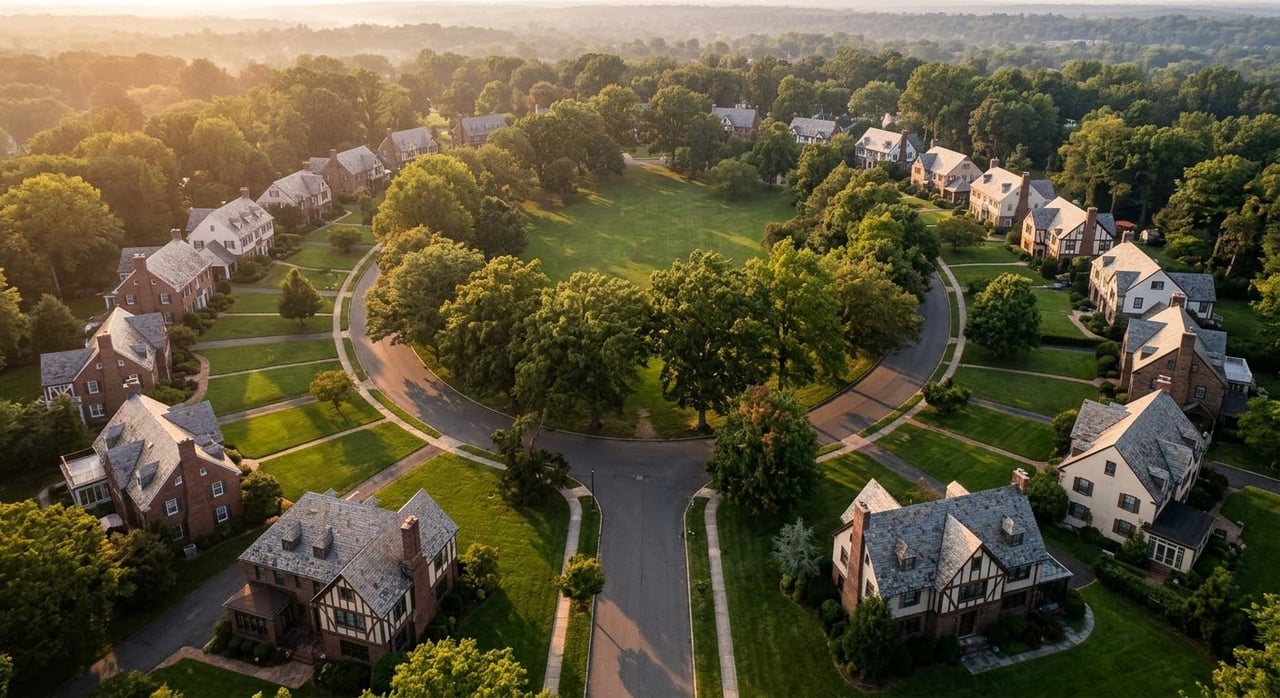
Stoneleigh Park is the smallest, oldest, and most legally distinctive residential enclave in Westfield, New Jersey. Thirty single-family houses. Approximately twenty acres. One looped park-road. A National Register-documented historic district. And a set of original 1904 deed restrictions — including a prohibition on visible fences between properties — that have shaped the neighborhood's character for one hundred and twenty-two years and continue to bind every new owner.
This is what buyers, sellers, and curious neighbors need to know about a planned residential community that was developed before automobiles were standard, executed exactly as designed, and remains — by every meaningful measure — the most architecturally cohesive address in town.
|
1904 Founding Year Tremaine developers |
30 Total Houses The entire supply |
~20 Acres Total Including roadway |
National Designation Historic district |
Most Westfield neighborhoods are defined by feel — a buyer learns where Wychwood "starts" by walking the streets and noticing when the canopy gets denser and the lots get larger. Stoneleigh Park is the exception. The Westfield Historic Preservation Commission's nomination report literally writes down the perimeter, and the four streets that form the boundary haven't changed in over a century.
◆ The Four Boundary Streets
|
Southwest Rahway Avenue |
Northwest Dorian Road |
|
Northeast Westfield Avenue |
Southeast Shackamaxon Drive |
Inside that perimeter is a single looped road and thirty houses. Drive the loop slowly and you can see every property in the neighborhood in under five minutes. There are no through-streets, no shortcuts, and no commercial uses. Stoneleigh Park is functionally an island of residential design dropped into the larger Westfield grid.
For buyers comparing Stoneleigh to the rest of Westfield's residential pockets, see our complete Westfield neighborhood guide.
Stoneleigh Park was platted and developed in 1904 by the Tremaine developers — a date that is genuinely significant in the context of Westfield's residential history. The Gardens, often described as Westfield's earliest planned neighborhood, was developed beginning in 1909. Wychwood Manor came in the 1920s. Stoneleigh Park predates both. It is the first planned park-residential community in Westfield, and the model that the others would refine.
The Tremaine vision was specific. Build a single loop road. Set the houses back enough to feel private but close enough to feel held by the streetscape. Standardize the architecture so the neighborhood would read as a unified composition rather than a collection of competing facades. The original development intent specified Colonial Revival as the base style for every home — and while that uniformity was eventually relaxed, the underlying logic of cohesion has held.
Three phases of development are visible in the neighborhood today.
|
Phase 1 1904–1915 |
Original Tremaine Build-Out Foundational Colonial Revival homes following the original 1904 design specification. The cohesion that defines the neighborhood today was set in this period. |
|
Phase 2 1920s |
Tudor Revival Era Additions Significant English Tudor Revival examples added during the broader American "Stockbroker Tudor" wave. National Register documentation references contributing structures from this period. |
|
Phase 3 Mid-20th c. |
Craftsman & Selective Infill A small number of Craftsman-style homes and infill builds completed the neighborhood. By mid-century, Stoneleigh Park was effectively built out at thirty houses. |
For buyers comparing the planned-enclave history of Westfield's three major designed neighborhoods — Stoneleigh, The Gardens, and Wychwood — see our Wychwood Manor buyer's guide for the 1920s perspective.
This is the section that almost no other Westfield broker writes about, and it's the single most distinctive feature of buying in Stoneleigh Park.
⬢ The Original 1904 Deed Restriction
"No demarcation of property lines that would disrupt the park setting."
In practice: no fences, no walls, no formal hedge-lines marking lot boundaries. Front lawns flow into neighboring front lawns. The cumulative visual effect is the "park" in Stoneleigh Park.
The covenant is original to the 1904 plat. It runs with the land, meaning it binds every successive owner regardless of whether they read the deed carefully or understood what they were buying into. Title companies surface it during the closing process, but the practical implications are easy to under-appreciate until you actually live there.
Practical implications buyers should think through before closing:
The cultural enforcement is at least as strong as the legal enforcement. Stoneleigh's neighbors know the covenant, expect adherence, and have been protecting the streetscape for over a century. A new owner attempting to test the boundary almost always loses both the legal argument and the social one.
Three architectural traditions are represented in Stoneleigh Park's thirty homes, and they correspond directly to the three phases of development outlined above.
Colonial Revival is the foundation. The Tremaine developers' original 1904 specification mandated Colonial Revival across the neighborhood — symmetrical facades, side-gabled roofs, centered entries with pediments and sidelights, classical detailing in the cornices and window surrounds. The homes from Phase 1 establish the visual baseline. Even where later phases introduced different styles, the Colonial Revival foundation reads as the dominant aesthetic.
English Tudor Revival entered Stoneleigh in the 1920s, in parallel with the broader American Stockbroker Tudor movement. Half-timbering, steeply pitched cross gables, prominent stone chimneys, leaded casement windows. National Register documentation references contributing Tudor structures dating to approximately 1928. These homes are scattered through the neighborhood rather than concentrated in one section, which contributes to the architectural diversity within the overall cohesion.
Craftsman and Selective Infill rounds out the inventory. A small number of Craftsman-style homes — characterized by deep porches, exposed rafter tails, and natural-material exteriors — fill out the mid-twentieth-century build-out. These are the rarest style in Stoneleigh and tend to attract buyers specifically seeking the Craftsman aesthetic.
What matters more than any single style is the cohesion. Stoneleigh's homes were designed and built to complete each other rather than compete with each other — a philosophy directly opposed to the modern American suburban norm. For a complete walkthrough of the architectural styles found across Westfield, see our Westfield home styles guide.
Stoneleigh Park's National Register designation is one of its most-cited features and one of its most misunderstood. Here is what the regulatory framework actually does — and what it doesn't.
|
▲ What It Does
|
◆ What It Does Not Do
|
The honest summary: National Register designation is more about prestige and documentation than about regulation. The 1904 deed restrictions and the cultural pressure of Stoneleigh's neighbors have a more direct day-to-day impact on what owners actually do with their properties than the federal designation does.
For broader context on Westfield's regulatory landscape — zoning, RS districts, variance processes — see our Westfield zoning map explainer.
Pricing analysis for Stoneleigh Park is the most caveat-laden of any Westfield neighborhood, and any broker who tells you otherwise isn't being straight with you.
Thirty houses with very low turnover means there is no clean Redfin or Zillow "neighborhood median" in the conventional sense. Stoneleigh doesn't generate enough annual transactions to produce a statistically reliable price point. What we have is a directional read built from individual recorded sales over multiple years.
"Thirty houses is the entire supply.
There is no future inventory."
— Anthony Licciardello
The structural pricing logic of Stoneleigh is this: thirty houses is the entire supply. There is no future inventory. The neighborhood was built out by mid-century and the deed restrictions plus the historic district status make new construction effectively impossible. When a Stoneleigh home comes to market — typically only one or two per year — the buyer pool isn't competing against future supply. They're competing against each other.
For broader market context, see our 2026 Westfield real estate update.
Buying in Stoneleigh Park is not the same as buying in any other Westfield neighborhood, and not just because of the architecture or the deed restrictions. The scale of the community itself — thirty households, one loop road — produces a social dynamic that you either love or you don't.
The neighbors know you. All of them. The longest-tenured residents have been there for decades, in some cases generations. New arrivals are noticed, welcomed, and assessed for fit with the neighborhood's culture of stewardship. This is not anonymity. If that sounds like a feature, Stoneleigh is for you. If it sounds like a constraint, you may be more comfortable in a larger pocket like The Gardens or Brightwood.
Walkability is genuine. Stoneleigh sits within Westfield's commuter-walkable second ring — roughly 0.5 to 1 mile from the NJ Transit station depending on which side of the loop you're on. Many residents walk to the train, downtown, the Saturday farmer's market, and Mindowaskin Park. For deeper context on the train-station premium and how Stoneleigh's location interacts with the broader Westfield walkability map, see our walk-to-train premium analysis.
Custodianship is the operative word. Stoneleigh residents understand that they are temporary stewards of a 122-year-old planned community. Renovations, landscape decisions, and exterior changes are made with that frame in mind. The neighborhood has held its character across a century of individual ownership turnover precisely because owners have consistently prioritized fit over self-expression.
Each of Westfield's planned and estate enclaves occupies a different spot in the architectural and pricing hierarchy. Here's the side-by-side.
| Neighborhood | Founded | Defining Feature | Typical Price |
|---|---|---|---|
| Stoneleigh Park | 1904 | National Register · no-fence covenant · 30 houses | $800K – $3.2M |
| The Gardens | 1909–1940s | Pocket gardens, Tudor & Norman, walkability | $1M – $2M+ |
| Wychwood Manor | 1920s | Curving streets, Echo Lake, Tudor concentration | $1.25M – $4M+ |
| Indian Forest | Mid-20th c. | Largest lots, mature canopy, mid-century scale | $1.5M – $3.9M |
| Brightwood | Mixed | 44-acre Brightwood Park anchor, mixed stock | $700K – $2.5M+ |
Stoneleigh's defining advantage in this comparison isn't lot size or absolute price. It's the regulatory and cultural protection of the streetscape. The other neighborhoods are governed by zoning and norms; Stoneleigh is governed by zoning, norms, deed restrictions, and federal historic designation. Four layers, not two.
|
▲ For Buyers
|
◆ For Sellers
|
⬢ The 2026 Macro Pattern Worth Watching
Two of New Jersey's most consequential 2026–2030 real estate catalysts are infrastructure-driven: One Westfield Place at the train station, and Netflix's billion-dollar studio campus at Fort Monmouth. Both anchor demand to specific geographic radii — and supply-constrained neighborhoods like Stoneleigh Park are where that demand concentrates first. For the parallel analysis, see our Netflix Effect on Monmouth County analysis.
Q
Stoneleigh Park is bounded by Rahway Avenue (southwest), Dorian Road (northwest), Westfield Avenue (northeast), and Shackamaxon Drive (southeast). It is a single looped road with thirty single-family houses across approximately twenty acres. The boundaries are formally documented in the Westfield Historic Preservation Commission's nomination materials and in National Register documentation.
Q
No. The original 1904 deed restrictions prohibit any demarcation of property lines that would disrupt the park setting — meaning fences, walls, and formal hedge-lines marking lot boundaries are not permitted. The covenant runs with the land and binds successive owners. Privacy is achieved through landscape design rather than fencing, and a Stoneleigh-experienced landscape architect can help plan accordingly.
Q
Thirty single-family houses, set on approximately twenty acres including the loop roadway and shared public realm. The neighborhood was effectively built out by mid-century, and new construction is functionally impossible given the deed restrictions and historic district status. The 30-house supply is the entire supply, both now and in any foreseeable future.
Q
The National Register designation documents Stoneleigh Park as a federally recognized historic district. It enables federal tax credits for qualified rehabilitation work on income-producing properties and provides protection against federally-funded projects that might harm the district. It does not prohibit exterior changes on owner-occupied homes, does not require federal approval for routine renovations, and does not trigger Certificate of Appropriateness review. The 1904 deed restrictions and the cultural pressure of the neighborhood have a more direct day-to-day impact on what owners actually do than the federal designation does.
Stoneleigh Park is the most architecturally and legally distinctive neighborhood in Westfield, and for the right buyer it is one of the most rewarding places to own a home in New Jersey. It is also a neighborhood where the wrong fit becomes apparent quickly — the deed restrictions, the cultural expectations, and the social density of a 30-house community are not for everyone.
Prodigy Real Estate operates across New York and New Jersey with deep expertise in Union County and the Westfield market specifically. Whether you're buying, selling, or evaluating a long-hold position in one of the state's most architecturally distinguished neighborhoods, reach out — we'll walk through the deed, the covenants, and the actual pricing implications for your specific opportunity.
Related reading: What it really costs to sell a home in Westfield NJ.
About the Author
 |
NYS/NJ Licensed Broker · The Prodigy Team 20+ years and 5,000+ closed transactions across New Jersey and Staten Island. Anthony specializes in the Westfield and Union County corridor, with a focus on architectural micro-markets, historic neighborhoods, and the data-driven side of luxury suburban real estate. Reach out through ProdigyRE.com for buyer, seller, or market consultation inquiries. |
Prodigy Real Estate is an innovative real estate company offering high-end video production, home valuation services, purchasing, and home sales. Serving New York and New Jersey.