
May 7, 2026
Westfield, NJ
By Anthony Licciardello, The Prodigy Team
NYS/NJ Licensed Broker · Westfield, NJ Market Specialist
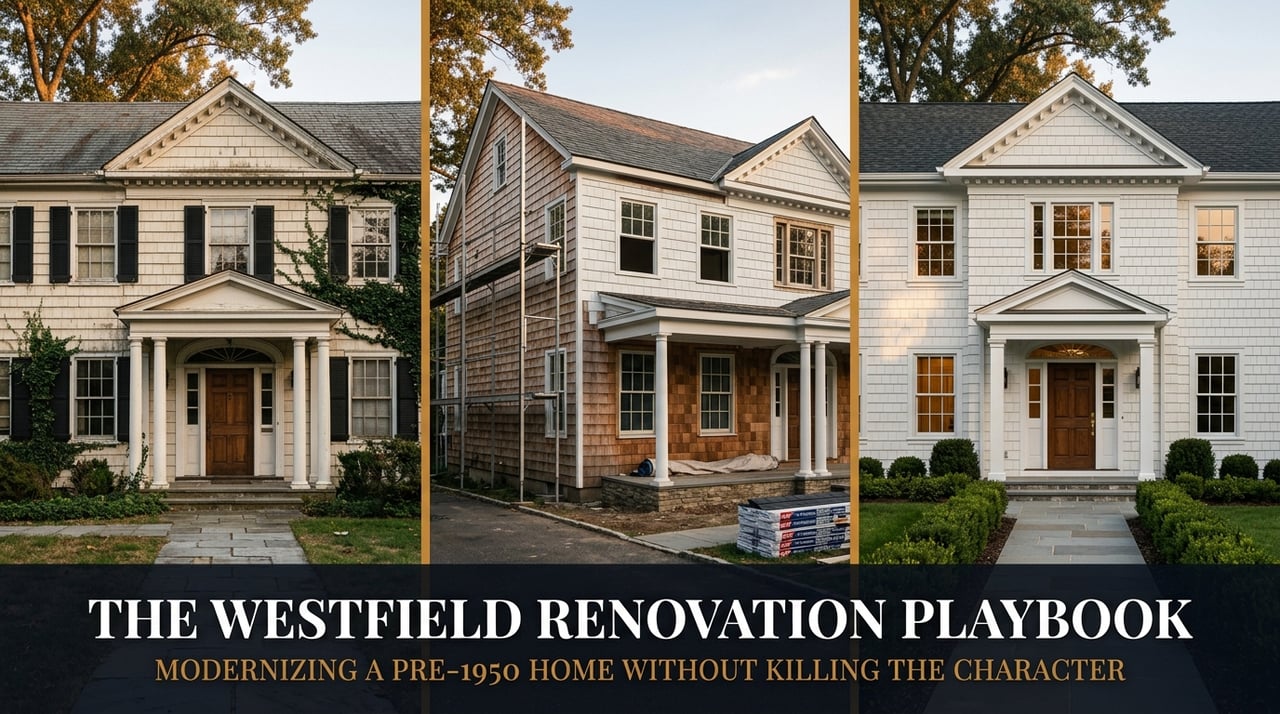
The majority of Westfield's housing stock was built before 1950. That is the central fact every buyer, owner, and seller in this market eventually has to deal with. The Victorian on Dudley Park. The 1920s Tudor in Wychwood. The 1904 Colonial Revival in Stoneleigh Park. The 1905 Dutch Colonial that became the most famous house in town because of a Netflix series. They are all spectacular pieces of architecture. They were also all built before central air conditioning, before two-car garages were standard, before primary suites had walk-in closets, and before kitchens were considered the social center of a home.
Modernizing one of these homes without destroying what makes it valuable is the single most important skill in the Westfield real estate ecosystem — and the one most often gotten wrong. Here is the 2026 playbook: which projects deliver, which materials hold up, where the regulatory landmines are, and where the architectural-integrity line actually sits.
|
Majority Pre-1950 Stock Westfield housing |
$250K–$500K Strategic Reno Mid-range range |
65–80% Reno ROI Best-in-class |
1 Local HPC District Kimball Avenue |
Westfield was incorporated in 1798, and most of the residential blocks that define the town today were laid out between the late 1880s and the late 1940s. The Gardens (1909). Stoneleigh Park (1904). Wychwood Manor (1920s). The dense grid streets near downtown (1880s–1920s). Even the post-war ranches and splits in the Tamaques and Jefferson elementary zones — the "newer" Westfield — were largely built between 1948 and 1960. Truly modern construction, in any meaningful volume, did not arrive in Westfield until the South Side rebuild boom of the 2010s and 2020s.
The implication for buyers: nearly every home you'll consider in Westfield was originally built for a household whose daily routines, technology, and aesthetic expectations bear almost no resemblance to your own. Plaster walls. Cast-iron radiators. Single-pane windows. Galley kitchens with no breakfast nook. Bedrooms without closets. Half-baths inserted under stairs. These houses are gorgeous, but they require translation work to function as 2026 homes. The translation work is what we call renovation.
For the broader market context — what these homes are trading for, days on market, sale-to-list ratios — see our 2026 Westfield real estate update.
Every pre-1950 Westfield renovation falls into one of three buckets. The bucket determines budget, timeline, regulatory exposure, and resale strategy.
|
Tier 1 Light Refresh $50K–$200K |
Cosmetic Updates · 6–12 weeks Paint, refinishing, hardware, lighting, partial kitchen or bath updates. No structural work. No permits beyond electrical and plumbing finishes. Best for homes with good bones and dated finishes — common in pre-listing prep. |
|
Tier 2 Strategic Reno $250K–$500K |
Targeted Reconfiguration · 6–9 months Full kitchen rebuild, primary suite addition or expansion, mudroom build-out, mechanical system overhaul. Permits required, possible variance. Most common Westfield renovation tier — the sweet spot for owner-occupiers planning a 7-to-15-year hold. |
|
Tier 3 Studs-Out $700K–$1.5M+ |
Full Reconstruction · 12–18 months Down to the framing. Second-floor addition, rear bump-out, complete reconfiguration of interior layout. Variances likely. Tax reassessment certain. Approaches the cost of new construction without the lot acquisition — only justified when the original home has true architectural value. |
The wrong tier for your situation is the most expensive mistake in Westfield renovation. A Tier 1 refresh on a home that needs Tier 2 work produces a glossy listing with structural problems that show up in inspection. A Tier 3 studs-out on a home that didn't deserve the investment produces a beautiful house that resells at a discount because the basis exceeded what the lot supports.
Walk a high-end Westfield renovation site and you'll see a specific palette of materials repeated across nearly every project. These are the products that have proven themselves over 10–20 years of New Jersey weather, architectural compatibility, and resale buyer expectations. Substitutes exist; almost none of them are worth the savings.
|
Exterior Cladding James Hardie Shake & Plank Cement-fiber siding that mimics traditional cedar shake or clapboard with a 30-year warranty and zero cedar-rot risk. The default choice for full exterior renovations on Colonial Revivals and Dutch Colonials. Arctic White is the dominant Westfield color. |
|
Trim & Detail Work Azek PVC Trim Cellular PVC trim for window surrounds, fascia, soffits, and corner boards. Holds paint indefinitely, cannot rot, and replicates the profile of period wood trim. Pairs with Hardie cladding to deliver the silhouette of a 1920s home with maintenance-free longevity. |
|
Windows Andersen 400 Series Wood interior, vinyl-clad exterior, thermal glass, true divided lite simulated muntins. The default high-end window for full exterior renovations. Pella Reserve and Marvin Signature are credible alternatives. Avoid all-vinyl windows in Tier 2 or Tier 3 work — they read as a value engineering compromise to buyers. |
|
Roofing GAF Timberline HDZ Architectural asphalt shingles with a 30-year limited warranty. Charcoal and Weathered Wood are the dominant Westfield colors. For genuine slate or cedar shake replacement on Tudor and high-end Colonial Revivals, synthetic slate (DaVinci) is the contemporary substitute. |
|
Interior Finishes Reclaimed Wood, Natural Stone, Hand-Applied Plaster High-end Westfield interiors increasingly avoid the spec-builder finishes (engineered LVP, calacatta-style quartz, builder-grade trim) in favor of materials that read as period-appropriate. Reclaimed wood beams, real stone counters and fireplace surrounds, and hand-applied plaster in entry foyers and primary baths give renovated homes a sense of "instant age" that compensates for the new construction underneath. |
For an architectural identification primer — what style your home is, what details define it, and which materials are period-appropriate — see our Westfield home styles guide.
Across hundreds of Westfield transactions and the renovations that preceded them, five projects appear repeatedly. Understanding what each delivers — and what it costs — is the foundation of any pre-1950 home strategy.
◆ Project 1 · Kitchen Reconfiguration ($150K–$350K)
The single most impactful renovation in any pre-1950 Westfield home. Pre-war kitchens were galley-style, separated from the dining room, and disconnected from family life. Modern buyers expect open-concept kitchens with center islands, breakfast nooks, and sightlines to a family room. The reconfiguration usually involves removing one or two non-load-bearing walls, replacing or relocating mechanicals, and rebuilding the entire space. Granite or quartz counters, professional-grade ranges (Wolf, Thermador, Jenn-Air), and custom cabinetry are standard at this price point.
◆ Project 2 · Primary Suite Addition or Expansion ($200K–$450K)
Pre-1950 homes were not built with the modern primary suite concept. Bedrooms were small, closets were minimal, and en-suite baths were rare. Adding a primary suite — typically through a rear or side bump-out, or by reconfiguring two existing bedrooms into one suite — is the second-most-common renovation in town. Walk-in closet, double vanity, freestanding tub, separate shower with glass enclosure, and a sitting area are the modern standard.
◆ Project 3 · Mudroom Build-Out ($35K–$75K)
The single best ROI project in active New Jersey family households. A dedicated mudroom — typically located off the side or rear entry — with built-in cubbies, bench seating, brick or stone flooring, and a half-bath nearby is essentially mandatory in this market. The cost is modest, the daily lifestyle improvement is enormous, and buyers absolutely notice its absence at showings.
◆ Project 4 · Mechanical System Overhaul ($75K–$200K)
Cast-iron radiators, knob-and-tube electrical, galvanized plumbing, and 60-amp electrical service are still present in plenty of Westfield homes. Replacing them is invisible work that buyers pay for indirectly through inspection comfort and insurance underwriting. Modern HVAC (forced air with central AC, or high-velocity Spacepak for homes with no existing duct chases), 200-amp electrical service, copper or PEX plumbing, and updated insulation are the four pillars. This work is rarely glamorous, but it's the difference between a buyer's offer landing or stalling.
◆ Project 5 · Bathroom Reconfigurations ($45K–$150K each)
Pre-war Westfield bathrooms are typically small, dated, and configured for an era when fewer bathrooms per household were the norm. Adding a half-bath on the main floor (if not present), expanding a hall bath, or fully renovating an existing primary or hall bath are all common Tier 2 projects. Heated floors, walk-in showers with frameless glass, and double vanities are the modern expectation in primary baths.
Every renovation involves trade-offs. The decisions that matter most are the ones that affect how the house "reads" to a buyer five or ten years from now. Some choices age into character; others age into expensive mistakes.
|
▲ Splurge Here
|
◆ Save Here
|
The architectural integrity question is most acute in Westfield's planned historic neighborhoods, where stewardship of the period character is part of the implicit purchase agreement. See our Wychwood Manor and Stoneleigh Park guides for the cultural and regulatory context that shapes renovation decisions in those enclaves specifically.
Three regulatory bodies will touch any non-trivial Westfield renovation: the Historic Preservation Commission, the Planning Board (or Board of Adjustment for variances), and the Union County Tax Assessor. Knowing how each one operates determines whether your project clears smoothly or spends six months in approval purgatory.
The Historic Preservation Commission (HPC) only has binding authority over locally designated historic districts and individually designated landmarks. In Westfield, the only locally designated historic district is the Kimball Avenue Historic District. If your home is in that district, exterior changes require a Certificate of Appropriateness — a meaningful regulatory burden that buyers should understand before purchase. Other Westfield neighborhoods that are "identified" as historically significant (Wychwood, Stoneleigh, The Gardens) are documented in the Master Plan but are not subject to the same regulatory review.
Variances become relevant when an addition or reconfiguration would exceed the zoning district's lot coverage, setback, or height requirements. Westfield's RS districts (RS-6 through RS-40) all have specific dimensional limits, and many planned renovations bump against them. The Board of Adjustment is the venue, the timeline is typically 3–6 months, and the outcome depends heavily on the specifics of the request, the neighborhood character, and the quality of the application. For the technical breakdown of how zoning shapes Westfield's character, see our Westfield zoning map explainer.
Tax reassessment is the regulatory consequence buyers most often miss. Any meaningful permitted renovation triggers a re-evaluation of the home's assessed value, which directly affects property taxes. A $400,000 strategic renovation might add $4,000–$8,000 to the annual property tax bill. This isn't a reason to avoid renovation — but it is a reason to model the post-renovation carrying cost before you commit. For the full breakdown of how Westfield property taxes are calculated, see our Westfield property tax guide.
Not all renovation dollars come back at sale. National remodeling-cost-versus-value reports consistently show kitchen and bath updates clearing 65–80% of cost recovery in well-positioned suburban markets — and Westfield, with its high baseline price point and architectural premium, sits at the upper end of that range when projects are executed well.
"The renovations that pay back in Westfield
are the ones that respect what the house already is."
— Anthony Licciardello
Highest-ROI projects in Westfield:
Lower-ROI projects in Westfield:
For sellers planning a pre-listing renovation specifically — the calculus on ROI is different and more time-sensitive. See our what it really costs to sell a home in Westfield guide for the full transaction cost breakdown.
|
▲ For Long-Hold Owners (7–15+ Years)
|
◆ For Pre-Listing Sellers (Within 12 Months)
|
⬢ One Note on Location and Renovation Strategy
Renovation strategy in Westfield is also shaped by where the home sits in the town's pricing geography. Homes within the half-mile train radius support different renovation budgets than estate-tier homes in Wychwood or Indian Forest, because the underlying value drivers differ. For the breakdown of how transit proximity affects valuation — and why it matters for renovation ROI — see our walk-to-train premium analysis.
Q
Three tiers cover almost all Westfield renovations. Tier 1 light refresh runs $50,000–$200,000 over 6–12 weeks. Tier 2 strategic renovation — full kitchen plus primary suite plus mechanicals — typically runs $250,000–$500,000 over 6–9 months. Tier 3 studs-out reconstruction approaches the cost of new construction at $700,000–$1.5 million-plus over 12–18 months. Most Westfield owner-occupiers sit in Tier 2.
Q
Yes — any meaningful permitted renovation triggers a re-evaluation of assessed value, which directly affects the property tax bill. A $400,000 strategic renovation might add $4,000–$8,000 to annual property taxes. This is not a reason to avoid renovation, but it is a reason to model the post-renovation carrying cost before committing to scope.
Q
The only locally designated historic district in Westfield is the Kimball Avenue Historic District, where exterior changes require Certificate of Appropriateness review by the Historic Preservation Commission. Other Westfield neighborhoods — Wychwood Manor, Stoneleigh Park, The Gardens — are documented in the town's Master Plan as historically significant but are not subject to the same binding review process. Stoneleigh Park is also on the National Register at the federal level, which carries different implications.
Q
Almost always sell as-is or after a Tier 1 light refresh. A Tier 2 renovation started within 12 months of intended listing rarely pencils out — the delivery risk, the carrying cost during the project, and the discount buyers apply to a recently completed renovation (versus their own renovation choices) typically erase any expected price uplift. The exception is when a specific inspection issue (roof age, panel age, plumbing) is materially affecting offer quality.
Renovating a pre-1950 home in Westfield is one of the most consequential financial and lifestyle decisions an owner makes — and one of the easiest to get wrong without local market context. The right tier, the right materials, the right neighborhood-specific approach, and the right understanding of regulatory and tax implications make the difference between a renovation that adds value and one that quietly erodes it.
Prodigy Real Estate operates across New York and New Jersey with deep expertise in Union County and the Westfield market specifically. Whether you're evaluating a pre-purchase renovation budget, planning a long-hold strategic investment, or scoping a pre-listing refresh, reach out — we'll walk through the project economics for your specific home and block.
Related reading: the complete Westfield neighborhood guide.
About the Author
 |
NYS/NJ Licensed Broker · The Prodigy Team 20+ years and 5,000+ closed transactions across New Jersey and Staten Island. Anthony specializes in the Westfield and Union County corridor, with a focus on architectural micro-markets, pre-1950 housing stock, and the data-driven side of luxury suburban real estate. Reach out through ProdigyRE.com for buyer, seller, or market consultation inquiries. |
Prodigy Real Estate is an innovative real estate company offering high-end video production, home valuation services, purchasing, and home sales. Serving New York and New Jersey.