
Anthony Licciardello | September 12, 2026
Scotch Plains, NJ
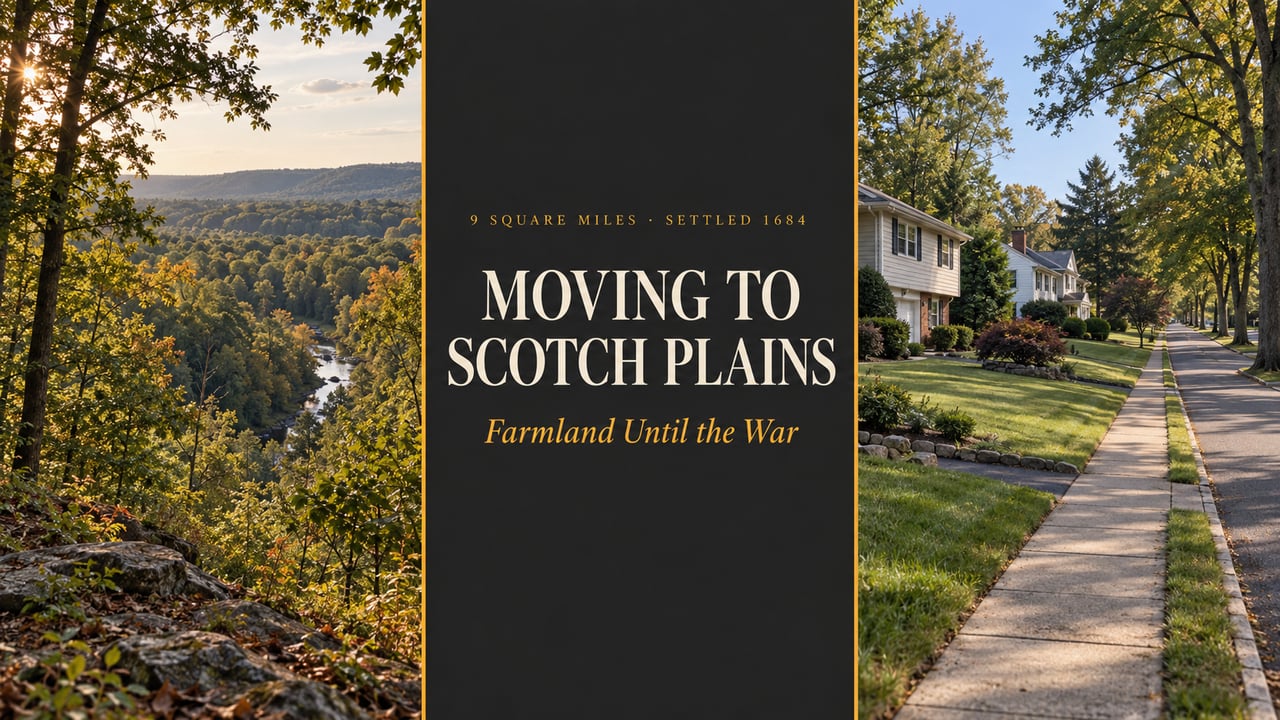
During the Second World War, Scotch Plains was a rural township of four thousand five hundred people. By 1953 it held ten thousand. Today it holds roughly twenty-five thousand. Almost everything you will tour here was built inside a twenty-year window on what used to be farmland — and that single fact explains the divide that governs this entire real estate market.
Nine square miles at the base of the Watchung Reservation, settled in 1684, rural until the war, then built out fast. The postwar wave landed disproportionately on the south side, and that asymmetry is why one set of train tracks still splits this market in two. The median runs near $895,000 at roughly 104% of list in 33 days. The township has no station of its own — Fanwood and Westfield serve it, on the Raritan Valley Line, not Midtown Direct. And the first township-wide revaluation in roughly four decades certifies in January 2027, which means anyone modelling the cost of living here should be modelling 2027, not 2026.
This is the overview. The detail sits in the pieces linked throughout — the north-south divide, the tax and revaluation mechanics, the school zones, the architecture, the downtown redevelopment. Figures are point-in-time and every parcel is different; verify anything you intend to rely on with the Township and your own professionals.
The name is literal. In 1684 and 1685 the village was settled by Scottish immigrants who had landed at Perth Amboy under the leadership of George Scot — as the Township's own history puts it, "thus we were Scot's Plains." Before that the land belonged to the Raritans, of the Leni Lenape branch of the Delawares, whose village stood near what are now the Shackamaxon and Ash Brook golf courses. Captain John Baker bought the region before 1684, paying one cent for every ten acres.
And here is the detail that reframes the whole town for a buyer. In those early days Scot's Plains was part of West Fields — later Westfield — which was itself part of Elizabethtown. The township everyone now compares against Westfield was Westfield. It later developed as a stagecoach stop between New York and Philadelphia, which is why the historic buildings sit where they do.
During the Second World War — still mainly a rural town of 4,500. Nine hundred residents served; fourteen did not return.
By 1953 — 10,000 people, with school enrolment already doubled.
The 1950s and 60s — the biggest growth, especially on the south side, where large housing developments replaced tracts of farmland.
The schools built to keep up — Shackamaxon, Evergreen, Brunner, Coles, Terrill Middle, McGinn and a new School One. A new high school went up; the old one became Park Middle School.
Today — roughly 25,000 residents across 9.0 square miles.
The postwar wave landed unevenly — heavily on the south side, on former farmland, with larger parcels and newer stock. The north retained the older, denser pattern around the downtown and the rail corridor. That asymmetry did not fade; it hardened into two distinct markets that behave differently and must be comped separately. Our north–south divide analysis is the single most important thing to read before you shop here — comping a north-side house against south-side sales is the most common and most expensive mistake made in this township.
And the older layer survived the building boom. The Scotch Plains Baptist Church stands in the heart of downtown, its cemetery holding the original settlers and twenty-four Revolutionary War soldiers. The Frazee House and the Osborn Cannonball House still stand. Two historic districts run through the township, and we mapped them in our historic districts guide.
NJMLS data through April 2026 puts the township median around $895,000, up roughly 8% year over year, at a median 33 days on market, with active list pricing pushing toward $975,000. The sale-to-list ratio runs near 104%, and in competitive windows three of four homes have traded above asking.
The supply side is what distinguishes Scotch Plains from its neighbours. Unlike towns where lot sizes are tight and teardown economics do not pencil, Scotch Plains still has parcels where builders can go big — and they do. New construction lands between $950,000 and $1.4 million, with custom builds beyond; a 2025 estate on nearly an acre ran past 15,000 square feet. But acreage on a tax card is not acreage you can build on — our usable acreage analysis shows two identically-sized lots trading $250,000 apart on topography alone.
Scotch Plains is undergoing its first township-wide revaluation in roughly four decades. Professional Property Appraisers, Inc. was contracted; letters went to every owner on December 29; inspections are underway. New values certify to the Union County Tax Board on January 10, 2027, with appeals due by May 1, 2027.
The scale is unusual. The 2026 county equalization table puts Scotch Plains at an aggregate assessed value of $1.04 billion against an aggregate true value of $6.66 billion — a gap of $5.62 billion. The 2025 certified general rate is $12.350 per $100, which looks extreme only because assessments sit at a fraction of market; the effective rate is 2.138%, and the 2026 Chapter 123 ratio has since fallen to 15.65%.
A revaluation is revenue-neutral for the township and emphatically not neutral for individual owners. Owners whose homes have appreciated faster than the township average are most exposed; owners of older, less-renovated property may see relative relief. Model a 2027 carrying cost, not a 2026 one. The mechanics are in our tax and revaluation breakdown, with the county picture in our Director's Ratio map.
And downtown is being rebuilt while all of this happens. A nine-acre redevelopment along the Park Avenue and Bartle Avenue corridor is under way under Woodmont Properties' conditional designation, with a four-storey height cap. The redevelopment lifts north-side values; the revaluation then captures those higher values into new assessments. That interaction is covered in our Park Avenue rebuild analysis.
Start with the one almost no guide to this township mentions. The Township's own profile records that Shady Rest at Scotch Hills Golf Course contains the first African-American country club in the nation, and that its golf professional, John Shippen, was the first American-born professional golfer to enter the U.S. Open Championship.
That is a piece of national history sitting inside a nine-square-mile Union County township, and it is on a municipal golf course you can play. Buyers relocating from New York consistently arrive not knowing it is here. It deserves to be the first thing said about Scotch Plains rather than a footnote below the school ratings.
Watchung Reservation — 1,945 acres, the largest nature reserve in Union County, running through the upper valley of Blue Brook between the First and Second Watchung Mountains, with Lake Surprise behind a dam near the headwaters. Trails for hiking and horseback riding; biking on the trails is not permitted. Scotch Plains sits at its base.
Shackamaxon Country Club and Ash Brook Golf Course — on ground where the Raritans' village once stood.
Shady Rest at Scotch Hills — the John Shippen course.
The Fanwood-Scotch Plains YMCA and the Jewish Community Center of Central Jersey.
The Frazee House, the Osborn Cannonball House and the Scotch Plains Baptist Church, whose cemetery holds twenty-four Revolutionary War soldiers.
The Reservation has its own history worth knowing. In 1882 Warren Ackerman bought the property and turned it into a summer resort called Glenside Park, offering golf, boating and horseback riding — a mountain retreat for city people, until the Jersey Shore took that trade away. What remains is nearly two thousand acres of protected woodland at the edge of a commuter township, and it is genuinely uncommon. The trails, Lake Surprise, the Watchung Stables, the Trailside Nature & Science Center and the Deserted Village of Feltville are covered in full in our Watchung Reservation guide.
One caution that belongs beside the amenity, because both are true. The Watchung topography that produces the woodland also produces slope, and slope reduces buildable footprint. Our usable acreage analysis puts it bluntly: two lots can carry identical one-acre designations and trade $250,000 apart, and none of that arithmetic shows up on the tax card. Buy the view, but price the ground.
2026 is not a normal year here. It is the last year before every assessment in the township is reset.
In a market clearing near 104% of list in 33 days, the wrong list price still sits for ninety days while the right one clears in twenty. We comp within your side of the tracks and your architectural category rather than against a township median, price ahead of the January 2027 certification rather than behind it, and treat your current tax line as the marketing asset it is while it still is one. Backed by the New York metro buyer pool we bring to every listing.
Nine square miles with parcels that still support serious building, at a median well below Westfield or Summit, with 1,945 acres of protected reservation at the northern edge. If space and greenery are what you are buying, this is the township in the corridor that still has them.
Scotch Plains has no station. Fanwood and Westfield serve it — on the Raritan Valley Line, not Midtown Direct, so peak trains generally mean a Newark transfer. And Fanwood charges Scotch Plains residents $650 a year against $350 for its own residents, releasing permits to Fanwood first. None of that is a dealbreaker; all of it should be priced before you offer. Full detail in our Scotch Plains commute guide — and note the inversion most buyers miss: on effective tax rate Fanwood runs 2.251% against Scotch Plains' 2.138%, so the borough charging you more to park also taxes its own residents harder. Our Scotch Plains and Fanwood comparison covers it.
Scotch Plains-Fanwood is a regional district now moving to a PreK-5 / 6-8 / 9-12 structure, phased over several years. The grade configuration your child experiences depends on their entry year, and catchments are address-specific. Our schools deep-dive and elementary zone analysis cover both. Verify the catchment for your exact address with the district.
A revaluation certifying in January 2027 and a nine-acre downtown rebuild are happening simultaneously. The seller's current tax line is not the tax line you will inherit, and the walkability you are pricing today is not the walkability the property will have in three years. Both cut in your favour if you model them and against you if you do not.
Four things to do before you offer, in this order. Establish which side of the tracks the house is on and insist on a comp set restricted to that side. Model the 2027 carrying cost, not the current one. Check the buildable footprint if the lot is anywhere near the Watchung slope. And drive to both Fanwood and Westfield at your real departure hour and try to park.
If you are selling instead, the same transition works the other way, and the full playbook is in our 2026 seller's guide and our note on selling before the revaluation.
Ask any agent showing you Scotch Plains one question: which side of the tracks is this, and can I see comps only from that side? The township's postwar growth landed disproportionately on the south side, on former farmland, and the north kept the older, denser pattern around the downtown. Seventy years later they are still two different products with two different buyer pools, and the most common expensive mistake made here is comping across the line. An agent who hands you a township-wide comp set is handing you a number that describes neither house. One question, asked at the first showing, and it tells you whether the person you are working with knows this town or just sells in it.
"Scotch Plains was four and a half thousand people during the war and ten thousand by fifty-three. The whole town you're touring got built in about twenty years, mostly on the south side where the farms were. That's not a history lesson — that's why the north and the south are still two different markets, and why comping across the tracks is the most expensive mistake people make here. Two other things I'd want a buyer to know. Shady Rest at Scotch Hills has the first African-American country club in the country, and John Shippen — first American-born pro to enter the U.S. Open — was the golf pro there. That's national history on a municipal course. And the town is being revalued for the first time in about forty years, certifying January twenty-seven. So whatever tax number the seller shows you, that's not your number."
— Anthony Licciardello, Broker, The Prodigy Team

Scotch Plains' 2026 buyer pool comes in large part from New York City and Hudson County, and that is the market I work: I'm Anthony Licciardello, Broker of The Prodigy Team, dual-licensed in New York and New Jersey, a former Director of Community Affairs in the Bloomberg Administration, and a leading broker for cross-border New York–New Jersey transactions.
Anthony Licciardello · Broker, The Prodigy Team · 718-873-7345
We comp within your side of the tracks and model the 2027 carrying cost — before you offer.
What is Scotch Plains, NJ like?
A Union County township of roughly 25,000 residents across 9.0 square miles, sitting at the base of the Watchung Reservation. Settled in 1684 by Scots who landed at Perth Amboy under George Scot, it was long part of West Fields — later Westfield — and developed as a stagecoach stop between New York and Philadelphia. It remained rural until the war, holding about 4,500 people, reaching 10,000 by 1953 and its current size through the 1950s and 60s, with the biggest growth on the south side where developments replaced farmland.
How much do homes cost in Scotch Plains?
NJMLS data through April 2026 shows a township median sale price of approximately $895,000, up roughly 8% year over year, at a median 33 days on market with active list pricing pushing toward $975,000; the sale-to-list ratio runs near 104%. New construction lands between $950,000 and $1.4 million. But the township median describes neither side of the tracks — north and south are distinct markets and must be comped separately.
How do you commute from Scotch Plains to New York?
Scotch Plains has no station of its own. Residents use Fanwood or Westfield on the Raritan Valley Line — not Midtown Direct, which is a Morris & Essex service. RVL peak trains generally require a transfer at Newark; one-seat service runs mainly off-peak. Fanwood's annual permit is $350 for its own residents and $650 for Scotch Plains residents, released to Fanwood first. NJ Transit bus 114 runs to the Port Authority and 95 to Newark. Route 22, I-78 and the Parkway serve drivers.
What is happening with Scotch Plains property taxes in 2027?
The township is undergoing its first municipal-wide revaluation in roughly four decades. New values certify to the Union County Tax Board on January 10, 2027, with appeals due by May 1, 2027. The 2026 equalization table puts aggregate assessed value at $1.04 billion against $6.66 billion true value. A revaluation is revenue-neutral for the township but not for individual owners — those whose homes appreciated fastest are most exposed. Model a 2027 carrying cost, not a 2026 one.
Scotch Plains Crossing — The First Delivery, and Two Months Free
Buying in Scotch Plains — Four Things Your Competition Doesn't Know
The North–South Divide — Why One Set of Tracks Splits the Market
The Scotch Plains Commute — You Pay More and You Go Second
Property Taxes 2026 — Rates, Budget and the 2027 Revaluation
The Scotch Plains-Fanwood Schools Deep-Dive
Inside the Five Elementary School Zones
Colonial vs. Split-Level vs. Ranch — What Each Style Commands
The Park Avenue Rebuild — The 9-Acre Downtown Redevelopment
The Two Historic Districts — Frazee, Cannonball, Kramer Manor
Usable Acreage — Why Topography Costs Sellers Five Figures
Selling a Home in Scotch Plains — The 2026 Playbook
The Watchung Reservation — Trails, Lake Surprise & the Deserted Village
Scotch Plains Homes for Sale — Browse Current Listings
Details as of publication, from the sources noted, and subject to change. History and township profile per the Township of Scotch Plains' published History and Township Profile pages: a population of nearly 25,000 across just over 9 square miles at the base of the Watchung Reservation; the area first settled in 1684, with the native Raritans of the Leni Lenape branch of the Delawares living in a village near what are now the Shackamaxon and Ash Brook golf courses; Verrazano in the region around 1524, the Dutch claim of 1609 following Henry Hudson's explorations, Peter Sonmans holding the heartland until the English conquest of 1664, and Captain John Baker purchasing the region before 1684 paying one cent for every ten acres; settlement in 1684 and 1685 by Scottish immigrants who landed at Perth Amboy under George Scot, "thus we were Scot's Plains"; Scot's Plains forming part of West Fields, later Westfield, itself part of Elizabethtown; development as a stagecoach stop between New York and Philadelphia; a wartime population of about 4,500 with 900 residents serving and 14 lost; 10,000 residents by 1953 with school enrolment doubled; the largest growth in the 1950s and 1960s especially on the south side where large housing developments replaced farmland, prompting construction of Shackamaxon, Evergreen, Brunner, Coles, Terrill Middle School, McGinn and a new School One, with a new high school built and the former high school becoming Park Middle School; and 24,405 residents recorded in 2018. Per the Township Profile, recreational amenities include part of the Watchung Reservation in the north, Shackamaxon Country Club, Ash Brook Golf Course, and the Shady Rest at Scotch Hills Golf Course, which the Township states contains the first African-American country club in the nation, and whose golf professional John Shippen was the first American-born professional golfer to enter the U.S. Open Championship; the Scotch Plains Baptist Church stands in the heart of downtown with original settlers and twenty-four Revolutionary War soldiers buried in its cemetery; the Frazee House and Osborn Cannonball House are named among the township's historic properties; and the Fanwood-Scotch Plains YMCA and the Jewish Community Center of Central Jersey are listed among community organisations. Watchung Reservation: 1,945 acres, the largest nature reserve in Union County, governed by the Union County Parks Department, consisting mainly of the upper valley of Blue Brook between the ridges of the First and Second Watchung Mountains, with a dam near the headwaters creating Lake Surprise; the reservation spans Summit, Mountainside, Berkeley Heights, Scotch Plains and Springfield; trails are popular with hikers and horseback riders and biking on the trails is not permitted; in 1882 Warren Ackerman bought the property and converted it to a summer resort called Glenside Park offering golf, boating and horseback riding. Market and tax figures are drawn from our own Scotch Plains analyses and their cited sources: an NJMLS township median sale price of approximately $895,000 through April 2026 with roughly 8% year-over-year appreciation, a median 33 days on market and median active list pricing toward $975,000; a sale-to-list ratio near 104%; new construction between $950,000 and $1.4 million; a 2025 certified general tax rate of $12.350 per $100 with a certified effective rate of 2.138% derived from the 2025 ratio of 17.31%, and a 2026 Chapter 123 ratio of 15.65%; a 2026 county equalization table showing aggregate assessed value of $1.04 billion against aggregate true value of $6.66 billion; and a town-wide revaluation contracted to Professional Property Appraisers, Inc. effective for Tax Year 2027, with notification letters mailed December 29, values certifying to the Union County Tax Board January 10, 2027 and appeals due May 1, 2027. Household income, per-capita income, median age, household composition and religious composition data available for this municipality have been deliberately excluded, as we exclude such material for every community we cover; no school performance rankings or ratings are published here, and the Township's own promotional characterisations of school quality are not reproduced. Medians and averages are not appraisals and describe populations of transactions rather than any individual property; the township median describes neither side of the north–south divide. Tax bills, assessments, buildable footprint, school attendance assignments, permit availability and transit schedules must be verified for any specific property. This is general information and market commentary, not legal, tax, or investment advice — verify all current details with the Township of Scotch Plains, the Scotch Plains-Fanwood school district, NJ Transit and your own professionals before buying or selling.
Prodigy Real Estate is an innovative real estate company offering high-end video production, home valuation services, purchasing, and home sales. Serving New York and New Jersey.