
Anthony Licciardello | April 29, 2026
Scotch Plains, NJ
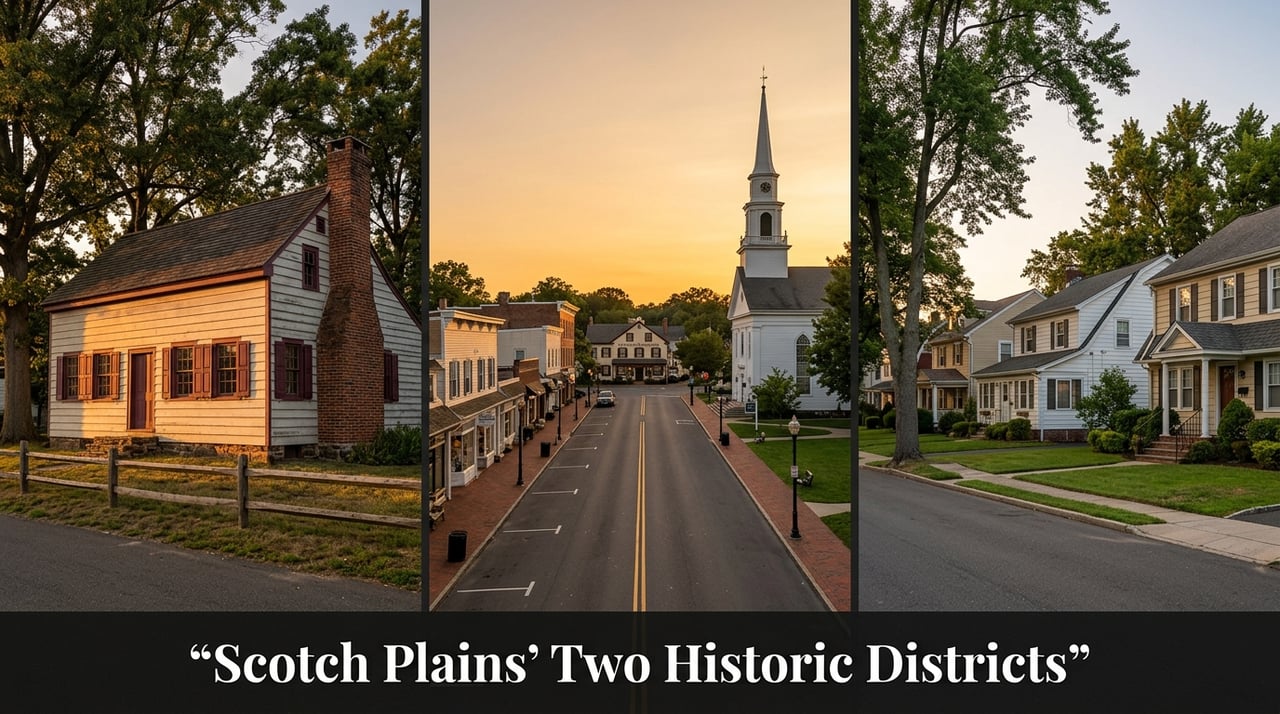
Scotch Plains was settled by European Quakers in the late 17th century and developed as a stagecoach stop on the Swift-Sure line running between New York and Philadelphia.1 By the time of the American Revolution, the township already had working farmhouses, an active Baptist meeting house, and the kind of crossroads commerce that put it directly in the path of military movement during the Battle of Short Hills in June 1777. That history is not abstract. Three of the original buildings still stand. Two are operated as museums. One sits inside a still-occupied residential neighborhood that the New Jersey Black Heritage Trail formally added in 2024.
The Historical Society of Scotch Plains and Fanwood maintains formal map boundaries for two distinct heritage areas in the township: the Scotch Plains Downtown Historic District and the Scotch Plains Southside Historic District.2 Neither of these is on the National Register as a contiguous district — though specific buildings within them are — but both function as recognized heritage corridors that shape buyer perception, photography, and pricing in measurable ways. This post is the third installment in Prodigy's twelve-part Scotch Plains series. It maps the township's pre-Revolutionary housing stock, the two historic districts, the structural buildings that anchor them, and what owning a heritage-adjacent home actually means in 2026.
The Frazee House at 1451 Raritan Road, near the intersection with Terrill Road, was built somewhere between 1720 and 1740 — predating the United States itself by half a century.3 The house is listed on both the National Register of Historic Places and the New Jersey Register of Historic Places, and in 2000 was named to PreservationNJ.org's list of New Jersey's ten most endangered historic places. The Fanwood-Scotch Plains Rotary Club has overseen its restoration since 2004.
Its place in American Revolutionary history is specific. During the Battle of Short Hills in June 1777, British troops under General Cornwallis arrived at the Frazee farm. Elizabeth "Aunt Betty" Frazee was a known prolific baker. Confronted by Cornwallis demanding her freshly baked bread, she refused him outright. The exchange entered local folklore and is the basis for the John Fazio film documenting the property's role in the broader Battle of the Short Hills, which ultimately allowed the bulk of Washington's forces to retreat to the safety of the Watchung Mountains. The Frazee House is currently under active restoration and is not open for interior tours, though the exterior is accessible to the public.
The Osborn Cannonball House at 1840 Front Street, built circa 1750-1760, takes its name from a single moment during the Battle of Short Hills: a colonial artilleryman misfired his cannon at pursuing British troops, and the shot struck the side of the Osborn family home.4 The house has been continuously occupied or maintained since the 18th century, was leased to the Historical Society of Scotch Plains and Fanwood by the Township in 1972, and operates as a museum today.
The construction itself is the artifact. The Osborn House was built with wooden pegs rather than iron nails, plaster made of crushed oyster shells reinforced with animal hair, and brick-filled walls between low ceilings and short doors — all standard methods for the period, all rare to find still standing. The building sits inside the Downtown Historic District corridor along Front Street and Park Avenue, directly across from the Stage House Restaurant, another c.1700s commercial structure that operated as the Stage House Inn during the Swift-Sure stagecoach era.
The Scotch Plains Downtown Historic District as mapped by the Historical Society spans the central commercial and civic corridor of the township — primarily Park Avenue and East Front Street — and includes the Osborn Cannonball House, the Stage House Inn, and the Scotch Plains Baptist Church. The Baptist Church cemetery contains the graves of the township's original European settlers and twenty-four Revolutionary War soldiers. The church itself is one of the oldest continuously-operating Baptist congregations in New Jersey, founded by the same families that built the homes now standing as museums.
For real estate purposes, the Downtown Historic District is the corridor most directly affected by the Woodmont Properties redevelopment program covered in the North-South pillar analysis. Properties immediately surrounding Park Avenue and Front Street are simultaneously inside the township's most actively redeveloping zone and adjacent to its oldest preserved buildings — an unusual combination that creates real questions for buyers about how a 21st-century four-story mixed-use scheme will sit alongside an 18th-century farmhouse-museum and a colonial-era cemetery. The Township has stated its intent to preserve historic scale and character throughout the redevelopment, but the specific design treatments along sightlines from the Cannonball House and the Baptist Church are decisions that remain in active planning review.
The Scotch Plains Southside Historic District covers the southern portion of the township and contains two of the most historically significant sites in New Jersey African-American history. The Shady Rest at Scotch Hills Country Club was established in 1920 as the first African-American golf and country club in the United States.5 Its first golf professional, John Matthew Shippen Jr., was the first American-born professional golfer to enter the U.S. Open Championship. The club hosted Ella Fitzgerald and Duke Ellington during its prime decades and continues to operate today as a public 9-hole golf course with a historic clubhouse originally built as a 1700s farmhouse.
Kramer Manor, a residential neighborhood of approximately one hundred households just outside the Shady Rest property, marked its centennial in 2024 and was added to the New Jersey Black Heritage Trail in the same year.6 For the majority of its hundred-plus year history Kramer Manor stood as an all-Black residential enclave; it now operates as a multicultural community of single-family homes. The Heritage Trail designation is administered by the New Jersey Department of State and creates formal recognition of the neighborhood's role in the state's African-American history. The trail designation does not impose preservation restrictions on individual homes — owners retain standard zoning rights — but it does formally elevate the neighborhood's status in the state's cultural infrastructure.
For buyers, Kramer Manor sits at an unusual intersection: a residential neighborhood with formal heritage recognition, walkable proximity to the Shady Rest, and pricing that has historically tracked the broader South Side of the township rather than carrying a heritage premium. Whether that gap closes in coming market cycles is one of the more interesting structural questions in the Scotch Plains pricing conversation.
A house being adjacent to or proximate to a designated historic property is not the same as the house itself being historic. Most of the residential housing stock surrounding both Scotch Plains historic districts was built between 1900 and 1960, with smaller pockets of older Victorian and Eastlake-style homes — including the 1875 Eastlake Victorian referenced by the Historical Society's archives — scattered throughout the central township grid. These are old homes by suburban New Jersey standards but they carry no individual landmark designation, no preservation restrictions, and no special tax treatment.
What heritage adjacency does provide is a different photographic and marketing context. Homes within the Downtown Historic District benefit from sightlines to the Baptist Church, the Cannonball House Museum, and the planned Park Avenue village green redevelopment. Homes in the Southside Historic District benefit from proximity to the Shady Rest and the Frazee House. Listing photography that includes those backdrops — and listing copy that accurately describes the heritage context without overstating it — tends to perform measurably better in days-on-market than identical homes a few blocks away.
For the architectural valuation question more broadly — how Colonial Revival, Victorian, Craftsman, ranch, and split-level housing stock prices against each other in the township — the upcoming architectural premium post in this series will dig into the data. The short version: Colonial and Colonial Revival homes consistently command the highest aggregate prices, mid-century split-levels carry the largest renovation arbitrage opportunity, and aggressively modern architecture has historically struggled on resale in this specific market.
For buyers, the most useful approach to the heritage corridors is to understand what the designation actually does and does not do. A National Register listing on the Frazee House does not confer protection on neighboring properties. A Black Heritage Trail designation on Kramer Manor does not restrict what individual homeowners can do with their houses. The heritage context affects neighborhood character, marketing, and long-term identity — not zoning, taxes, or renovation rights for adjacent owners.
For sellers in or near either historic district, the marketing case is genuine but specific. Sellers who lean into accurate heritage language — "two blocks from the Osborn Cannonball House Museum," "inside the Southside Historic District corridor," "walking distance to the Scotch Plains Baptist Church and cemetery" — are providing buyers real, verifiable context. Sellers who use vague heritage language — "historic charm," "old-world feel" — are leaving value on the table. Pricing strategy should still follow the disciplined comp set rules covered in the pillar post and the Scotch Plains seller certificate checklist, with the heritage context as marketing context rather than a price multiplier. The pre-closing inspection requirements identified in the Scotch Plains seller mistakes guide apply identically to heritage-adjacent properties.
Buyers relocating from out of state should also understand that the township's Revolutionary War heritage is part of an active 250th-anniversary commemoration program, which the Township has formally branded "Scotch Plains Revolution 250" alongside the federal Semiquincentennial. That program will run through 2026 and into 2027, and will produce additional public-facing events at the Cannonball House, the Frazee House, and the Stage House Inn corridor. For broader migration context, the NYC-to-New Jersey relocation breakdown covers the macro patterns driving 2026 demand. For the alternative Raritan Valley Line corridor, the Cranford NJ market report provides the closest peer comparison.

Prodigy Real Estate is an innovative real estate company offering high-end video production, home valuation services, purchasing, and home sales. Serving New York and New Jersey.