
Anthony Licciardello | August 2, 2026
Scotch Plains, NJ
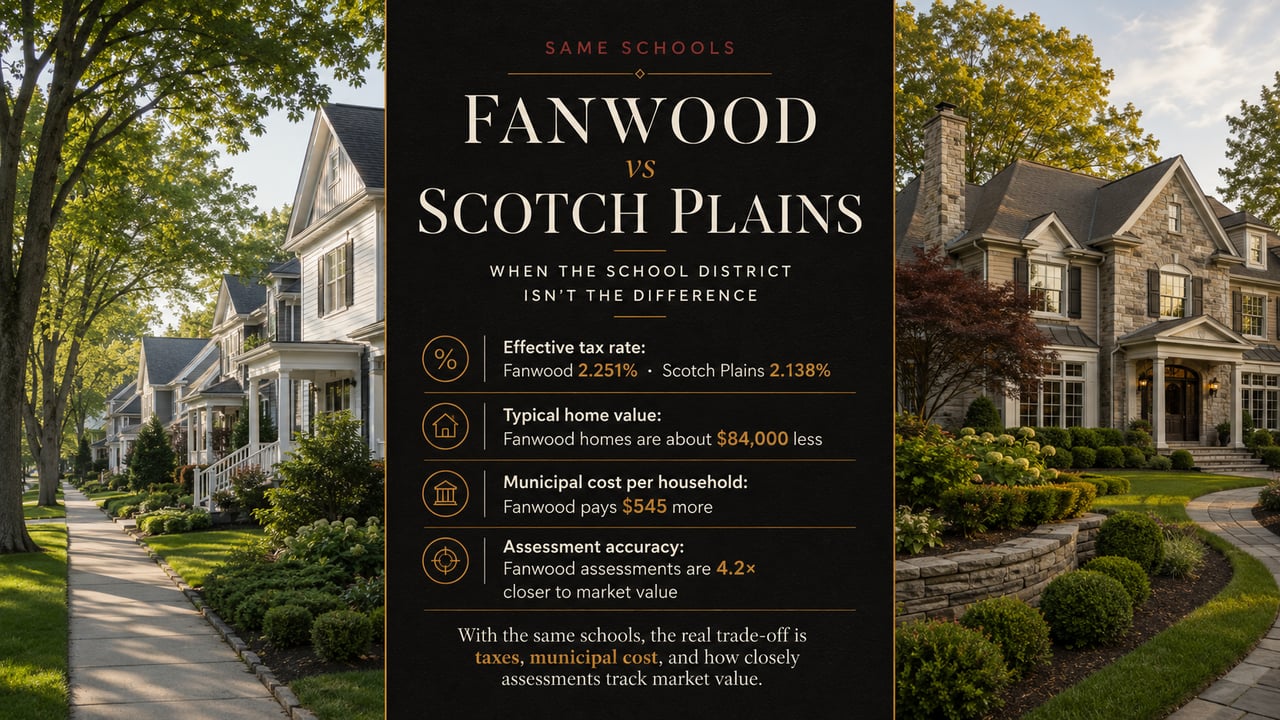
These two towns send their children to the same schools. So the usual comparison — which district is better — doesn't apply, and what's left is a genuinely interesting question. The certified county records answer it, and one of the answers runs backwards from what everyone assumes.
Scotch Plains and Fanwood share the Scotch Plains-Fanwood Regional School District, which removes the single biggest variable in most New Jersey town comparisons. What remains is a choice between two genuinely different propositions, and the certified 2025 county records make the trade explicit. Fanwood carries the higher effective tax rate — 2.251% against Scotch Plains' 2.138% — on homes worth roughly $84,000 less. Its bills are smaller in absolute terms ($14,758 against $15,818) only because its houses are smaller. It pays $545 more per household for municipal services, the diseconomy of a borough one-third the size. And its assessments sit 4.2 times closer to market value, meaning a Fanwood tax line means something and a Scotch Plains one currently doesn't. So the real question isn't which town is cheaper. It's whether you want a walkable station and predictable numbers on a smaller house, or land, scale, a lower rate and an assessment that will eventually be corrected.
Most town comparisons in New Jersey are really school comparisons wearing a disguise. Take that variable away and the conversation gets more honest — and more useful. Every figure below comes from the certified 2025 Abstract of Ratables filed by the Union County Board of Taxation, which applies identical methodology to both municipalities in the same document. For the internal geography of the larger town, start with our pillar on the Scotch Plains North–South divide.
An automated estimate reads your assessment — and in Scotch Plains that number sits at roughly 17% of market value. Across the line in Fanwood it’s near 72%. The same tool is wrong in two completely different ways. See what yours is actually worth →
The regional district is the dominant line on both towns' tax bills. In Fanwood it accounts for $9,243 of a $14,758 average bill — 62.6%. In Scotch Plains it accounts for $10,538 of $15,818 — 66.6%. Two-thirds of what a household in either town pays goes to a system both towns share.
The $1,295 difference isn't unfairness — it's apportionment. A regional district's cost is divided between its member municipalities by equalized valuation, so the town with more total property value carries more of it. Scotch Plains is roughly three times the size of Fanwood by residential parcel count, and its households are individually worth more, so it carries the larger share both in aggregate and per household.
What this means practically is that the school question is settled before you choose. A family weighing these two towns is not choosing between districts. They are choosing between a borough and a township that happen to educate their children together — which makes everything else on the comparison sheet unusually load-bearing.
Compare the two general tax rates and Scotch Plains looks catastrophic: $12.350 per $100 against Fanwood's $3.120 — nearly four times higher. That comparison is meaningless, because the two rates are applied to completely different bases. Fanwood assesses at 72.16% of market value; Scotch Plains at 17.31%.
Normalise both to market value — which is exactly what the state publishes the effective rate to do — and the ranking flips. Fanwood's effective rate is 2.251%. Scotch Plains' is 2.138%. The borough with the low-looking headline rate is the one taxed more heavily per dollar of property value.
Fanwood's bills are still smaller — because its houses are. Divide each town's average bill by its effective rate and you get the implied average home value: roughly $655,600 in Fanwood against $739,900 in Scotch Plains, a gap of $84,231, or 12.8%. Fanwood households pay $1,060 less a year on property worth $84,000 less at a higher rate. All three of those facts are true simultaneously, and quoting any one without the others produces a misleading comparison.
This is the same trap we work through in our Union County ratio map, where nineteen of twenty-one municipalities sit below the state's 85% compliance threshold. Never compare New Jersey towns on the general rate. It is the most quoted and least useful number in the state.
General and effective tax rates per the certified 2025 Abstract of Ratables, Union County Board of Taxation, certified December 31, 2025. Equalization ratios of 72.16% (Fanwood) and 17.31% (Scotch Plains) explain the entire gap between the two charts. The ordering reverses — that reversal is the point.
Fanwood pays more for municipal services — $2,885 per household against Scotch Plains' $2,340. That is $545 more a year for police, public works, administration and the rest, in a borough with 2,477 residential parcels against the township's 7,413. It is the arithmetic of small municipalities: the same functions divided among fewer households.
What Fanwood gets for it is walkability. Its station sits in the middle of the borough, and the borough is small enough that a large share of it is genuinely within walking distance. Scotch Plains, for all its size, has no station of its own — its residents use Fanwood's or Westfield's. That is the clearest single thing the extra $545 buys, and for a rail commuter it may be the whole decision.
One thing both towns share is an unusually exposed tax base. Residential property makes up 91.95% of Fanwood's ratables and 91.55% of Scotch Plains' — the two most residential municipalities in Union County. Neither has meaningful commercial ratable to absorb budget growth, so in both towns homeowners carry essentially the entire levy. When a school or municipal budget rises in either place, there is nobody else to spread it across.
Distribution of property taxes for the average residential property per the certified 2025 Abstract of Ratables, Union County Board of Taxation. Components shown are the three largest; library and open space levies account for the remainder in both municipalities. Note that Fanwood's municipal share is larger both proportionally and in absolute dollars despite serving roughly one-third as many residential parcels.
Fanwood offers walkability and predictability. A station in the middle of a small borough, and assessments sitting at 72.16% of market value — 4.2 times closer than Scotch Plains'. When you look at a Fanwood listing, the tax line broadly reflects what the house is worth. What you give up is size: smaller lots, smaller houses, and roughly $84,000 less in average value.
Scotch Plains offers land, scale and a lower effective rate — plus a market where new construction is now the dominant force at the top, as our analysis of lot size versus new construction sets out. What you take on is an assessment roll at 17.31% of market in a township that has announced it is preparing a revaluation. That correction is coming, and it will land unevenly — our seller positioning guide works through who is most exposed.
And for a commuter the choice may be simple. Fanwood's station is walkable from much of the borough. Scotch Plains has none, so its residents drive to Fanwood or Westfield and park. If you take the train five days a week, that difference compounds into something the tax comparison never captures — and it is worth more than $545 a year to a lot of households.
A station inside a small borough is something Scotch Plains structurally cannot offer. Five days a week, that's the whole argument.
Assessments at 72.16% of market mean the listing figure broadly reflects reality. No large correction sitting in the future.
Larger lots, larger houses, roughly $84,000 more in average value, and a genuine top tier reaching past $2.9 million. Fanwood has no equivalent.
The teardown-and-rebuild market is concentrated there. Model your carrying cost at the effective rate, not the listing's tax line.
Both towns fund the Scotch Plains-Fanwood Regional district, and it accounts for roughly two-thirds of the average bill in each. That variable is settled before you choose.
All figures per the certified 2025 Abstract of Ratables, Union County Board of Taxation. Averages describe entire residential classes and no representation is made about any individual property. Confirm current figures with each municipal assessor.
When you're comparing a Fanwood listing against a Scotch Plains one, don't compare the tax lines — compare assessment divided by asking price on each. In Fanwood that fraction will land near 0.72, and the bill you're shown is broadly the bill you'll keep paying. In Scotch Plains it will land near 0.17, which tells you the number on the sheet reflects a valuation from a very different market. Two listings, two tax figures, and only one of them is currently telling you the truth about what the house costs to hold.
"Families come to me having already decided Scotch Plains is the 'better' town and Fanwood is the fallback. Same schools. Same train line. Fanwood actually taxes you harder per dollar, and it's the one where the tax bill on the listing is real. I'm not saying pick Fanwood — I'm saying stop treating this as a step down. It's a different trade, and for a rail commuter it's frequently the better one."
— Anthony Licciardello, Broker, The Prodigy Team
We work both sides of this municipal line and read the certified county records before advising on either. I'm Anthony Licciardello, Broker of The Prodigy Team, dual-licensed in New York and New Jersey, a member of the Staten Island Growth Management Task Force, and a former Director of Community Affairs in the Bloomberg Administration.
Our Above the Streets cinematic drone series extends that reach — aerial storytelling that markets entire towns rather than single listings.
Anthony Licciardello · Broker, The Prodigy Team · 718-873-7345
Buyers cross this line constantly and most of them are comparing the wrong numbers. We price from certified county records, explain the carrying cost properly, and market to the New York households shopping this corridor against Westchester.
Do Scotch Plains and Fanwood share a school district?
Yes. Both municipalities fund the Scotch Plains-Fanwood Regional School District, and it is the dominant line on each town's tax bill — 66.6% of the average Scotch Plains bill and 62.6% of the average Fanwood bill. The cost is apportioned between the two towns by equalized valuation, which is why Scotch Plains households contribute $10,538 on average against Fanwood's $9,243 for the same district.
Which has higher property taxes, Scotch Plains or Fanwood?
It depends which measure you mean, and the two point opposite ways. Fanwood's effective tax rate is higher — 2.251% against Scotch Plains' 2.138% — so proportionally its owners are taxed more heavily. But Scotch Plains' average residential bill is larger at $15,818 against $14,758, because its homes are worth roughly $84,000 more. Ignore the general tax rates of $12.350 and $3.120; those apply to assessments at 17.31% and 72.16% of market value and cannot be compared.
Are homes more expensive in Scotch Plains or Fanwood?
Scotch Plains, by roughly 12.8%. Dividing each town's average residential tax bill by its effective rate implies an average home value near $739,850 in Scotch Plains against $655,620 in Fanwood — a gap of about $84,231. Scotch Plains also has a genuine luxury tier reaching past $2.9 million that Fanwood does not, largely driven by teardown-and-rebuild activity.
Does Scotch Plains have a train station?
No. Scotch Plains residents use the Fanwood or Westfield stations on NJ Transit's Raritan Valley Line. Fanwood's station sits within its own small borough, so a meaningful share of Fanwood is genuinely walkable to rail — which is the clearest single thing distinguishing the two towns for a daily commuter, and something the tax comparison does not capture.
Why do Scotch Plains tax bills look so different from Fanwood's?
Because their assessment rolls are in very different states. Fanwood assesses at 72.16% of market value; Scotch Plains at 17.31% — roughly 4.2 times further from market. A Fanwood listing's tax line broadly reflects what the house is worth. A Scotch Plains listing's reflects a valuation from a much earlier period, which is why the township has announced it is preparing a revaluation.
The Scotch Plains North–South Divide — the pillar
Why Scotch Plains' Biggest Lots Aren't Its Biggest Prices
Selling in Scotch Plains Before the Revaluation
Union County Revaluation — 19 of 21 Towns Below Compliance
Usable Acreage — why your tax card is the wrong number
Scotch Plains Homes for Sale
All tax figures per the certified 2025 Abstract of Ratables for Union County, filed by the Union County Board of Taxation and certified December 31, 2025. Fanwood Borough: general tax rate $3.120 per $100, equalization ratio 72.16%, effective tax rate 2.251%, average residential tax bill $14,758 (regional school $9,243; municipal purposes $2,885; county $2,266; county open space $95; municipal library $222; municipal open space $47), 2,477 Class 2 residential line items assessed at $1,171,701,900, residential property 91.95% of the tax base, 1.61% of county taxes. Scotch Plains Township: general tax rate $12.350 per $100, equalization ratio 17.31%, effective tax rate 2.138%, average residential tax bill $15,818 (regional school $10,538; municipal purposes $2,340; county $2,558; county open space $110; municipal library $246; municipal open space $26), 7,413 Class 2 residential line items assessed at $949,434,400, residential property 91.55% of the tax base, 5.45% of county taxes. Implied average home values of approximately $655,620 (Fanwood) and $739,850 (Scotch Plains) are computed as average residential tax bill divided by effective tax rate and describe entire residential classes rather than transacted properties. Regional school costs are apportioned between member municipalities by equalized valuation. Rail service descriptions per NJ Transit; timetables and service patterns change. Averages describe whole municipal classes and no representation is made about any individual property. Rates, ratios and budgets change annually. This is general information, not legal, tax, financial, or educational advice — confirm current figures with the Scotch Plains Township Assessor, the Fanwood Borough Assessor, the Union County Board of Taxation, and a licensed New Jersey professional before relying on any of it.
Prodigy Real Estate is an innovative real estate company offering high-end video production, home valuation services, purchasing, and home sales. Serving New York and New Jersey.