
Anthony Licciardello | April 29, 2026
Scotch Plains, NJ
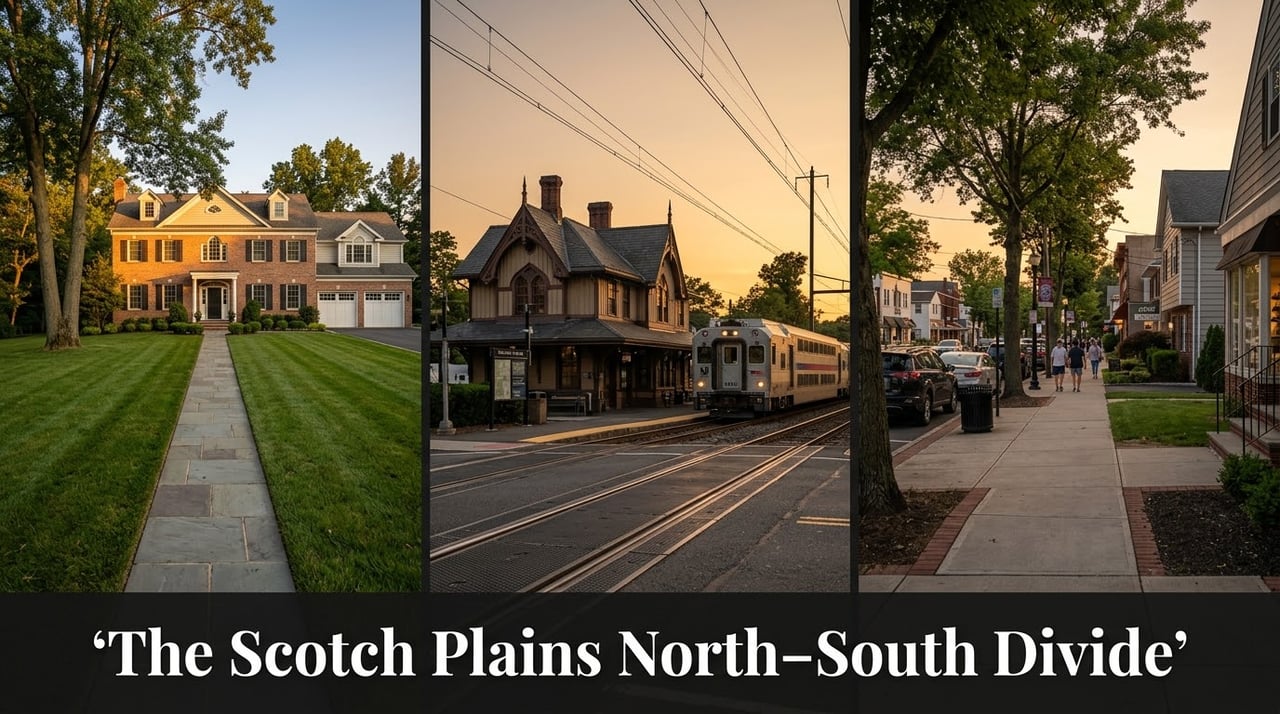
Scotch Plains real estate in 2026 is not one market. It is two — separated by a working set of railroad tracks, a forty-minute walk, and a buyer pool that does not overlap. The Raritan Valley Line cuts horizontally across the township, and on either side of those tracks sit two distinct economies of land, lot size, school feed, and price ceiling. Buyers searching the 07076 zip code see one median number on Zillow and assume the market behaves uniformly. It does not.
Through the trailing twelve months, the township-wide median sale price reached $895,000, an eight-percent year-over-year increase per New Jersey MLS data aggregated by Homes.com.1 Median list prices climbed to $975,000 in April 2026 according to Movoto.2 But pull those numbers apart by side of the tracks and the spread widens dramatically. South Side estate properties have been trading well into seven figures while North Side starter homes still anchor the entry-level market under $700,000. Same town. Same school district. Two pricing ceilings.
This is the first post in a twelve-part Prodigy series mapping Scotch Plains street by street, neighborhood by neighborhood. The pillar piece sets the framework: how the divide works, why it is structural rather than cosmetic, and what it means if you are buying or selling in the township in 2026. To see how Scotch Plains compares against Union County peers at a macro level, the broader 2026 Scotch Plains market report covers township-wide trends, new construction baselines, and absorption.
The dividing line is literal. The Raritan Valley Line runs east-west through the lower third of the township, with the Fanwood station sitting just inside the borough of Fanwood — not Scotch Plains itself. Scotch Plains has no rail station of its own. Every train commuter living in the 07076 either drives or walks to Fanwood Station or to the Westfield Station one stop east. That single piece of infrastructure dictates everything downstream.
More than 23,000 daily commuters depend on the Raritan Valley Line according to the Mayors Alliance representing Scotch Plains, Westfield, Fanwood, and Cranford.3 Mayor Josh Losardo has been actively lobbying NJ Transit for one-seat-ride service to New York Penn Station, which would eliminate the Newark Penn transfer that currently adds twenty minutes to every peak commute. The state of that advocacy — whether commuters get a direct ride or stay locked into the transfer — is currently the single biggest variable hanging over North Side property values.
South of the tracks, the housing fabric changes. Lot sizes step up — commonly half an acre to a full acre, with cul-de-sac estates pushing past two acres in a county where a quarter-acre is standard. The neighborhoods press up against the Shackamaxon Country Club, Ash Brook Reservation, and Ash Brook Golf Course. Garden State Parkway access is faster from this side than from the North.
The buyer profile is different too. South Side buyers tend to be either move-up purchasers from Westfield, Cranford, and Summit who want more land for the same dollar, or relocations from New York City and Hudson County who have already accepted that they will be driving to the train. Land, not transit, is the value driver. The active luxury inventory along Cooper Road, Sunnyfield Lane, and the Ditzel Farm cul-de-sac continues to set the ceiling for what custom-built, sub-acre Union County living costs in 2026 — a tier that will be analyzed transaction by transaction in a later post in this series.
North of the tracks, density goes up and lot sizes come down. Most parcels run under half an acre. Streets are tighter, blocks shorter, and the housing stock skews toward post-war ranches, split-levels, and modest colonials — many of which have been gut-renovated and traded multiple times in the last decade.
The trade-off is access. From most North Side blocks, Park Avenue's downtown commercial strip is a walk, not a drive. Fanwood Station is roughly a twenty-four minute walk from the township center per public transit mapping data, and considerably faster from the streets that branch off South Avenue.4 Scotch Plains-Fanwood High School and Park Middle School both sit on the North Side. So does the Woodmont Properties redevelopment footprint — a nine-acre overhaul of downtown public parcels that the Township Council formally designated in June 2023, with construction now visibly underway.5
That redevelopment matters. North Side homes within a half-mile of Park Avenue are increasingly priced against a future downtown that does not exist yet — the four-story-max mixed-use scheme Woodmont has proposed, plus the Lidl supermarket already pulling permits at Park Avenue per Mayor Losardo's January 2026 council update.6 When the Bartle Avenue, Forest Road, and Park Avenue districts deliver, the walkability premium currently being baked into North Side prices will have something physical underneath it. Today, buyers are paying for the option.
The reason the divide is widening rather than narrowing comes down to land economics. Teardown math still pencils on the South Side because lot sizes carry redevelopment value. A buyer paying $1.1 million for a tired 1960s ranch on three-quarters of an acre is rarely planning to live in that ranch — they are planning the next custom build. North Side teardowns rarely pencil because the lot underneath is not big enough to justify the construction premium.
That single dynamic creates two separate buyer competitions. South Side trades are fueled by builders, custom-home buyers, and trade-up families coming out of Westfield. North Side trades are fueled by first-time buyers from Hoboken, Jersey City, and Brooklyn looking for an entry into the Scotch Plains-Fanwood school district at any cost. As of the most recent NCES data, that district enrolled 5,758 students across eight schools, with William J. McGinn Elementary holding a 2022 US Department of Education National Blue Ribbon designation — the only school in the district to currently carry that recognition.7 Families competing for the McGinn attendance zone have been the dominant force in the $700,000 to $900,000 corridor for two consecutive market cycles.
Both pools are aggressive. They just hit different ceilings. And both are now compressed by the same outside variable: a property tax revaluation that will reshape every assessment in town starting in 2027.
Scotch Plains has not undergone a municipal-wide revaluation in roughly four decades. The Township has contracted Professional Property Appraisers, Inc. to execute a full reset, with field inspections running January through April 2026, completion targeted November-December 2026, and new values certified to the Union County Tax Board on January 10, 2027.8 The appeal deadline for the new assessments is May 1, 2027.
The 2025 certified general tax rate sits at $12.350 per $100 of assessed value — a number that looks extreme in isolation but reflects assessment ratios that have drifted to roughly 17.31 percent of true market value. The effective rate against actual market value works out to approximately 2.14 percent. The full mechanics, the 2026 budget pressure, and the available relief programs are covered in Prodigy's dedicated Scotch Plains property tax and 2027 revaluation breakdown.
What matters for the North-South divide: revaluations are mathematically revenue-neutral for the township, but they are emphatically not neutral for individual owners. South Side estate owners whose homes have appreciated faster than the township average are statistically the most exposed to tax increases. North Side owners of older, less-renovated properties may see relative tax relief. Buyers currently bidding aggressively on either side need to model a 2027 carrying-cost scenario, not a 2026 one. For a Westfield-comparison perspective on what mature reval markets look like, the Westfield NJ property tax breakdown is the closest analogue.
Picking a side is the first decision. It is not a price decision — it is a lifestyle and risk decision that determines which buyer pool you are competing against and which carrying-cost scenario you are inheriting in 2027.
North Side buyers should expect tighter inventory, faster offer windows, and less land per dollar — offset by walking-distance access to downtown, faster routes to the train, and a school-district floor that has held through every market correction in the last fifteen years. South Side buyers should expect wider price bands, more variability in condition, and a stronger relationship between lot size and resale value. Buyers actively migrating from New York to either side should review the broader NYC-to-New Jersey relocation breakdown for the county-level comparison and the Cranford NJ market report for an apples-to-apples Raritan Valley Line comparison.
The single most common pricing mistake in this market is comping a North Side house against South Side sales or vice versa. They are not the same product. Sellers preparing to list in 2026 should ask their broker for a comp set restricted to their side of the tracks, ideally within their own school feed zone. The wrong comp set produces the wrong list price, and overpriced inventory in this market sits while properly priced inventory absorbs in under thirty-three days at NJMLS-tracked medians.
Sellers should also stay ahead of the township's pre-closing compliance requirements — certificates of occupancy, smoke and carbon-monoxide certifications, and any open permit reconciliation needed before closing. Prodigy maintains a township-specific Scotch Plains seller certificate checklist for exactly that purpose, plus a companion piece on the most common Scotch Plains seller mistakes that delay or kill closings.
Over the next several weeks Prodigy will publish eleven additional posts breaking down individual neighborhoods, architectural premiums, school-feed price stratification, and the Park Avenue walkability story in granular detail — each one building on the framework established in this pillar. Coming next: the Homestead and Spruce Mill family corridors, the Woodland Avenue historic-stock arbitrage against Westfield, the Cooper Road / Sunnyfield Lane luxury spine, and a standalone deep-dive on the Colonial-versus-split-level renovation premium that drives so much of the entry-level competition.

Prodigy Real Estate is an innovative real estate company offering high-end video production, home valuation services, purchasing, and home sales. Serving New York and New Jersey.