
Anthony Licciardello | May 8, 2026
Scotch Plains, NJ
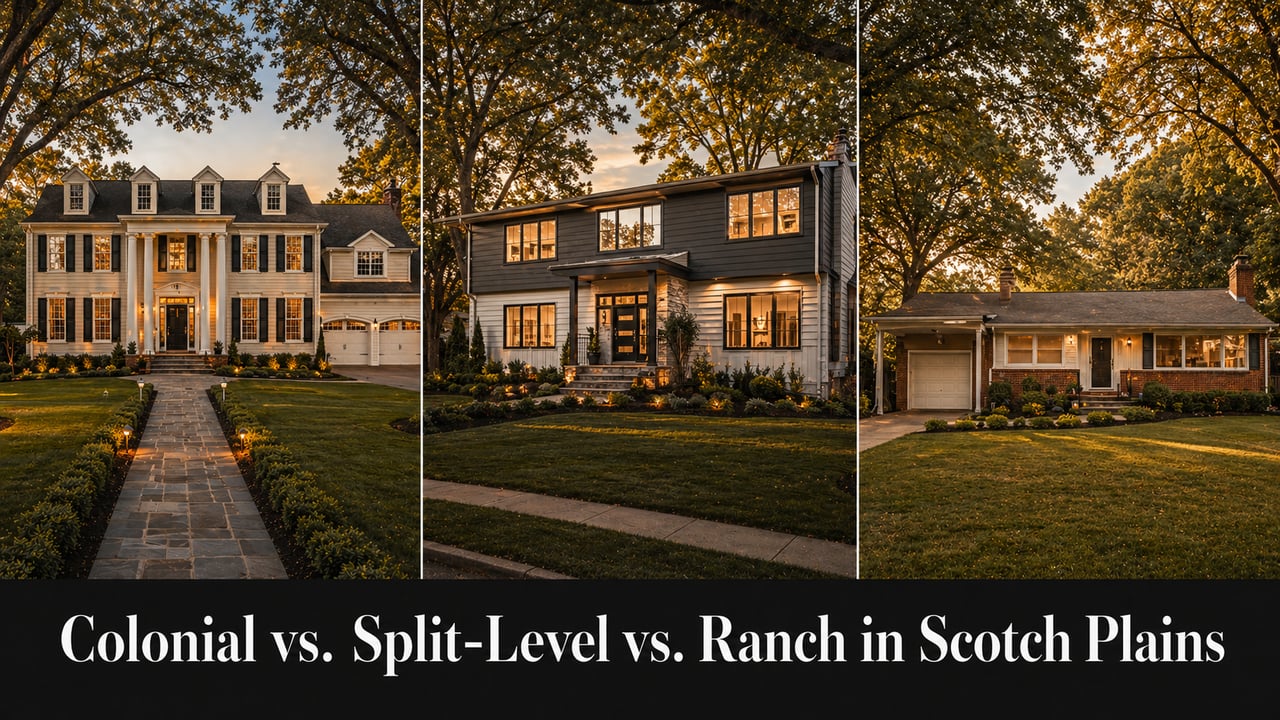
Most New Jersey real estate analysis treats location as the dominant value driver and architecture as a secondary aesthetic preference. In Scotch Plains, that ordering is wrong. Two homes on adjacent lots with identical school feeds can trade at a $700,000 spread — not because the location is different, but because the architecture is. Custom colonials clear the township's highest tier. Renovated mid-century homes sit in the middle. Original ranches and split-levels anchor the entry market. The structure on top of the lot is doing more pricing work than the lot underneath.
The verified comp data covered in the Cooper Road and Sunnyfield Lane corridor analysis demonstrates this directly: a 1952 original ranch on Cooper Road sold for $795,000 in August 2025 while a 2017 custom colonial on the same street closed at $1,750,000 in April 2023. Same street, same school zone, same lot pattern. The colonial premium is not a marketing claim — it's a recorded transaction spread.
This post is the fifth installment in Prodigy's twelve-part Scotch Plains series. It maps the three dominant architectural categories in the township, what each one currently commands, where the renovation arbitrage opportunity lives, and which style has historically struggled on resale despite favorable lot positioning.
The Colonial and Colonial Revival styles consistently command the township's highest aggregate prices. The reason has more to do with floor plan architecture than exterior aesthetics. Modern Scotch Plains buyers — particularly the relocations from New York City and Hudson County identified in the NYC-to-New Jersey relocation breakdown — are buying for entertaining, working from home, and multi-generational living. Two-story center hall colonials deliver the symmetry, the foyer, the sweep of formal living and dining rooms, and the four-to-six bedroom upstairs configurations that map to those uses. Split-levels and ranches do not, structurally.
The current top of the township's market is occupied almost entirely by custom-built colonials in the 4,800 to 5,500 square foot range. Active 2026 listings in the top tier include a 4,800-square-foot renovated colonial with six bedrooms and five bathrooms, a 5,000-plus-square-foot 2019 new-construction colonial with two-story foyer and chef's kitchen, and a 2025-completed 15,000-square-foot custom estate with 17 rooms. The pattern across the entire top-tier inventory: center hall layouts, two-story foyers, attached three-car garages, and lot sizes between half an acre and one acre.
For verified recorded sales rather than active listings, the pattern holds. The closed transactions on the South Side luxury corridor — 1761 Cooper Road at $1,750,000 in 2023, 1751 Cooper Road at $1,646,505 in 2016, 1235 Cooper Road at $1,500,000 in 2018, 1471 Cooper Road at $1,400,000 in 2021 — are all custom colonials. None are split-levels. None are ranches. The architectural skew at the top of the market is structural.
Split-level homes were the dominant new construction product in Scotch Plains during the 1950s and 1960s. They were built quickly and cheaply for returning veterans and growing post-war families, and the standard layouts feature deeply compartmentalized rooms, half-staircases between every level, and small footprints typically between 1,800 and 2,400 square feet. The original layouts conflict directly with current buyer preferences for open-concept main floors. Many also need significant infrastructure modernization — outdated electrical panels, original HVAC, and aging plumbing common to homes built in the 1950s.
That structural disadvantage at the original level is exactly what creates the arbitrage opportunity for renovators. A buyer acquiring an unrenovated 1958 split-level on a half-acre Scotch Plains lot for $700,000 to $850,000, executing a thoughtful renovation that opens the main level, modernizes the bathrooms and kitchen, and updates the systems, can frequently bring a finished product to market between $1.0 and $1.4 million. The math depends entirely on renovation discipline — specifically, the willingness to remove load-bearing interior walls to create the open main level and to add a partial second-story addition where original stair geometry permits.
The "add-a-level and total renovation" pattern that Scotch Plains MLS data shows recurring across active 2026 listings is exactly this play executed at scale: original 1950s split-levels with full second-story additions, complete interior reconfigurations, and main levels opened to support contemporary entertaining. When done well, the finished product is structurally indistinguishable from a custom colonial at the buyer-experience level — and frequently lists at colonial-tier pricing. When done poorly, the half-staircase compartmentalization remains visible, the renovation never quite reads as new, and the resale ceiling stays well below the colonial tier on the same street.
Single-story ranches form the township's most accessible architectural category for first-time buyers and the closest substitute for the down-sizer market. Most ranches in Scotch Plains were built between 1945 and 1965, run between 1,200 and 1,800 square feet, and sit on smaller-than-average lots primarily on the North Side of the township. The aggregate price tier sits below both colonials and renovated split-levels, with most active inventory landing in the $600,000 to $800,000 range as of early 2026.
Two specific ranch sub-types carry premiums that the broader category does not. Expanded ranches with renovated kitchens and updated bathrooms can clear $900,000 in the right school zone. Mid-Century Modern ranches with original architectural features — flat or low-pitch roofs, floor-to-ceiling windows, ridge-top siting — trade as a distinct category that does not follow standard ranch comp logic. The 1221 Woodland Avenue Mid-Century Modern home, sited on a heavily wooded ridge-top lot with a Joel Levinson-designed second-floor addition, is a representative example of this sub-type. Buyers searching specifically for architectural pedigree rather than square footage often pay above standard ranch comp values for properties with this provenance.
For first-time buyers entering the township at the entry tier, the ranch category is the most direct path to a single-family home in the Scotch Plains-Fanwood district under $800,000. The trade-offs are smaller lot size, single-story configuration that does not scale with growing families, and resale ceilings that sit below the colonial and renovated split-level tiers on the same blocks. For broader entry-tier strategy, the elementary school zones breakdown covers which attendance areas are most accessible at this price point.
Three additional architectural categories operate inside the Scotch Plains housing fabric in smaller numbers. Each behaves differently on resale.
Built primarily in the 1940s and 1950s, Cape Cods sit between the ranch tier and the colonial tier in pricing. The standard configuration is one-and-a-half stories with sloped roof lines that compress upper-floor square footage. Expanded Capes — where dormers have been added to recover usable second-floor space — clear meaningfully higher prices than original-configuration Capes. The category serves a buyer pool that wants more storage and bedroom count than a ranch but is not chasing the colonial entertaining footprint.
The township's Victorian and Eastlake-style housing stock is small in number and clustered primarily in the older sectors covered in the Scotch Plains historic districts analysis. The Historical Society's archives reference an 1875 Eastlake Victorian as a recognized example. These homes carry architectural pedigree that the broader market values, but on a transaction-by-transaction basis they trade against a narrow buyer pool that specifically values the period detailing. When the right buyer is in the market, Victorians clear strong pricing. When that buyer is not actively shopping, days-on-market can run materially longer than for the dominant categories.
Scotch Plains has historically been a difficult market for hyper-modern, harshly geometric, or European-avant-garde residential design. The dominant buyer pool relocating from urban centers in New York and Hudson County is shopping for traditional Northeastern suburban character — symmetry, classical proportions, traditional rooflines. Aggressively modern architecture frequently faces extended days-on-market and price reductions in this specific township market. Sellers with hyper-modern properties typically need a buyer pool that is shopping nationally rather than regionally, which extends timelines and increases transaction friction.
| Architectural Category | Typical Price Tier | Common Sqft Range | Buyer Pool |
|---|---|---|---|
| Custom Colonial / Center Hall | $1.4M–$1.75M+ | 3,500–5,500 | Move-up, NYC relo, established family |
| Renovated Split-Level (add-a-level) | $1.0M–$1.4M | 2,800–4,000 | Mid-tier family buyer |
| Expanded Cape | $800K–$1.05M | 2,000–3,000 | Mid-tier family, growing household |
| Original Split-Level | $700K–$900K | 1,800–2,400 | First-time, renovator, investor |
| Renovated Ranch | $750K–$950K | 1,400–2,000 | Down-sizer, single-story preference |
| Original Ranch | $600K–$800K | 1,200–1,800 | Entry-tier, first-time buyer |
Tiers reflect typical 2026 pricing patterns observed across Garden State MLS, Movoto, Homes.com, and Redfin closed-sale and active listing data. Specific properties can clear above or below these ranges based on lot size, school zone, condition, and buyer competition.
For buyers, the architectural category is a useful filter to apply before the location filter. A buyer with a $900,000 budget who insists on a colonial will be working primarily with original or modestly updated stock and will compete against renovators for the same inventory. The same buyer open to a renovated split-level or expanded Cape can access materially better-condition properties at the same price point. Architecture-flexible buyers in this market consistently get more home for the same dollar than architecture-rigid buyers.
For sellers, the architectural category sets the realistic price ceiling. A 1958 split-level in original condition cannot be priced against custom colonial comps even on the same street. Sellers preparing to list should ask their broker for a comp set restricted to their architectural category, ideally within their school feed zone, with renovation level explicitly weighted in the analysis. The pre-closing requirements covered in the Scotch Plains seller certificate checklist apply to all architectural categories, but the most common pricing mistakes covered in the Scotch Plains seller mistakes guide are disproportionately a result of cross-category comping.
For renovators considering the split-level arbitrage play specifically, the underwriting math has to include the 2027 revaluation impact covered in the Scotch Plains 2027 revaluation breakdown. A property whose tax assessment was set against a 1958 split-level baseline and which gets renovated into a 4,000 square foot finished product will face a substantially different tax line under the new assessments. The arbitrage is real; the carrying cost is also real. For broader context on township-level pricing, the 2026 Scotch Plains market report covers macro trends.

Prodigy Real Estate is an innovative real estate company offering high-end video production, home valuation services, purchasing, and home sales. Serving New York and New Jersey.