
Anthony Licciardello | April 25, 2026
Two Family Homes
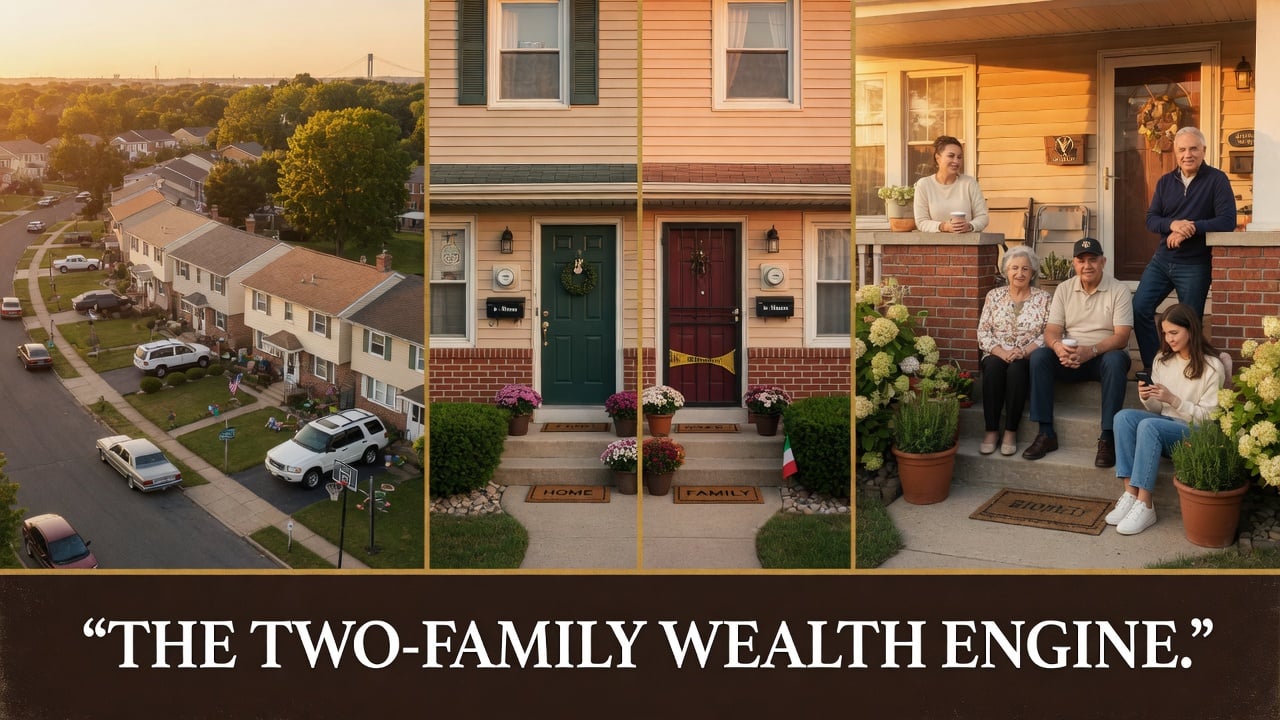

If you want to understand how Staten Island built one of the highest homeownership rates in New York City, stop looking at single-family homes. Look at the two-family next door.
The Staten Island two-family home is the most underrated wealth-building asset in the five boroughs. It is not glamorous. It is not photogenic. It rarely shows up in glossy real estate features. But it is the single most important reason a generation of working- and middle-class families on this borough own homes their incomes alone could not have qualified them to buy. The math behind that statement is not opinion. It is documented in HUD's underwriting guidelines, in the borough's housing-stock data, and in the deed history of roughly a quarter of the homes on this Island.
In 2026, that engine is still running. And it is about to get a regulatory tailwind it has not had in fifty years.
01 — The Scale
Eighty-three percent of Staten Island's housing units sit inside one- or two-family buildings. That is, by a wide margin, the highest concentration of any borough in New York City. In Manhattan, the figure is essentially zero. In Brooklyn and Queens, where small-home stock is meaningful, it is a fraction of what it is here.*
Inside that 83 percent, roughly a quarter of the Island's entire housing stock is two-family or small multi-family product, depending on how the count is run.* That is not a quirk of how the data is measured. It is a reflection of how this borough was zoned, built, and financed in the postwar period. R3 and R3X districts run across the South Shore, Mid-Island, and large stretches of the East Shore — districts that explicitly accommodate two-family attached, semi-attached, and detached construction. Builders responded to the zoning, and three generations of buyers responded to the builders.
The result is a housing inventory that looks nothing like the rest of New York City. The closest analog is the small-home belts of southeast Brooklyn and central Queens, but neither comes close to Staten Island's per-capita density of legal two-family product. This matters because the financing rules that apply to a two-family home are categorically different from the rules that apply to a single-family. And on Staten Island, those rules apply at scale.
02 — The Financing Math
Here is what almost no one says clearly. An owner-occupant buying a two-family home with an FHA loan can put 3.5 percent down, count 75 percent of the projected rental income from the second unit toward their qualifying income, and is not subject to the self-sufficiency test that applies to three- and four-unit properties. Conventional financing rules are similar in spirit and slightly stricter on documentation. No prior landlord experience is required. The owner has to occupy one unit as a primary residence for at least twelve months. That is the deal.
Run the numbers on a real Staten Island purchase. A buyer with $135,000 in household income, no extraordinary debt, looking at a $900,000 detached two-family in Great Kills with a second unit that the appraiser values at $2,500 per month in market rent. The lender takes 75 percent of that rent — $1,875 per month, or $22,500 annually — and adds it to the buyer's qualifying income. The buyer is now being underwritten as if they earn $157,500. That delta is the difference between qualifying for the home and not qualifying.
A single-family home at the same price point, with the same buyer, returns nothing. The qualifying income stays at $135,000. At current rates near 6.2 percent, that gap routinely separates a "yes" from a "no" on a $900,000 purchase price.
The 25 percent haircut on rental income is the lender's vacancy and maintenance buffer, not a penalty. It exists for a reason. A buyer who runs their personal budget on the assumption of full-occupancy rent collection will be in trouble the first month a unit turns over. The math works because the buffer exists.
03 — The Wealth Pattern
The pattern is so common on Staten Island it became invisible. A young couple buys a two-family on a working-class income. The husband's parents move into the second unit and contribute rent that doubles as family support. Five years later, the parents move out, the unit goes to market, and the rental income that was always there on paper now hits the household checkbook. The couple uses the strengthened cash flow to refinance, pulls equity, and either renovates the primary unit, pays down the principal, or — most often — uses it as a down payment on a second property somewhere on the South Shore.
That sequence has run, in some variation, tens of thousands of times in Great Kills, Eltingville, New Dorp, Dongan Hills, and Tottenville from the 1970s forward. The same pattern was structurally harder to execute almost everywhere else. Brooklyn priced it out of reach for working-income buyers in the 1990s. Queens has more two-family stock than people realize, but its zoning is patchier and the price per door ran ahead of Staten Island's by a meaningful margin for two decades. Manhattan was never in the conversation.
"You did not need to be rich to build wealth on this Island. You needed to buy a two-family, hold it, and let the rent roll do its job. The borough was built on that math."
The result is visible in the borough's homeownership rate, which is 66.6 percent — more than double the New York City average of 32.5 percent — and in the median household income of $99,170, roughly 25 percent above the citywide median.* Those numbers are not unrelated. They are the same number, viewed from two angles.
04 — Where the Stock Sits
Two-family product on Staten Island concentrates on the South Shore and Mid-Island, with meaningful pockets in the East Shore and a different breed entirely on the North Shore. The pricing varies by neighborhood, configuration, and lot size, but the underwriting math runs the same in each.
| Neighborhood | Typical Two-Family Range | Dominant Configuration |
|---|---|---|
| Great Kills | $800K – $1.05M | Detached and semi-attached high-ranches, up-and-down |
| Eltingville | $835K – $1.425M | Detached high-ranches and side-by-side semi-attached |
| New Dorp / Dongan Hills | $775K – $1.05M | Side-by-side semi-attached, mid-block |
| Charleston / Rossville | $850K – $1.15M | Newer-construction semi-attached two-families |
| Tottenville / Princes Bay | $900K – $1.25M | Larger detached two-families, side-hall colonials |
| North Shore (St. George, Stapleton) | $650K – $900K | Older detached and converted Victorians, investor-heavy |
The current borough-wide median list price for a multi-family on Staten Island is sitting north of $1.1 million, but that headline number is skewed by larger three- and four-unit product on the North Shore.* The actual transaction price for a clean, owner-occupied-suitable two-family in the South Shore core runs in the high $800Ks to mid-$900Ks for most of the typical inventory. That price, financed correctly, is well within reach of a dual-income Staten Island household earning between $140K and $180K — exactly the band that most working professional buyers fall into.
05 — The Income Amplifier
The amplifier is real, but it has limits. The 75 percent rental-income credit lifts a buyer's qualifying income by roughly $18,000 to $25,000 annually on most Staten Island two-family configurations, depending on the appraiser's rent schedule. That converts, at current rates, into roughly $90,000 to $130,000 of additional purchasing power on the loan side. It is not unlimited free money. The buyer still needs to clear DTI thresholds, hit reserve requirements, and document everything cleanly.
The ceiling shows up in two places. First, FHA loan limits cap how much the buyer can borrow regardless of income — the 2026 FHA limit for a two-unit property in New York City's high-cost area sits at $1,599,375, which is generous enough to cover most owner-occupied two-family deals on Staten Island but not enough to reach into the upper tier of newer-construction or larger-lot product. Second, the appraiser's rent schedule is the binding number. If the appraiser says the unit will rent for $2,200 instead of $2,500, the math compresses by roughly $2,700 in qualifying income annually. That difference, on the margin, can decide a deal.
Buyers above the FHA ceiling can still run the same play with conventional financing. Under Fannie Mae's 2023 policy change, owner-occupied two-family purchases can be financed with as little as 5 percent down on loans at or below the conforming limit, with the same 75 percent rental-income credit. High-balance loans above the conforming limit still require 15 percent or more. The two-family financing advantage does not disappear above the FHA ceiling — it just gets more technical to execute.
06 — The Regulatory Tailwind
Here is the part that matters for anyone who already owns a two-family on Staten Island, or is thinking about buying one in 2026. The regulatory environment around accessory dwelling units is shifting in ways that have not played out at this scale in fifty years.
The City of Yes for Housing Opportunity legislation, passed by the City Council on December 5, 2024, opened pathways for accessory dwelling units in one- and two-family homes across most of New York City's lower-density zoning districts — including the R3 and R3X districts where most of Staten Island's two-family stock sits. The DOB began accepting ADU applications in September 2025. Several restrictions apply on Staten Island specifically: detached and backyard ADUs are not permitted in R1A, R2A, or R3A contextual districts unless the property sits inside a transit-accessible zone, and ground-floor or basement ADUs are not permitted in flood-prone areas — a meaningful carve-out on this borough given the post-Sandy flood-zone footprint along the East Shore and parts of the South Shore.
A separate pilot program — the basement and cellar legalization pathway under Local Law 126 of 2024 — creates a path for currently-illegal basement units to come into legal compliance with proper egress, ceiling height, and certificate-of-occupancy work. The pilot is currently limited to specific community districts in the Bronx, Brooklyn, Manhattan, and Queens. No Staten Island community districts are included in the initial pilot. Advocates have pushed to expand the program borough-wide, and that expansion is part of the active state legislative conversation, but as of 2026 a Staten Island homeowner with an illegal basement unit does not have a clean legalization path under the pilot.
Translate that into pricing. The City of Yes ADU pathway alone — for new ADUs added to legal one- and two-family homes outside flood and contextual-district carve-outs — meaningfully expands what an existing Staten Island lot can legally produce in rental income. Existing legal two-families with usable basements or accessory structures get repriced upward as that pathway gets used. If the basement legalization pilot expands to include Staten Island community districts in a future legislative cycle, a chunk of the borough's single-family stock with informally-occupied basements gets a path into legal two-unit status, and the spread between legal and illegal product compresses sharply.
Whether that second scenario plays out depends on a stack of regulatory decisions still in motion. But the direction of travel is unambiguous. State and city housing policy is pushing toward more legal density inside existing low-density zoning, not less. Owners of clean, fully-papered two-family homes on this Island are sitting on an asset class that gets more valuable, not less, the longer that policy direction holds.
07 — The Risks
The two-family math only works on a clean two-family. There are categories of Staten Island product that look like two-families on a listing sheet and fall apart on the financing side, and any buyer running the strategy needs to know what they are.
The first category is the illegal three-family. On title and on tax records, the property reads as a two-family. In reality, a basement has been finished and rented as a third unit, often for years, sometimes for decades. FHA appraisers are explicitly looking for this on their inspection. The deal does not close as a two-family if there are three meters, three kitchens, and three separate entrances. It either gets restructured, the third unit gets demolished back to legal, or the buyer walks.
The second category is the unpermitted basement conversion. The property is a legal two-family on paper, but the basement was finished without permits and is being marketed as an income-producing unit. A national lender will not count the unpermitted space as a legal third unit, will not count its rent toward qualifying, and may flag the entire deal for additional underwriting if the configuration suggests illegal occupancy. Local portfolio lenders sometimes work around it. National FHA underwriting usually will not.
The third category is the shared utility setup. Two-families with a single gas meter or a single electric service feeding both units pass FHA in some configurations and fail in others. Properties with a shared driveway that the owner does not have a recorded easement on get rejected outright by certain national underwriters. These are the issues that surface ten days before closing and kill deals that should have been clean from contract.
A serious buyer on a Staten Island two-family asks the listing agent three questions before going hard on contract. Is this property recorded as a legal two-family with the Department of Buildings, with a current and matching certificate of occupancy. Are all units separately metered for gas and electric. Is the driveway recorded as deeded property of this lot, or is it shared with neighbors under an easement. The answers to those three questions determine whether the financing math actually closes.
08 — The 2026 Read
For buyers, the read is straightforward. At current rates, with the borough's median single-family price hovering near $755,000 and inventory still tight, the two-family is still the single best path into Staten Island ownership for a working-income household. The financing math has not changed. The product is plentiful. The neighborhoods that hold value the longest — Great Kills, Eltingville, Tottenville, New Dorp — all have meaningful two-family stock at price points that work.
For sellers, the read is more nuanced. A clean, fully-papered two-family with separate meters and a current certificate of occupancy commands a documented premium over a single-family on the same block — and that premium is widening, not narrowing, as ADU regulatory pressure builds. A two-family with paperwork issues, illegal conversions, or shared utilities prices in line with a single-family because that is what it can be financed as. The gap between the two is real money. Sellers who clean up their paperwork before listing capture it. Sellers who do not, do not.
For long-term holders, the read is the simplest of the three. The income engine that built this borough's middle class is about to get a regulatory tailwind it has not had in fifty years, and the asset class most positioned to benefit is the one already sitting in tens of thousands of driveways across the South Shore and Mid-Island. The borough was built on this math. The borough is going to be valued on it for the next decade.
For more current Staten Island market data, see the latest Staten Island Q1 2026 market report and the related analysis on why the borough's hill sections command structural premiums.
* Housing-stock composition figures drawn from the Citizens Housing & Planning Council analysis of the 2023 New York City Housing and Vacancy Survey, with cross-reference to NeighborhoodScout property-type breakdowns. Homeownership and median income figures from NYU Furman Center 2023 borough profile data. FHA underwriting rules per HUD Handbook 4000.1 and 2025–2026 mortgagee letters. Multi-family listing and price data from current closed-sale and listing-side market trackers. Neighborhood pricing reflects a synthesis of recent twelve-month closed-sale data; individual property performance varies materially by configuration and condition.
FAQ
Can I buy a two-family home on Staten Island with 3.5 percent down?
Yes, if the property is owner-occupied and you finance it with an FHA loan. FHA allows owner-occupants to purchase legal two-family homes with 3.5 percent down, provided the buyer occupies one unit as a primary residence for at least twelve months and the property meets HUD minimum property standards. No prior landlord experience is required. Conventional owner-occupied financing on a two-family is also available — and as of Fannie Mae's November 2023 policy change, can be done with as little as 5 percent down on loans at or below the conforming limit. High-balance conventional loans above the conforming limit still typically require 15 percent or more down, but neither path imposes the FHA mortgage insurance premium.
How much rental income can I count toward qualifying for a Staten Island two-family mortgage?
FHA and most conventional lenders allow you to count 75 percent of the projected rental income from the non-owner-occupied unit toward your qualifying income. The rental figure is established either by an existing lease or by the FHA appraiser's market rent estimate, whichever is supportable. The 25 percent reduction is an underwriting buffer for vacancy and maintenance. The self-sufficiency test that requires rental income to fully cover the mortgage payment applies only to three- and four-unit properties — not to two-family homes.
Are basement apartments in Staten Island two-families legal?
It depends on the certificate of occupancy. A basement unit in a property recorded as a legal two-family is part of one of the two legal units only if the certificate of occupancy includes it as habitable space. Many Staten Island basements have been finished and rented as separate units without the proper permits, egress, and ceiling height to qualify legally. National lenders treat unpermitted basement units as non-qualifying space for both rental income and appraised value purposes. The basement legalization pilot under Local Law 126 of 2024 creates a path for some illegal basement units to come into compliance, but the pilot's currently-designated community districts are in the Bronx, Brooklyn, Manhattan, and Queens — not Staten Island. New ADU construction in legal one- and two-family homes is permitted on Staten Island under the City of Yes ADU rules, subject to flood-zone and contextual-district restrictions.
Is it better to buy a single-family or a two-family on Staten Island in 2026?
For most working-income buyers in the $130K to $200K household income band, a two-family is the better financial vehicle for the first purchase on Staten Island. The rental-income credit expands qualifying power, the borough's two-family inventory is genuinely deep, and the long-term resale story is reinforced by current ADU and zoning policy direction. A single-family makes more sense for buyers who specifically do not want shared occupancy, who are above the FHA loan limits, or who are buying in neighborhoods like Todt Hill or upper Lighthouse Hill where two-family product is essentially nonexistent.
Prodigy Real Estate is an innovative real estate company offering high-end video production, home valuation services, purchasing, and home sales. Serving New York and New Jersey.