
Anthony Licciardello | April 19, 2026
Staten Island
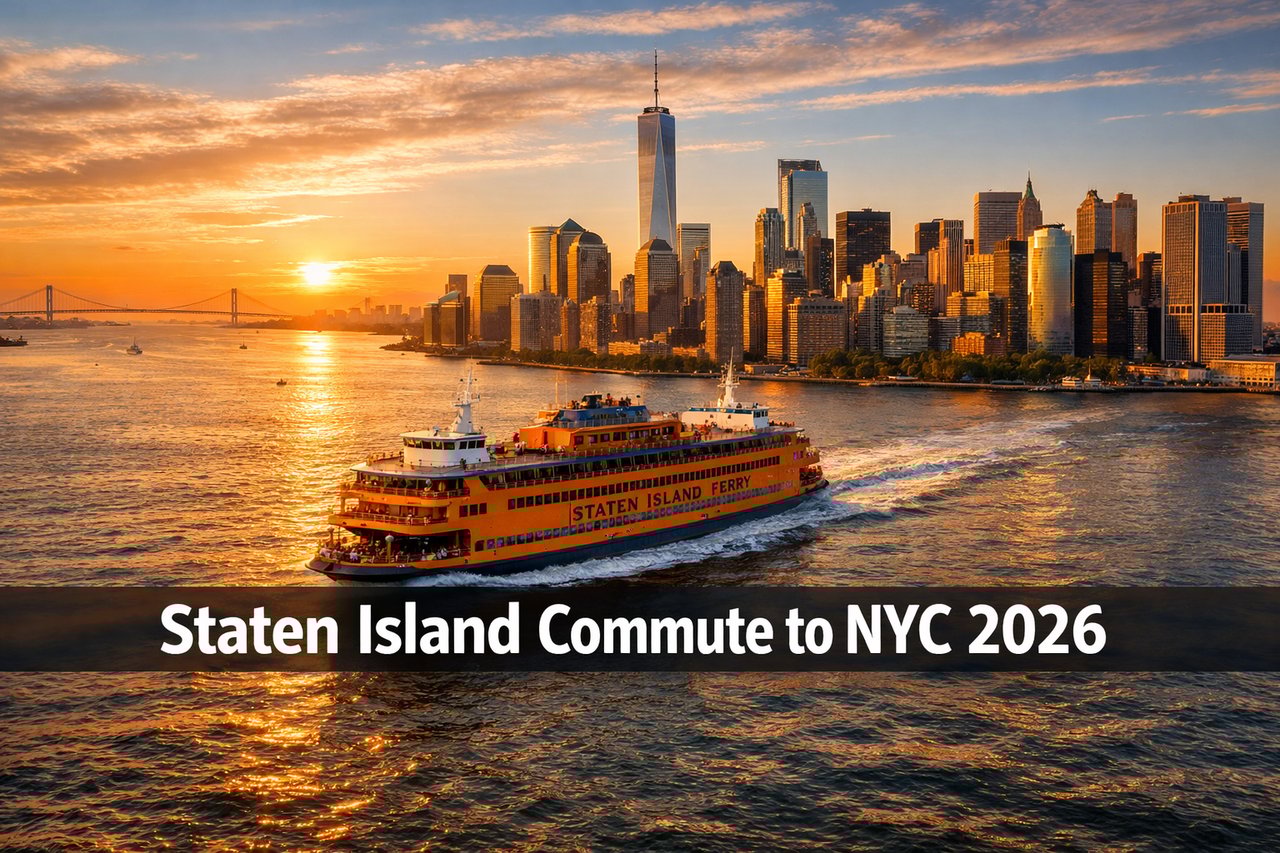
Most buyers shop Staten Island homes by price, school, or square footage. That's backwards. On this island, the commute mode you pick locks in which neighborhoods you can actually live in — and once you close on the wrong one, a 35-minute ride becomes 75 minutes, five days a week, forever. This is the honest breakdown of how long it really takes to get from every part of Staten Island to Manhattan in 2026, what it costs, and which neighborhoods match which commute.
Staten Island has four viable commute modes to Manhattan: the free ferry from St. George, the SIM express bus network, the Staten Island Railway feeding into the ferry, and driving across the Verrazzano-Narrows Bridge. Each one has a natural catchment, a real cost, and a neighborhood profile. Get the match right and the island is one of the most affordable commutes in New York City. Get it wrong and you'll spend two hours a day regretting the floor plan.
The Four Modes
There are four real options. Each serves a different buyer profile, and the Manhattan destination — Downtown versus Midtown — matters as much as where on the island you live.
Best for Downtown/FiDi workers living near St. George. Rush-hour boats every 15–20 minutes. Connects to the 1, R, and W at Whitehall.
Best for Midtown workers on the Hylan corridor or West Shore. $67 weekly cap functions like a monthly pass.
Best for East Side residents connecting to the ferry. You only pay the $3.00 fare once at St. George.
Best for off-hour workers or car-required roles. Resident rebate cuts tolls 77% below Tolls by Mail rate.
The Verrazzano resident discount is not automatic. You need a New York Customer Service Center E-ZPass account, a vehicle registered to a Staten Island address, and enrollment in the SIR plan. Miss a recertification cycle and the discount drops off. New owners: line this up in the first month, not the first year.
Along the Rail
The Staten Island Railway runs the length of the island's east side — 14 miles, 21 stations, 24 hours a day. It's the closest thing the borough has to a subway, and every stop is a distinct micro-market. Buyers who understand the line have a real advantage: they can trade a few minutes of commute time for a meaningful difference in housing stock, schools, and price per square foot. Here's what each corridor actually offers, north to south.
The North Shore anchor. New waterfront condos, historic single-families in the hills behind the terminal, and the borough's highest commute premium. St. George sellers routinely outperform island averages on price per square foot because no other address delivers a 35-minute FiDi commute.
Stapleton has one of Staten Island's richest concentrations of Victorian-era housing — brownstones, wood-frame Queen Annes, and historic multifamily stock. The revitalizing waterfront and the Urby development have pulled new residents in. A real option for buyers priced out of St. George who still want a short ferry commute.
Grasmere sits right at the Verrazzano approach, which makes it one of the island's only true dual-mode neighborhoods: SIR to the ferry for Downtown, bridge to Brooklyn for anything east. Housing stock is predominantly detached single-families with deeper-than-average lots.
Classic traditional mid-island. Semi-attached and detached single-families on compact lots, strong family buyer base, and pricing that runs meaningfully below North Shore levels. Dongan Hills is where first-time buyers priced out of Brooklyn often land.
The commercial spine of mid-island. New Dorp Lane is the retail corridor, Miller Field is the park anchor, and Hylan Boulevard delivers express bus access alongside the rail stop. Three distinct micro-markets in the neighborhood reward buyers who know the blocks — one of the few mid-island places where SIM + SIR dual access is truly practical.
Great Kills has a distinctive character among SIR-line neighborhoods because of the marina and harbor. Waterfront single-families trade for premiums, and the Great Kills Park and yacht club pull in buyers who want lifestyle alongside the commute. Condo and townhouse stock is deeper here than in most South Shore neighborhoods.
The Eltingville Transit Center is the most important single transit asset on the South Shore — roughly a dozen SIM routes converge here, including direct Midtown service. Housing spans from mid-century attached single-families to newer construction. Eltingville holds value better than comparable South Shore neighborhoods because of that hub.
Huguenot is where buyers start getting real house for the money. Suburban character, larger setbacks, and a newer-construction profile than neighborhoods to the north. The commute is the cost: full-line SIR plus ferry plus subway is the longest mode combination on the island. Most Huguenot commuters choose driving or SIM from nearby stops instead.
Tottenville is effectively a village at the southern tip of the borough. The largest homes on the island sit here, on deeper lots, often with waterfront or water-view positioning. Historic Main Street character, working marina, and a genuine separation from the rest of the city. The commute is demanding, but Tottenville buyers are choosing lifestyle and space — not speed.
The SIR isn't just a commute tool. It's a price gradient laid down one stop at a time — and buyers who read it correctly find the best value on the whole island.
North Shore
The North Shore is the shortest commute on the island and the reason Downtown workers should start their search here. Buyers walking from a St. George condo can reach the ferry terminal in under ten minutes. Tompkinsville and Stapleton riders hop on the SIR and are at St. George in five. Add the 25-minute crossing and a FiDi worker is at their desk in 35 to 45 minutes — faster than most Brooklyn commutes.
Housing stock skews two directions: new and renovated condos around St. George and the revitalizing waterfront, and Victorian-era single-families in New Brighton and Randall Manor. Pricing per square foot runs above the borough average because of the commute advantage. Midtown workers get less benefit here — the subway transfer at Whitehall adds 20 to 30 minutes — so they should weigh SIM-served neighborhoods instead.
Mid-Island
Mid-Island is the sweet spot for dual-mode commuters. The SIR runs through the spine of the corridor, and Hylan Boulevard carries the SIM3, SIM4, SIM8, and other express routes directly into Midtown and Downtown. Buyers here don't have to commit to one mode. When the ferry is delayed, the bus still runs. When the Gowanus is a parking lot, the train still moves.
Door-to-desk times run 50 to 70 minutes depending on destination and traffic. Housing stock is mostly semi-attached homes, traditional detached single-families, and a healthy supply of two-families — which makes the area popular with investors and multigenerational buyers. Price per square foot sits below North Shore levels, so you trade 10 to 15 minutes of commute for meaningfully more house.
South Shore
The South Shore is where the commute tradeoff gets real. Door-to-desk times run 65 to 90 minutes. What you get in exchange: bigger lots, more detached single-family stock, newer construction, and prices that haven't priced out working-family buyers. Tottenville homes are structurally different from anything on the North Shore — larger setbacks, deeper yards, more square footage per dollar.
The critical commute asset is the Eltingville Transit Center, where roughly a dozen SIM routes converge — SIM1, SIM1C, SIM4, SIM4C, SIM5, SIM6, SIM7, SIM8, SIM10, SIM15, SIM22, and SIM31 all stop there. That density is why Eltingville, Annadale, and Great Kills hold value better than pure South Shore addresses without express bus access. Tottenville riders typically choose between the SIR up to St. George plus ferry, or driving to the Eltingville park-and-ride.
West Shore
Most SI buyers overlook this corridor. The SIM33C from Mariners Harbor and the SIM3C from Port Richmond run to Midtown via the Goethals Bridge, New Jersey Turnpike, and Lincoln Tunnel — a completely different route than the Verrazzano-based SIMs. The trip works because it dodges Brooklyn traffic entirely. Door-to-desk runs 60 to 80 minutes to Midtown. Pricing here is among the most affordable on the island, with two-family stock common and a real multifamily investor market. The weakness is limited off-peak service and few direct Downtown routes.
Monthly Cost
Using 22 workdays and two trips per day, here's what each mode runs in 2026. All figures use current OMNY and MTA rates effective January 4, 2026.
MTA fares effective January 4, 2026: $3.00 local transit base, $7.25 express bus base with $67 weekly cap, $2.75 effective Verrazzano toll under the Staten Island Resident Rebate Program. Parking ranges reflect typical Manhattan monthly garage rates.
Decision Framework
Downtown workers should start on the North Shore or anywhere on the SIR line. Midtown workers should prioritize SIM-served corridors — the Hylan Boulevard spine, the Eltingville area, or the West Shore. Hybrid workers going in two or three days a week can tolerate longer rides, which opens up the South Shore and its larger homes.
Full car commuters should look at the West Shore or South Shore near Verrazzano approaches, but only with the resident E-ZPass discount locked in. Off-hour workers — hospital staff, trades, anyone on a non-9-to-5 — have the most flexibility and should weight housing value heavily over commute optimization. One more principle: ferry-heavy commuters pay their commute cost in housing price per square foot. SIM commuters pay it in dollars per trip. The mode you choose is effectively a pricing mechanism built into the island's real estate market.
FAQ
How long does it actually take to get from Staten Island to Midtown Manhattan?
Midtown door-to-desk runs 55 to 70 minutes from St. George via ferry and subway, 50 to 65 minutes from the Hylan Boulevard corridor via SIM express bus when traffic cooperates, and 75 to 95 minutes from the South Shore via SIR plus ferry plus subway. The SIM is usually fastest to Midtown when the BQE and Gowanus are clear. When they're not, the ferry-plus-subway route becomes competitive because the subway doesn't sit in traffic.
What's the fastest Staten Island neighborhood for a Manhattan commute?
St. George is the fastest neighborhood for Lower Manhattan commuters — the walk to the ferry terminal is under ten minutes from most addresses, and the free 25-minute crossing drops you steps from the 1, R, and W trains. For Midtown workers, the fastest options are Hylan Boulevard corridor addresses in Mid-Island, where SIM express buses provide a one-seat ride when traffic allows.
Is it cheaper to take the ferry or the SIM express bus from Staten Island?
The ferry plus subway is roughly half the monthly cost of the SIM express bus — about $132 a month versus $288 under the 2026 $67 weekly fare cap. The ferry itself is free; you only pay the $3.00 local transit fare for the subway transfer at Whitehall. SIM buses are a premium service with a $7.25 base fare, but they offer a one-seat ride to Manhattan that the ferry route can't match for Midtown destinations.
Do Staten Island residents still get a discount on the Verrazzano Bridge toll in 2026?
Yes. The Staten Island Resident Rebate Program continues in 2026 and provides an effective toll rate of $2.75 each way for qualifying residents — roughly 77% below the $12.03 Tolls by Mail rate that took effect January 4, 2026. Eligibility requires a New York Customer Service Center E-ZPass account, a vehicle registered to a Staten Island address, and enrollment in the SIR plan. Residency status is subject to periodic recertification.
Prodigy Real Estate is an innovative real estate company offering high-end video production, home valuation services, purchasing, and home sales. Serving New York and New Jersey.