
Anthony Licciardello | May 9, 2026
ADU New Jersey
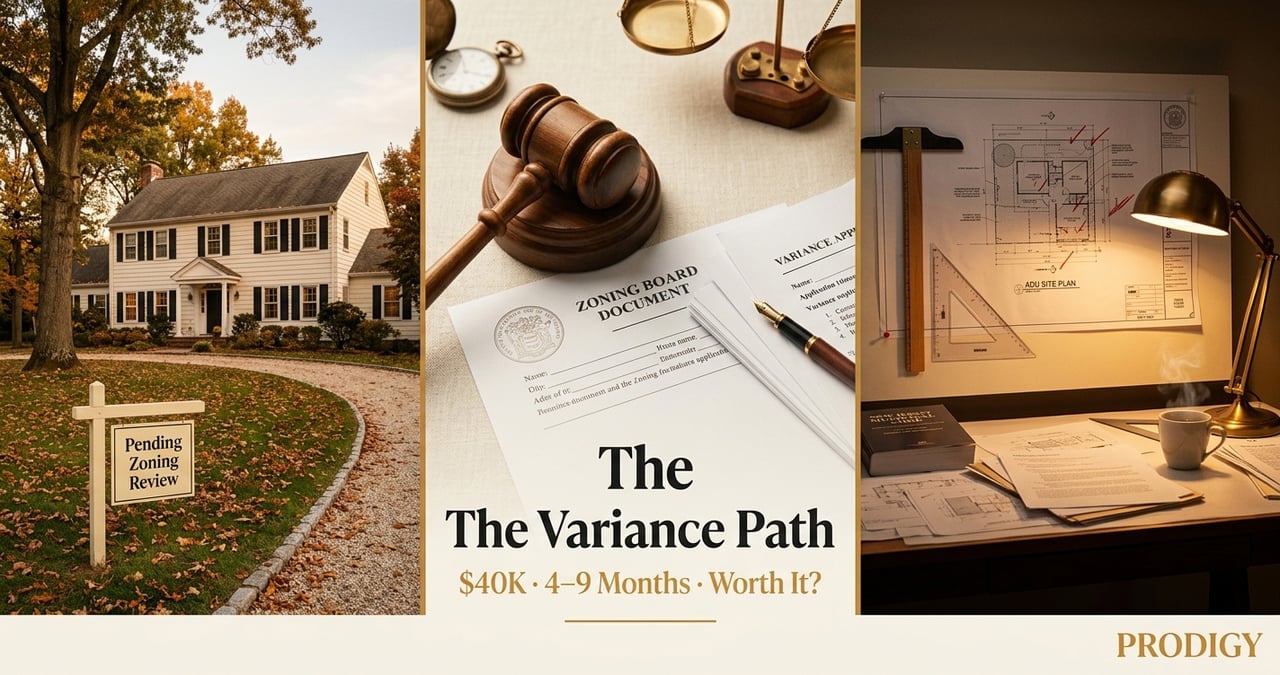
By Anthony Licciardello, The Prodigy Team
NYS/NJ Licensed Broker · Series Part 3 of 5
If you opened your Westfield, Edison, or New Brunswick zoning code and searched for "accessory dwelling unit," you got zero hits. That's not a bug — that's the situation across most of Union and Middlesex Counties in 2026. Both counties are largely silent on ADUs, with a handful of restrictive provisions and one outright prohibition on the books. Yet New Jersey statewide median prices are up 3.8% YoY to $545,700, and the Fourth Round Mount Laurel obligations under P.L. 2024, c.2 are forcing every NJ municipality to rewrite its housing strategy. The opening for ADUs in Union and Middlesex isn't legal yet — but the legal pathway is becoming clearer with each Fair Share Plan filing.
This is part 3 of our five-part series. Post 1 covered the statewide landscape; Post 2 walked through the friendly Hudson and Essex markets. Here we tackle the harder reality: building when your town hasn't adopted an ADU ordinance.
|
0 Modern ADU Ordinances In Union/Middlesex 2026 |
$15–40K Use Variance Cost Pre-construction |
4–9 mo Variance Timeline Filing to decision |
3/15/26 Fourth Round Deadline Implementing ordinances |
Union County has not adopted a county-wide ADU ordinance, and most of its 21 municipalities haven't either. Westfield, Summit, Cranford, Scotch Plains, and most of the suburban communities treat the topic with silence — which in zoning terms means "not a permitted use." (For context on Union County's wealthier suburbs, see Westfield property taxes and Scotch Plains taxes and the 2027 revaluation.) The Township of Union (the township specifically) has accessory-dwelling-unit registration provisions in Chapter 419 of its municipal code, suggesting the township at least anticipates them, but the broader zoning treatment is cautious.
Middlesex County is similar. There is no county-wide ordinance. The Borough of Middlesex's zoning code (Chapter 420) explicitly states that "no accessory building shall be used for residential dwelling purposes in any zoning district" — about as direct a prohibition as you'll find in NJ. Edison, Highland Park, New Brunswick, Woodbridge, Piscataway, East Brunswick, Old Bridge, and most other Middlesex towns are silent or restrictive in similar ways.
⬢ The Honest Read
In 2026, neither Union nor Middlesex County is a permissive ADU jurisdiction. That doesn't mean you can't build one. It just means the path is different — and the math is different. Variance applications cost real money up front with no guaranteed outcome. Whether the math works depends on your specific situation.
When a zoning ordinance doesn't list ADUs as a permitted use, three things follow:
|
Reality 1 No As-of-Right Build |
A construction permit will be denied because the use isn't listed in the ordinance. No exceptions, no workarounds. |
|
Reality 2 Use Variance Pathway |
You can pursue a use variance under N.J.S.A. 40:55D-70(d). Formal application, public notice, hearing, affirmative showing the use is not detrimental — meets the "positive and negative criteria" set out in case law (the Medici standard). |
|
Reality 3 High Bar for Approval |
Use variances are not routinely granted. Boards weigh neighborhood character, traffic, parking, infrastructure. ADUs do better than commercial uses in residential zones (still residential), but applicants typically need a hardship argument and professional planning/legal testimony. |
A use variance application is a real undertaking. Realistic 2026 cost stack:
| Cost Component | 2026 Range |
|---|---|
| Land-use attorney | $5,000–$15,000+ (depending on opposition) |
| Professional planner's report and testimony | $3,000–$8,000 |
| Architect for variance-grade plans | $4,000–$10,000 |
| Application fees and escrows | $1,500–$5,000 |
| Total pre-construction | $15,000–$40,000 over 4–9 months |
That's $15K–$40K spent before you've laid a brick, with no guarantee. Ask honestly whether the project clears that hurdle in expected value.
Variance applications work for sympathetic family use cases on adequate-size lots. They don't work for purely investment-driven applications on tight lots with vocal opposition.
— What Zoning Boards Actually Look At
| Variance Likely To Succeed | Variance Likely To Fail |
|---|---|
| Sympathetic use case (aging parent, family member with disability) | Tight lot where ADU would loom over neighbors |
| Lot is large enough that ADU fits without imposing | No off-street parking solution |
| Neighborhood support (or no organized opposition) | Motivated primarily by rental income |
| Town's master plan signals ADU study/openness | Vocal neighbor objects |
⬢ Anthony Licciardello
Variance applications cost $15K–$40K and 4–9 months. Whether your lot is a strong candidate is a 30-minute conversation with comps and zoning context — not a guess.
|
✓ Lot Read Honest assessment of whether your lot has the bones for a successful variance application. |
✓ Attorney Network Vetted referrals for NJ land-use attorneys with track records before specific local boards. |
✓ Two-Family Path If your home is or could be a legal two-family, that's a different (often faster) path. |
Call/Text: (718) 873-7344 · Schedule: ProdigyRE.com
No charge for the initial conversation. Real numbers from someone who works this market every day.
The other strategy is patience. The Singleton ADU preemption bill (S-1786 in the 2026–27 session) would, if passed, force every municipality to allow ADUs as of right under statewide standards. If it passes, towns that are silent today would have 90 days to adopt a compliant ordinance.
If you don't have a pressing reason to build now, watching the legislation through 2026 is reasonable. Predecessor versions (S-2347 most recently) have stalled, but the political momentum is real, and the implementation of the 2024 Mount Laurel reform under P.L. 2024, c.2 gives towns reason to look at ADUs as a Fourth Round housing tool. Final implementing-ordinance deadline: March 15, 2026. Some Union and Middlesex municipalities will adopt limited ADU provisions in their Fourth Round packages.
Despite the broadly restrictive picture, several specific situations in Union and Middlesex Counties are worth flagging:
|
Opening 1 Existing Two-Family |
Many older homes in Elizabeth, Plainfield, New Brunswick, and Perth Amboy are already legal two-family structures. Your conversation isn't "can I add an ADU" — it's "can I formalize the unit my parents lived in." Paperwork-and-construction-code path. Often faster and cheaper than variance. |
|
Opening 2 Affordable Housing Overlays |
Several Middlesex and Union towns have affordable-housing overlay zones. Under P.L. 2024, c.2, every NJ municipality had to adopt a Housing Element and Fair Share Plan by June 30, 2025; some plans contemplate ADUs as a tool. Pull your municipality's current Fair Share Plan and check. |
|
Opening 3 Older Urban Towns |
Plainfield, Linden, Roselle, Rahway, and New Brunswick have housing markets and political pressures broadly similar to Newark's. None has adopted a Maplewood-style ADU ordinance, but a homeowner with a constructive proposal may find a more receptive zoning officer than in the wealthier suburban townships. |
If you own in Union or Middlesex County and you're serious about an ADU, here's a high-value sequence of steps that costs you nothing or close to it:
|
Step 1 Pull Your Code |
Confirm your zone and pull the relevant section of your zoning ordinance. Search for "accessory," "two-family," "secondary unit," and "in-law." |
|
Step 2 Call Zoning |
Ask: are accessory dwelling units permitted in my zone? If not, what would the path look like — variance, redevelopment plan, anything else? Note their answer. |
|
Step 3 Read Master Plan |
Search the master plan and Fair Share Plan for "ADU" or "accessory dwelling." Town signaling matters for variance applications. |
|
Step 4 Lawyer Consult |
30-minute paid consult with a NJ land-use attorney. Bring your zone, ordinance excerpt, master plan reference, project goal. They'll tell you within that window whether you have a viable path. |
⬢ Owner Note
Many Middlesex and Union homes have unauthorized basement apartments that owners think of as "ADUs." Legally, they're not — they're either an unpermitted second dwelling unit (a code violation) or, if the home is a legal two-family, just the second of two units. Don't conflate these when talking to officials. If you're buying a home with a "bonus apartment," do not skip the zoning compliance check.
Q
No. As of mid-2026, no Union or Middlesex County municipality has adopted a modern, homeowner-friendly ADU ordinance comparable to Maplewood, Montclair, South Orange, Jersey City, or Asbury Park. Some have legacy provisions or registration frameworks; none provide as-of-right ADU permitting in the Hudson/Essex sense.
Q
Typically 4–9 months from filing to a Zoning Board of Adjustment decision in NJ. That's before construction permitting, which adds another 4–6 months for an ADU project. Total timeline from variance filing to occupied ADU: 14–24 months realistic.
Q
If your project is driven by family need (aging parent, multigenerational living), no — pursue the variance now. Family situations have time pressure that legislation doesn't. If you're motivated by long-term rental income with no specific timeline, watching S-1786 through 2026 is reasonable. Even if the bill stalls, the Fourth Round implementing-ordinance deadline (3/15/26) means some Union/Middlesex towns may add limited ADU provisions in their Fair Share Plans.
Q
It depends on whether your home is zoned single-family or two-family. If it's a legal two-family and the basement is an additional unit, you may need to remove it. If it's single-family and the basement was permitted only as living space (not a separate unit), legalization is essentially a use variance — same cost and timeline as building a new ADU. The zoning officer's interpretation is the gating factor; get it in writing.
Q
New Brunswick is the most likely first mover in Middlesex — college town, chronic housing pressure, ADU-style units already exist informally. In Union County, Plainfield, Linden, and Rahway have housing politics broadly similar to Newark's and could move next. The wealthier suburbs (Westfield, Summit, Cranford) are unlikely to adopt voluntarily unless S-1786 forces them to.
Union and Middlesex Counties are harder ADU territory than Hudson and Essex, but they're not impossible. Your three real options in 2026: pursue a use variance, formalize an existing two-family or pursue an affordable-housing overlay, or wait for state preemption. What you should not do is start planning, hire an architect, and build into a regulatory situation you don't understand. The order of operations matters. Related reading: Post 1 — The NJ ADU Playbook · Post 2 — Hudson and Essex · Post 4 — Monmouth and Somerset · Post 5 — From Idea to CO.
About the Author
 |
NYS/NJ Licensed Broker · The Prodigy Team 20+ years and 5,000+ closed transactions. Long Branch and Monmouth coastal corridor specialist. ProdigyRE.com. |
Prodigy Real Estate is an innovative real estate company offering high-end video production, home valuation services, purchasing, and home sales. Serving New York and New Jersey.