
Anthony Licciardello | May 10, 2026
ADU New Jersey
By Anthony Licciardello, The Prodigy Team
NYS/NJ Licensed Broker · Long Branch & Monmouth Coastal Specialist · Series Part 5 of 5
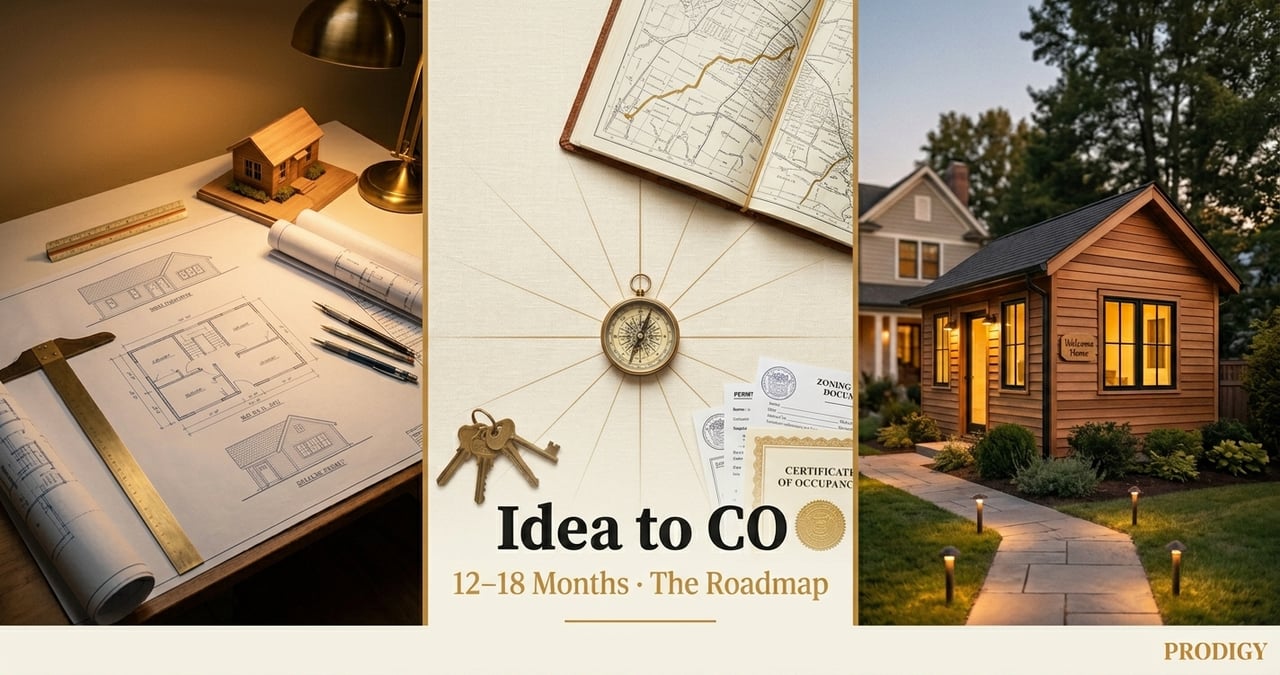
Permitted ADU in a friendly New Jersey town: 8 to 12 months from idea to certificate of occupancy. Variance-required project: 14 to 24 months. Detached new build budget in 2026: $200K to $400K-plus, with a 15–20% contingency that you will probably use. The work splits into five phases — feasibility, design and approvals, financing, construction, and post-CO compliance. Each phase has specific decisions that determine whether the project closes the gap between paper math and actual cash flow.
This is the final installment in our five-part series. Post 1 covered the statewide landscape; Posts 2, 3, and 4 walked through the six counties. This post is the operating manual: how to actually build one without losing money or your weekends.
|
5 Project Phases Feasibility to compliance |
15–20% Mandatory Contingency On top of build cost |
3–6% Annual ROI Realistic NJ ADU range |
7 Mistakes to Avoid That derail projects |
Three deliverables before you spend real money:
|
Deliverable 1 Regulatory Path |
Confirm in writing whether your lot can support an ADU under current zoning. Zoning Determination Letter (Jersey City) or zoning verification (East Orange, Newark) or written staff letter from the zoning officer (everywhere else). Cost: $25–$200. |
|
Deliverable 2 Site Assessment |
Setbacks, utility access, mature trees, septic capacity (if applicable), parking, slope and drainage. A walk-through with a contractor or architect ($300–$1,500 informal consult) is enough at this stage. |
|
Deliverable 3 Financial Model |
Spreadsheet with build cost (with contingency), all-in basis (incl. plans, permits, financing), expected gross rent, vacancy/maintenance/insurance/tax-reassessment haircuts to net rent, and ROI on capital. Decide your hurdle rate before doing the math, not after. |
⬢ Owner Note · Realistic Net Rent
A typical NJ ADU pulls $2,000–$3,500/month gross. Net rent is usually 50–65% of gross after vacancy (5–8%), maintenance/CapEx reserves (8–12%), insurance (~$500–$1,500/year), property tax reassessment ($1,500–$5,000/year added), and management (if not self-managed, 8–10%). Run net numbers, not gross.
This is where most projects either pick up speed or stall. Three key moves:
Hire an architect first. Not a contractor. NJ-licensed architect, ideally with prior ADU experience in your specific town. They produce stamped plans the building department will accept. Fee range: $5K–$15K for a basic ADU; $15K–$25K for complex variance-grade applications. The architect quarterbacks the rest of the design phase.
Run the permit gauntlet. Zoning permit → construction permit → building, electrical, plumbing, mechanical sub-permits → utility approvals (water, sewer, gas, electric) → if applicable: HPC certificate of appropriateness, NJDEP septic approval, FEMA elevation review, Planning Board / Zoning Board of Adjustment approval. Total fees: $1,500–$5,000.
Get ahead of the neighbors. Neighbor objections are the leading reason variance applications fail. Talk to immediate neighbors before noticing your hearing. A short, plain-English explanation of what you're building and why solves 80% of objections before they become formal opposition.
The cheapest dollar you'll spend on an ADU is the dollar you spend on the licensed architect who keeps you out of the construction code crosshairs at inspection.
— What the Mistakes-That-Derail-Projects List Boils Down To
| Financing Option | Best For | Watch-Out |
|---|---|---|
| Cash-out refinance | Long-tenured owners with significant equity | Resets your blended rate higher in 2026's rate environment |
| HELOC | Phased build / draw-as-needed flexibility | Variable rate; convert to fixed when project is complete |
| Construction loan | Larger detached new builds | More documentation; converts to permanent loan post-CO |
| FHA 203(k) | Buyers acquiring a property and building ADU as part of acquisition | Strict project approvals; not all contractors qualify |
| Cash | Avoiding rate exposure; smaller projects | Opportunity cost of tied-up capital |
| Asbury Park grant | Asbury Park owner-occupants accepting affordable deed restriction | 10-year rent restriction; details in Post 4 |
⬢ Anthony Licciardello
A permitted, legal ADU is a real comp variable in 2026. Whether you're selling now or in five years, the listing strategy that prices the income unit appropriately is different from a standard residential listing.
|
✓ Comp Strategy Selling against ADU-permitted comps in the same town, not generic single-family. |
✓ Buyer Targeting Direct relationships with NYC and tri-state buyers who price the rental optionality. |
✓ Documentation Clean, permitted compliance file makes the appraisal lift easier to defend at the closing table. |
Call/Text: (718) 873-7344 · Schedule: ProdigyRE.com
Free home valuation. No pressure. Just real numbers from someone who works this market every day.
Contractor selection. Use only contractors registered as Home Improvement Contractors with the New Jersey Division of Consumer Affairs. Verify the registration on the state's lookup tool — unregistered contractors expose you to liability and make warranty enforcement nearly impossible. Get three bids on the architect's plans, not on contractor sketches. Bids should compare apples to apples on the same scope.
Contract terms that matter. Fixed-price (preferred) vs cost-plus. Payment schedule tied to milestones with retainage. Change-order procedure (in writing, signed before work). Specific completion date with liquidated damages. NJ Home Improvement Contractor surety bond requirements. Lien waivers from subs at each draw.
Inspections. NJ Uniform Construction Code requires multiple inspections — foundation, framing, rough-in plumbing/electrical/HVAC, insulation, final. Coordinate the schedule with your inspector. Failed inspections aren't catastrophes, but unaddressed failed inspections become catastrophes. Every inspection failure is documented and follows the project to CO.
CO issuance is the legal trigger that lets you occupy or rent the unit. It's not the end of the compliance work:
|
Compliance 1 Annual Filings |
Asbury Park: annual registration. Maplewood/Montclair: annual affidavit of continued compliance. Jersey City: portal sign-off. Miss one and you risk a violation finding. |
|
Compliance 2 Insurance & Tax |
Update homeowner's policy to cover landlord exposure (or a separate landlord/dwelling policy). Property tax reassessment kicks in — typical $1,500–$5,000/year added bill in our coverage area. |
|
Compliance 3 Landlord Registration |
N.J.S.A. 46:8-27 et seq. (NJ Landlord Registration Act). Truth in Renting Act disclosures to tenant at lease signing. Standard NJ residential lease compliance. |
|
Compliance 4 Income Tax |
Schedule E rental income reporting on federal return; depreciation deduction for the ADU portion of basis. Talk to a CPA who handles NJ rental properties — the depreciation strategy materially affects after-tax ROI. |
| Mistake | What Happens |
|---|---|
| 1. Skipping the zoning verification | Spending $10K on plans for a project that can't be built where you're trying to build it |
| 2. Ignoring the 40%-of-principal cap | Designing a 750 sq ft ADU when your house can only support 600 sq ft |
| 3. Hiring an unregistered contractor | No surety bond, no recourse on warranty, no enforceable lien protections |
| 4. Forgetting septic capacity | $30K septic upgrade discovered three months into the build |
| 5. Modeling Airbnb income | Building to a revenue assumption that's prohibited by every modern NJ ADU ordinance |
| 6. No contingency budget | Surprise foundation work, utility connection fees, or HPC redesign blows the budget by 25% |
| 7. Ignoring the neighbors | A formal opposition letter from a neighbor turns a routine variance into a contested hearing |
⬢ The Real Estate Reality
Two things can be true at once. A well-executed ADU in a permissive NJ town is one of the highest-yielding capital improvements available to a residential property in 2026 — and the project takes 12 to 24 months, costs more than the spreadsheet, and tests your patience with regulatory process. If those tradeoffs match your goals and timeline, the math works. If they don't, the right answer is to wait, not to push through.
Q
In a permissive NJ town (Maplewood, Montclair, South Orange, Jersey City, Asbury Park) with no variance required: 8–12 months from concept to certificate of occupancy. In a town requiring a use variance (most of Union, Middlesex, Somerset, suburban Monmouth): 14–24 months. Variance hearings are the longest single delay — figure 4–9 months from filing to decision before construction permitting starts.
Q
For a $250,000 detached new build pulling $2,500/month in rent in a typical Hudson/Essex location: net rent (after 50% gross-to-net haircut) ≈ $15,000/year on $250K basis = 6% gross yield, falling to ~3–5% after property tax reassessment. Plus appraisal lift on the underlying property. The ROI is more compelling on conversions ($120K–$220K basis) than on detached new builds, all else equal.
Q
Generally no. NJ residential construction is regulated under the Uniform Construction Code with multiple inspection points. Owner-builder pathways exist but expose you to liability, financing complications, and inspection delays that often exceed the GC fee you're trying to save. Hire a registered NJ Home Improvement Contractor and keep your weekends.
Q
Yes — and many NJ ADU ordinances were designed with this use case in mind. Family rentals are still rentals for tax purposes, so document a lease and a market-rate (or family-rate) rent, and report income on Schedule E. Below-market family rentals have specific IRS treatment; check with a CPA before the first month's rent changes hands.
Q
In Maplewood, the new owner reapplies for the ADU permit within 60 days of title transfer (§ 271-95). In Montclair, the buyer must accept and continue the annual affidavit. In Asbury Park, registration is annual and stays with the property. None of these towns allow you to sell the ADU separately from the principal dwelling. Sale of an ADU-equipped property in a permissive town typically commands a premium versus comparable non-ADU properties — the rental optionality is a real comp variable.
Five posts. Six counties. 564 zoning codes. One reasonably consistent operating manual. Whether your ADU project lives in Maplewood (8–12 months, ~$300K all-in, clear path), Asbury Park (potentially with a $35K grant), or Bedminster (variance required, septic-driven, multigen-care use case), the order of operations is the same — confirm regulatory path, validate the financial model, hire a real architect, run the permit gauntlet, build with a registered NJ contractor, and stay current on annual compliance. Skip a step and projects stall. Run them in order and a 12-to-24-month build becomes one of the highest-yield improvements available to a NJ residential property in 2026. Related reading: Post 1 — The NJ ADU Playbook · Post 2 — Hudson and Essex · Post 3 — Union and Middlesex · Post 4 — Monmouth and Somerset · The NJ Housing Market Is Splitting in Two.
About the Author
 |
NYS/NJ Licensed Broker · The Prodigy Team 20+ years and 5,000+ closed transactions. Long Branch and Monmouth coastal corridor specialist. ProdigyRE.com. |
Prodigy Real Estate is an innovative real estate company offering high-end video production, home valuation services, purchasing, and home sales. Serving New York and New Jersey.