
Anthony Licciardello | May 9, 2026
ADU New Jersey
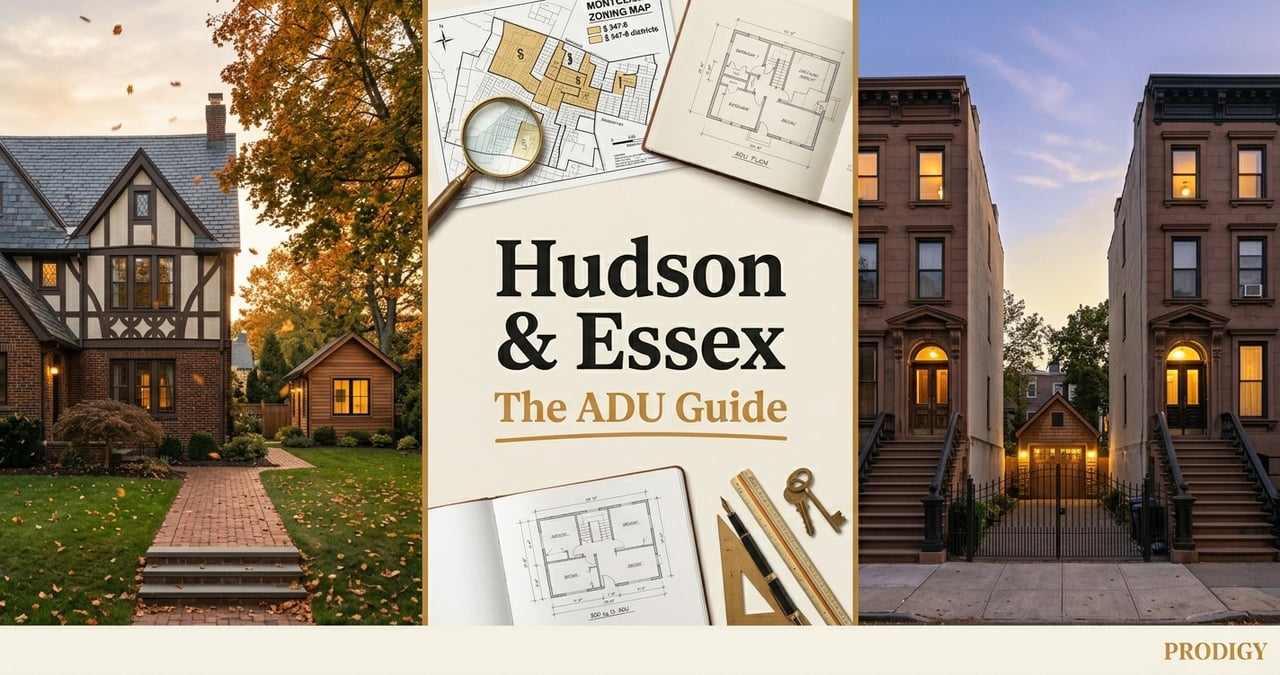
By Anthony Licciardello, The Prodigy Team
NYS/NJ Licensed Broker · Union, Long Branch & Monmouth Coastal Specialist · Series Part 2 of 5
Montclair median home prices closed at $1.4M in March 2026, up 42.1% YoY. Maplewood ZHVI: $811K, up 2.2% YoY, with homes going pending in 11 days. Downtown Jersey City: $875K median, $794/sf, up 20.7% YoY. These are the towns where ADU ordinances are not just on the books — they're being used. If you own in Hudson or Essex County, you're standing in the most ADU-friendly corner of New Jersey, and the data behind those medians is partly a story about smart density that lets a primary home support an income unit on the same lot.
This is part 2 of our five-part series. Part 1 covered the statewide landscape. Here we walk through the towns where the rules are most favorable, what each ordinance actually says, and where homeowners trip up. Cross-reference with Where NYC Buyers Are Moving in New Jersey — these are the same towns NYC migrants are buying into, and ADUs are part of why the entry math works.
|
$1.4M Montclair Median +42.1% YoY · March '26 |
$811K Maplewood ZHVI 11 days to pending |
$794/sf Downtown JC +5.2% YoY price/sf |
800 sf Max ADU Size Maplewood & Montclair |
Jersey City passed a major rezoning in late 2023 that explicitly added ADUs as a permitted accessory use in residential zones. The relevant provisions are in Chapter 345 of the Land Development Ordinance. Citywide median is $705K (March 2026), up 2.5% YoY. Downtown is on a different curve entirely: $875K median, +20.7% YoY, with the price-per-square-foot at $794. That premium is partly NYC migration, partly downtown amenity density — and partly the fact that an ADU-permitted lot in Jersey City carries optionality that most NJ properties don't.
| Jersey City ADU Rule | What It Says |
|---|---|
| Permitted zones | RH-1, RH-2, R-1, R-2 |
| Quantity | One ADU per lot, regardless of lot size |
| Form | Must be in a separate accessory structure — not within the main house |
| Garage conversion | Detached garage: yes. Attached/ground-floor garage: requires conditional-use approval (separate process) |
| Code compliance | NJ Uniform Construction Code, including safe egress from every floor |
⬢ Owner Note
Jersey City's ordinance does not allow you to convert space inside your existing principal house into an ADU. If you want to add a unit to your main building, you're looking at the Affordable Housing Overlay or other density mechanisms — not the ADU pathway. Practical first step: Submit a Zoning Determination Letter (ZDL) request through the Jersey City Online Permitting and Licensing Portal. Modest cost, ~10 business day turnaround, written confirmation of what's permitted on your specific lot.
The rest of Hudson County: Hoboken, Bayonne, Union City, Weehawken, and West New York have not adopted dedicated ADU ordinances as of mid-2026. Hoboken's dense brownstone landscape leaves most lots with no room for a detached ADU anyway. In Bayonne and the others, a homeowner would need a use variance — significantly higher bar. If you own in one of these towns and want to add a unit, your better paths are usually a duplex/triplex conversion under existing density rules or a redevelopment plan, not an ADU.
Maplewood was an early adopter — Article IX of Chapter 271 was added in October 2020 and amended in January 2021. The Maplewood market is one of the tightest in Essex County: ZHVI of $811K, homes going pending in 11 days. The combination of NJ Transit Midtown Direct, a walkable downtown, and a permissive ADU ordinance makes it a textbook example of how zoning flexibility shows up in property values.
| Maplewood Rule | Specific Standard |
|---|---|
| Permitted zones | R-1-4, R-1-5, R-1-7, R-2-4 (detached one-family residences) |
| Maximum size | Lesser of 800 sq ft or 40% of principal dwelling living area |
| Minimum size | 300 sq ft, max 2 bedrooms, max 3 occupants |
| Cellar | Cannot be located in a cellar |
| Owner-occupancy | Either ADU or primary dwelling must be the domicile of the property owner |
| Exterior materials | Attached ADU must use same exterior materials and colors as principal dwelling |
| Decks/balconies | Not permitted on the ADU |
| Accessibility bonus | +5% floor area for fully handicapped-accessible ADUs (Barrier Free Sub Code) |
| Annual compliance | Owner's annual affidavit of continued compliance (§ 271-93) |
| Title transfer | New owners must reapply within 60 days of title transfer (§ 271-95) |
| CO fee | $100; violations $500/day |
| Historic properties | Require certificate of appropriateness from Historic Preservation Commission |
⬢ Owner Note
The 40%-of-principal cap is the binding constraint on smaller homes. On a 1,500 sq ft Maplewood Tudor, your ADU ceiling is 600 sq ft — not 800. Run the math on your specific square footage before assuming you get the full 800. Maplewood originally required occupants to be 62+; that restriction has been removed. The matching-materials rule remains a friction point and Council members have flagged it for possible relaxation.
Montclair median home prices hit $1.4M in March 2026, up 42.1% year-over-year. Per-foot pricing was actually down 11.3% — meaning the buyer composition shifted up-market faster than the underlying square-foot pricing did. Larger homes selling. The town's ADU ordinance is § 347-8 (Ord. No. O-22-27), adopted in early 2023, applicable to one- and two-family dwellings in R-O, R-O(A), R-1, and R-2 zones.
| Montclair Rule | Specific Standard |
|---|---|
| Permitted zones | R-O, R-O(A), R-1, R-2 (one- and two-family dwellings) |
| Size cap | Lesser of 800 sq ft or 40% of principal dwelling; 300 sq ft floor |
| Room count | No more than 3 rooms, excluding kitchen and bathroom |
| Detached length/width | Cannot exceed 40 feet in any one direction |
| Owner-occupancy | Required (owner in primary or ADU; for two-family, in one of three units) |
| Parking | One off-street space required for the ADU |
| Sale | ADU cannot be sold independent of primary dwelling |
| Disclosure | Property listing must disclose ADU presence |
| Accessibility bonus | +5% size for fully handicapped-accessible ADUs |
| Process | Property survey + architect-prepared plan; Zoning Officer meeting within 10 business days; annual affidavit of continued compliance |
"ADUs help older adults to age in place by providing an accessible dwelling, housing a caretaker, or providing rental income, and ADUs can give young adults the opportunity to move into or return to the communities they grew up in but might be priced out of."
— Christina Kata · Regional Plan Association · NJ Senate Testimony
Department of Planning & Community Development: 973-509-4954. Property tax treatment is a known open question — your tax bill will likely change once an ADU is built, but how much depends on configuration and whether utilities are separately metered. Build a property tax reassessment into your financial model.
⬢ Anthony Licciardello
A property's ADU eligibility — or its existing legal ADU — is a real comp variable in 2026. When you list with me, that optionality gets priced into the marketing strategy from day one.
|
✓ NY → NJ Pipeline Direct relationships with active Manhattan, Brooklyn, and tri-state buyers searching for NJ properties with rental income optionality. |
✓ YouTube Reach One of the largest real estate YouTube channels in NJ — qualified buyers who already understand ADU economics. |
✓ Zoning Literacy I read the actual ordinance. Your property's eligibility is documented in the listing, not glossed over. |
Call/Text: (718) 873-7344 · Schedule: ProdigyRE.com
Free home valuation. No pressure. Just real numbers from someone who works this market every day.
South Orange Village adopted its ADU ordinance in February 2023. Provisions live in § 185-176B (Chapter 185, Land Development). The ordinance is structurally similar to Maplewood's but with its own twist on dimensional rules — a tighter 750 sq ft maximum but an explicit prohibition on basement, cellar, and attic ADUs.
| South Orange Rule | Specific Standard |
|---|---|
| Permitted zones | RA-50, RA-60, RA-75, RA-100, RB (detached single- or two-family) |
| Size range | 350–750 sq ft, must be less than principal dwelling, max 2 bedrooms |
| Location prohibitions | Cannot be in basement, cellar, or attic |
| Setbacks | Must meet principal-building setbacks (no less than 10 ft new / 7 ft existing) |
| Detached siting | Cannot be forward of front wall of principal; 20 ft from principal; 10 ft from any other accessory structure |
| Height | Maximum 25 ft |
| Owner-occupancy | Required; common ownership with principal |
| Short-term rentals | Prohibited |
| Parking | One additional off-street space required |
Practical first step: The Village consolidates ADU information at southorange.org/960. A zoning permit is submitted via the Village's GovPilot online portal. Existing ADUs that pre-date the ordinance are grandfathered, but modifications trigger compliance with current rules.
East Orange has had an ADU provision in its zoning ordinance (Chapter 51) for years, predating the modern ADU movement. Article XVII permits "one accessory dwelling unit in an accessory building, limited in size to not more than 25% of the principal building not including the cellar." The provision is older and narrower than Maplewood's or Montclair's. ADUs are conditionally permitted, subject to Planning Board approval, with restrictions on occupancy, entrance placement, and parking. The practical first step is a written zoning verification from the East Orange Zoning Department ([email protected]; $25 fee).
Newark rewrote its zoning ordinance comprehensively on November 1, 2023 (Ord. No. 6PSF-E, Title XLI), with amendments in September 2024. Accessory buildings and structures in residential zones are governed by §§ 41:5-6-1 through 41:5-6-3:
| Newark Zone | Accessory Building Footprint Cap | Other Limits |
|---|---|---|
| R-1 | Lesser of 1,000 sq ft or 20% of principal structure footprint | 20-ft height max; 3.5-ft setback from non-front lot lines |
| R-2 / R-3 | Cannot exceed 40% of principal structure footprint | Same height/setback rules; 10 ft from secondary front lot line |
| R-4 / R-5 / R-6 | Different bulk standards under § 41:5-6-2 | Confirm with Zoning Office for current interpretation |
⬢ Owner Note · Newark
Newark added ADUs to its master plan as part of a broader housing strategy. Many older Newark homes already contain unauthorized accessory apartments — the new framework is partly a way to bring them into compliance. If you own in Newark, the practical question is often "can I legalize what's already there?" rather than "can I build new?" The post-2023 zoning rewrite is still being interpreted in practice. Don't rely on third-party blog summaries (including this one) for specific size/use caps; pull the current code section for your zone and confirm with city staff via newarkportal.us.
Other Essex towns (Bloomfield, Belleville, Nutley, Livingston, West Orange, Verona) are largely silent on ADUs. A homeowner there would need a variance — covered in Post 3, where the variance path is the dominant scenario.
|
Mistake #1 Cross-Town Assumptions |
Assuming Jersey City rules apply elsewhere in Hudson, or that Maplewood rules apply in West Orange. They don't. A friend's ADU in the next town tells you nothing about your lot. |
|
Mistake #2 Underestimating HPC |
In Maplewood, Montclair, and parts of South Orange, properties in historic districts have an extra approval layer that can add months and meaningful design constraints. Talk to the HPC before talking to a contractor. |
|
Mistake #3 Airbnb Math |
Every Hudson/Essex town with an ADU ordinance prohibits short-term rentals. If your model assumes nightly rates, your model is broken. ADUs are 30+ day tenancies only. |
⬢ The Real Estate Reality
For a detached new-build ADU in Hudson or Essex County, expect $250,000–$400,000 all-in (construction, plans, permits, utility hookups, landscaping, finishes). Conversions of existing structures land lower. Construction labor in these counties runs 15–25% above the state average. The math still works because rents are high — a properly executed 750 sq ft ADU in Maplewood, South Orange, or central Jersey City can pull $2,500–$3,500/month long-term, which underwrites a meaningful portion of a typical $300K build cost over a 10–15 year hold.
Q
Jersey City, Maplewood, Montclair, and South Orange have the most modern, homeowner-friendly ordinances. East Orange has an older provision still on the books. Newark rewrote its zoning in 2023 with accessory-building provisions that may evolve into a more explicit ADU framework. Other Essex towns (Bloomfield, Belleville, West Orange, Livingston, Nutley, Verona) and most Hudson cities outside Jersey City are largely silent and require a variance.
Q
Both towns cap the ADU at the lesser of 800 sq ft or 40% of the principal dwelling's living area, with a 300 sq ft floor. On a 1,500 sq ft house, that's a 600 sq ft ceiling — not 800. Always run the math against your specific principal-dwelling square footage.
Q
Not under Jersey City's ADU ordinance — it requires the ADU to be in a separate accessory structure. If you want to add a unit inside your existing principal house, you're looking at the Affordable Housing Overlay or other density mechanisms, not the ADU pathway. Pull a Zoning Determination Letter for your specific lot before designing anything.
Q
In Maplewood, Montclair, South Orange, and Jersey City, yes — buyers actively price the income-unit optionality. Permitted, legal ADUs with documented compliance histories command a premium over comparable properties without one. Unpermitted basement apartments are the opposite — they're a liability that buyers' agents will discount or use to renegotiate.
Q
Yes. Every Hudson/Essex town with a modern ADU ordinance — Jersey City, Maplewood, Montclair, South Orange — requires owner-occupancy of either the principal dwelling or the ADU. This rules out the pure-investor playbook of buying, building an ADU, and renting both units. The ordinance is structured to keep ADUs in owner-occupied housing stock, not turn neighborhoods into rental portfolios.
If you're in Jersey City, Maplewood, Montclair, South Orange, or East Orange, request a Zoning Determination Letter or zoning verification for your specific lot before doing anything else. It's the cheapest, fastest way to get a written answer from the municipality. If you're in Newark, schedule a pre-application meeting with the Zoning Office before designing anything. If you're in a silent Essex town, the variance path is your only option short of waiting on S-1786. Related reading: Post 1 — The NJ ADU Playbook · Post 3 — Union and Middlesex · Where NYC Buyers Are Moving in NJ · The NJ Housing Market Is Splitting in Two.
About the Author
 |
NYS/NJ Licensed Broker · The Prodigy Team 20+ years and 5,000+ closed transactions. Long Branch and Monmouth coastal corridor specialist. ProdigyRE.com. |
Prodigy Real Estate is an innovative real estate company offering high-end video production, home valuation services, purchasing, and home sales. Serving New York and New Jersey.