
Anthony Licciardello | May 9, 2026
ADU New Jersey
By Anthony Licciardello, The Prodigy Team
NYS/NJ Licensed Broker · Long Branch & Monmouth Coastal Specialist · Series Part 1 of 5
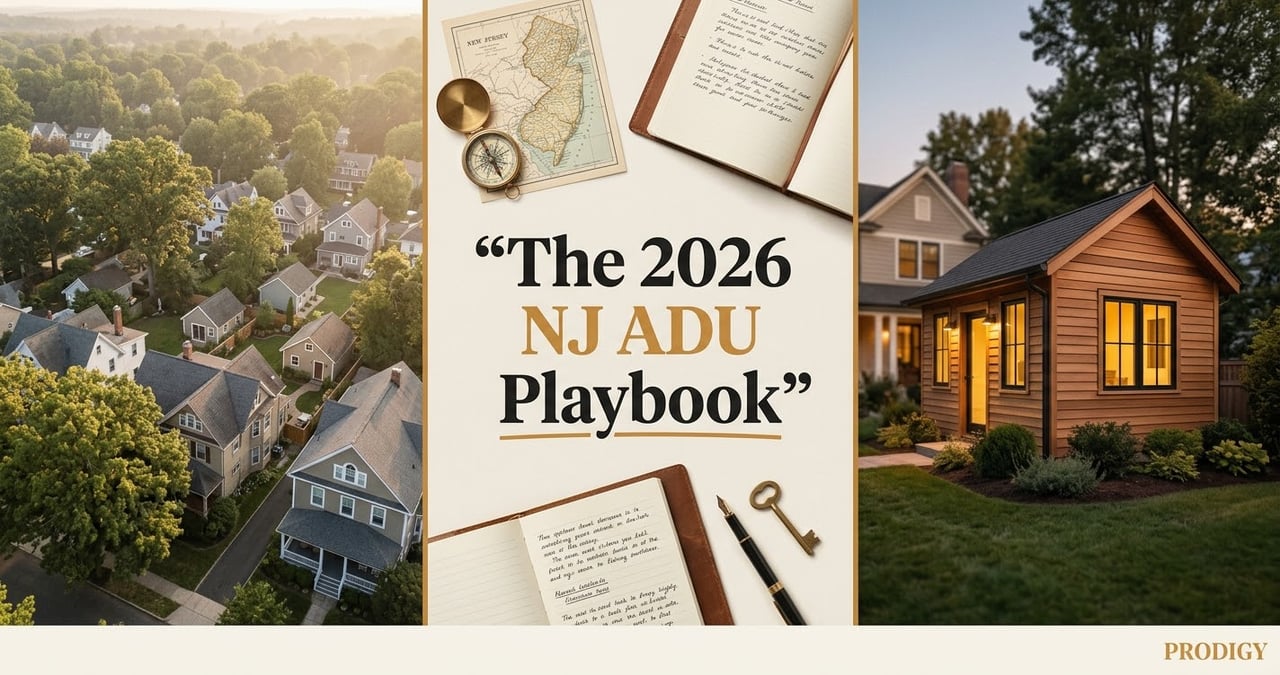
Six New Jersey counties. 564 zoning codes. One pending state bill that could change all of them in a 90-day window. The accessory dwelling unit market in 2026 is the most fragmented housing opportunity in the state — and the most overlooked. Median NJ home prices crossed $545,700 in March 2026, up 3.8% year-over-year, with 43.8% of homes selling above list. Inventory is up 10.6% YoY but still historically tight (and the 2027 supply cliff is going to make it tighter). Against that backdrop, a permitted ADU can deliver $2,000–$3,500 per month in long-term rental income on a $200K–$400K build cost. The catch is that whether you can build one depends almost entirely on which side of a town line you're standing on.
This is part 1 of a five-part series for homeowners across Middlesex, Union, Hudson, Essex, Monmouth, and Somerset counties. Before we walk through the towns, you need a working map of how ADU regulation in New Jersey actually functions. Get this part right and the rest of the series — and your conversation with your zoning officer — will make a lot more sense. Related reading: The New Jersey Housing Market Is Splitting in Two.
|
564 NJ Municipalities Each writes its own ADU rules |
~6 Towns Friendly to ADUs In our 6-county area |
$200K+ Detached ADU Build 2026 NJ ranges |
S-1786 Pending Preemption Singleton, 2026–27 session |
An accessory dwelling unit is a second, fully self-contained home on a lot already occupied by a single- or two-family house. It has its own kitchen, its own bathroom, and its own entrance. The legal threshold is independent living facilities — meaning someone could move in and live there without using the main house's kitchen or bathroom.
Common forms include a finished apartment above a detached garage, a converted basement with a separate exterior entrance (where local code allows it — many do not), a backyard cottage built from scratch, or an attached in-law suite carved out of an existing home. An ADU is not a finished basement rec room, a pool house with a wet bar, or a home office. Once a space crosses into "dwelling unit" territory, it's regulated by zoning law, the New Jersey Uniform Construction Code, and (in many towns) a separate ADU ordinance.
⬢ Owner Note
Search your local zoning code for "accessory dwelling," "accessory apartment," "ADU," "in-law suite," or "second dwelling unit." Different municipalities use different terminology for the same legal concept. The ones that have actually adopted modern ordinances usually use "accessory dwelling unit" or "ADU" — towns still using older language like "accessory apartment" often have narrower, more restrictive provisions.
There is no statewide law in 2026 that requires New Jersey municipalities to allow ADUs. Every town sets its own rules. Some have detailed, modern ADU ordinances. Many are silent — which usually means an ADU isn't a permitted use and would require a variance. A few effectively prohibit them outright.
Two state-level developments matter for your timeline:
The 2024 Mount Laurel/Fair Share reform. In March 2024, Governor Murphy signed P.L. 2024, c.2 (A-4/S-50), the most significant overhaul of New Jersey's affordable housing framework in decades. The law abolished the Council on Affordable Housing, codified a methodology for calculating each municipality's affordable housing obligation, and set binding deadlines through 2025–2026 for towns to adopt Housing Elements and Fair Share Plans. The Department of Community Affairs' implementation initiative, NJHOMES (NJ Housing Opportunities for Municipal Equity and Success), specifically lists ADUs as one of the housing forms it will support municipalities in developing. The practical effect: as towns rewrite their Fourth Round housing plans, many are looking at ADUs as a tool to help meet their obligations.
The preemption bills. Senator Troy Singleton has been the lead sponsor on a series of bills that would force every municipality to allow ADUs as of right on single- and two-family lots. The most recent version, S-2347 (combined with S-1106), was amended on the Senate floor in June 2025 but did not pass before the session ended. The current vehicle is S-1786, introduced in the 2026–27 session.
"Jersey City, Maplewood, Montclair, Newark, Princeton, and South Orange have recently passed ADU ordinances. While we applaud their initiative, tackling ADUs town by town is a piecemeal approach that can be confusing for residents."
— Christina Kata, NJ Policy Associate · Regional Plan Association · S-2347 Testimony
Key proposed standards across the preemption bills: a minimum 300 sq ft, a 5-foot setback, no required additional parking (or no parking required at all if within ½ mile of public transit), no required fire sprinklers if the main house doesn't have them, and a 60-day ministerial review window with deemed approval if the municipality misses the deadline. The New Jersey League of Municipalities is actively opposing the bills on home-rule grounds.
If preemption passes, the landscape changes. Until it does, you're operating under the local rules.
Before you spend a dollar on an architect, walk through this sequence:
|
Step 1 Find Your Zoning District |
Pull up your municipality's online zoning map (most are on the town's website under Planning, Zoning, or Land Use). Search by address. Note your zone — something like R-1, R-2, RH-1, RA-50, etc. |
|
Step 2 Pull the Local Ordinance |
Most NJ municipal codes are on eCode360 or municipalcodeonline.com. Search the document for "accessory dwelling," "accessory apartment," "ADU," or "in-law suite." |
|
Step 3 Identify Your Bucket |
Permitted use (Jersey City, Maplewood, Montclair, South Orange, East Orange, Asbury Park) · Conditional use (Planning Board approval required) · Silent or prohibited (use variance from Zoning Board of Adjustment). |
|
Step 4 Call the Zoning Officer |
The single most useful 15-minute call you'll make. Ask: are ADUs permitted in my zone? What are the bulk and use standards? What's the application process? Get a name and a written confirmation if available. |
Once ADUs are at least theoretically permitted, the project's feasibility comes down to five answers. Every town's ordinance handles them differently:
| Question | 2026 Coverage-Area Range | Why It Matters |
|---|---|---|
| Maximum size | South Orange 750 sq ft → Maplewood/Montclair 800 sq ft (with 40%-of-principal cap) | On a 1,500 sq ft house, the 40% cap is the binding constraint, not the absolute number |
| Setbacks | 5–10 ft side/rear typical | Determines whether your lot can physically fit a detached ADU |
| Owner-occupancy | Required in nearly every NJ ADU ordinance | Kills the "buy a duplex, ADU it, rent both" investor playbook |
| Short-term rentals | Banned in Asbury Park, Jersey City, Maplewood, Montclair, South Orange | If your model assumes Airbnb/VRBO income, your model is broken |
| Parking | 0–1 additional space; some towns allow tandem driveway use | If you have a driveway, this is usually solvable |
|
$80–180K Basement / Attic Where allowed |
$120–220K Garage Conversion Most common path |
$200–400K+ Detached New Build Backyard cottage |
$2–3.5K Monthly Rent Typical NJ ADU |
Add architectural plans ($5K–$15K), permit fees ($1,500–$5K), surveying ($1,500–$3K), utility connection fees if a separate meter is required (several thousand each), and a property tax reassessment after completion. Construction labor in Hudson and Essex runs 15–25% above the state average. We'll break down the financing menu in Post 5.
⬢ Anthony Licciardello
The buy-or-build decision shifts when you have real numbers on lot suitability, current comps, post-build appraisal lift, and the rent stack your specific neighborhood will support. I work with homeowners across all six counties in this series.
|
✓ Lot Feasibility Setbacks, accessory-structure rules, and which ADU configurations actually fit your property. |
✓ Local Comps Real rent rolls and post-build appraisal lift from properties in your zip code. |
✓ Architect Network Vetted referrals for licensed NJ architects and registered home improvement contractors. |
Call/Text: (718) 873-7344 · Schedule: ProdigyRE.com
Free home valuation. No pressure. Just real numbers from someone who works this market every day.
|
Post 2 Hudson + Essex |
The friendliest counties. Verified ordinances for Jersey City, Maplewood, Montclair, South Orange, East Orange, and the post-2023 Newark zoning rewrite. |
|
Post 3 Union + Middlesex |
Mostly silent territory. Use-variance economics ($15K–$40K, 4–9 months), the legalize-existing-two-family path, and the wait-for-S-1786 calculation. |
|
Post 4 Monmouth + Somerset |
Asbury Park's pioneering ordinance with the $20K–$35K affordable ADU grant program, and the suburban Somerset reality where ADUs require variances. The shore-town flood-zone twist. |
|
Post 5 The Roadmap |
From idea to certificate of occupancy. Financing menu, contractor selection, contract terms that matter, the seven mistakes that derail projects. |
⬢ The Real Estate Reality
Two things can be true at once. New Jersey's ADU framework is a confusing patchwork that punishes homeowners who don't do their homework — and a permitted ADU in the right town is one of the highest-yielding capital improvements you can make to a residential property in 2026. The towns that figured it out (Maplewood, Montclair, South Orange, Asbury Park) are seeing measurable price-per-square-foot premiums. The ones still on the sidelines are the ones the state legislature wants to force into compliance.
Q
No. There is no statewide law in 2026 requiring municipalities to allow ADUs. Each of New Jersey's 564 municipalities sets its own rules. In our 6-county coverage area, roughly six towns have modern, homeowner-friendly ADU ordinances; most others are silent (effectively prohibitive) or restrictive. Always confirm with your municipal zoning officer before designing anything.
Q
S-1786 is the current preemption bill in the 2026–27 New Jersey Senate session, sponsored by Senator Troy Singleton. If passed, it would force every municipality to allow ADUs as of right under uniform statewide standards (300 sq ft minimum, 5-foot setbacks, 60-day ministerial review). Predecessor versions (S-2347, S-1106) have not passed. The League of Municipalities is opposing on home-rule grounds.
Q
Almost never. Every NJ town with a modern ADU ordinance — Asbury Park, Jersey City, Maplewood, Montclair, South Orange — explicitly bans short-term rentals. The minimum rental term is typically 30 days. If your project's financial model assumes nightly rates, the model is broken. ADUs are long-term housing.
Q
Yes. New Jersey assessors are systematic. Expect a property tax reassessment after CO is issued. The actual dollar increase depends on the size of the unit, your municipality's mill rate, and whether utilities are separately metered. Typical range in our coverage area: $1,500–$5,000 per year added to your bill. Build it into your model.
Q
If your town already has a workable ADU ordinance, no — you have a clear path right now. If your town is silent and you don't have a pressing reason to build, watching the legislation through 2026 is reasonable. Predecessor bills have stalled, but the Mount Laurel reform (P.L. 2024, c.2) gives towns reasons to permit ADUs even without state preemption. Do not, however, delay if your project is driven by family need (aging parent, multigenerational arrangement) — variance paths are slow but viable.
In 2026, building an ADU in New Jersey is legal, viable, and increasingly common — but only if you start with your local rules and treat the state-level conversation as the slow-moving backdrop it is. The single biggest mistake homeowners make is assuming their neighbor's situation in the next town tells them anything about their own lot. Two zoning maps, two outcomes. Read the next four posts in this series before you sign anything. Related reading: Post 2 — Hudson and Essex Counties · Post 3 — Union and Middlesex · Post 4 — Monmouth and Somerset · Post 5 — From Idea to Certificate of Occupancy · The New Jersey Housing Market Is Splitting in Two.
About the Author
 |
NYS/NJ Licensed Broker · The Prodigy Team 20+ years and 5,000+ closed transactions. Long Branch and Monmouth coastal corridor specialist. ProdigyRE.com. |
Prodigy Real Estate is an innovative real estate company offering high-end video production, home valuation services, purchasing, and home sales. Serving New York and New Jersey.