
Anthony Licciardello | April 15, 2026
New Jersey
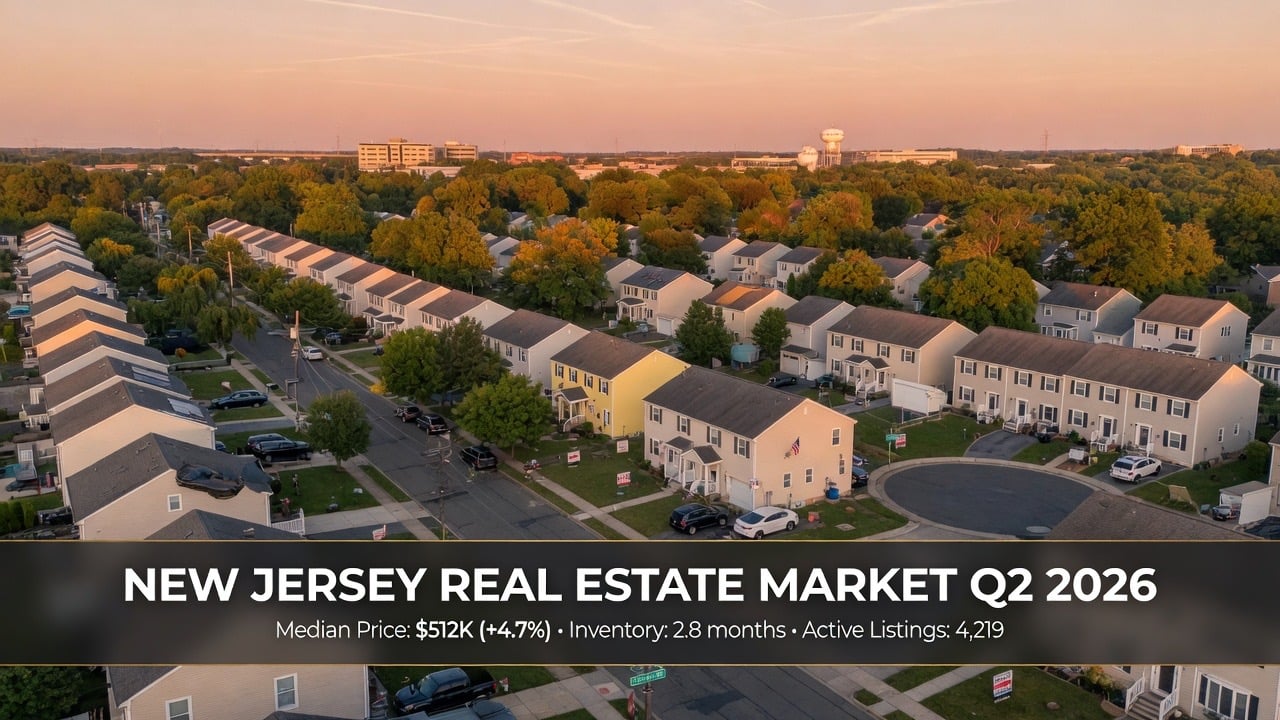
What follows is not a headline summary. It is a structural analysis of the statewide New Jersey housing market as it stands heading into Q2 2026 — segmented by property type, explained through the data, and translated into strategy for buyers and sellers operating in this market right now.
The statewide median home price in New Jersey reached approximately $531,000 to $539,300 entering the second quarter of 2026 — a 3.6% to 4.8% year-over-year increase. On the surface, that looks like a healthy, appreciating market. And it is. But the story the aggregate tells is not the story playing out street by street.
Active inventory climbed 11.2% year-over-year heading into the spring selling season — the most meaningful supply expansion the state has seen since 2022. Meanwhile, the average days on market expanded from historical lows around 38 days to a more normalized 55 to 60 days statewide. Both of those shifts sound, on paper, like market cooling. They are not — or at least not in any uniform way.
What they actually signal is the end of the pandemic-era market, in which buyers waived everything and sellers priced with impunity. What has replaced it is what analysts are calling the "Extra Time" market: a period of deliberate, methodical decision-making in which buyers are executing real due diligence, comparison-shopping across multiple properties, and using extended market time as negotiating leverage. The market now rewards precision. It penalizes wishful pricing.
That distinction matters enormously for anyone preparing to list or buy in New Jersey this year. Broad statewide appreciation is still real and ongoing. But the mechanics of how you achieve that appreciation — on both the buy side and the sell side — are entirely different from what they were two years ago.
Throughout late 2025 and into Q1 2026, mortgage rates stabilized near the 6.1% mark. After three years of extreme volatility — from sub-3% pandemic lows to near-8% peaks in late 2023 — that stabilization has itself become a market driver. Buyers who spent two years frozen by uncertainty have begun accepting 6.1% as the baseline. A $200 billion Federal Reserve allocation into mortgage-backed securities acted as a structural stabilizing force, preventing further rate spikes and establishing a new borrowing plateau.
The panic buyer of 2021 and 2022 — who waived appraisal contingencies, skipped inspections, and submitted offers sight unseen — has been replaced by a methodical buyer who comparison-shops across multiple properties, uses extended market time as leverage, and pushes back on any pricing that cannot be defended with closed-sale data. Decision timelines are longer. Negotiating posture is more assertive. The dynamic is not favorable or unfavorable across the board — it depends entirely on what you are selling and how accurately it is priced.
The single most consequential data point to understand this shift: homes priced more than 5% above their defensible market value are averaging 82 days on market — and are still ultimately selling for less than they would have under a correctly priced initial strategy. The overpricing penalty is no longer theoretical. It is showing up in closed-sale records, and it compounds over time as accumulated days on market trigger buyer skepticism and require successive price reductions.
For a deeper look at how rate movements translate directly into buyer behavior and transaction volume, see our analysis: The Rate and Sales Feedback Loop: What Mortgage Data Actually Tells Us About the Housing Market.
Here is the central paradox of the New Jersey housing market in 2026: inventory is rising, and yet supply remains structurally insufficient. These two facts are not contradictory — they are a direct consequence of where the baseline was set.
The 11.2% year-over-year inventory gain sounds substantial. But it is measured against a baseline that sits approximately 22% below pre-pandemic supply levels. In other words, New Jersey entered spring 2026 with more homes than a year ago — but far fewer than it had in 2019. The uptick in listings is not closing that gap. It is chipping at it.
The primary cause is the lock-in effect. A large share of New Jersey homeowners refinanced into sub-4% mortgages during the 2020 and 2021 boom. Trading that rate for a 6.1% purchase loan — on a home that now costs more — represents a significant monthly payment increase even when moving laterally on price. Many of those homeowners have made a rational financial calculation: they are staying put.
The practical result is that the homes currently coming to market represent motivated sellers — estates, job relocations, upsizing families, divorces, and life-change moves — rather than the casual or opportunistic listing activity that characterizes a fully normalized market. That distinction keeps demand-to-supply ratios elevated even as total inventory climbs incrementally from its historical trough.
To understand where New Jersey's housing market stands in 2026, you have to zoom out and look at what has happened to the suburban price floor over the past decade. New Jersey's suburbs have appreciated 86% over the last ten years — roughly double the 43% appreciation rate recorded by New York City itself over the same period. That gap is not incidental. It reflects a fundamental re-rating of what New Jersey suburbs are worth to the buyers choosing them over city living.
As of early 2026, nearly 100 communities across New Jersey carry median home prices above $1 million — a dramatic expansion from roughly one in ten markets a decade ago. The wealth density of New Jersey's suburb-to-city migration corridor has been fundamentally restructured by a decade of compounding appreciation.
The more critical shift is what has happened at the entry level. In 2016, approximately 61% of New Jersey's suburban communities were priced below $500,000 — providing an accessible ramp for first-time buyers into homeownership. As of early 2026, that figure has collapsed to roughly 8%. The sub-$250,000 market has essentially ceased to exist in any meaningful volume statewide.
This is not a temporary pricing anomaly. The decade-long appreciation has permanently raised the floor of the market. First-time buyers who cannot compete for the vanishing supply of sub-$500,000 single-family homes are being channeled into attached housing — which, as the next section shows, carries its own mounting affordability crisis.
The most consequential analysis failure anyone can make in 2026 is treating New Jersey residential real estate as a single market. It is not. NJ REALTORS® February 2026 data reveals that the state's three primary housing segments are operating under entirely different supply, demand, and pricing mechanics — and the gaps between them are widening.
| Segment | Median Price | YoY Price | Inventory | YoY Inventory | Days on Market | YoY DOM |
|---|---|---|---|---|---|---|
| Single-Family | $558,000 | +5.3% | 8,860 units | −5.6% | 48 days | +2.1% |
| Townhouse / Condo | $407,792 | +0.1% | 3,943 units | +4.5% | 50 days | +16.3% |
| Adult Communities (55+) | $375,000 | +5.6% | 1,417 units | +14.6% | 54 days | +17.4% |
* NJ REALTORS® Monthly Indicators, February 2026.
Single-Family: Still a Seller's Market — but a Precise One
Single-family homes remain the dominant and most competitive segment in the state. Despite total closed sales falling 9.5% year-over-year to 2,827 transactions, the median sales price climbed 5.3% to $558,000. The driver is scarcity — inventory in this segment actually contracted 5.6%, leaving just a 1.9-month supply at the current sales pace. The average sale price in the segment ($717,314) rose at a faster 4.8% clip than the median, confirming that larger, premium-tier single-family homes are clearing quickly and pulling aggregate figures upward. Fewer homes are entering the market and fewer are closing — but the homes that do trade are still commanding historically elevated valuations.
Townhouse and Condo: The Affordability Ceiling Has Been Hit
The attached housing segment tells a sharply different story. Closed sales dropped 17.4% year-over-year to just 976 transactions — the steepest volume decline of any segment in the state. The median price barely moved, gaining a nominal 0.1% to $407,792. Days on market climbed 16.3% to 50 days, and inventory expanded 4.5% to 3,943 units. Sellers in this segment have lost the pricing leverage they held even one year ago. The cause is a compounding affordability squeeze: condo and townhouse buyers — predominantly first-time buyers, downsizers, and payment-sensitive households — are simultaneously absorbing 6.1% mortgage rates, rising property taxes, and escalating HOA fees driven by insurance costs and capital reserve requirements. Even where nominal asking prices are stable, the total monthly carrying cost has crossed a threshold that is pricing buyers out or pushing them to the sidelines. Seller concessions and repair credits are becoming standard in this segment where they were essentially absent two years ago.
Adult Communities (55+): The Quiet Outperformer
The 55+ active adult segment is the market's most underreported success story. Inventory rose a substantial 14.6% to 1,417 units — but unlike the condo market, where new supply stalled pricing, demand in adult communities absorbed the additional inventory and still pushed median prices 5.6% higher to $375,000. The housing affordability index for this specific segment actually improved 7.0% year-over-year — a figure that is almost unthinkable anywhere else in the statewide data. The reason is structural: equity-rich downsizers who purchased or refinanced a decade ago have watched their suburban values climb 86%. They are arriving at the adult community market as predominantly cash buyers, deploying accumulated home equity into lower-maintenance living without engaging the 6.1% rate environment at all.
If you are selling a single-family home in New Jersey in 2026, the structural environment still favors you — but the market has attached a condition. Scarcity is still your ally. The buyers circling your home, however, are not waiving contingencies blindly. They are informed, slower-moving, and they will use any pricing error against you with precision.
The 82-day average for overpriced homes is the most important number in this section. A home priced correctly still moves quickly in this market and commands strong terms. A home priced even 5% above defensible market value accumulates stigma as days on market climb — buyers begin to wonder what is wrong with it, showings thin out, and the seller ultimately accepts a lower figure than they would have received at a well-priced launch. The time and carrying costs lost to overpricing vastly exceed whatever upside the aspirational list price was chasing.
If you are selling a condo or townhouse, the calculus is different and more demanding. Your buyer pool is financially stretched. Your competition is growing — inventory in the attached segment is up 4.5% year-over-year. Presentation quality and seller flexibility on terms are now the primary differentiators in this tier. Concessions are no longer a sign of weakness in the condo market; they are the expected cost of moving a property in a reasonable timeframe.
Before you list — whether single-family or attached — make sure you have a clear picture of your net proceeds. Our full breakdown covers every fee NJ sellers encounter at closing: New Jersey Closing Costs: What Buyers and Sellers Are Really Paying in 2026.
The "Extra Time" market is real — and if you are buying in New Jersey in 2026, you should use it strategically. The window of deliberate decision-making that now exists in most segments of the market is not an invitation to stall. It is an invitation to do the analysis that was impossible in 2021. Use it.
In the condo and townhouse market, buyers have real, quantifiable leverage. Inventory is building. Days on market are extending. The 0.1% median price growth means sellers in this segment cannot afford to be stubborn. This is the corner of the market where a well-represented buyer can negotiate meaningful concessions, repair credits, and closing cost contributions that were simply not available in previous cycles. Push back. The data supports it.
In the single-family market, the calculus reverses entirely. With only 1.9 months of supply and inventory contracting — not expanding — well-priced single-family homes in desirable corridors are still averaging 48 days or fewer on market and drawing competitive offers. The extended average market time statewide does not apply uniformly. Buyers who have done their homework and are pre-approved need to be ready to move decisively when the right property surfaces. Deliberation is appropriate; delay is not.
Finally: waiting for a significant price correction in the single-family segment is not a strategy that the data supports. The lock-in effect is structural, not cyclical. The homeowners who might list are not coming to market because they have no financial incentive to trade their rate. Until mortgage rates fall meaningfully — and there is no current signal that they will in the near term — the inventory flood that would trigger a correction is not coming. Buyers who wait for that moment are likely to wait through more appreciation.
If you are relocating from New York City and evaluating which New Jersey county makes the most financial and lifestyle sense, see our full breakdown: Where NYC Buyers Are Moving in New Jersey: A County-by-County Breakdown.
Ready to make your move in New Jersey?
Whether you are buying, selling, or simply running the numbers, Prodigy Real Estate works with buyers and sellers across Monmouth County, Union County, and Staten Island. Call or text (718) 873-7345 for a no-pressure consultation.
ProdigyRE.com | Independent. Hyperlocal. Data-Driven.
Q
Is the New Jersey housing market going to crash in 2026?
The data does not support a crash scenario. Total inventory remains approximately 22% below pre-pandemic levels despite an 11.2% year-over-year increase entering spring. The lock-in effect — homeowners holding sub-4% mortgages from the 2020–2021 refinancing cycle — is keeping supply structurally constrained. Prices continue to appreciate statewide at 3.6% to 4.8% year-over-year. The softening in the condo and townhouse segment is real, but it reflects a demand-side affordability ceiling, not a collapse in underlying value. The floor of this market is structurally higher than it was before the pandemic, and it is not retreating.
Q
Are New Jersey home prices still rising in 2026?
Yes — but unevenly across segments. The statewide median home price reached approximately $531,000 to $539,300 in early 2026, up 3.6% to 4.8% year-over-year. Single-family home prices rose 5.3% to a median of $558,000. Adult community prices rose 5.6% to a median of $375,000. The segment that has effectively stalled is townhouses and condos, where median price growth was nearly flat at just 0.1%. The headline appreciation number is real, but it is being driven by the single-family and 55+ segments — not by all property types equally.
Q
Is it a good time to sell a home in New Jersey in 2026?
For single-family sellers, the structural conditions remain favorable — but precise pricing is now non-negotiable. Homes priced more than 5% above their defensible market value are averaging 82 days on market and ultimately selling for less than a correctly priced strategy would have achieved at launch. For condo and townhouse sellers, the market has shifted meaningfully toward buyers. Preparation quality and willingness to offer concessions are now the primary variables determining how quickly a property sells and at what effective price.
Q
Why is New Jersey housing inventory still low if the market is slowing down?
Inventory is rising relative to the past two years — but the starting baseline was severely depleted. New Jersey's total active listings remain approximately 22% below pre-pandemic supply even after an 11.2% year-over-year increase. The primary structural constraint is the lock-in effect: homeowners who secured sub-4% mortgage rates during 2020–2021 have little financial incentive to sell, because doing so means replacing a historically low monthly payment with a 6.1% loan on their next purchase. Until rates fall meaningfully and persistently, that segment of the potential seller population is largely immobile — and the inventory flood buyers are waiting for is not coming.
Prodigy Real Estate is an innovative real estate company offering high-end video production, home valuation services, purchasing, and home sales. Serving New York and New Jersey.