
Anthony Licciardello | May 20, 2026
Staten Island
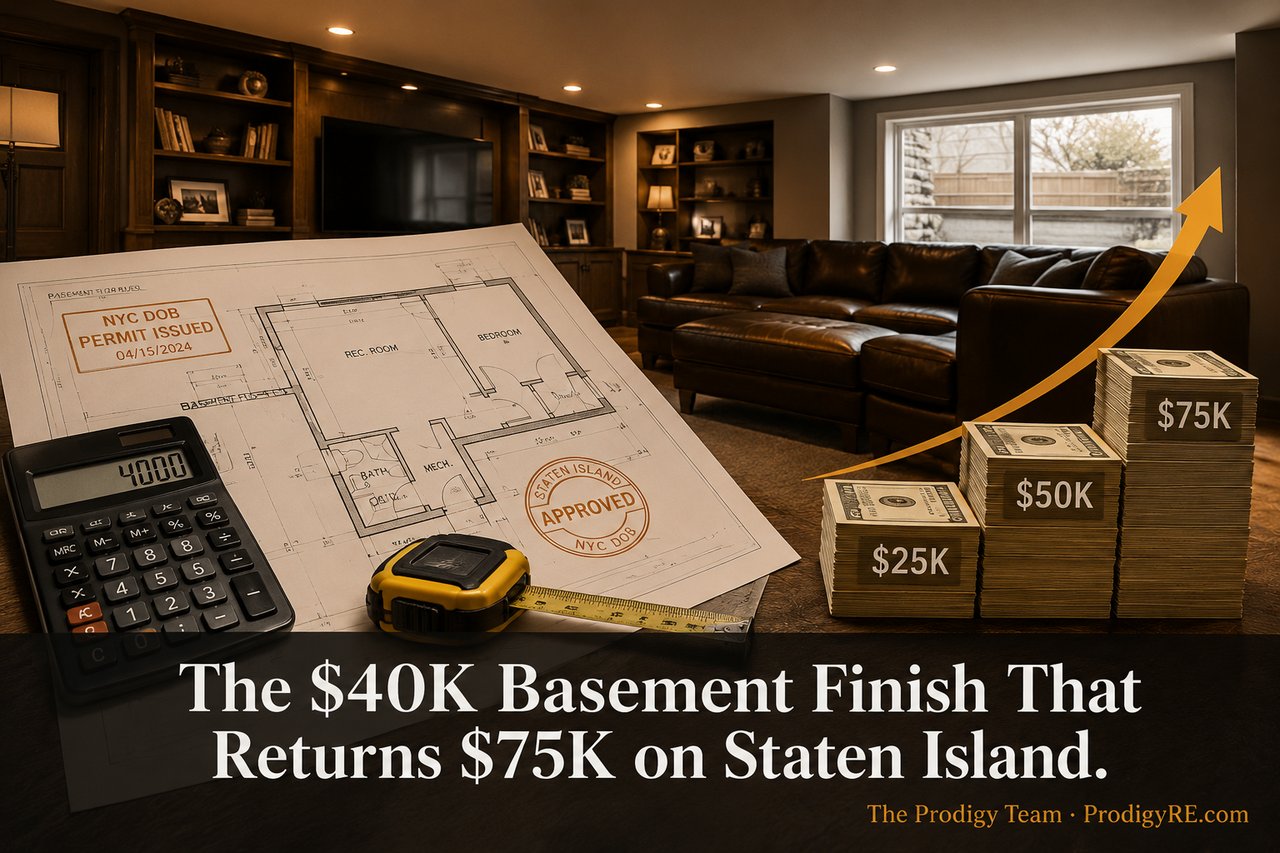
The 2026 Staten Island Basement Report · Post 2

By Anthony Licciardello, The Prodigy Team · Published May 18, 2026 · 10 min read
✦ Key Takeaways
There are very few renovations on Staten Island in 2026 that return more than they cost. Kitchens recoup roughly 70% of their cost on resale. Bathrooms hover in the same range. A $50,000 deck addition in Annadale might add $25,000 to your sale price if you're lucky. The math on most home improvement spending is, frankly, not great.
A permitted basement finish is the rare exception. In the current Staten Island market — characterized by inventory deficit, strong NYC relocator demand, and the dominance of homes with below-grade space — a properly executed basement finish typically returns 60% to 95% of its direct hard cost in immediate resale premium. The remaining recovery comes from the compounding benefit of faster sale times and the avoidance of price reductions that drag long-DOM listings down.
In Post 1 of this series, we covered why ANSI Z765-2021 removed basement square footage from the Gross Living Area column on every appraisal, and why a $25,000–$75,000 line-item adjustment now governs the appraiser's treatment of finished below-grade space on Staten Island. This post turns that framework into a homeowner's ROI calculation: what does a basement finish actually cost, what does it return, and where does the math fall apart?
The Cost Side
Before we get to the return side of the equation, the cost side needs to be honest. A "basement finish" is not one product. It is a spectrum of work that ranges from putting up drywall and laying down vinyl plank to a full permitted build-out with new electrical, separate HVAC zone, full bathroom, egress windows, and a Letter of Completion on file with the NYC Department of Buildings.
On Staten Island in 2026, here's what each tier of work typically costs for an 800–1,000 square foot basement — the size range that covers most single-family homes in Great Kills, Eltingville, and Mid-Island neighborhoods.
| Finish Tier | Scope | Typical Cost (800–1,000 SF) |
|---|---|---|
| Basic (cosmetic) | Drywall, paint, basic flooring, existing electrical, no plumbing changes | $15,000 – $25,000 |
| Mid-tier (partial) | Add half-bath, recessed lighting, upgraded flooring, partial HVAC tie-in | $25,000 – $45,000 |
| Fully permitted (full finish) | Full bath, separate HVAC zone, egress, permits, Letter of Completion | $40,000 – $80,000 |
| Premium (luxury build-out) | Wet bar, wine room, home theater wiring, custom millwork, designer finishes | $80,000 – $150,000+ |
Source: Staten Island contractor estimates compiled from active 2025–2026 Prodigy Real Estate seller consultations. Costs vary materially by ceiling height, moisture conditions, and existing electrical service capacity.
The tier that drives the strongest ROI on Staten Island in 2026 is the fully permitted middle tier — $40,000 to $80,000. That's the band where the work is substantial enough to deliver a finished family room that buyers treat as primary living space, but disciplined enough not to over-improve into territory the comps won't support.
The Return Side
As we established in Post 1, SIBOR sold data through Q1 2026 shows finished, permitted basement space adds $25,000 to $75,000 to the typical Staten Island single-family home sale price. That figure represents the direct contributory value the appraiser assigns and the market validates at the closing table.
Comparing the cost tier against the resale premium produces the recoup ratio. The math, for a homeowner deciding whether to invest in a basement finish before listing, looks like this:
| Finish Tier | Typical Cost | Resale Premium | Direct Recoup |
|---|---|---|---|
| Basic (non-permitted) | $15K – $25K | $10K – $25K | 40–60% |
| Mid-tier (partial) | $25K – $45K | $20K – $40K | ~65–80% |
| Fully permitted | $40K – $80K | $25K – $75K | 60–95% |
| Premium luxury | $80K – $150K+ | $50K – $100K | ~50–70% |
Direct recoup excludes DOM compression value and is calculated against SIBOR Q1 2026 sold-comp adjustments. Premium luxury recoup drops because over-improvement exceeds neighborhood comp ceilings.
Two patterns jump off the table. First, the fully permitted tier consistently delivers the highest direct recoup ratio. Permits are not a tax — they're the documentation that allows the appraiser to credit the full contributory value of the work. Second, premium luxury build-outs hit diminishing returns in most neighborhoods on Staten Island. A $120,000 basement build-out in a $750,000 Great Kills market doesn't sell for $200,000 more — it sells for maybe $80,000 more, because the comps in that price band don't support the over-improvement.
The Hidden Return
The recoup ratios above only capture the direct dollar premium. They miss the second — and arguably more valuable — return that a finished basement delivers: days-on-market compression. Staten Island homes with finished basements sell 15–20% faster than otherwise comparable homes without them. That speed advantage matters more than most sellers realize because of a pattern that shows up consistently in SIBOR data through 2025–2026:
The typical price erosion absorbed by listings that linger past 60–75 days on Staten Island in 2026 — driven by the first price reduction, then by the perception of "stale" inventory among buyer agents. On a $750,000 home, that's $22,500 to $37,500 of avoided loss.
A listing that closes in 14 to 21 days typically clears at or above asking. A listing that drags past 60 days almost always sees at least one price reduction, often two. The sellers who finish their basements correctly avoid that price-reduction cycle entirely — which means the true return on a basement finish is the direct premium plus the avoidance of the 3–5% drag.
Combine the two effects and the math on a $40,000–$80,000 permitted finish on a $750,000 Staten Island home looks like this: $25,000 to $75,000 in direct premium, plus $22,500 to $37,500 in avoided price erosion, for a total return of roughly $47,500 to $112,500 against an $80,000 maximum investment. That's why permitted basement work is the highest-ROI renovation we recommend to listing clients in 2026.
"The kitchen and bathroom money pays you back at 70 cents on the dollar. The permitted basement money pays you back at a dollar — and saves you from the price reduction that would have cost you another 30 cents."
— Anthony Licciardello, Broker-Owner, Prodigy Real Estate
The Permit Penalty
The most common ROI mistake we see on Staten Island in 2026 — and the most expensive one — is finishing a basement without pulling permits. The contractor convinces the homeowner the work is "cosmetic enough" to skip the NYC Department of Buildings filing. The homeowner saves $3,000–$8,000 on permit fees, design drawings, and inspection scheduling. The basement looks beautiful. The trouble shows up at the appraisal.
A non-permitted finished basement appraises at a 15% to 20% discount to an identical permitted one. The appraiser cannot extend the full SIBOR adjustment range to work that lacks the documentation trail. On a finish that should have commanded a $60,000 premium, the non-permitted version captures roughly $40,000–$48,000. The $3,000–$8,000 "savings" on permits costs the seller $12,000–$20,000 at closing.
Worse, the non-permitted finish often surfaces during the buyer's due diligence as an open item. The buyer's attorney requests the Letter of Completion. There isn't one. The buyer requests a price concession to cover the cost of either retroactively permitting the work or accepting the title risk. The concession can run another 1–2% of the sale price. We cover the full permitting pathway and 15–20% premium dynamic in Post 6 of this series, but the headline applies here: if you're going to invest in a basement finish, pull the permits.
When the Math Doesn't Work
The 60–95% recoup ratio is a Staten Island average. It does not apply to every home, every neighborhood, or every seller timeline. There are three specific scenarios where we tell clients not to invest in a basement finish before listing:
Scenario 1: The neighborhood comp ceiling is too low. In neighborhoods where the median price sits at $550,000 or below, the SIBOR basement adjustment compresses toward the lower end of the range. A $50,000 finish in Mariners Harbor doesn't capture the same premium it would in Annadale. The recoup ratio drops to 40–55%, which means the seller is effectively buying themselves a small DOM advantage at meaningful out-of-pocket cost.
Scenario 2: The timeline is too short. A fully permitted basement finish takes 8 to 16 weeks from contract signing to Letter of Completion in most Staten Island scenarios — and that timeline can stretch when DOB inspections back up. A seller who needs to be on the market in 30 days will not capture the full ROI of a finish completed during the listing period; buyers will perceive the work as fresh and unproven, and the appraiser will not have the LOC paperwork to credit the full premium. In short-timeline scenarios, we recommend listing with the basement disclosed as "ready to finish" and pricing for the as-is condition.
Scenario 3: The structural conditions don't support it. A basement with persistent moisture issues, low ceiling height (under 7 feet), or inadequate egress will not return the finish investment regardless of the cosmetic quality of the work. Fixing the structural issues — interior drainage system, ceiling height workarounds, egress window installation — can push total project cost into the $80,000–$120,000 range, which collapses the recoup ratio. In these cases, we recommend the seller invest in the structural remediation and disclose the basement as "dry and ready to finish" rather than completing the finish themselves.
✦ Thinking About Finishing Before You List?
Whether your basement is worth finishing before listing depends on your neighborhood comps, your timeline, the structural condition of the space, and the price band your home will compete in. A 20-minute pre-renovation conversation usually identifies whether to invest the $40,000–$80,000 or list as-is with a credit. We've run this analysis for hundreds of Staten Island sellers in 2025–2026, and the recommendation is split closer to 60/40 than most homeowners expect.
Call (718) 701-5626 Request a Pre-Renovation Audit →
Anthony Licciardello · The Prodigy Team · Conversations are confidential.
Frequently Asked Questions
What's the highest ROI basement finish I can do on Staten Island?
The fully permitted middle tier — $40,000 to $80,000 for an 800–1,000 SF space, including a full bath, recessed lighting, upgraded flooring, separate HVAC zone, egress, and a Letter of Completion on file with the NYC Department of Buildings. This tier consistently delivers 60–95% direct cost recoup against the SIBOR Q1 2026 adjustment range, plus the DOM compression value that helps you avoid price reductions on listing. Going lower (basic cosmetic) compresses your premium; going higher (luxury build-out) hits the neighborhood comp ceiling.
How much does it cost to finish a basement on Staten Island in 2026?
Costs in 2026 break across four tiers: a basic cosmetic finish runs $15,000–$25,000 (drywall, paint, basic flooring, no plumbing). A mid-tier partial finish runs $25,000–$45,000 (adds half-bath, recessed lighting). A fully permitted finish — the highest-ROI tier — runs $40,000–$80,000 (full bath, separate HVAC, egress, permits, Letter of Completion). A premium luxury build-out runs $80,000–$150,000+ (wet bar, home theater wiring, designer finishes). Costs vary materially by ceiling height, moisture conditions, and existing electrical service capacity, so contractor estimates should be obtained for any specific project.
Will I get my money back if I finish my basement before selling?
For a fully permitted finish in the $40,000–$80,000 range, the direct resale premium runs $25,000–$75,000 — a 60–95% direct cost recoup ratio. The remaining return comes from days-on-market compression: finished basements close 15–20% faster, which avoids the 3–5% price erosion that long-DOM listings absorb through price reductions. On a $750,000 home, that adds another $22,500–$37,500 of value preservation. Total recovery in most Staten Island neighborhoods exceeds 100% of the finish investment when both effects are counted together.
Is it worth finishing a basement without permits to save money?
No — and this is the single biggest ROI mistake we see on Staten Island. A non-permitted finished basement appraises at a 15–20% discount to an identical permitted one, because appraisers cannot credit the full SIBOR adjustment range to undocumented work. The $3,000–$8,000 typically "saved" on permits costs the seller $12,000–$20,000 at closing — and often triggers an additional 1–2% buyer concession when the missing Letter of Completion surfaces during due diligence. Pull the permits. Always.
How long does a permitted basement finish take on Staten Island?
Most fully permitted basement finishes on Staten Island in 2026 run 8 to 16 weeks from contract signing to Letter of Completion. The first 2–4 weeks cover design drawings, NYC DOB filing, and permit issuance. Construction typically runs 4–8 weeks depending on scope. Final inspections and the Letter of Completion add another 2–4 weeks. Timelines stretch when DOB inspection scheduling backs up or when contractor labor capacity is tight, which has been the case through much of 2025–2026. Sellers needing to list in under 30 days should generally not start a finish — list as-is with the basement disclosed as "ready to finish" and price for the current condition.
Sources & Methodology
Cost tier estimates compiled from Prodigy Real Estate seller consultations and licensed Staten Island contractor pricing, 2025–2026. Resale premium ranges derived from SIBOR Q1 2026 closed-sale data and Prodigy Real Estate market adjustments file. DOM compression and price-reduction analysis based on SIBOR aggregate days-on-market and reduction-frequency patterns, 2025–2026. ANSI Z765-2021 regulatory framework per Fannie Mae Single Family Standardized Property Measuring Guidelines (effective April 1, 2022). Individual home results vary based on neighborhood, structural condition, finish quality, and market timing.
Prodigy Real Estate is an innovative real estate company offering high-end video production, home valuation services, purchasing, and home sales. Serving New York and New Jersey.