
Anthony Licciardello | April 5, 2026
Jersey City, NJ
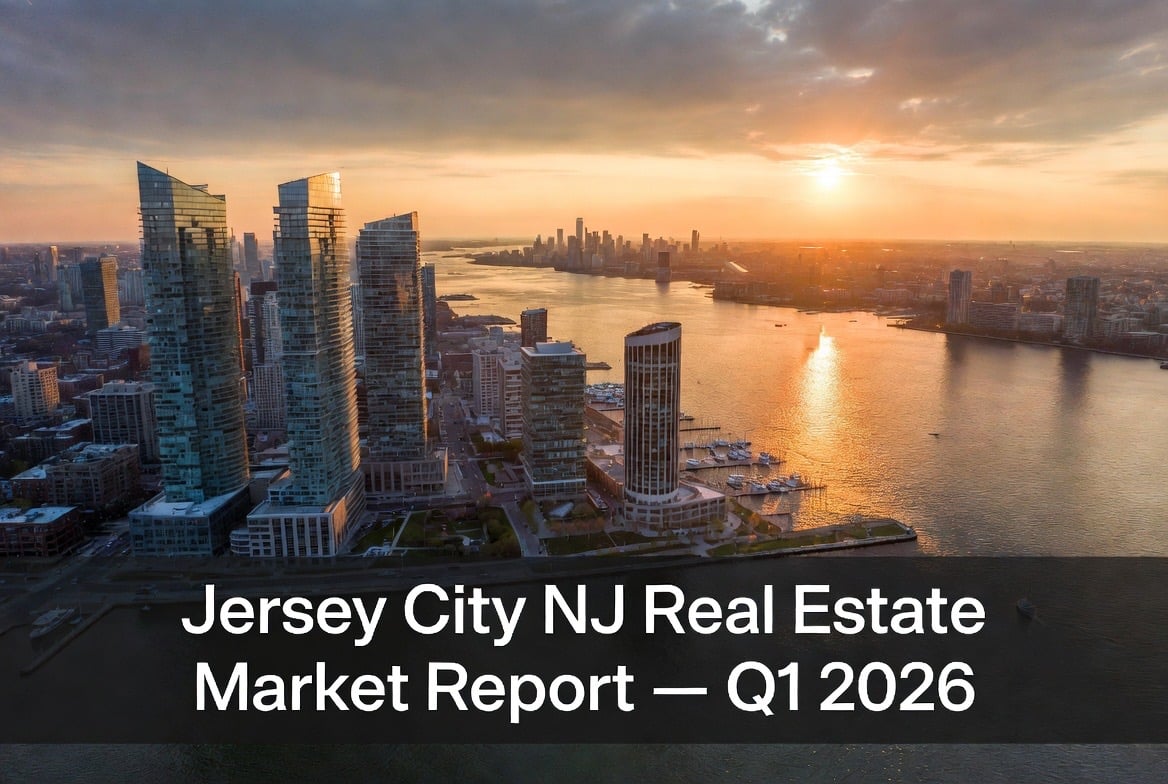
Jersey City NJ real estate in Q1 2026 did not move in one direction. It moved in several — simultaneously — depending on which data source you looked at and where in the city you focused. Closed-sale data* updated through February 2026 shows a median sale price of $800,000, up 20.5% year-over-year. The listing-side snapshot for March 2026 puts the median listing price at $696,500, down half a percent from a year ago. A modeled home value index** lands at $653,810 — also slightly negative YoY. Three different measurements. Three different numbers. All of them correct. All of them measuring something different.
That divergence isn't a data problem. It's a structural feature of a market with enormous price dispersion by neighborhood, a heavy condo and co-op share, and an active new-supply pipeline that continually reshapes what's being listed versus what's actually closing. Reading Jersey City's market without that framing leads to miscalibrated expectations on both sides of a transaction.
Before the numbers, a quick framework that will save you from a common mistake.
Closed-sale data* reflects transactions recorded through MLS and public records — what buyers actually paid. Listing-side data is an active-inventory metric — what sellers are currently asking. A home value index** is a modeled estimate built from monthly value changes across the housing stock. It tracks trends, not transaction prices.
In a market as product-diverse as Jersey City — luxury waterfront towers, pre-war walk-ups, small multifamily, and everything in between — those three numbers will almost always diverge. The goal is to understand what each one is telling you.
The table below pulls together the most current publicly available citywide indicators, each labeled with the source and the date range it covers. Closed-sale datasets typically publish with a lag, while listing-side data updates more frequently.
| Metric | Value | YoY Change | Data Through | Source |
|---|---|---|---|---|
| Median sale price (closed) | $800,000 | +20.5% | Feb 2026 | * |
| Median sale price per sq ft | $536 | +5.3% | Feb 2026 | * |
| Homes sold (monthly) | 133 | +0.8% | Feb 2026 | * |
| Median days on market (closed-sale) | 68 days | −8 days | Feb 2026 | * |
| Sale-to-list price ratio | 98.8% | −0.24 pt | Feb 2026 | * |
| Median listing price (active inventory) | $696,500 | −0.50% | Mar 2026 | Realtor.com |
| Listing price per sq ft | $639 | +3.73% | Mar 2026 | Realtor.com |
| Active listings (inventory snapshot) | 1,029 | +4.68% | Mar 2026 | Realtor.com |
| Median days on market (listing-side) | 39 days | −7.14% | Mar 2026 | Realtor.com |
| Typical home value — index | $653,810 | −1.1% | Feb 28, 2026 | ** |
| For-sale inventory (snapshot) | 544 | — | Feb 28, 2026 | ** |
| New listings (snapshot) | 120 | — | Feb 28, 2026 | ** |
| Median days to pending | 81 days | — | Feb 28, 2026 | ** |
The divergence between a $800K closed-sale median and a $653K home value index figure isn't a contradiction — it reflects that closed sales in February skewed toward larger, higher-priced product (likely waterfront condos and larger units), while the index weights its estimate across the entire housing stock. The listing-side median at $696.5K sits in between, reflecting what's actively available across the inventory mix.
One other number deserves attention: inventory is up 4.68% year-over-year on the listing side. That's not dramatic, but in a market where rate sensitivity has been suppressing listing activity across NJ markets through late 2025, even modest inventory growth is a signal worth tracking. It means sellers have slightly less structural leverage than they did a year ago.
Citywide medians are a starting point. Neighborhood data is where the market actually becomes useful — especially in a city where the waterfront and the west side are separated by $800,000 in median listing price.
Colgate Center is the city's price ceiling, with a median listing price of $1.25 million and a listing rate of $1,192 per square foot. That's a luxury condo market operating at a completely different tier than the rest of the city. Powerhouse Arts District follows at $999,000 median listing, also at $1,024/sf — the same per-square-foot rate as The Waterfront, which at 172 active listings is the largest inventory pool in this price band. The Waterfront's median sits at $938,000 with a tight 29-day median DOM, meaning well-priced product at that level is not sitting.
The Heights is doing something worth noting: at a $834,900 median listing and $645/sf, it's priced substantially below the waterfront core while carrying significantly more inventory — 239 active listings. For buyers priced out of the waterfront but unwilling to compromise on urban walkability, the Heights represents a real entry point into a still-appreciating submarket. Downtown Jersey City holds at $710,000 median listing and $805/sf.
Van Vorst Park lists at $662,500, Journal Square at $544,749.
Bergen-Lafayette is the market segment most worth watching from a trajectory standpoint. At $649,000 median listing and $451/sf, it's meaningfully lower than its proximity to Downtown and Van Vorst Park would imply. Greenville sits at $565,000 and $364/sf. The West Side carries the lowest median in this table at $434,000 and $373/sf. Port Liberte, the planned community near Liberty State Park, lists at $419,000 with only 30 active homes.
| Neighborhood | Median Listing Price | $/sq ft | For Sale | Median DOM |
|---|---|---|---|---|
| Colgate Center | $1,192 | 50 | 16 days | |
| Powerhouse Arts District | $1,024 | 36 | 34 days | |
| The Waterfront | $1,024 | 172 | 29 days | |
| The Heights | $645 | 239 | 36 days | |
| Downtown Jersey City | $805 | 134 | 44 days | |
| Van Vorst Park | $692 | 45 | 32 days | |
| Bergen – Lafayette | $451 | 122 | 39 days | |
| Greenville | $364 | 108 | 39 days | |
| Journal Square | $554 | 90 | 37 days | |
| West Side | $373 | 119 | 36 days | |
| Port Liberte | $407 | 30 | — |
Source: Neighborhood listing-side market data; charts through February 2026. See data notes below. Bar lengths indicate relative price within this table.
A second set of neighborhood benchmarks — drawn from a modeled home value index** updated through February 28, 2026 — provides a valuation-index view rather than a listing-price snapshot. These figures tell a consistent story: The Waterfront is a different market from Journal Square in the same way that Manhattan's Hudson Yards is a different market from Inwood.
| Neighborhood | Typical Home Value** |
|---|---|
| The Waterfront | |
| Downtown | |
| The Heights | |
| Liberty Park | |
| Bergen – Lafayette | |
| West Side | |
| Greenville | |
| Journal Square | |
| McGinley Square |
Source: Home value index data**; through February 28, 2026. See data notes below. Bar lengths indicate relative value within this table.
The gap between The Waterfront ($1.04M) and McGinley Square ($469K) is not a market inefficiency. It's a reflection of product type, transit proximity, and build quality concentrated at opposite ends of the city's geography. Buyers who treat any of these numbers as interchangeable are making a strategic error.
Days-on-market data gives you a feel for real-time buyer demand — and in Q1 2026, the signal is fairly clear: the city is not sitting on its inventory. Listing-side DOM hit 39 days at the city level in March, down 7.14% year-over-year. That's a faster pace than most people would expect from a market where headline inventory is up slightly.
The closed-sale DOM figure* of 68 days reflects a different pipeline — the time from original list date to a signed contract that ultimately closes. That figure is often longer than listing-side DOM because it captures homes that sat, had price reductions, or were relisted. Together, the two figures suggest a market where well-priced product moves in 4–6 weeks while overpriced listings drag the average higher. A 98.8% sale-to-list ratio confirms that buyers are negotiating, but not drastically — sellers are still getting close to ask.
This pattern is consistent with what the Prodigy team is tracking across multiple competitive commuter markets in northern and central NJ — calibrated demand, not a frenzy, but not a buyer's market either.
Jersey City is not a single market, and it won't behave like one. Buyers need to evaluate neighborhoods and specific buildings rather than citywide averages — the spread between The Waterfront and the West Side is so wide that a neighborhood-agnostic budget is essentially meaningless.
The modest YoY inventory increase (+4.68%) is a structural improvement for buyers compared to peak tight-inventory conditions, but it's not creating leverage across the board. Core waterfront submarkets — particularly Colgate Center, where median DOM is 16 days — are still operating under supply constraints that favor sellers. The Heights, with 239 active listings and a 36-day DOM, is where buyers with flexibility are finding the most negotiating room relative to product quality.
One dynamic worth understanding: a significant share of Jersey City's housing stock is in buildings with active PILOT agreements (long-term tax abatements), which affect carrying costs relative to full-assessed properties. As Jersey City's new administration has launched a formal audit of those abatements — covered in detail in the companion development and policy report — buyers in abated buildings should confirm current agreement terms during due diligence.
The fundamentals still support sellers, but the margin is thinner than it was in 2021–2022 and the data requires honest interpretation. A 20.5% YoY increase in the closed-sale median* sounds dramatic — and for the product types that drove those February closings, it may have been. But that figure can reflect mix effects as much as pure appreciation. If February's closings were weighted toward larger waterfront units, the headline number rises even if individual comps didn't.
Sellers should pay close attention to active inventory in their specific submarket. With 1,029 active listings citywide as of March 2026 — up from a year ago — the question is not whether demand exists but whether individual listings are priced competitively within their micro-market. The listing-side median being essentially flat YoY (−0.50%) suggests that sellers who overreached on pricing in 2025 have been disciplined by the market.
The 98.8% sale-to-list ratio tells sellers something useful: the market is willing to transact close to ask, but not significantly above it. Pricing for a bidding war in 2026 requires more justification than it did two years ago.
It depends on the data source and what it measures. Closed-sale data* showed a median of $800,000 as of February 2026. The listing-side median was $696,500 in March. A home value index** puts the typical value at $653,810. These figures measure different things — transaction prices, active asking prices, and a modeled index — so no single number is "the" average. By neighborhood, medians range from $419,000 in Port Liberte to $1.25 million in Colgate Center.
Balanced, leaning toward sellers in core submarkets. Inventory is up slightly year-over-year (+4.68% per March 2026 listing data), which gives buyers more options than in recent tight years. But median days on market is shrinking and sale-to-list ratios are still near 99%, indicating that well-priced properties are not sitting. The waterfront and Downtown neighborhoods remain tighter; The Heights and Bergen-Lafayette offer more negotiating room.
Colgate Center, with a median listing price of $1.25 million and a listing rate of $1,192 per square foot per listing data through February 2026. The Waterfront and Powerhouse Arts District follow at $938,000 and $999,000, respectively. Home value index data** puts The Waterfront's typical value at $1,038,169 as of February 28, 2026.
Jersey City — particularly the waterfront — competes directly with lower Manhattan and Brooklyn in terms of pricing and lifestyle. For buyers willing to go further into Hudson County or toward the Heights and west side neighborhoods, the price-per-square-foot gap relative to comparable NYC product widens substantially. The Prodigy team has covered the NYC-to-NJ migration dynamic in depth — Jersey City is consistently among the first markets that NYC buyers evaluate before broadening their search.
Data notes: * Closed-sale metrics (median sale price, $/sf, homes sold, days on market, sale-to-list ratio) are derived from MLS and public records aggregated through a major national real estate platform; data through February 2026. ** Home value index figures represent a modeled estimate of typical home values across the housing stock, updated through February 28, 2026; this is a valuation index, not a transaction price. Listing-side metrics (median listing price, listing $/sf, active listings, listing-side days on market) sourced from Realtor.com; data through March 2026. All figures are subject to revision as additional closed-sale records are reported. Market conditions vary significantly by neighborhood and property type; consult a licensed real estate professional for property-specific guidance.
-->
Prodigy Real Estate is an innovative real estate company offering high-end video production, home valuation services, purchasing, and home sales. Serving New York and New Jersey.