
Anthony Licciardello | July 19, 2026
Westfield, NJ
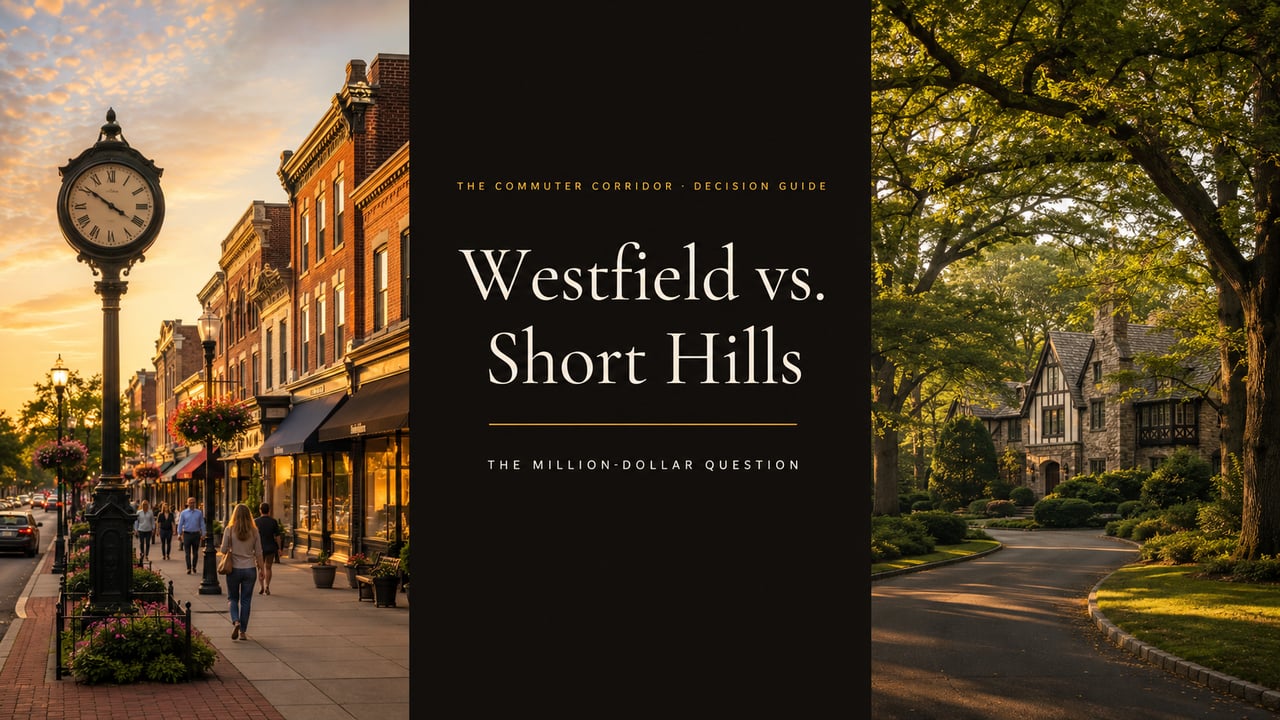
Same buyer, same closets full of Manhattan boxes, two very different checks. Short Hills sells the one-seat train and the state’s most decorated school district at a $2.4 million average value; Westfield sells nearly the same life — bigger downtown, deep architecture, elite schools of its own — for roughly a million dollars less, with a transfer at Newark Penn as the toll. This is the honest ledger: the price gap, the $7,000 tax gap, the commute that explains everything, and the framework for deciding which trade is yours.
Short Hills — the estate section of Millburn Township, Essex County — carries a Zillow average home value of about $2.39 million (up 6.9% year over year), a Midtown Direct one-seat ride to Penn Station in the low-40-minute range from two stations, and a school district perennially ranked at or near the top of New Jersey. Millburn’s average residential tax bill runs about $26,300. Westfield — Union County’s flagship downtown town — runs single-family medians of roughly $1.25–$1.5 million depending on neighborhood and product, an average tax bill of $18,948 at a ~1.81% effective rate, elite schools in its own right, and a commute on the Raritan Valley Line that still transfers at Newark Penn during peak, with one-seat shoulder-of-peak service pledged for late 2026.
Strip it to the trade and it is remarkably clean: Short Hills concentrates its premium in the one-seat ride and the district banner; Westfield distributes its premium across the town — the larger downtown, the architectural depth, the restaurant scene — and hands the buyer back roughly a million dollars of purchase price plus $7,000 a year in carrying costs. Which side of that trade is right depends on exactly two questions, and this guide ends with both.
This is the comparison our New York buyers actually run — not Westfield versus Cranford, but Westfield versus the town they assumed they’d buy in before they priced it. Our Westfield relocation guide calls the town “the premium-suburb life without the Short Hills entry point,” and this post exists to prove or puncture that line with numbers: each side’s canonical figures, same measures wherever possible, methodology named where it isn’t.
Short Hills is not a municipality — it is the storied section of Millburn Township (9.8 square miles, Essex County), planned by Stewart Hartshorn in the nineteenth century as a landscape-first enclave: winding roads, broken sight lines, oak canopy, and an architectural inheritance running from Tudor Revival through Georgian, with the Short Hills Park district on the National Register and the Wyoming district on the state register. Around it: the Paper Mill Playhouse (producing since 1934), a compact walkable downtown along Millburn Avenue, the Mall at Short Hills as the region’s luxury retail anchor — and two Morris & Essex Line stations putting the township one seat from Penn Station.
Westfield is the fuller town: a genuinely large award-winning downtown, a restaurant scene deep enough that we wrote it a full guide, twelve identified historic districts from The Gardens to Wychwood, elite schools, and a 1890s station on the Raritan Valley Line. The buyer pools overlap almost entirely — high-income NYC households buying schools, a downtown, and architecture — which is why the decision reduces to the three structural gaps below: the money, the train, and the district banner.
The entry gap first, with measures named because they differ: Zillow’s average home value for Short Hills stands at about $2.39 million, up 6.9% year over year, while Census ACS medians run about $1.67 million for the Short Hills CDP and $1.37 million for Millburn Township as a whole — the township number smoothed by Millburn-side capes, condos, and townhomes. Westfield’s single-family medians, per our ongoing market coverage, run roughly $1.25–$1.5 million by neighborhood and product. Compare like against like — the Short Hills estate product against Westfield’s premium neighborhoods — and the gap is on the order of a million dollars for a broadly comparable family house.
Then the carrying costs:
Sources: Millburn per the Short Hills Association’s 2026 tax analysis (2.019% rate on an average residential assessment of $1,302,529; Essex County last revalued Millburn in 2017, next expected ~2029). Westfield and Summit per 2026 Union County averages; Westfield’s effective rate ~1.81% on market value. Assessment bases differ by county — the bills, not the nominal rates, are the comparable figures.
The bill gap — roughly $7,350 a year on the averages, derived arithmetic on the cited figures — understates the true delta, because the average Short Hills house sits far above Millburn’s township-wide average assessment: at a 2% effective neighborhood rate, a $2.4 million Short Hills purchase carries a bill in the mid-$40,000s, against roughly $27,000 at Westfield’s 1.81% on a $1.5 million premium-neighborhood buy. And every dollar of that difference lives above the SALT cap — paid with zero federal offset — a dynamic our Westfield tax analysis unpacks in full. The honest counterweight: Short Hills owners are buying the state’s most decorated district and the one-seat ride with that money, and the resale market has long validated the price. The question is only whether you need what it buys.
Strip away everything else and the price gap largely maps to one fact: Millburn and Short Hills stations sit on the Morris & Essex Lines with Midtown Direct one-seat service to Penn Station — low-40-minute rides, seven days a week — while Westfield sits on the Raritan Valley Line, where most peak trains still require the transfer at Newark Penn. That transfer is real friction: a platform change twice a day, every working day, with the schedule risk that transfers carry. Our Westfield relocation guide treats it squarely — and notes the live catalyst: NJ Transit has pledged one-seat Raritan Valley service at the shoulders of peak for late 2026, the most consequential potential change to Westfield’s value equation in a generation.
The framework for pricing it: count the actual seats. A daily-office Manhattan commuter buys the one-seat ride 480 times a year — for that household, Short Hills’ premium is at least partly consumption, paid for something used constantly. A hybrid two-or-three-day commuter buys it 100–150 times — and at that frequency, a million dollars of purchase price plus the tax delta for a smoother ride starts to look like the most expensive convenience in New Jersey. It is no accident that Westfield’s post-2020 buyer pool skews hybrid: the value case strengthens with every day you don’t ride.
On schools, the honest sentence is short: Millburn’s district is perennially ranked at or near the very top of New Jersey — a banner asset, priced accordingly — while Westfield’s is elite in its own right, routinely among the state’s strongest and the single largest line in the town’s tax levy. A family optimizing purely for district rank picks Millburn and knows why. But rank is a blunt instrument at this altitude: both districts operate at a level where the marginal difference for any individual child is far smaller than the ranking gap implies, and the right diligence — per-school NJDOE Performance Reports, building visits, program fit — is identical in both towns.
So, the two questions the whole decision reduces to. One: how many times a year will you actually sit on the train? Daily → the one-seat ride is a real asset; hybrid → it is a luxury tax. Two: is the district banner itself the purchase, or is the education? If the banner — Millburn earns its premium. If the education plus the town around it — Westfield delivers the schools, the bigger downtown, the architecture, and roughly a million dollars of retained capital that becomes renovation budget, college fund, or simply a smaller mortgage. Pick Short Hills for the concentrated premium: the ride, the banner, the estate landscape — the current Short Hills homes for sale show what the premium buys this week. Pick Westfield for the distributed one — the current Westfield homes for sale show the range — and if the late-2026 one-seat pledge lands, know that you bought the corridor’s best value story just before its biggest discount expired.
“I sell to the same family in both towns — same jobs, same kids, same Sunday-night spreadsheet. The ones who pick Short Hills are buying two things and they know it: the seat and the banner. The ones who pick Westfield looked at that million dollars and decided a transfer at Newark Penn was the best-paid twenty minutes of their week. Neither is wrong. The mistake is paying for the seat you’ll never sit in.”
— Anthony Licciardello, Broker, The Prodigy Team
Every guide on this site is part of a system: town-by-town content clusters, dedicated neighborhood pages, and cross-state marketing engineered for one outcome — putting your listing in front of the motivated New York families already searching for it. I’m Anthony Licciardello, Broker of The Prodigy Team — a former Director of Community Affairs in the Bloomberg Administration and a member of the Staten Island Growth Management Task Force — and this pipeline is what 22 years and 5,000 closings taught me to build.
Our Above the Streets cinematic drone series extends that reach — aerial storytelling that markets entire towns, not just listings, with audience performance exceeding industry benchmarks for real estate media.
Anthony Licciardello · Broker, The Prodigy Team · 718-873-7345
Tell us your commute pattern and your number — we’ll build the side-by-side for your actual life: the real tax bills at your price point, the door-to-door times for your office days, and the current inventory in both towns.
How much more expensive is Short Hills than Westfield?
On the order of a million dollars for a comparable family home: Zillow’s average Short Hills value is about $2.39 million (up 6.9% year over year), while Westfield’s single-family medians run roughly $1.25–$1.5 million by neighborhood. Census medians tell the same story — about $1.67 million for the Short Hills CDP against Westfield’s range — and the carrying-cost gap adds roughly $7,000+ a year on average tax bills.
Is the commute really that different between Westfield and Short Hills?
Structurally, yes — it is the core of the price gap. Millburn and Short Hills stations offer Midtown Direct one-seat service to Penn Station in the low 40 minutes; Westfield’s Raritan Valley Line still requires a Newark Penn transfer on most peak trains, with one-seat shoulder-of-peak service pledged for late 2026. For daily commuters the one-seat ride is a real asset; for hybrid commuters the gap shrinks dramatically.
Are Millburn’s schools better than Westfield’s?
By statewide rank, Millburn’s district is perennially at or near #1 in New Jersey — while Westfield’s is elite in its own right, routinely among the state’s strongest. At this level the ranking gap overstates the practical difference for most students; per-school NJDOE Performance Reports and building visits are the right diligence in both towns.
How do property taxes compare between the two towns?
Millburn’s average residential bill runs about $26,300 (2026, on a 2.019% rate against 2017-era assessments), versus Westfield’s $18,948 average at a ~1.81% effective rate — and on the actual homes buyers compare, the gap widens: a $2.4 million Short Hills purchase carries a bill in the mid-$40,000s against roughly $27,000 on a $1.5 million premium Westfield buy, all of it above the SALT cap.
Moving to Westfield, NJ: The New York Buyer’s Guide
Westfield, NJ Property Taxes: Rates, Bills & What Buyers Pay
Westfield, NJ Real Estate: What’s Happening With Prices in 2026
Westfield’s 12 Identified Historic Districts
Short Hills and Millburn figures per the Zillow Home Value Index (Short Hills average value $2,389,321, +6.9% YoY, May 2026), U.S. Census ACS 2020–2024 owner-occupied medians (Short Hills CDP ~$1.67M; Millburn Township ~$1.37M), and the Short Hills Association’s 2026 property-tax analysis (2.019% rate, average residential assessment $1,302,529, average bill $26,298; Millburn last revalued 2017, next expected ~2029). Westfield figures per our published tax analysis (average bill $18,948; school levy ~$12,464; ~1.81% effective rate; Union County 2026 averages, with Summit at $19,701) and our market coverage (single-family medians $1.25–$1.5M; ~34 active listings, early 2026). Commute facts per NJ Transit service patterns and our Westfield relocation guide (Raritan Valley one-seat shoulder-of-peak service pledged late 2026). Derived dollar gaps are arithmetic on the cited figures; measures differ by source and are labeled in text. This post is general information, not tax or investment advice.
Prodigy Real Estate is an innovative real estate company offering high-end video production, home valuation services, purchasing, and home sales. Serving New York and New Jersey.