
Anthony Licciardello | June 25, 2026
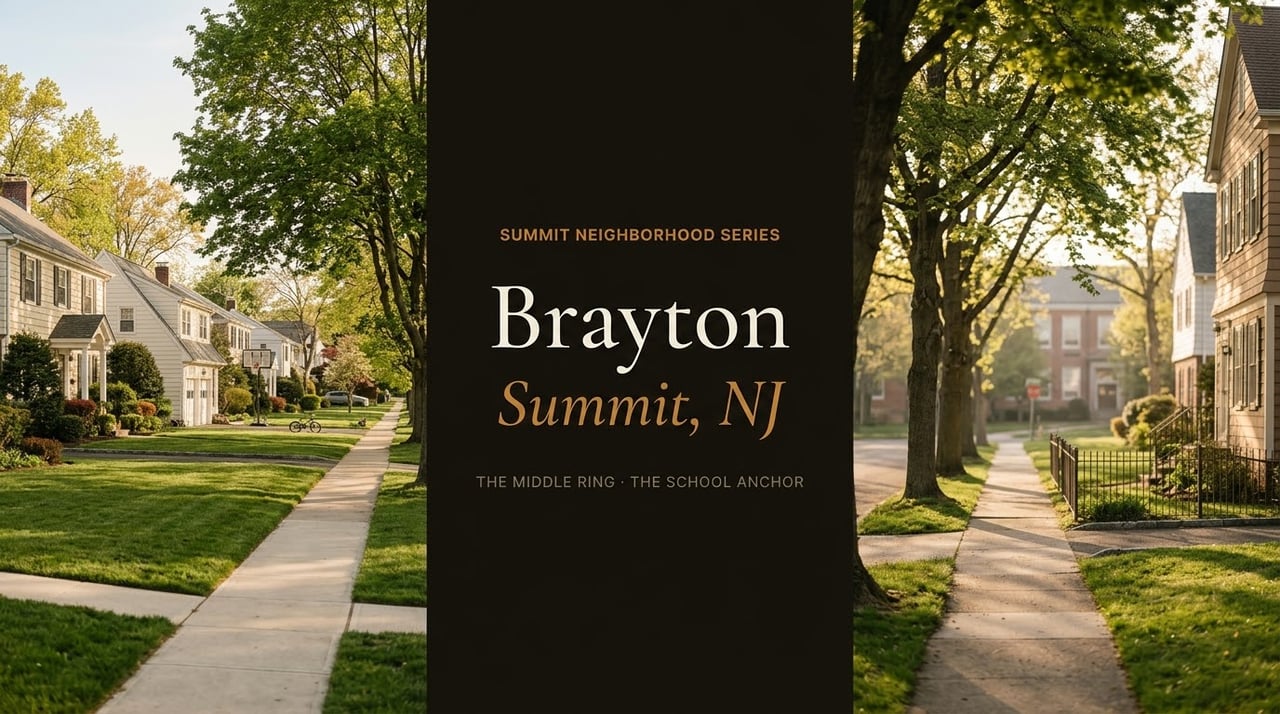
Brayton, Summit: Where the School Catchment Is the Headline Asset.
In most Summit neighborhoods the school district is one variable among several. In Brayton it is the variable — the single asset that anchors the buyer pool, sets the floor on demand, and explains why this Middle Ring neighborhood prices the way it does.
Brayton is the most school-anchored neighborhood in Summit. While every Summit neighborhood benefits from the strength of the district, Brayton is the one where the elementary school catchment functions as the literal headline asset — the variable the buyer pool optimizes for above all others, the variable that sets the floor on demand, and the variable that explains the neighborhood’s pricing resilience even in softer markets. The Middle Ring access regime and the generous family lots support the school anchor, but they do not replace it. For the Brayton seller, the listing strategy is the clearest in Summit: the catchment leads, and everything else follows.
Brayton occupies a specific and well-understood position in the Summit market: it is the neighborhood where the school district stops being a background benefit and becomes the foreground asset. The neighborhood shares its name with Brayton School at 89 Tulip Street — one of the five elementary schools in the Summit Public Schools district, serving grades 1 through 5 — and the families who buy in Brayton are, in the dominant majority of cases, optimizing their purchase around that single variable. One detail worth knowing precisely: Summit houses its pre-school and Kindergarten programs at two separate primary centers (Wilson and Jefferson), so a Brayton-catchment family sends grades 1 through 5 to Brayton School itself, while Pre-K and Kindergarten are handled district-wide at a primary center. The Middle Ring access, the generous lots, the family-scale housing — all of it supports the school anchor, but none of it replaces it.
This makes Brayton, in one important sense, the simplest Summit neighborhood to price — and in another sense the most demanding. It is simple because the headline asset is unambiguous: the school catchment leads, and the listing strategy follows directly. It is demanding because the school anchor produces a buyer pool with unusually specific requirements and unusually strong demand resilience, which means small errors in how a listing documents or fails to document the catchment have outsized effects on the outcome. A Brayton home that fails to lead with the catchment is leaving its single strongest asset on the table.
This post applies the broader Summit framework specifically to Brayton, with the school anchor as the organizing principle. It works through the school-catchment economics that define the neighborhood, the architectural fabric, the school-motivated buyer profile, the comp-set discipline relevant to a catchment-anchored market, and the operational pricing framework. The foundational frameworks are Part III (Middle Ring) and Part V (AVM mispricing) of the seller series. Brayton shares the family-buyer character of Wyoming but concentrates it more tightly around the school variable.
The defining economic fact about Brayton is that the school catchment is not a feature of the home — it is the structural foundation of the home’s value. In a school-anchored neighborhood, the catchment functions as a near-permanent demand floor. As long as families continue to seek the Brayton School catchment, there is a continuously renewing pool of buyers specifically looking for addresses inside the boundary, which produces demand resilience that few other variables can match. Even in softer markets, school-anchored neighborhoods like Brayton tend to hold value better than neighborhoods whose appeal rests on more discretionary variables.
This demand floor has a specific consequence for pricing. The Brayton buyer is not comparing the home primarily against other homes at a similar price point across Summit — she is comparing it against other homes inside the catchment boundary. The relevant competitive set is narrower and more sharply defined than in non-school-anchored neighborhoods. A family who has decided that the Brayton catchment is non-negotiable is choosing among the available inventory inside the boundary, which means a well-presented Brayton home competes within a constrained and motivated pool rather than against the entire Summit market.
For the seller, the implication is direct: the catchment must be documented prominently, accurately, and verifiably in the listing. The single most important sentence in a Brayton listing is the one that establishes the school catchment — ideally naming Brayton School and its grade-1-through-5 assignment explicitly, where that can be done accurately for the specific address. It should appear early, and it should be verified directly with the Summit Public Schools district — reachable through the district office and the Brayton School main office at (908) 273-1276 — before publication, because catchment boundaries can shift over time, and an incorrect catchment claim in a listing creates real liability as well as the risk of a deal collapsing late when a buyer’s own verification contradicts the listing.
A note on responsible framing. Fair housing law governs how schools and demographics can be referenced in real estate marketing. The appropriate practice is to state the factual catchment assignment and let buyers evaluate the school on their own terms and through their own sources, rather than making subjective quality claims that could implicate fair housing considerations. The factual catchment statement is both the more defensible practice and, as it happens, the more effective one — the school-motivated buyer has already done her research and wants the factual assignment confirmed, not a sales pitch about the school.
In Brayton, the catchment is the demand floor. As long as the school holds its reputation, there is always a renewing pool of families who have decided the boundary is non-negotiable. That is the most durable pricing asset a Summit neighborhood can have — and the listing has to lead with it.
Brayton’s housing stock is predominantly family-scale and spans a moderate range of construction eras — concentrated in the 1920s through 1950s, with selective later additions and renovations. The architectural character is solidly residential-suburban: center-hall colonials, expanded capes, colonial revivals, and the occasional Tudor or split-level, on the generous family lots the neighborhood is known for. The fabric is more consistent than Wyoming’s ninety-year span but less architecturally distinguished than the early-century stock of Northside or Beacon Hill.
This is not a weakness for the neighborhood — it is a reflection of what the Brayton buyer actually prioritizes. Because the school catchment dominates the purchase decision, architectural distinction is a secondary consideration for the dominant buyer profile. The Brayton family buyer wants a well-functioning, well-maintained family home inside the catchment. She values architectural quality, but she will not trade the catchment for it, and she will accept a less architecturally distinguished home inside the boundary over a more distinguished home outside it.
For the seller, this shifts the renovation calculus toward the Wyoming model rather than the Beacon Hill model. Family-functional updates — a modernized kitchen, an updated primary bath, a floor plan that opens the kitchen to a family room, finished lower-level play or homework space — tend to pay back strongly in Brayton, because they align with what the school-motivated family buyer actually uses. Period-correct architectural restoration, by contrast, is rewarded less here than in the architecturally-distinguished neighborhoods, because the Brayton buyer is not paying primarily for architectural character.
The practical guidance: invest renovation dollars in the family-functional improvements that the school-motivated buyer will use daily, and document those improvements clearly in the listing alongside the catchment. A Brayton home with an updated kitchen, a renovated primary bath, a flexible family-room layout, and a clearly documented catchment is precisely the package the dominant buyer is seeking.
The Brayton buyer is the most predictable buyer profile in the entire Summit market. She is a family buyer, typically with young children either approaching or already in the grades 1-through-5 window that Brayton School serves, for whom the catchment assignment is the organizing principle of the entire home search. She has often researched the Summit district in detail before engaging an agent — including the practical detail that Pre-K and Kindergarten run through the district’s primary centers before her child enters Brayton School itself in first grade — has identified the specific catchment she wants, and is searching within the boundary with a clarity of purpose that few other Summit buyers match.
This buyer’s decisiveness is a meaningful asset for the Brayton seller. Because she has already committed to the catchment before viewing any specific home, she moves through the decision process faster than the comparison-shopping buyer in a non-school-anchored neighborhood. When the right home appears inside the boundary — well-maintained, family-functional, accurately documented — she is prepared to act. The well-presented Brayton home that leads with the catchment converts this prepared buyer efficiently.
Secondary profiles exist but are smaller. The local move-up family — a Summit household already in a smaller home, relocating into Brayton specifically to enter the catchment as their oldest child approaches school age — behaves similarly to the relocation buyer with stronger local knowledge. The long-term hold family — a buyer planning to remain through the entire elementary-and-beyond arc — weighs the durability of the home and the lot more heavily, since she is buying for a decade-plus horizon rather than a near-term resale.
The listing implication is the clearest in the neighborhood series. Lead with the catchment, factually and prominently. Document the family-functional features the school-motivated buyer uses. Establish the Middle Ring commute access via the post-2016 rideshare program as the supporting commute story. The Brayton listing does not need to be clever — it needs to be accurate, prominent, and complete on the variables this highly-specific buyer is verifying.
The Brayton buyer has already decided the catchment is non-negotiable before she sees a single listing. The seller’s job is not to sell her on the neighborhood. It is to confirm, accurately and prominently, that this home is inside the boundary she has already committed to.
Comp selection in Brayton follows a discipline that other Summit neighborhoods do not require: the comp set should be drawn primarily from inside the same school catchment. Because the catchment is the dominant pricing variable, a sale inside the boundary is a fundamentally better comp than a sale of a similar home just outside it, even when the two homes are architecturally identical, similarly sized, and a short distance apart. The catchment boundary is a pricing boundary.
This is the inverse of the error that AVMs make. An automated model sees two similar homes a quarter-mile apart and treats them as strong comps, with no recognition that one is inside the catchment and one is outside it. The school-motivated buyer treats them as entirely different assets. The disciplined comp set respects the catchment boundary as a primary filter, applied before the standard distance, size, era, and condition filters.
The disciplined comp set for a Brayton listing draws from post-2022 sales inside the same catchment, filtered for family-functional condition tier, lot size, and square footage. Where in-catchment comp depth is thin — which can happen in a constrained boundary with limited turnover — the analyst extends carefully to recent in-catchment sales from slightly further back, weighting them for market movement, rather than reaching outside the boundary for more recent but less relevant sales. Recency matters, but catchment membership matters more.
The AVM mispricing here is specific and predictable. Because the algorithm does not recognize the catchment boundary, it tends to underprice strong in-catchment Brayton homes (by comping them against just-outside-the-boundary sales that carry no school premium) and to overstate the value of just-outside homes (by comping them against in-catchment sales that do). The disciplined, catchment-aware comp-built range is the right anchor; the AVM systematically misses the variable that defines the neighborhood.
The Brayton pricing exercise integrates everything above, with the catchment as the foundational variable. The scorecard below summarizes the practical operational framework for any homeowner preparing to list in the neighborhood.
Pricing Input | Brayton-Specific Treatment | Common Mistake |
|---|---|---|
Headline Asset | The school catchment — documented factually, prominently, verified with the district | Burying the catchment or failing to verify it before listing |
Ring Designation | Middle Ring — rideshare-enabled commute as the supporting story | Treating the commute as the headline instead of the catchment |
Renovation Strategy | Family-functional updates — kitchen, primary bath, family-room flow, play space | Period-correct restoration the school-motivated buyer does not value |
Comp Set | In-catchment first — the boundary is a pricing boundary, applied before other filters | Comping against just-outside-the-boundary sales that carry no school premium |
AVM Treatment | Unreliable — the algorithm cannot see the catchment boundary | Trusting an AVM that ignores the single most important Brayton variable |
The operational discipline for a Brayton seller follows the framework above, with the catchment as the non-negotiable headline. Verify the catchment with the district and document it prominently. Invest renovation dollars in family-functional improvements. Build the comp set from inside the catchment boundary first. Establish the Middle Ring rideshare commute as the supporting story. Treat the AVM as the least reliable input, because the algorithm cannot see the boundary that defines the neighborhood’s value.
For the broader Summit framework, begin with Part I of the Summit Seller Series. Brayton homeowners preparing to list will benefit particularly from Part III on the Middle Ring revaluation and Part V on AVM mispricing. The seven-decision synthesis in Part VI walks through the full pricing exercise step by step.
The most expensive mistake I see in Brayton is the seller who assumes the catchment sells itself and buries it in the third paragraph of the listing. The school-motivated buyer is scanning for one fact before she reads anything else. Put it first, verify it with the district, and you have already won half the battle. Bury it, and you have made her work to find the one thing she came for.
Yes, and the premium is one of the most durable in the Summit market. Because the catchment is the organizing principle of the buyer’s search, a home inside the boundary competes within a constrained pool of motivated buyers, while a similar home just outside competes in the broader market without the school anchor. The school-motivated buyer treats the two as fundamentally different assets even when they are architecturally similar and a short distance apart. The boundary is, in pricing terms, a real line.
Verify directly with the Summit Public Schools district — the Brayton School main office can be reached at (908) 273-1276, and the district maintains current assignment information — rather than relying on third-party websites, which are frequently out of date. Remember that Brayton School serves grades 1 through 5, while Pre-K and Kindergarten run through the district’s primary centers, so “in the Brayton catchment” specifically describes the grade-1-and-up assignment. Catchment boundaries can shift over time as enrollment and capacity change, so the assignment that applied when you bought may not be the one that applies today. Confirming the current assignment in writing before listing protects both the accuracy of your marketing and the integrity of the eventual transaction — an incorrect catchment claim discovered late in a deal can cause it to collapse.
Prioritize family-functional improvements over architectural restoration. The school-motivated Brayton buyer values a modernized kitchen, an updated primary bath, a floor plan that connects the kitchen and family room, and flexible play or homework space far more than period-correct architectural detail. These updates align with how the family actually lives and tend to pay back strongly. Unlike the architecturally-distinguished neighborhoods, Brayton rewards function over fidelity.
Generally, yes. School-anchored neighborhoods tend to carry a more durable demand floor than neighborhoods whose appeal rests on more discretionary variables, because the catchment produces a continuously renewing pool of families for whom the boundary is non-negotiable regardless of broader market conditions. This does not make Brayton immune to market cycles, but it does tend to make the neighborhood more resilient through them — the school-motivated demand persists even when discretionary demand softens.
Both are Middle Ring family-buyer neighborhoods, but the weighting differs. In Wyoming, the family buyer balances several priorities — school access, lot, family-functional space, and commute — with school as one important factor among several. In Brayton, the school catchment dominates the decision more completely, functioning as the literal headline asset rather than one priority among several. Wyoming also carries a wider architectural range. For the family for whom a specific catchment is non-negotiable, Brayton is often the sharper fit; for the family weighing a broader bundle, Wyoming offers more variety.
Brayton completes the six-part Summit Neighborhood Series. Together, the six guides cover every ring of the Summit pricing geography and every major buyer profile in the city — a complete map of how Summit residential value is actually set, neighborhood by neighborhood.
A 30-minute Brayton pricing audit with The Prodigy Team begins with verifying and positioning your school catchment, then covers family-functional condition assessment, in-catchment comp selection, and a defensible list-price recommendation grounded in the framework above — not in an AVM that cannot see the boundary that defines your home’s value.
Prodigy Real Estate is an innovative real estate company offering high-end video production, home valuation services, purchasing, and home sales. Serving New York and New Jersey.