
Anthony Licciardello | June 9, 2026
Summit, NJ
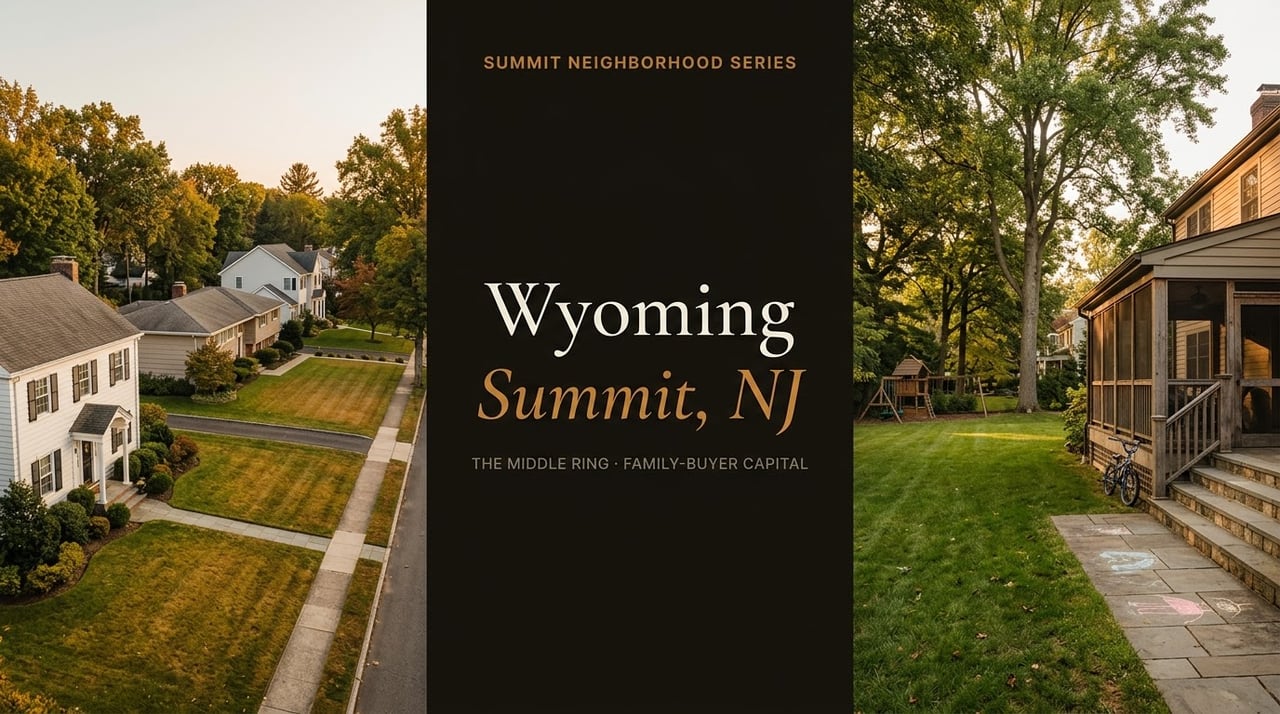
Wyoming, Summit: The Family-Buyer Capital of the Middle Ring.
An architecturally varied Middle Ring neighborhood where the school-district map, the lot sizes, and the post-2016 rideshare access regime combine to produce Summit’s most consistent move-up family market — and one of the most reliably mispriced sections of the city.

Wyoming is the family-buyer capital of Summit. The Middle Ring sub-band the post-2016 rideshare program effectively repriced, combined with the Summit school-district anchor and the largest typical lots in the inner-Summit market, produces a buyer pool that is more uniform and more decisive than any other neighborhood in the city. The architectural fabric is more varied than Beacon Hill or Edgewood — 1920s colonials sit alongside 1960s ranches and recent teardown-rebuilds — which makes comp selection more nuanced and the AVM mispricing more compounded. The right Wyoming list price is built from a disciplined, in-band, era-filtered comp set, not from the algorithm’s averaged guess.
Wyoming is the part of Summit most people picture when they picture Summit. The neighborhood sits in the city’s Middle Ring — roughly 1.0 to 1.5 miles from Summit Station, well inside the band the seller framework series identifies as the most affected by the 2016 rideshare program. The streets are wide, the lots are generous, the canopy is mature, and the housing stock spans a wider architectural range than any other Summit neighborhood. The result is a residential character that reads as quintessentially suburban-American in a way Beacon Hill’s more historically consistent fabric does not.
For pricing purposes, what defines Wyoming is the concentration of one specific buyer profile. The move-up family buyer — the household trading out of a Manhattan or Hoboken apartment, or from a smaller Pedestrian Zone Summit home, into a full-sized family residence with the Summit school district as the headline asset — lands in Wyoming more often than in any other neighborhood in the city. The combination of Middle Ring access, generous lots, the school anchor, and the post-2016 rideshare regime makes the neighborhood the most consistent destination for this profile. Listing strategy that names the family-buyer story directly outperforms listing strategy that does not.
This post applies the broader Summit framework specifically to Wyoming. It works through the Middle Ring economics relevant to the neighborhood, the architectural variety that distinguishes Wyoming from the more strictly-1920s Beacon Hill, the dominant family-buyer profile and its specific priorities, the comp-set discipline required in a neighborhood with this much era and condition variance, and the operational pricing framework that produces top-of-range outcomes for Wyoming sellers.
Wyoming sits squarely inside the Middle Ring — approximately 1.0 to 1.5 miles from Summit Station along clean residential streets, with no parcels approaching the Pedestrian Zone boundary at the inner edge or the Outer Ring threshold at the outer edge. The neighborhood occupies a slightly different sub-band than Beacon Hill: where Beacon Hill is concentrated in the 1.0-to-1.3-mile sub-band, Wyoming extends slightly further out, with many addresses in the 1.2-to-1.5-mile range. The difference is modest but meaningful for pricing.
The post-2016 rideshare revaluation that Part III of the seller series documents applies in full to Wyoming. The municipal Lyft program’s 40 Railroad Avenue pickup is geographically convenient for Wyoming residents, and the door-to-platform elapsed time via the program is competitive with driving and parking. The pre-2016 friction discount has been functionally dissolved here. The Wyoming homes that have transacted post-2022 reflect the new equilibrium; the AVMs and many comp analyses still partially anchor to the older pricing regime.
What sets Wyoming apart from Beacon Hill within the Middle Ring is the school-district anchoring. Wyoming sits in the heart of the catchment areas for the most-requested Summit elementary schools, which makes the neighborhood the highest-demand destination for the move-up family buyer specifically prioritizing schools. The school variable is not unique to Wyoming — the entire Summit district is strong — but the concentration of family-oriented housing stock, lot generosity, and elementary school proximity gives Wyoming a structural edge with one specific buyer profile that other Middle Ring neighborhoods do not match as completely.
For the seller, this means the Wyoming listing strategy is the cleanest school-anchored family-buyer pitch in Summit. The headline assets are: post-2016 rideshare-enabled Middle Ring access, generous family-scale lot, Summit-district school catchment, and a full-sized family-oriented residence. Vague language about "convenient location" or "great schools" underperforms here as everywhere else. Specific language about the named schools, the family-oriented lot configuration, and the rideshare-enabled commute consistently sells at the top of the comp range.
Wyoming is where the family-buyer story lives most clearly. The school anchor plus the lot plus the rideshare-enabled commute plus the family-scale housing fabric — that bundle is the asset. Sellers who name it specifically outsell sellers who gesture at it.
Wyoming’s architectural fabric is the most varied in Summit. The neighborhood was developed across a longer time horizon than Beacon Hill, Franklin Hill, or Edgewood — with significant construction from the 1920s through the 1960s, additional development in the 1980s and 1990s, and a meaningful number of recent teardown-rebuild parcels from the 2010s and 2020s. The result is a streetscape where a 1928 center-hall colonial may sit next to a 1965 split-level, which sits next to a 2019 contemporary on a teardown-rebuild lot.
This architectural variety has two consequences for sellers. The first is that the visual impression of any given street varies meaningfully block to block, so the listing photography and the property remarks need to position each individual home within the local micro-context honestly. A 1928 colonial on a street of mostly contemporary teardowns reads as a different asset than the same colonial on a street of consistently-historical homes. Both are valid listings; they appeal to different buyer micro-segments and benefit from different framing.
The second consequence is for comp selection, which Chapter IV treats in detail. Pulling Wyoming comps without filtering for architectural era systematically distorts the analysis, because a 1928 colonial and a 2019 contemporary on similar lots are different assets even when they appear comparable on AVM input fields. The disciplined comp set filters by era and condition tier as rigorously as by distance and lot size.
The sympathetic-renovation discipline that applies in Beacon Hill and Franklin Hill applies in Wyoming with a different weighting. The family buyer in Wyoming is somewhat more tolerant of contemporary updates than the buyer in the more architecturally consistent neighborhoods — she is paying primarily for the family-functional space, the lot, and the school access, with architectural character as a secondary consideration. Substantive kitchen-and-primary-bath updates often pay back strongly in Wyoming, even when they edge away from period-correct treatment. The discipline is to update in ways that align with current family-buyer expectations, while avoiding renovations so aggressive they read as flippy or generic.
More than any other Summit neighborhood, Wyoming is dominated by a single buyer profile: the move-up family. She is typically in her mid-thirties to mid-forties, often relocating from Manhattan, Hoboken, Jersey City, or Park Slope, with one to three children either entering or already in elementary school. Her purchase decision is anchored to one variable above all others — the Summit school district, and specifically the elementary school catchment for the address she is buying. Everything else follows.
After the school anchor, her priorities order as follows. Full-sized family-functional space — meaningful square footage, four or more bedrooms, a true family floor plan with usable kitchen, family room, and play space. A real backyard — the half-acre Wyoming norm reads as generous compared to anywhere in Manhattan or Hoboken and supports the outdoor family life she is exiting urban density to achieve. The post-2016 rideshare-enabled commute back to Manhattan, often used three or four days a week rather than five, with a hybrid schedule that lets the parent attend afternoon school events. Architectural quality and condition matter, but as third-tier rather than headline priorities.
Secondary buyer profiles do appear in Wyoming. The local upsizer — a Summit family currently in a smaller Pedestrian Zone or Middle Ring home, moving into more space as the family grows — represents a meaningful share of transactions. The re-entry buyer — a household returning to suburban life after a Manhattan or Brooklyn stretch, often with children entering school age — behaves similarly to the relocation buyer but typically has stronger local knowledge and faster decision-making. The empty-nester staying in Summit — a long-tenured Wyoming household selling the large family home to downsize into a Pedestrian Zone property — is the seller, not the buyer, but understanding this profile helps a Wyoming listing agent represent both sides of the move-up market accurately.
The listing implication is that the Wyoming property remarks should lead with the school catchment by name (where this can be done verifiably and accurately), the lot size and configuration, the family-functional floor plan specifically, and the rideshare-enabled commute access. The architectural era and the renovation work go in the second tier, after the family-anchored bundle has been established. Listings that lead with architectural style or interior aesthetics underperform listings that lead with the family-buyer headline assets.
The Wyoming buyer is buying the school district, the half-acre lot, and the hybrid-friendly commute in that order. The architecture matters — but it is a tiebreaker, not a headline. Listings that lead with the right variables for this specific buyer sell at the top of the range. Listings that get the order wrong underperform.
Building a defensible comp set for a Wyoming listing is more challenging than for the more architecturally consistent neighborhoods because the housing stock spans roughly ninety years of construction. The discipline is to filter rigorously on both era and condition tier, then refine to the subset that genuinely matches the subject property on the variables the family buyer actually weighs.
A useful three-tier era classification: historical (1920s through 1940s — center-hall colonials, Tudors, capes), mid-century (1950s through 1980s — split-levels, ranches, contemporary colonials), and contemporary (1990s through 2020s — recent construction or substantive rebuild). Each tier appeals to a slightly different sub-segment of the Wyoming family-buyer pool and transacts in slightly different price-per-square-foot bands. Mixing the tiers in a single comp analysis produces a price range that is too wide to be useful.
The disciplined comp set for a typical Wyoming listing draws from three to five post-2022 sales of same-era homes within roughly a quarter-mile of the subject parcel, with lot size and total square footage within 15% of the subject. Smaller and more disciplined beats larger and looser. The price-per-square-foot reading from this filtered set is the right anchor; the broader Wyoming average is a misleading metric.
A condition-tier overlay is also critical. Within each era, distinguish between turnkey-renovated, lightly-updated, and original-condition properties. A 1958 split-level renovated to 2024 family standards transacts differently than a 1958 split-level in original condition. Both have legitimate comp pools, but they are different pools.
The AVM consensus for a Wyoming property is typically the least reliable for the most architecturally distinctive properties — either the well-preserved 1928 colonial or the substantially renovated contemporary on a teardown-rebuild lot. The algorithm averages across the broad Wyoming stock and produces a number that often misses both ends of the era spectrum by meaningful margins. The disciplined comp-built range from a properly filtered set is the right anchor; the AVM is the sanity check, not the baseline.
The Wyoming pricing exercise integrates everything above. The scorecard below summarizes the practical operational framework for any homeowner preparing to list in the neighborhood.
| Pricing Input | Wyoming-Specific Treatment | Common Mistake |
|---|---|---|
| Ring Designation | Clean Middle Ring — post-2016 rideshare regime fully applies | Anchoring to raw distance from station instead of network access |
| Headline Asset | Summit school catchment + family-scale lot + family floor plan + rideshare commute | Leading with architectural style instead of family-buyer headline assets |
| Era Classification | Historical / mid-century / contemporary — each transacts in different bands | Treating all Wyoming homes as a single comp pool |
| Comp Set | Post-2022, same-era, quarter-mile radius, lot & SqFt within 15% | Mixing era tiers to "broaden" the comp set — widens the price range uselessly |
| Renovation Strategy | Family-functional updates pay back — kitchen, primary bath, family room flow | Period-correct restoration in a neighborhood where the buyer values function |
| AVM Treatment | Least reliable for era-distinctive properties; sanity check, not baseline | Anchoring to Zestimate when the comp set and the algorithm disagree |
The operational discipline for a Wyoming seller follows the framework above. Score the parcel honestly against the family-buyer headline assets. Classify the home by era and condition tier explicitly. Build the comp set from same-era, in-radius, post-2022 sales with disciplined lot-and-square-footage filters. Renovate for family-functional outcomes rather than period-correct ones. Treat the AVM as a sanity check rather than a baseline, particularly for era-distinctive properties.
For the broader Summit framework, begin with Part I of the Summit Seller Series. Wyoming homeowners preparing to list will benefit particularly from Part III on the Middle Ring revaluation and Part V on AVM mispricing. The seven-decision synthesis in Part VI walks through the full pricing exercise step by step.
In twenty years of representing Wyoming sellers, the single most common pricing mistake I see is the AVM-trusting homeowner who lists at the algorithm’s number for a 1965 split-level. The neighborhood’s comp pool contains 1928 colonials, 1965 splits, and 2019 contemporaries on the same street. The algorithm averages all three. Yours is one of them, not all of them. The right list price is built from the same-era set — not the average.
Three meaningful differences. First, the lot size norm is larger in Wyoming — roughly 0.5 acres versus Beacon Hill’s 0.4 acres — which supports more family-scale floor plans and outdoor space. Second, the architectural fabric is more varied in Wyoming, spanning 1920s through 2020s construction, where Beacon Hill is concentrated in the 1920s era. Third, the buyer-profile mix is more uniformly family-anchored in Wyoming, where Beacon Hill draws meaningfully from architectural-enthusiast buyers as well as family buyers. The neighborhoods are complementary destinations within the Middle Ring rather than substitutes.
Often, and substantively. The Wyoming family buyer prioritizes function over architectural fidelity. Kitchen updates that produce contemporary family workflow, primary-bath refreshes that meet 2026 expectations, and floor-plan adjustments that open the family room to the kitchen frequently pay back three to five times the investment. Unlike Beacon Hill or Franklin Hill, where preserving period detail is critical, Wyoming rewards updates that align with current family-functional standards — while still avoiding renovations so aggressive they read as flippy.
Critical. The Wyoming family buyer is making a school-anchored purchase decision, and the specific elementary school catchment for each address is one of the first variables she verifies before scheduling a showing. Listings that document the catchment accurately and prominently in the property remarks reach buyers further down the funnel than listings that leave it implicit. The catchment should always be verified directly with the Summit Public Schools district before publication, because catchment boundaries can shift and incorrect information in a listing creates real liability.
In the same direction as it affects Beacon Hill, with comparable magnitude. The municipal Lyft program’s 40 Railroad Avenue pickup dissolves the pre-2016 friction discount that the broader Middle Ring carried for decades. Wyoming’s 1.2-mile typical distance from Summit Station maps cleanly to the program’s convenience — door-to-platform elapsed time via Lyft is competitive with driving and parking, and structurally more reliable. The Wyoming homes that have transacted post-2022 reflect this new equilibrium; the AVMs and many comp analyses still partially anchor to the older friction-discount regime.
Because the architectural fabric spans roughly ninety years of construction. A 1928 colonial, a 1965 split-level, and a 2019 teardown-rebuild contemporary can all sit within a quarter-mile of one another on similar lots — but they are different assets that appeal to slightly different buyer micro-segments and transact in different price-per-square-foot bands. The disciplined comp set filters by era and condition tier before applying the standard distance and size filters. The broader Wyoming average is a misleading metric. Same-era, in-radius, post-2022 sales are the right anchor.
A 30-minute Wyoming pricing audit with The Prodigy Team covers your specific school catchment, era and condition tier, family-buyer headline assets, in-band same-era comp set, and a defensible list-price recommendation grounded in the framework above — not in the algorithm’s averaged guess across ninety years of mixed Wyoming construction.
Request Your AuditProdigy Real Estate is an innovative real estate company offering high-end video production, home valuation services, purchasing, and home sales. Serving New York and New Jersey.