
Anthony Licciardello | June 25, 2026
Summit, NJ
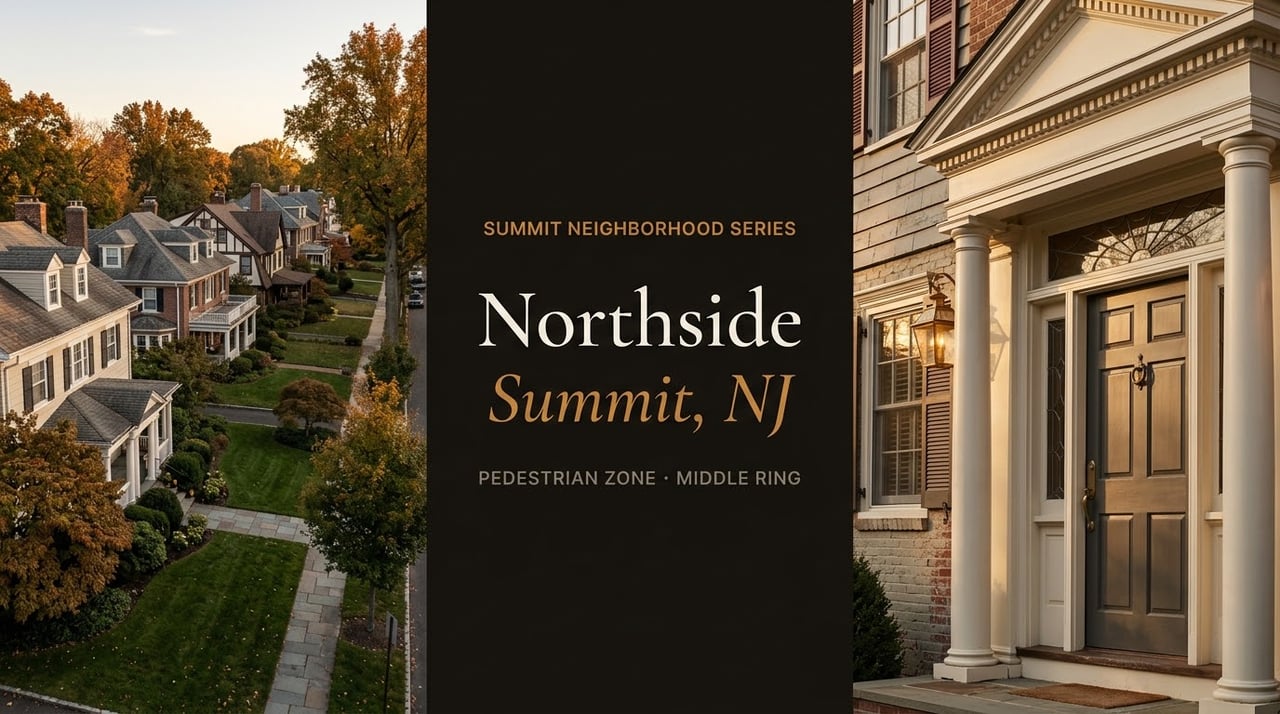
Northside, Summit: One Neighborhood, Two Rings, Two Pricing Regimes.
Most Summit neighborhoods sit cleanly inside one ring. Northside does not. The same architecturally distinguished streetscape spans the Pedestrian Zone boundary and the Middle Ring — which means the single most consequential pricing decision a Northside seller makes is figuring out which ring her specific address actually belongs to.
Northside is the neighborhood that breaks the clean ring model. Its streets span the Pedestrian Zone boundary and the Middle Ring, which means two structurally different pricing regimes operate inside a single neighborhood with a continuous architectural fabric. A home on a Northside street four hundred meters from the station follows Pedestrian Zone economics; a home on a Northside street eleven hundred meters from the station follows Middle Ring economics — even when the two homes are architecturally identical and a five-minute walk apart. The single most consequential decision a Northside seller makes is correctly identifying which ring her address belongs to. Get it right and the listing prices correctly. Get it wrong and the home either sits overpriced or sells underpriced.
Northside is one of Summit’s most architecturally distinguished neighborhoods, and also its most analytically complicated. The streets carry some of the finest early-twentieth-century housing stock in the city — substantial Victorians, Colonial Revivals, Tudors, and Foursquares, many with original detail intact, on tree-lined streets with mature canopy and a coherent architectural character. On the strength of its housing fabric alone, Northside ranks among the most desirable addresses in Summit.
What makes Northside complicated is its geography. The neighborhood spans the boundary between the Pedestrian Zone and the Middle Ring. Its innermost streets sit within the half-mile walking radius of Summit Station — firmly in Pedestrian Zone territory, where walk-time and amenity overlap dominate the pricing logic. Its outermost streets sit beyond the half-mile, in the Middle Ring, where the post-2016 rideshare access regime and the lot-and-school bundle dominate instead. The two pricing regimes are structurally different, and they operate inside a single neighborhood with a continuous architectural fabric and no visible internal boundary.
This post applies the broader Summit framework to Northside’s specific complication. It works through the ring-split that defines the neighborhood, the architectural fabric that gives Northside its desirability across both rings, the buyer profiles that differ between the inner and outer streets, the comp-set discipline required when a single neighborhood straddles two pricing regimes, and the operational pricing framework that produces top-of-range outcomes. The foundational frameworks are Part IV (Pedestrian Zone) and Part III (Middle Ring) of the seller series — Northside is the neighborhood where both apply, on different streets, simultaneously.
The defining analytical fact about Northside is that it does not belong to one ring. The neighborhood’s streets range from roughly 0.4 miles to roughly 1.1 miles from Summit Station, which means the inner streets sit inside the Pedestrian Zone (the half-mile walking radius) while the outer streets sit in the Middle Ring. This is not a trivial distinction. The two rings follow different pricing logic, attract different buyer profiles, and require different listing strategies. A Northside seller who applies the wrong ring’s logic to her specific address makes the single most consequential pricing error available in the neighborhood.
Consider two architecturally identical 1910 Colonial Revivals, both in Northside, both with comparable lots and condition, a five-minute walk apart. The first sits on an inner street, seven minutes’ walk to Summit Station — squarely in the Pedestrian Zone. Its value is anchored to walk-time and amenity overlap, and it should be priced and marketed as a walkable downtown home. The second sits on an outer street, beyond the half-mile radius, requiring a longer walk or the post-2016 Lyft program to reach the platform — squarely in the Middle Ring. Its value is anchored to the lot-and-access bundle, and it should be priced and marketed as a Middle Ring family home. The two homes can carry meaningfully different values despite their architectural similarity.
The error most Northside listings make is treating the neighborhood as a single undifferentiated unit. A listing agent who pulls "Northside comps" without distinguishing between the inner Pedestrian Zone streets and the outer Middle Ring streets builds a comp set that blends two different pricing regimes — producing a price range too wide to be useful and a list price that systematically misprices the subject property in one direction or the other. The disciplined approach begins with the ring determination, then proceeds to the appropriate framework for that ring.
For the seller, the first and most important step is the walk-time measurement described in the broader framework series. Walk the route from the front door to Summit Station, time it honestly, and determine the ring. Under ten minutes by sidewalk places the home in Pedestrian Zone territory; meaningfully more than ten minutes places it in the Middle Ring. The ring determination drives every subsequent decision. It is worth getting right before any other pricing work begins.
Two architecturally identical Northside Colonials, a five-minute walk apart, can carry meaningfully different values — because one is Pedestrian Zone and the other is Middle Ring. The ring determination is the whole ballgame in this neighborhood. Everything else follows from it.
If the ring-split is what divides Northside, the architectural fabric is what unifies it. The neighborhood carries one of the most coherent and distinguished collections of early-twentieth-century housing stock in Summit — substantial Colonial Revivals, Victorians, Tudors, Foursquares, and Shingle-style homes, predominantly built between roughly 1900 and 1930, when Northside was developing as one of Summit’s prestige residential sections. Both the inner Pedestrian Zone streets and the outer Middle Ring streets share this fabric, which gives the neighborhood a visual and architectural continuity that masks the underlying pricing split.
The architectural quality is a genuine pricing asset in both rings, but it functions slightly differently in each. In the Pedestrian Zone inner streets, the architectural character compounds with the walkable-downtown bundle — a buyer paying for walkability also gets period architecture, which lifts the ceiling on what the walkable premium can command. In the Middle Ring outer streets, the architectural character compounds with the lot-and-access bundle — a family buyer paying for the Middle Ring home gets period architecture as a meaningful upgrade over the more varied Middle Ring fabric found in neighborhoods like Wyoming.
The sympathetic-renovation discipline applies in Northside with particular force, because the neighborhood’s architectural integrity is a primary driver of its desirability across both rings. The discipline established in the Beacon Hill and Franklin Hill posts holds here: preserve original architectural detail, modernize function without erasing character, and resist gut renovations that strip the period elements buyers in this neighborhood specifically value.
A Northside consideration specific to the architectural fabric: because the neighborhood is among Summit’s most architecturally distinguished, it draws a meaningful share of architecturally-motivated buyers who would also consider Beacon Hill, the inner sections of Franklin Hill, and prestige addresses in adjacent towns. The listing strategy should treat the architecture as a headline asset in its own right — documenting the period, the original detail, and the provenance with the specificity that the architecturally-motivated buyer rewards, regardless of which ring the home sits in.
The ring-split produces a buyer-split. The inner Pedestrian Zone streets of Northside attract one buyer profile; the outer Middle Ring streets attract another. A listing strategy that understands which buyer the specific address attracts will outperform a strategy that markets to a generic "Northside buyer" who does not exist.
On the inner Pedestrian Zone streets, the dominant buyer mirrors the Edgewood profile with an architectural premium attached. She is often a downsizer prioritizing walkable access to downtown and the train, or an urban-relocation professional who values both the Midtown Direct line and the period architecture. The architectural distinction of Northside lets these inner streets command a premium over comparable Pedestrian Zone homes elsewhere in Summit. The listing leads with the walk-time and the downtown amenity overlap, with the architectural character as a strong supporting asset.
On the outer Middle Ring streets, the dominant buyer mirrors the Beacon Hill and Wyoming family profile, again with an architectural premium attached. She is a move-up family prioritizing the Summit school district, the lot, and the rideshare-enabled commute — but she is also drawn to Northside specifically because the architectural fabric is more distinguished than the more varied Middle Ring stock she would find in other neighborhoods. The listing leads with the family-buyer bundle, with the period architecture as a meaningful upgrade differentiator.
A meaningful share of Northside transactions in both rings involves the architecturally-motivated buyer — a household for whom the period architecture is the primary draw and the ring position is secondary. This buyer compares Northside against Beacon Hill, the inner Franklin Hill streets, and architecturally distinguished addresses in adjacent towns. For this buyer, the ring matters less than the architecture, and the listing strategy should foreground the architectural provenance most prominently. Identifying which of the three buyer types a given Northside listing is most likely to attract — and tailoring the listing accordingly — is the core of effective Northside marketing.
There is no generic Northside buyer. There is a Pedestrian Zone buyer, a Middle Ring family buyer, and an architecture-first buyer who compares the neighborhood against the finest addresses in Summit. The listing that knows which one it is talking to is the listing that sells at the top.
Comp selection in Northside is the most demanding in the entire neighborhood series, because the analyst must respect the ring boundary that runs invisibly through the neighborhood. The cardinal rule: comp a Pedestrian Zone Northside home against other Pedestrian Zone homes, and comp a Middle Ring Northside home against other Middle Ring homes. Crossing the boundary — comping an inner-street home against outer-street sales or vice versa — contaminates the analysis with the wrong pricing regime.
For a Pedestrian Zone Northside home, the comp set should draw from other Pedestrian Zone sales — including inner Northside streets and comparable walkable downtown homes in adjacent Pedestrian Zone sections like Edgewood — filtered for architectural era and walk-time. The architectural premium that Northside carries means the comp set should weight toward the architecturally comparable, period-appropriate Pedestrian Zone sales rather than newer construction within the band.
For a Middle Ring Northside home, the comp set should draw from other Middle Ring sales — including outer Northside streets and architecturally comparable Beacon Hill and Wyoming sales — filtered for the post-2016 access regime, lot size, and architectural era. Again the architectural premium argues for weighting toward the period-appropriate, architecturally distinguished Middle Ring sales rather than the more varied Middle Ring stock.
The AVM mispricing problem is more acute in Northside than anywhere else in Summit, for a precise reason: the automated models do not recognize the ring boundary at all. The algorithm sees a continuous Northside neighborhood with a consistent architectural fabric and prices it as a single unit — averaging across the Pedestrian Zone and Middle Ring sales that should never be blended. As a result, the AVM systematically underprices the inner Pedestrian Zone homes (which the algorithm drags down toward the Middle Ring average) and overprices the outer Middle Ring homes (which the algorithm lifts toward the Pedestrian Zone average). The disciplined comp-built range, ring-aware, is the right anchor; the AVM is more misleading here than in any other Summit neighborhood.
The Northside pricing exercise integrates everything above, with the ring determination as the foundational first step. The scorecard below summarizes the practical operational framework for any homeowner preparing to list in the neighborhood.
Pricing Input | Northside-Specific Treatment | Common Mistake |
|---|---|---|
Ring Determination | The foundational step — measure walk-time, assign Pedestrian Zone or Middle Ring | Treating Northside as one undifferentiated neighborhood |
Headline Asset | Ring-dependent: walk-time (inner) or lot-and-access bundle (outer), plus architecture in both | Applying the wrong ring’s headline assets to the listing |
Architecture | Headline asset in both rings — document period, detail, provenance specifically | Treating architecture as a footnote rather than a primary asset |
Comp Set | Ring-matched: never comp an inner home against outer sales or vice versa | Blending Pedestrian Zone and Middle Ring sales into one Northside comp pool |
AVM Treatment | Most misleading in Summit — the algorithm cannot see the ring boundary | Trusting an AVM that averages across two pricing regimes |
The operational discipline for a Northside seller follows the framework above, with the ring determination as the non-negotiable first step. Measure the walk-time and assign the ring. Apply the appropriate ring’s headline assets. Document the architecture as a primary asset in either case. Build the comp set strictly within the ring, never across the boundary. Treat the AVM consensus as the least reliable input available, because the algorithm cannot see the boundary that defines the neighborhood.
For the broader Summit framework, begin with Part I of the Summit Seller Series. Because Northside straddles two rings, its sellers benefit from both Part IV (Pedestrian Zone) and Part III (Middle Ring), plus Part V (AVM mispricing), which applies with unusual force here. The seven-decision synthesis in Part VI walks through the full pricing exercise.
I have watched Northside listings sit unsold for months because the seller priced an outer-street Middle Ring home as if it were an inner-street Pedestrian Zone home. The architecture was identical. The street name sounded the same. But the buyers knew the difference even when the listing did not. In this neighborhood, the ring determination is not a technicality. It is the difference between a sale and a stalled listing.
Walk the route from your front door to Summit Station and time it honestly, in normal conditions, by sidewalk rather than by car or straight-line distance. Under ten minutes places the home in Pedestrian Zone territory, where walk-time and downtown amenity overlap dominate the pricing logic. Meaningfully more than ten minutes places it in the Middle Ring, where the post-2016 rideshare access regime and the lot-and-school bundle dominate. This single determination drives every subsequent pricing decision for a Northside home, so it is worth doing carefully before any other work begins.
Boundary homes are the cases that most reward careful analysis. The honest practice is to score the home against both rings — build a Pedestrian Zone comp set and a Middle Ring comp set — and identify which framing produces the stronger, more defensible price. Some boundary homes are best marketed as the outer edge of the Pedestrian Zone; others as the premium entry point of the Middle Ring. The decision depends on the specific walk-time, the quality of the walking route, and the buyer profile most likely to bid on the specific home.
Yes, in both rings. Northside’s early-twentieth-century housing stock is among the most distinguished and coherent in Summit, and the architectural integrity is a genuine pricing asset that compounds with whichever ring bundle applies. A Pedestrian Zone Northside home commands a premium over comparable walkable homes elsewhere; a Middle Ring Northside home commands a premium over the more varied Middle Ring stock in neighborhoods like Wyoming. The premium is real but must be documented specifically — period, original detail, provenance — rather than asserted generically.
Because the algorithm cannot see the ring boundary that runs through the neighborhood. An AVM treats Northside as a single continuous neighborhood with a consistent architectural fabric, and prices it as one unit by averaging across Pedestrian Zone and Middle Ring sales that should never be blended. The result is systematic: the AVM tends to underprice the inner Pedestrian Zone homes (dragging them toward the Middle Ring average) and overprice the outer Middle Ring homes (lifting them toward the Pedestrian Zone average). A ring-aware, comp-built range is the right anchor; the AVM is more misleading in Northside than in any other Summit neighborhood.
The listing must first identify which ring the home is in and which of the three Northside buyer types it is most likely to attract — the Pedestrian Zone walkability buyer, the Middle Ring family buyer, or the architecture-first buyer. Then the listing leads with the headline assets relevant to that buyer, with the architectural distinction as a strong supporting or leading asset depending on the buyer type. A generic Northside listing that markets to no specific buyer underperforms a targeted listing that knows exactly who it is talking to.
A 30-minute Northside pricing audit with The Prodigy Team begins with the ring determination that defines your home’s pricing regime, then covers architectural documentation, ring-matched comp selection, buyer-type targeting, and a defensible list-price recommendation — grounded in the framework above, not in an AVM that cannot see the boundary running through your neighborhood.
Prodigy Real Estate is an innovative real estate company offering high-end video production, home valuation services, purchasing, and home sales. Serving New York and New Jersey.