
Anthony Licciardello | June 2, 2026
Summit, NJ
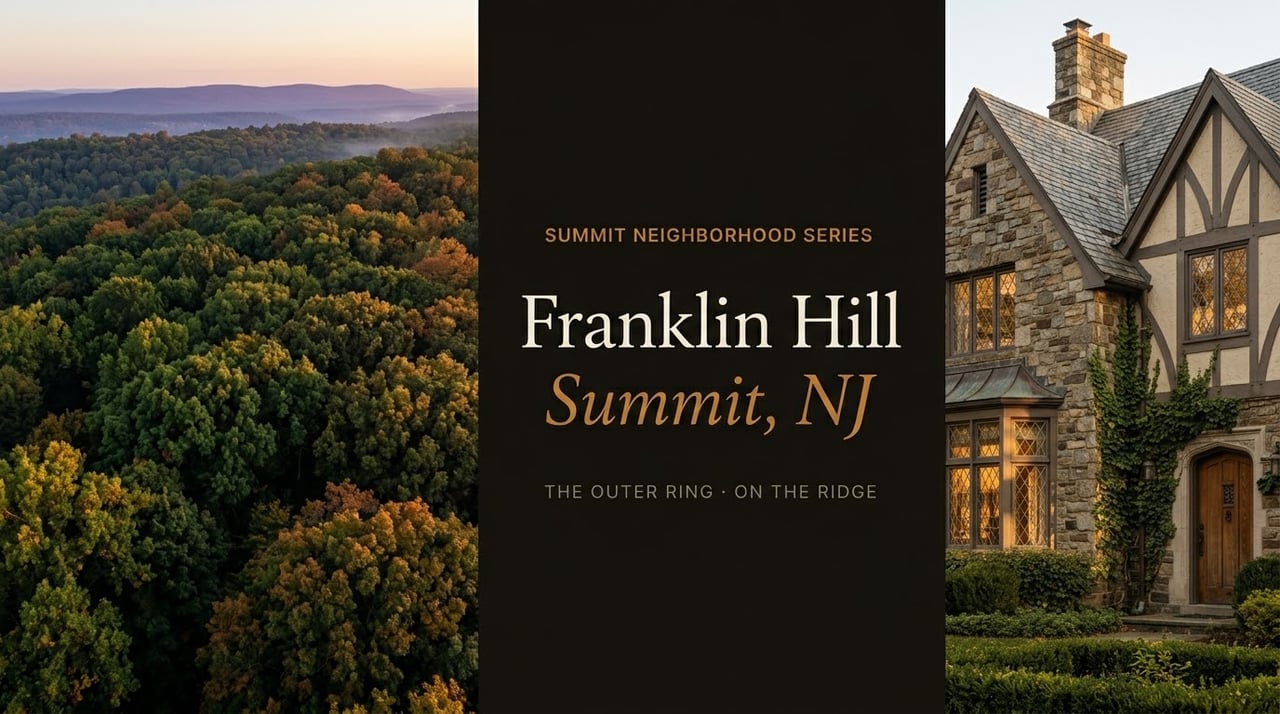
Franklin Hill, Summit: Where the Watchung Ridge Sets the Price.
The most prestigious addresses in Summit are not the ones closest to the train. They are the ones highest on the basalt ridge, with the longest line of sight, on the smallest set of streets buyers and brokers both treat as a category unto itself.

Franklin Hill is where the Summit pricing logic inverts. Two miles or more from Summit Station, viewshed and elevation eclipse transit access as the dominant pricing variables. The architectural fabric is the most distinguished in the city — large 1920s and 1930s stone manors, Tudor-revivals, and architect-designed homes set on generous lots along the Second Watchung Ridge. The buyer pool is smaller, more particular, and willing to pay premium prices for the specific combination of viewshed, elevation, privacy, and architectural prestige that no other Summit neighborhood replicates. The pricing exercise here is unlike any other in the city, and the listings that mishandle it underperform meaningfully.
Franklin Hill is the geographic and economic peak of Summit. The neighborhood occupies the upper western flank of the Second Watchung Mountain, with parcel elevations typically running between 450 and 580 feet above the valley basin where Summit Station sits. The streets are quiet, the lots are generous, the canopy is mature, and the architectural fabric — large 1920s and 1930s stone manors, Tudor-revivals, English country and architect-designed homes — is among the most distinguished housing stock in northern New Jersey.
For pricing purposes, however, what defines Franklin Hill is not the architecture alone. It is the specific combination of architectural prestige with the topographical asset the rest of Summit cannot replicate: line-of-sight viewshed across the protected Watchung Reservation. The neighborhood’s western edge looks down across roughly two thousand acres of permanently preserved Union County parkland — a viewshed that no zoning variance, no developer’s site plan, no neighbor’s renovation can ever erode. That permanence is the asset Franklin Hill buyers are fundamentally paying for, and the asset that drives the neighborhood’s consistent position at the top of Summit’s pricing distribution.
This post applies the broader Summit framework specifically to Franklin Hill. It works through the neighborhood’s Outer Ring position, the viewshed tier system established in Part II of the seller series, the architectural-prestige premium that compounds with viewshed, the specific buyer profile that drives Franklin Hill transactions, and the operational pricing framework that produces top-of-range outcomes. Sellers in the neighborhood are the primary audience. Buyers researching what they are about to pay for, and why, are the secondary audience.
The textbook urban-economics model says property values fall as distance from the train station increases. For most of Summit this is broadly correct — with the structural adjustments the seller framework series has documented across the Pedestrian Zone and Middle Ring. Past roughly two miles from Summit Station, however, the model breaks down entirely. Franklin Hill sits past that threshold. And rather than continuing the downward slope, prices in the neighborhood begin climbing again.
The reason is straightforward. At Franklin Hill’s distance from the station, transit access ceases to be the dominant pricing variable. The buyer who is shopping in Franklin Hill is not optimizing for a daily Midtown commute — she is often a remote-or-hybrid professional, a household that has aged out of daily commuting, a buyer relocating from Manhattan or international markets specifically for prestige and privacy, or a Wall Street or law-firm partner whose commute pattern is car-and-driver rather than train-and-platform. The Midtown Direct line is a nice-to-have. It is not the asset that anchors the purchase.
What replaces transit as the pricing anchor is the combination of viewshed, elevation, lot size, and architectural prestige. Franklin Hill offers all four simultaneously in a way no other Summit neighborhood does. The result is that the neighborhood consistently produces the highest sale prices in the city, not because it is closest to anything, but because it is highest above everything, with the most generous lots, and the most distinguished architecture — a combination the market is willing to pay handsomely to assemble in one address.
For the seller, this means the listing strategy in Franklin Hill is fundamentally different from the listing strategy in any other Summit neighborhood. Leading with "convenient to train" or "minutes to Midtown Direct" is precisely backward — the Franklin Hill buyer is not paying for those variables, and emphasizing them anchors the buyer to a frame that competes against Pedestrian Zone listings the property cannot actually replace. The right Franklin Hill listing leads with the viewshed, the elevation, the architectural specificity, and the lot generosity. The transit access goes in the footnotes.
The Franklin Hill buyer is not paying for the train. She is paying for everything the train cannot offer: the elevation, the viewshed, the lot, the architectural prestige. Sellers who lead with transit access in this neighborhood are anchoring the listing to the wrong frame.
Within Franklin Hill, the single most consequential pricing variable is the specific viewshed tier of each parcel. The viewshed framework established in Part II of the seller series applies here with particular force — not as an abstract pricing input but as the variable that most directly explains why two seemingly comparable Franklin Hill homes can transact at dramatically different prices. The discipline is to score the parcel honestly on its actual line-of-sight, not on its altitude alone.
The four-tier system from the framework series applies directly. A Tier I Permanent Franklin Hill home has an unobstructed western azimuth across the Watchung Reservation — the most valuable viewshed in the neighborhood and arguably in the city. The target is permanently protected parkland, the sightline is structurally unbreakable, and the buyer is paying premium prices for an asset that cannot be eroded by future development. These properties consistently sit at the top of the Franklin Hill price distribution.
A Tier II Treetop Franklin Hill home sits high enough on the ridge that its main living levels look across the canopy rather than into it — the foreground is the sea of oak and beech crowns rather than the trees themselves. This is a meaningfully different asset than Tier I but a strong one in its own right, and one that is often undermarketed because sellers and agents treat the canopy as an obstruction rather than a foreground subject.
A Tier III Seasonal Franklin Hill home offers a strong viewshed in winter when leaves are off the canopy, with the view substantially obscured in summer. These properties are best marketed honestly — with both seasons documented and the seasonality named directly in the listing remarks — rather than overstated as full-time view homes. Honest framing protects the eventual sale price and the buyer’s trust.
A Tier IV Altitude-Only Franklin Hill home sits at high elevation but is encircled by mature canopy or obstructed by neighboring rooflines such that no usable line-of-sight is realized. These properties should not be marketed as viewshed homes at all. Lead instead with the privacy, the canopy character, the architectural distinction, and the lot. Pricing should reflect the absence of viewshed honestly; AVMs and buyers will both detect the gap if the marketing overstates it.
Western azimuth, unobstructed, multi-mile sightline to permanently protected Watchung Reservation. Highest pricing tier in the neighborhood — full capitalization defensible.
Elevated sightline across local canopy, foreground is the trees themselves. Strong tier, frequently undermarketed because sellers treat canopy as obstruction rather than subject.
Strong leaves-off view, substantially obscured in summer. Best marketed honestly with both seasons documented; modest premium, but honest framing protects sale price.
High elevation but encircled by canopy or neighboring rooflines. Reframe as privacy asset rather than viewshed. Do not chase a viewshed premium the property cannot defend.
Within Franklin Hill, the western and northwestern azimuths are the highest-value orientations because they look toward the protected Reservation. Eastern azimuths face inland and carry significantly less permanence value, though some northern parcels enjoy distant Manhattan-skyline glints on clear days. The honest framing matters here as much as the scoring — an eastern viewshed described accurately outsells a western viewshed described abstractly.
Franklin Hill’s housing stock is, on average, the most architecturally distinguished in Summit. The neighborhood was developed primarily in the 1920s and 1930s, during a period when wealthy New York households were building country estates and ridge-line retreats on the elevated lots that distinguished the upper Watchung sections. The architectural vocabulary reflects that era and that intent — large stone-and-stucco Tudor-revivals, English country manors, Norman-revival homes, architect-designed colonial revivals, and the occasional Gilded Age estate carved into smaller parcels over the subsequent century.
What makes the architectural premium real in Franklin Hill is the consistency of the housing stock. Unlike the Middle Ring sections of Summit, where 1920s homes coexist with 1960s ranches and recent teardown-rebuilds, Franklin Hill has largely maintained its architectural identity. Renovations have tended to be sympathetic. Teardowns are rare. The walking experience along the neighborhood’s streets reads as architecturally intentional in a way that resonates strongly with the prestige-oriented buyer pool the neighborhood draws.
For pricing, the implication is that architectural specificity compounds with viewshed and elevation rather than substituting for them. A Tier I Permanent viewshed on a stone-and-stucco 1928 Tudor with original leaded glass, slate roofing, and intact period detail commands a meaningfully higher price than the same viewshed on a renovated 1980s contemporary, even when the structural square footage and lot size are comparable. The buyer pool is paying for the asset bundle, and the architectural integrity is a significant component of that bundle.
The sympathetic-renovation standard from the Beacon Hill post applies here with particular force. Franklin Hill sellers who renovate in ways that strip original architectural detail typically realize substantially less return on the investment than sellers who renovate sympathetically — preserving period elements while modernizing function. The prestige buyer is not paying for contemporary surfaces. She is paying for character that the contemporary market cannot produce, on a ridge that no other Summit neighborhood replicates.
The Franklin Hill premium is not the viewshed alone. It is the viewshed plus the elevation plus the lot plus the architectural specificity — compounded into an address the rest of Summit cannot replicate. That bundle is what the prestige buyer is paying for.
The Franklin Hill buyer pool is smaller, more particular, and structurally different from the family-buyer pool that drives Beacon Hill or the downsizer pool that drives the Pedestrian Zone. Three buyer profiles dominate Franklin Hill transactions, each with a distinct purchasing logic and each requiring a slightly different listing strategy.
The first profile is the prestige relocation buyer — a senior executive, partner, or principal who has been transferred to or recruited into the New York metropolitan area, and who is selecting a residence primarily on the basis of architectural distinction, address prestige, lot privacy, and the specific cultural signal Franklin Hill carries within the metropolitan market. This buyer often comes through a relocation service or a personal-introduction channel rather than open MLS browsing. She is comparing Franklin Hill primarily against the most prestigious neighborhoods in adjacent towns — Short Hills, Far Hills, and the upper sections of Bernardsville — rather than against other Summit listings.
The second profile is the architectural-and-viewshed enthusiast — a buyer who has specifically sought out a Watchung ridge address for the combination of architectural integrity, elevation, and viewshed. This buyer often has Summit connections (current Pedestrian Zone or Middle Ring residents trading up, or local high-net-worth households consolidating into the most distinguished addresses) and is willing to pay full Franklin Hill prices for the asset bundle the neighborhood uniquely offers. She is well-informed, expects honest documentation of the viewshed tier, and rewards listing strategies that name the architectural specifics directly.
The third profile is the remote-or-hybrid professional — a household that no longer commutes daily, that values privacy and grounds and quiet, and that is exiting Manhattan or Brooklyn specifically for the kind of established suburban quality Franklin Hill represents. This buyer is increasingly common in the post-pandemic market, has the financial capacity to purchase at full Franklin Hill prices, and frequently outbids the prestige-relocation buyer because she is making a lifestyle decision rather than a credential one.
The listing strategy implication is that Franklin Hill marketing should not generalize. The listing remarks should be written to a sophisticated, well-informed buyer who expects specificity about viewshed orientation, architectural pedigree, lot configuration, and historical provenance. Vague claims (“stunning views,” “classic elegance,” “timeless luxury”) underperform in this band. Specific claims (“western azimuth Reservation viewshed,” “1928 architect-designed stone-and-stucco Tudor with original leaded glass and slate roofing,” “0.82-acre wooded lot with formal gardens”) consistently sell at the top of the comp range.
The Franklin Hill pricing exercise integrates everything above. The scorecard below summarizes the practical operational framework for any homeowner preparing to list in the neighborhood.
| Pricing Input | Franklin Hill-Specific Treatment | Common Mistake |
|---|---|---|
| Ring Designation | Outer Ring — transit access is a footnote, not a headline variable | Leading the listing with "minutes to Midtown Direct" |
| Headline Asset | Viewshed tier + elevation + lot + architectural pedigree, named specifically | Vague language: "stunning views," "classic elegance," "timeless luxury" |
| Viewshed Scoring | Honest tier assignment (I – IV) with documented azimuth and seasonal behavior | Overstating Tier III or Tier IV as full-time view homes |
| Comp Set | Post-2022, in-neighborhood, filtered for matching viewshed tier and era | Comparing Tier I and Tier IV parcels as if they were the same asset |
| Renovation Strategy | Sympathetic updates that preserve architectural period detail | Contemporary gut-renovations that strip the character buyers are paying for |
| AVM Treatment | Least reliable input in the Outer Ring — bidirectional errors | Trusting the Zestimate when comp set and viewshed tier disagree |
The operational discipline for a Franklin Hill seller follows the framework above. Score the viewshed tier honestly. Document the architectural pedigree with specificity. Build the comp set from same-tier, same-era Franklin Hill transactions post-2022. Renovate sympathetically or not at all. Treat the AVM consensus as the least reliable input in the analysis — in the Outer Ring more than anywhere else in Summit, the AVM mispricing detailed in Part V of the seller series compounds aggressively because the variables that drive Franklin Hill prices are precisely the variables the algorithms cannot read.
For the broader Summit framework that contextualizes this neighborhood-specific analysis, begin with Part I of the Summit Seller Series. Franklin Hill homeowners preparing to list will benefit particularly from Part II on the Watchung viewshed framework and Part V on AVM mispricing. Both apply with particular force in this neighborhood, and the seven-decision synthesis in Part VI walks through the full pricing exercise.
Three compounding factors. First, the neighborhood sits at the top of the Second Watchung Ridge, with parcel elevations of approximately 450–580 feet that produce viewsheds across the protected Watchung Reservation no other Summit neighborhood can replicate. Second, the lots are among the most generous in the city, typically running 0.5 to 1.5 acres or more. Third, the architectural fabric is consistently distinguished — large 1920s and 1930s stone manors, Tudor-revivals, and architect-designed estates. The combination is what the prestige buyer is paying for, and the combination is unique within Summit.
More important than any other single variable in the neighborhood. A Tier I Permanent viewshed across the Reservation can command meaningfully higher prices than a Tier IV Altitude-Only property of similar square footage, lot size, and architectural pedigree. The viewshed tier should be scored honestly before pricing begins, because the wrong tier designation flows into every downstream decision — comp selection, listing narrative, photography priorities, and the eventual list price.
Sympathetically and selectively, if at all. The Franklin Hill buyer is paying for architectural character that the contemporary market cannot produce. Gut renovations that strip period detail typically reduce the home’s appeal to the prestige-oriented buyer pool. Sympathetic updates that preserve original elements (leaded glass, slate roofing, period millwork) while modernizing function (mechanical systems, kitchen and bath layouts, lighting, technology infrastructure) tend to pay back well. The discipline is to preserve the character buyers are paying for, not erase it.
Three buyer profiles dominate the neighborhood. The prestige relocation buyer (a senior executive or partner relocating to the New York area, selecting on architectural and address prestige). The architectural-and-viewshed enthusiast (often a local high-net-worth household consolidating into a most-distinguished address, or an out-of-state buyer specifically pursuing Watchung ridge real estate). And the remote-or-hybrid professional (a Manhattan or Brooklyn household making a post-pandemic lifestyle decision). All three expect specificity in the listing remarks and reward sellers who name the architectural and viewshed assets directly.
Each carries a distinct profile. Short Hills offers a different commute pattern (the Morris & Essex line directly into Penn Station), strong schools, and a flatter topography without the ridge viewshed. Far Hills offers larger estate parcels and equestrian character but is meaningfully further from Midtown. Franklin Hill’s differentiator is the specific combination of Watchung Ridge elevation, Reservation viewshed, distinguished 1920s architectural fabric, and the Summit school district — on parcels that are generous by Summit standards but not the full estate scale of Far Hills. For the prestige buyer prioritizing topography, viewshed, and architectural integrity within the New York metropolitan commute zone, Franklin Hill is often the strongest fit.
A 30-minute Franklin Hill pricing audit with The Prodigy Team covers viewshed-tier scoring, architectural pedigree documentation, prestige-buyer narrative development, and a defensible list-price recommendation grounded in the framework above — not in the AVM that has never been able to read the Watchung ridge correctly.
Request Your AuditProdigy Real Estate is an innovative real estate company offering high-end video production, home valuation services, purchasing, and home sales. Serving New York and New Jersey.