
Anthony Licciardello | July 15, 2026
Staten Island
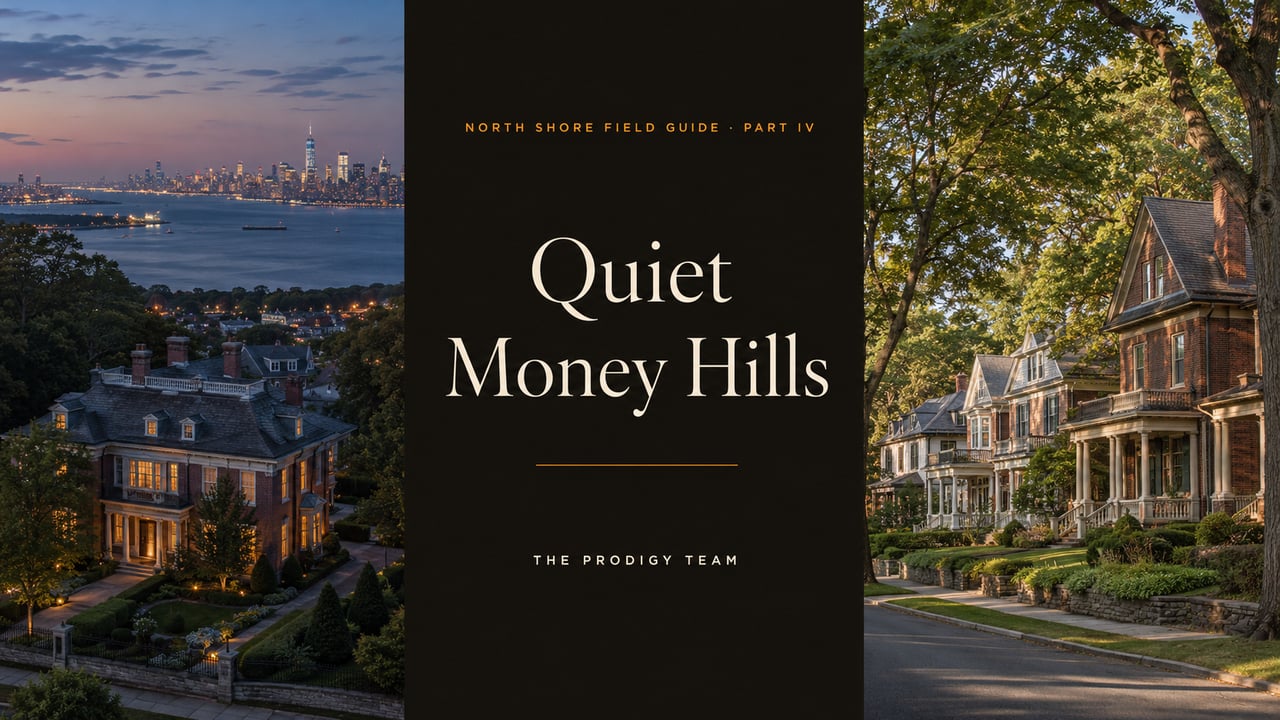
Grymes Hill, Randall Manor, and Livingston — the North Shore’s prestige enclaves, where a handful of sales a month set the record and a view of the harbor is a line item. How thin-inventory, view-driven homes actually price, and why the monthly median up here is nearly meaningless.
The Quiet Money Hills are the North Shore’s prestige tier: elevated, estate-scale in places, and defined by three assets no renovation can create — sightline, land, and address. Grymes Hill’s median is printing around $799,000 on 83 days to contract, but the honest headline is the sample size: a few closings a month, with active listings spanning $375,000 to $4.6 million on the same hill.
At that volume, the monthly median is noise and the “neighborhood price” is a fiction. These homes price on a view-and-land methodology — sightline quality, lot, provenance, condition — comped against a handpicked set of genuinely similar sales that often spans several years. Buyers and sellers who insist on radius comps here get the number wrong by six figures in either direction.
Old money on Staten Island built uphill. Grymes Hill — the borough’s second-highest point after Todt Hill — drew shipping magnate Sir Edward Cunard’s 1851 mansion and the Ward estate soon after, both of which survive today inside the Wagner College campus. Randall Manor and Livingston filled in below and west of Snug Harbor with the deep-porch, deep-lot houses of the borough’s professional class. A century and a half later the hills still trade on exactly what they were built for — elevation, privacy, and the harbor view — and they still trade the old-money way: rarely, quietly, and on terms the broader market’s statistics cannot see. This is the prestige chapter of Part I of the Field Guide.
Start with what the platforms print. Grymes Hill’s median sale price this spring was about $799,000 (average $810,715), with houses taking roughly 83 days to go under contract and active listings running from $375,000 to $4.6 million. Randall Manor’s listing median has hovered around $924,000 on roughly 85 days — often with a single closing in a given month. Livingston, the smallest of the three, frequently doesn’t clear reporting thresholds at all.
Now the demonstration of why none of those medians deserve your trust: in one recent month, Grymes Hill’s printed median swung more than 130% year over year — not because the hill repriced, but because nine closings happened to include a different mix of product than the prior year’s fifteen. A market that closes a handful of homes a month, across a 12-to-1 price spread from bottom listing to top, produces medians that whipsaw with every estate sale and every condo closing. On the hills, the monthly statistic measures which houses sold, not what houses are worth.
The 12-to-1 listing spread on Grymes Hill is not a data error — it’s the hill’s actual composition. Condos and modest homes on the lower slopes share a neighborhood label with view estates on multi-lot parcels near the crest. Any “Grymes Hill median” is averaging across products that have nothing to do with each other. The label is geography; it is not a market.
If the median is useless, what replaces it? A component method — four graded inputs, in descending order of weight.
Sightline. Not “a view” — which view, from which rooms, protected by what. A harbor-and-skyline panorama from the principal living spaces is the single most valuable component on the hills, worth a premium measured in hundreds of thousands over an identical house facing the street. Grade it honestly — full panorama, partial water, seasonal, none — and grade its protection, because a view over a neighbor’s buildable lot is an option, not an asset.
Land. Lot size, and just as importantly lot logic: usable flat area versus slope, frontage, privacy plantings, and whether adjacent parcels are protected, developed, or institutional. Large lots near Wagner College and Silver Lake Park carry different adjacency-risk profiles, and buyers price them accordingly.
Address and provenance. A century of continuous prestige is a real input — certain streets and houses carry names, histories, and pedigrees that a specific buyer will pay for and a general buyer won’t. This is what makes the hills a patience market: the premium exists, but it is paid by the one right buyer, not the crowd.
Condition, last. The inversion that surprises people: at this tier, condition is the least defensible premium, because the buyer pool renovates to taste anyway. A dated estate with a protected panorama outsells a renovated house with no view — the opposite of the borough’s mid-market, and a cousin of the protect-don’t-modernize logic that governs the Victorian Belt in Part III. The comp set supporting all of this is handpicked and often multi-year: the last genuinely comparable sightline-and-lot sales, time-adjusted — not whatever closed within a half mile in 90 days. Lender appraisers don’t always have that latitude, which is why appraisal-gap strategy belongs in every hills contract conversation, on both sides.
Grymes Hill is the estate tier — the borough’s second-highest ground, the Cunard and Ward legacy inside the Wagner College campus, Howard Avenue’s long procession of set-back houses, and the widest quality spread of the three. It trades differently from Todt Hill despite comparable top-end price points: Todt Hill sells suburban seclusion at the island’s center; Grymes Hill sells the harbor panorama and a ten-minute run to the ferry — a different buyer with a different brief, which is why comping one hill against the other misfires.
Randall Manor is the family-prestige tier: walkable porch-and-lawn blocks below Snug Harbor, the most liquid of the three when priced correctly, with listing medians around the low $900,000s and closings that still often come one at a time. It draws the trade-up family who wants hills character without estate-scale maintenance — the Randall Manor neighborhood guide covers the lifestyle side.
Livingston is the quietest money of all — a small pocket against Snug Harbor’s landmark campus where inventory appears in single units, often trades with minimal marketing, and rarely generates enough closings to print a statistic. Here more than anywhere on the North Shore, the market is made by relationships and preparation: knowing a house may come available is frequently worth more than any search alert.
Buyers: grade the four components yourself before you tour — sightline, land, address, condition, in that order — and pay for the first three, not the last. Verify view protection at the parcel level (zoning and adjacent-lot buildability), expect an 80-plus-day market rhythm rather than a bidding-war sprint, and plan the appraisal conversation before you write the offer, because thin comps make lender valuations the most common failure point in hills contracts.
Sellers: your job is to reject the median publicly and prove the components privately — a comp package built from genuinely similar sightline-and-lot sales, even at two or three years’ distance, time-adjusted, plus marketing that shows the one thing street photographs cannot: the view itself, which is where aerial cinematography stops being a luxury and becomes the listing’s core evidence. Then price for the patient market this is. Every month spent chasing the wrong number with the wrong comps is a month of accumulated market skepticism. Borough context lives in our Staten Island market report; the hills’ job is to ignore most of it, knowingly.
“On the hills you don’t sell square footage. You sell a sightline, an acre, and a hundred years of address — and you wait for the one buyer who wants exactly that.”
— Anthony Licciardello, Broker, The Prodigy Team
Every guide on this site is part of a system: town-by-town content clusters, dedicated neighborhood pages, and cross-state marketing engineered for one outcome — putting your listing in front of the motivated New York families already searching for it. I’m Anthony Licciardello, Broker of The Prodigy Team — a former Director of Community Affairs in the Bloomberg Administration and a member of the Staten Island Growth Management Task Force — and this pipeline is what 22 years and 5,000 closings taught me to build.
Our Above the Streets cinematic drone series extends that reach — aerial storytelling that markets entire towns, not just listings, with audience performance exceeding industry benchmarks for real estate media.
Anthony Licciardello · Broker, The Prodigy Team · 718-873-7345
Component-based pricing, aerial cinematography that proves the sightline, and a buyer pipeline built for the hills’ patient market. Let’s talk before you list.
What do homes cost in Grymes Hill, Randall Manor, and Livingston?
Grymes Hill’s spring 2026 median printed around $799,000 with active listings from $375,000 to $4.6 million; Randall Manor’s listing median runs around the low $900,000s; Livingston trades too rarely for reliable statistics. Because closings number a handful per month, individual homes must be priced on components — sightline, lot, address, condition — against handpicked comparable sales, not neighborhood medians.
How is Grymes Hill different from Todt Hill?
Comparable top-end price points, different products: Todt Hill sells suburban seclusion at the island’s center, while Grymes Hill sells harbor-and-skyline sightlines minutes from the ferry. The buyer briefs differ, so cross-comping the two hills produces misleading valuations in both directions.
What’s the biggest risk when buying a view home on the hills?
Two: an unprotected sightline (a panorama over a neighbor’s buildable lot can be built out from under you — verify adjacent-parcel zoning before you pay for the view) and appraisal gaps (thin comps make lender valuations unreliable at this tier, so structure the contract with the appraisal conversation already had).
Why is my hills home taking longer to sell than the borough average?
By design: the hills run on a patience clock — roughly 83–85 days to contract in current data, longer at the estate tier — because the premium is paid by a narrow, specific buyer pool. The fix is a component-based comp package, view-forward marketing including aerial film, and distribution that reaches trade-up and cross-harbor buyers — never a panic reduction.
Part I: The North Shore, Decoded
Part III: The Victorian Belt
Part VI: The West Side — Mariners Harbor & Port Richmond
Grymes Hill Neighborhood Guide
Randall Manor Neighborhood Guide
Grymes Hill figures per Homes.com neighborhood data (spring 2026); Randall Manor and Grymes Hill listing medians, days on market, monthly closing counts, and historical median volatility per Redfin neighborhood data; borough medians compiled from MLS and public records, 2026. Neighborhood history per Grymes Hill development records, including the Cunard (1851) and Ward estates, now part of Wagner College. Hills medians are small-sample statistics subject to material revision. This post is general information, not appraisal advice.
Prodigy Real Estate is an innovative real estate company offering high-end video production, home valuation services, purchasing, and home sales. Serving New York and New Jersey.