
Anthony Licciardello | July 15, 2026
Staten Island
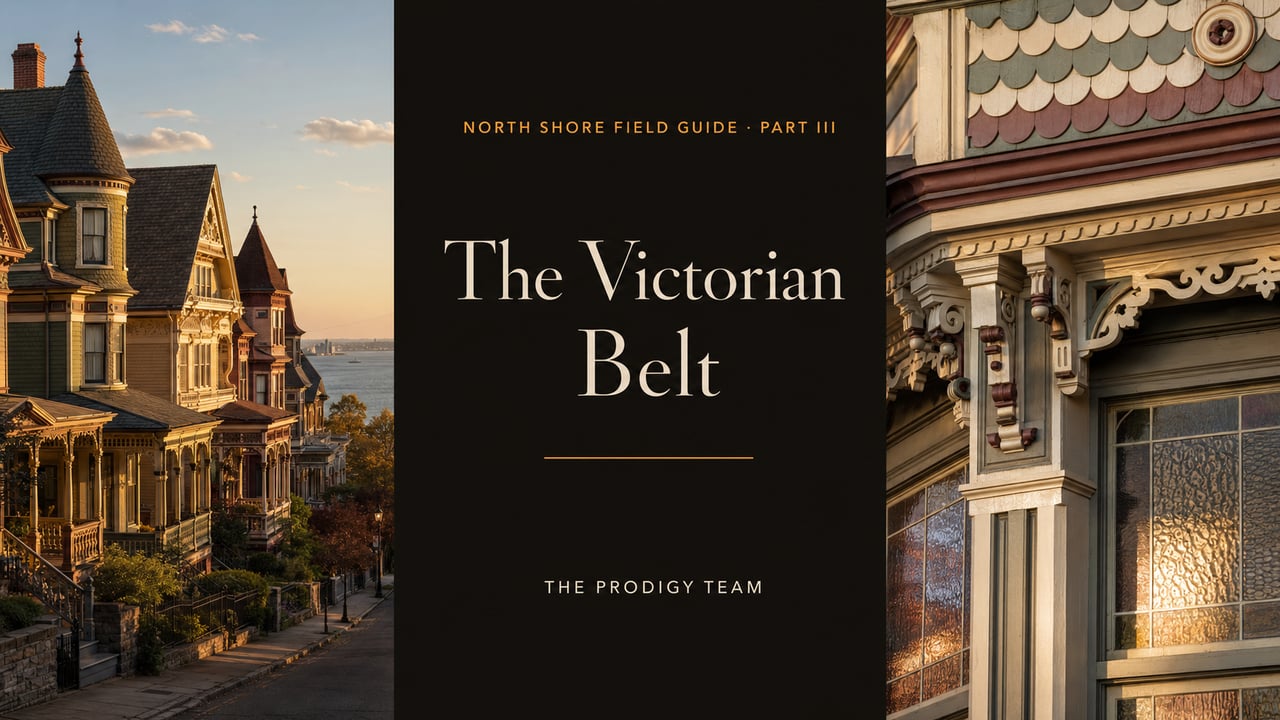
Two NYC landmark districts, a housing stock built between the 1830s and the 1930s, and a comping problem that costs sellers six figures. How the Victorian Belt actually trades — and why the restoration math here inverts every renovation rule the rest of the borough runs on.
The Victorian Belt — anchored by the St. George/New Brighton Historic District (designated July 19, 1994) and the St. Paul’s Avenue–Stapleton Heights Historic District (2004) — holds the borough’s only landmark-protected concentration of 1830s–1930s architecture: Queen Anne, Shingle, Colonial Revival, Italianate, much of it by Staten Island architect Edward Alfred Sargent. Restored examples trade in a band of roughly $700,000 to $1.2 million while the surrounding neighborhood medians print in the mid-$400,000s — a spread that makes comping mistakes here more expensive than anywhere else on the island.
The core discipline: never price a landmarked Victorian off the neighborhood median, and never renovate one like a colonial in Great Kills. Up here the original detail is the asset, the LPC governs the exterior, and the ROI math runs on protection, not modernization.
The Victorian Belt exists because of a real-estate promotion that failed on schedule and succeeded ninety years late. The New Brighton Association formed in 1834 to build one of the New York area’s earliest planned suburban communities on the hillsides above the harbor; the Panic of 1837 killed the association, but the street plan survived — and when the ferry terminal and the rapid-transit lines arrived in the 1880s, the hills filled in with the Queen Anne, Shingle Style, and Colonial Revival houses that still stand today. Two landmark designations, a generation apart, finally froze them in place — and those designations are the entire pricing story of this submarket. This is the architecture chapter of Part I of the Field Guide, built on the designation reports, not the folklore.
The St. George/New Brighton Historic District (LP-1883) was designated by the Landmarks Preservation Commission on July 19, 1994, covering the best-preserved section of what the LPC called Staten Island’s most fashionable nineteenth-century suburban community — roughly the blocks between Carroll Place and St. Mark’s Place, from Nicholas Street to Westervelt Avenue, in the hills behind the ferry terminal. The commission drew the boundaries conservatively; preservation advocates have argued for decades that worthy blocks to the south were left out — which matters for buyers, because district-adjacent is not district-protected.
The St. Paul’s Avenue–Stapleton Heights Historic District (LP-2147) followed in 2004, protecting the ridge of grand houses above Stapleton. Together the districts hold Queen Anne turrets, Shingle Style massing, Italianate brackets, and Colonial Revival porches in a protected concentration that exists nowhere else in the borough — many by Edward Alfred Sargent, whose name now functions as a provenance line in listing copy.
Designation means the LPC regulates visible exterior work: windows, siding, porches, rooflines, additions. The compensation is scarcity that cannot be diluted — no vinyl-clad infill will ever appear mid-block, and every restored façade raises the value of the ones beside it. One modern wrinkle: under the city’s new zoning, accessory dwelling units are not permitted in designated historic districts — our Staten Island ADU guide covers the geography — so the income-unit play that works elsewhere on the North Shore stops at the district line.
The most dangerous number in this submarket: St. George’s trailing-twelve-month median sale price is running around $415,000–$430,000, down slightly year over year, on roughly 98 days on market. Read cold, that says “soft, cheap neighborhood.” Read correctly, it says the median is built overwhelmingly from condos, co-ops, and unrestored multi-family stock in one of the borough’s most renter-heavy corners — waterfront condos start in the $350,000s and co-ops lower still. The landmarked houses on the hill are a different product in a different market that happens to share a zip code.
Restored Victorians in and around the districts trade between roughly $700,000 and $1.2 million — at and above the borough-wide median of ~$734,000, in a neighborhood whose printed median sits three hundred thousand dollars lower. That spread is the trap in both directions: a seller who lets an appraiser or a lazy CMA anchor to the neighborhood median leaves six figures on the table; a buyer who calls a landmarked Queen Anne at $895,000 “double the neighborhood median” isn’t spotting an overprice — they’re misreading which market the house is in.
The correct comp set for a Victorian Belt house is other district and district-quality period homes — across St. George, New Brighton, and Stapleton Heights, and when the sample runs thin, restored period stock in comparable ferry-corridor markets. It is never the vinyl colonial three blocks downhill. When in doubt, comp the product, not the radius.
One honest caveat: this is currently a patient market. Higher-priced pre-2000 North Shore stock has been among the borough’s slowest segments this year, with some New Brighton and Stapleton inventory stretching past 110 days on market. The premium is real, but it is paid by a thin, specific buyer pool — a marketing problem, not a value problem, and Chapter IV deals with it directly.
Everywhere else on Staten Island, renovation value flows from modernization — the open kitchen, the new bath, the finished basement. In the Victorian Belt the polarity reverses. The buyer paying $900,000 for a turreted Queen Anne is paying for original wavy glass, intact millwork, a wraparound porch with its brackets, and a façade the LPC will keep intact forever. Strip those and you have destroyed the premium you were trying to capture; a gut-modernized Victorian competes as ordinary square footage against newer, easier houses — and loses.
The working hierarchy for restoration dollars: envelope and systems first (roof, structure, heating, electrical — invisible, non-negotiable, and what inspection negotiations actually turn on); original-detail restoration second (windows repaired rather than replaced where the LPC requires it, porches rebuilt to profile, period exterior palettes); sympathetic modernization last, concentrated in kitchens and baths where the commission’s jurisdiction generally doesn’t reach. Exterior work in the districts needs LPC permits — budget time, and treat a prior owner’s unpermitted exterior work as a title-adjacent problem to resolve before closing, not after.
District-adjacent houses cut both ways. Outside the boundary you escape LPC review — and lose LPC protection: the teardown-and-infill pressure preservationists have warned about near the ferry terminal is exactly what an unprotected period block is exposed to. Adjacent Victorians can be genuine value plays, but underwrite them as unprotected assets, because that is what they are.
Buyers: confirm the exact district boundary for the specific lot (the LPC publishes parcel-level maps — do not trust listing copy); pull the LPC permit history; hire an inspector who knows century-old framing, knob-and-tube legacies, and slate; and price your offer against period comps, not the radius. The current 98-day pace in the broader neighborhood is your leverage — this is one of the few premium products in the borough where patient buyers negotiate.
Sellers: your buyer almost certainly does not live on Staten Island today — the Belt’s natural buyer is the brownstone-Brooklyn or Manhattan household who wants the architecture at a third of the Park Slope number, plus the 25-minute ferry. Reaching them is a distribution problem: period-correct presentation, architectural photography and film, and marketing where those buyers actually look. It is the same import-the-buyer logic Part VI applies to the West Side at the opposite end of the price ladder. Borough context lives in our Staten Island market report.
“Everywhere else on Staten Island you renovate to modernize. Up here you renovate to protect — the original detail is the asset, not the obstacle.”
— Anthony Licciardello, Broker, The Prodigy Team
Every guide on this site is part of a system: town-by-town content clusters, dedicated neighborhood pages, and cross-state marketing engineered for one outcome — putting your listing in front of the motivated New York families already searching for it. I’m Anthony Licciardello, Broker of The Prodigy Team — a former Director of Community Affairs in the Bloomberg Administration and a member of the Staten Island Growth Management Task Force — and this pipeline is what 22 years and 5,000 closings taught me to build.
Our Above the Streets cinematic drone series extends that reach — aerial storytelling that markets entire towns, not just listings, with audience performance exceeding industry benchmarks for real estate media.
Anthony Licciardello · Broker, The Prodigy Team · 718-873-7345
Period comps, architectural film, and a buyer pipeline that reaches the brownstone crowd across the harbor. Let’s talk before you price it off the wrong median.
What historic districts protect Staten Island’s Victorian homes?
Two NYC landmark districts anchor the Victorian Belt: the St. George/New Brighton Historic District, designated July 19, 1994, covering the hills behind the ferry terminal roughly between Carroll Place and St. Mark’s Place; and the St. Paul’s Avenue–Stapleton Heights Historic District, designated in 2004, along the ridge above Stapleton. Both regulate visible exterior alterations through the Landmarks Preservation Commission.
Why do restored Victorians sell so far above the St. George median?
Because the neighborhood median (~$415,000–$430,000) is built mostly from condos, co-ops, and unrestored multi-family stock, while restored district homes are a scarce, protected product trading in a $700,000–$1.2 million band. They are different markets sharing a zip code — the only valid comp set for a landmarked Victorian is other period homes, never the neighborhood median.
Can I renovate a house inside the historic districts?
Yes — interiors are generally yours, while visible exterior work (windows, siding, porches, rooflines, additions) requires Landmarks Preservation Commission approval. Note also that ADUs are not permitted in designated historic districts under the city’s current zoning rules. The highest-return approach restores original detail rather than replacing it: in this submarket the period fabric is the premium.
Is a house just outside the district boundary a better deal?
Sometimes — adjacent period homes escape LPC review and often price lower, but they also lack LPC protection, leaving them exposed to documented development pressure near the ferry terminal. Underwrite district-adjacent houses as unprotected assets and verify the exact boundary at the parcel level; never rely on listing copy.
Part I: The North Shore, Decoded
Part IV: Quiet Money Hills — Grymes Hill, Randall Manor & Livingston
Part VI: The West Side — Mariners Harbor & Port Richmond
St. George Neighborhood Guide
Snug Harbor Neighborhood Guide
District designations per NYC Landmarks Preservation Commission: St. George Historic District Designation Report (LP-1883, July 19, 1994) and St. Paul’s Avenue–Stapleton Heights Historic District (LP-2147, 2004); boundary and advocacy context per the Historic Districts Council. Neighborhood market figures per Homes.com trailing-12-month data for Saint George (2026); borough median compiled from MLS and public records. Neighborhood medians are small-sample statistics and subject to revision. This post is general information, not appraisal or legal advice.
Prodigy Real Estate is an innovative real estate company offering high-end video production, home valuation services, purchasing, and home sales. Serving New York and New Jersey.