
Anthony Licciardello | May 22, 2026
Red Bank, NJ
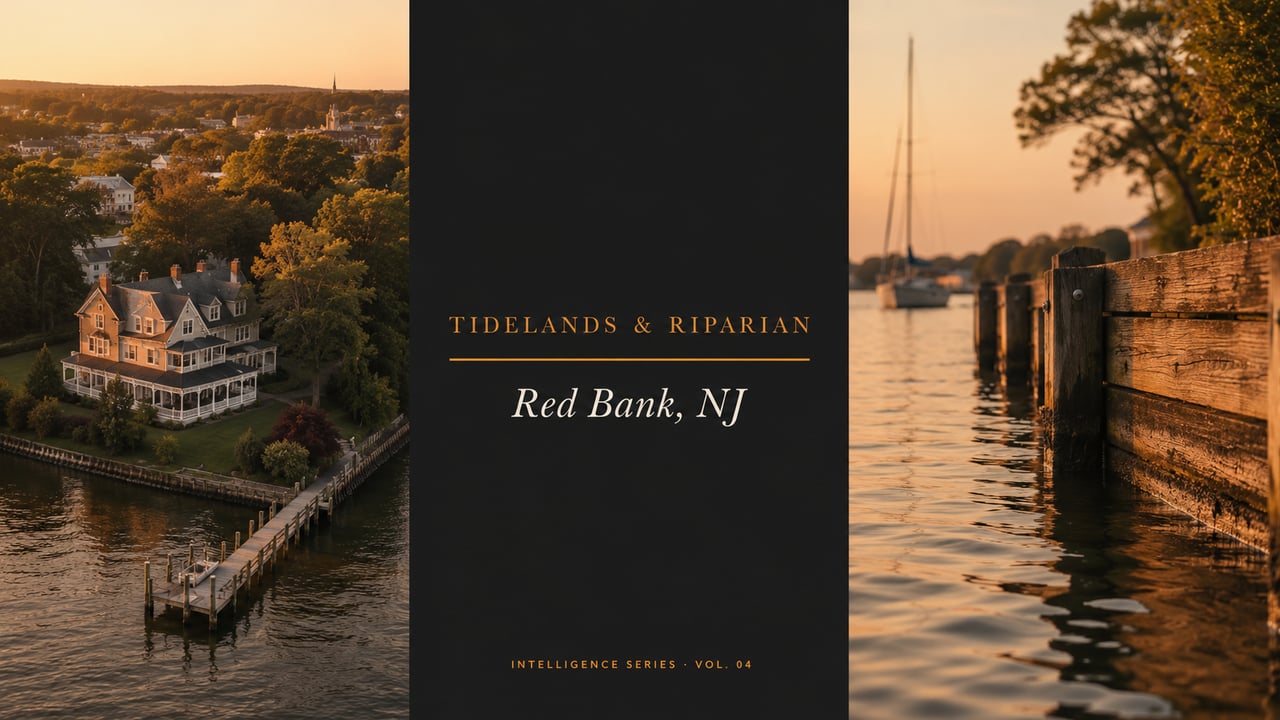
Buying a Navesink waterfront home in Red Bank involves a transaction structure that almost no other New Jersey real estate purchase requires: at some point during due diligence, the seller, the buyer, the title company, and the buyer's attorney will have to reckon with the possibility that the State of New Jersey holds fee simple ownership of part of the parcel being sold. Not an easement. Not a setback. Outright ownership. The reason is the New Jersey Public Trust Doctrine, a body of common law that traces back to Roman jurisprudence and arrives in modern New Jersey real estate practice with the full force of state law behind it. For waterfront buyers, the practical effect is that the title work on a $4 million East Side estate can produce a finding that twelve feet of the back lawn, the dock, the bulkhead, and the slip of water under the boat are not, strictly speaking, the seller's to convey. The transaction continues. It just continues differently.
This is Vol. 04 of the Red Bank Intelligence Series. Vol. 01 mapped the East–West micro-market divide and identified the Navesink waterfront as the borough's most acutely valued and most regulatorily complex sub-market. This installment goes inside that complexity. The framework below applies to any tidal waterfront purchase in New Jersey, but the financial stakes are most concentrated in Red Bank's luxury East Side tier, where Tidelands instruments can encumber single transactions for amounts approaching six figures — and where a missed riparian boundary issue can compromise a closing or, worse, surface years later as an unmarketable-title problem the new owner did not know they bought.
|
Public Trust Doctrine Origin
~535 CE
Justinian Code, adopted in NJ common law
|
Riparian Grant Timeline
18–24 mo
Application through approval
|
|
Tidelands Revenue Beneficiary
NJ Schools
All consideration directed by statute
|
Tidelands Claim Indicator
Green Map
NJ DEP claim maps, parcel-level
|
The Public Trust Doctrine holds that certain natural resources — navigable waterways, the air, wildlife, and the lands beneath tidal waters — are held by the sovereign in trust for the people, and cannot be conveyed away to private parties in a way that would defeat that trust. In New Jersey, this principle has been codified, refined, and litigated extensively over the past century, and it applies to every tidal waterway in the state, including the Navesink River from its mouth at Sandy Hook Bay through the Red Bank waterfront and upstream. The legal claim is rooted in the mean high water mark, a hydrological boundary determined by the average of all high tides over a measured nineteen-year period.
The doctrine creates two distinct categories of state-held land along the Navesink. The first is the obvious one: the river bottom itself, the slip of water beneath a moored boat, the area between mean high tide and the visible shoreline on any given day. The second is the one that catches buyers off guard: any land that was formerly flowed by tidal waters — even if that land was filled in, stabilized, and built upon a hundred years ago. A waterfront home built in 1920 on land that was tidal flats in 1880 may be sitting partially on state-claimed acreage today. The structure does not extinguish the state's claim. The fill does not extinguish the state's claim. The century of private use does not extinguish the state's claim. For buyers who chose Red Bank specifically for the walkable-waterfront-meets-NYC-commute lifestyle, the regulatory complexity is the price of admission to the asset class — one that is fully manageable with proper transaction preparation.
The practical instrument for managing this is the New Jersey Tidelands claim map system, administered by the Bureau of Tidelands Management at the NJ Department of Environmental Protection. The DEP publishes parcel-level "claim maps" — commonly called "green maps" because of their historical color coding — that indicate whether the state asserts a claim against a specific property. A green claim line crossing your prospective Navesink waterfront parcel is the trigger for the entire Tidelands inquiry. A claim line is not a deal-killer. It is a signal that the transaction structure has to include a Tidelands instrument before clear title can pass.
When the state asserts a Tidelands claim against a parcel, the property owner has two paths to resolve the encumbrance: a Tidelands License, or a Riparian Grant. They are different legal instruments with different durations, different costs, different processes, and meaningfully different implications for the property's long-term value.
A Tidelands License is a renewable permission to use the state-claimed land for a specified purpose — typically maintaining a dock, a bulkhead, a pier, or filled land beneath a structure. The license is annual or multi-year, requires a recurring fee paid to the state, and does not convey ownership. It is functionally a lease against state-held land. Licenses are appropriate for situations where the encroachment is modest, the use is well-defined, and the owner has no intent to construct major new water-side improvements. They are also typically faster and cheaper to obtain than a Riparian Grant.
A Riparian Grant is the permanent solution: a fee simple conveyance from the state to the property owner, transferring outright ownership of the previously state-claimed land. Once a Grant is issued and recorded, the parcel boundary effectively redraws to include the formerly state-claimed area, and the title clears for the long term. Grants are appropriate when the property owner intends to construct or substantially renovate water-side improvements (docks, piers, bulkheads), when the encroachment is significant, or when the long-term marketability of the title demands the permanent solution. Grants are also meaningfully more expensive and slower than Licenses — the consideration is typically tied to the appraised value of the conveyed area, and the application process can run 18 to 24 months from start to finish.
| Tidelands License | Riparian Grant | |
|---|---|---|
| Legal Nature | Renewable permission | Fee simple conveyance |
| Duration | Annual / multi-year | Permanent |
| Cost Structure | Recurring annual fee | One-time consideration + closing costs |
| Application Timeline | Typically 6–12 months | Typically 18–24 months |
| New Dock / Pier Authority | Limited / conditional | Full, subject to other permits |
| Title Marketability | Encumbered (renewable instrument) | Clear (permanent conveyance) |
| Best Use Case | Maintaining existing modest encroachments | New construction or premium resale positioning |
 |
Anthony Licciardello
Broker, The Prodigy Team
|
The Riparian Grant application process is administered by the NJ Bureau of Tidelands Management with oversight from the Tidelands Resource Council, a body that meets periodically to review applications and authorize Grants. The full process from application submission to recorded Grant typically runs 18 to 24 months under current post-pandemic conditions, longer if the application requires environmental review, archaeological assessment, public notice, or hearings.
The work product required to support a Grant application is substantial. The applicant must commission a licensed surveyor to produce a Tidelands claim map showing the parcel boundaries, the mean high water line, the area of state claim, and the proposed conveyance. Environmental review is required, including coordination with NJ DEP's Coastal Zone Management program where applicable. The state appraises the area to be conveyed and issues a "consideration" — a one-time payment from the applicant to the state, with proceeds directed by statute to New Jersey's public school funds. Consideration figures vary enormously based on parcel value and the size of the area being conveyed, but they are not nominal — six-figure considerations on premium Navesink waterfront parcels are not unusual.
For a buyer purchasing a property whose title encumbrance is unresolved, the timeline has direct transaction implications. If the closing is contingent on a Grant being in hand, the closing is approximately two years out. Most waterfront transactions do not wait that long. The typical workaround is to structure the closing around the existing Tidelands instrument — usually a License or a previously issued Grant — and price the cost of any future conversion or upgrade into the negotiated purchase price. The buyer takes title subject to the existing encumbrance, with full knowledge of what it costs and how it constrains future water-side improvements.
|
Month 0
|
Pre-Application Survey & Boundary Analysis
Licensed surveyor commissioned. Mean high water line determined. State claim area calculated against parcel boundaries.
|
|
Month 2
|
Application Filed with Bureau of Tidelands Management
Tidelands claim map, deed, title commitment, and supporting documents submitted. Application fee paid.
|
|
Month 6
|
Environmental & Coastal Zone Review
NJ DEP coordination, archaeological assessment if required, agency comment period.
|
|
Month 12
|
State Appraisal & Consideration Determination
State appraises the conveyance area. Consideration amount issued to applicant. Negotiation possible but limited.
|
|
Month 18
|
Tidelands Resource Council Review & Vote
Council meets periodically; application reviewed and authorized. Public notice and hearing may be required.
|
|
Month 24
|
Grant Executed, Recorded, Title Cleared
Consideration paid. Grant executed by state, recorded in county records. Title now reflects fee simple ownership of formerly state-claimed land.
|
Tidelands status is not a peripheral concern in waterfront transactions. It is one of the three or four variables that most directly affects the negotiated purchase price on a Navesink waterfront parcel, alongside flood insurance exposure, structural condition, and dock/bulkhead serviceability. The pricing math works in both directions, and educated buyers and sellers know how to read it.
A property with a clean, recorded Riparian Grant in place trades at peak value. The title insurance underwriting is straightforward, the financing pipeline is open to every conventional lender, and the buyer takes title knowing that the entire parcel — including any docks, bulkheads, and historically filled land — is owned outright. These properties command a meaningful premium versus comparable Navesink homes still operating under unconverted Tidelands Licenses or unresolved title clouds. The luxury buyers paying that premium are paying for the river view, the dock access, the architectural pedigree, and the proximity to Red Bank's downtown dining and cultural ecosystem — not the privilege of also taking on an unresolved Tidelands liability.
A property with an unresolved Tidelands claim, or with a long-expired License that was never converted, sells at a discount that approximates the cost and time of resolution. A six-figure expected consideration plus two years of process delay translates roughly to a six-figure price concession at the closing table, plus interim transaction structure work to ensure the buyer is protected if the resolution doesn't go as projected. Sellers who proactively initiate or complete the Grant process before listing recover the discount and then some. Sellers who try to push the problem into the buyer's column without surfacing it transparently are creating a renegotiation event at the inspection-period attorney review.
|
Anthony Licciardello
Broker, The Prodigy Team
|
For buyers who want Navesink waterfront exposure without taking on the riparian compliance burden directly, Red Bank's waterfront condominium inventory offers a structurally different risk profile. In developments like Southbank at the Navesink, the Bluffs, Riverview Towers, and Mara Vista, the master association holds the Tidelands instruments. The bulkhead maintenance, the dock authority, the master flood insurance, the marine engineering inspections — all are absorbed at the association level and passed through to owners in monthly HOA dues rather than appearing as individual ownership obligations.
This structural socialization of riparian liability is a meaningful part of why downtown waterfront condos command such intense downsizer demand and trade at $500 to $700 per square foot. The buyer is paying for the view and the lifestyle without inheriting the regulatory complexity. The trade-off is the HOA dependency — which is exactly why the framework laid out in Vol. 03 of this series matters so much for these buyers. The riparian risk in a waterfront condo lives on the association's balance sheet, which means the HOA financial health checklist is doing double duty: it's evaluating the building's structural reserves and its ability to fund ongoing marine compliance obligations simultaneously. A waterfront condo with a thin reserve study is also, implicitly, a riparian risk concentration that the buyer needs to underwrite.
Before writing an offer on any Navesink-facing or tidal-adjacent parcel in Red Bank, run this six-point check with your agent and have your attorney involved earlier than you typically would. Items that come back unclear or unanswered are items to price into the offer or condition into the contract.
|
1
|
Pull the NJ DEP Tidelands claim map for the parcel
Determine whether the state asserts a claim. A green claim line crossing the property triggers the full Tidelands inquiry. No claim line means the parcel may not require an instrument, but verify with the title company.
|
|
2
|
Identify the current Tidelands instrument
Is there a recorded Riparian Grant? An active License? An expired License never renewed? The current instrument determines the transaction structure and any future conversion path.
|
|
3
|
Survey the mean high water line
A licensed surveyor familiar with Tidelands work can determine the actual boundary against the state's claim. The seller's existing survey may not show this; commissioning your own protects both sides.
|
|
4
|
Dock, bulkhead, and pier inspection
Structural condition of marine improvements is its own underwriting category. Replacement costs are substantial, and aged bulkheads in particular can trigger immediate post-closing capital obligations.
|
|
5
|
Title commitment with Tidelands schedule
Ensure the title commitment explicitly addresses Tidelands status and any exceptions. Title insurance affirmatively over a Tidelands claim, where available, is a meaningful protection but is not always offered.
|
|
6
|
Future-state conversion scenario modeling
If the long-term plan includes new water-side construction or premium resale positioning, model the cost and timeline of converting a License to a Grant. Build this into the negotiated purchase price rather than discovering it as a post-closing obligation.
|
|
Anthony Licciardello
Broker, The Prodigy Team
|
Riparian rights are only one of the two regulatory variables that fundamentally affect Navesink waterfront economics. The other is flood insurance under FEMA's Risk Rating 2.0 methodology — the most significant overhaul of federal flood insurance pricing in fifty years, and one with particularly sharp implications for older waterfront properties built below the current Base Flood Elevation. Vol. 05 of the Red Bank Intelligence Series goes deep on that subject: how Risk Rating 2.0 changes the math, why Elevation Certificates are no longer optional, and what waterfront buyers should be modeling for annual flood insurance carry costs that can run from manageable to genuinely transaction-altering depending on the property's elevation and construction year.
The Prodigy Team pulls the Tidelands claim map, reviews the current riparian instrument, and models conversion scenarios on every Navesink waterfront transaction we represent — before the offer goes in, not after. Request a waterfront-specific due diligence review against the parcels on your shortlist.
Request a Waterfront Review › |
About Anthony Licciardello
Anthony is Broker at The Prodigy Team, an independent brokerage covering Staten Island and Monmouth, Union, Essex, and Ocean counties in New Jersey. The Prodigy Team produces 4K aerial and cinematic listing media in-house through its Above the Streets drone series and operates one of the region's largest hyperlocal SEO content engines. Direct: 718-873-7345.
This article describes general regulatory frameworks and is not legal advice. Riparian rights and Tidelands compliance are jurisdiction-specific and parcel-specific. Buyers should engage qualified New Jersey real estate counsel and licensed surveyors for any specific transaction.
|
Prodigy Real Estate is an innovative real estate company offering high-end video production, home valuation services, purchasing, and home sales. Serving New York and New Jersey.