
Anthony Licciardello | April 19, 2026
Red Bank, NJ
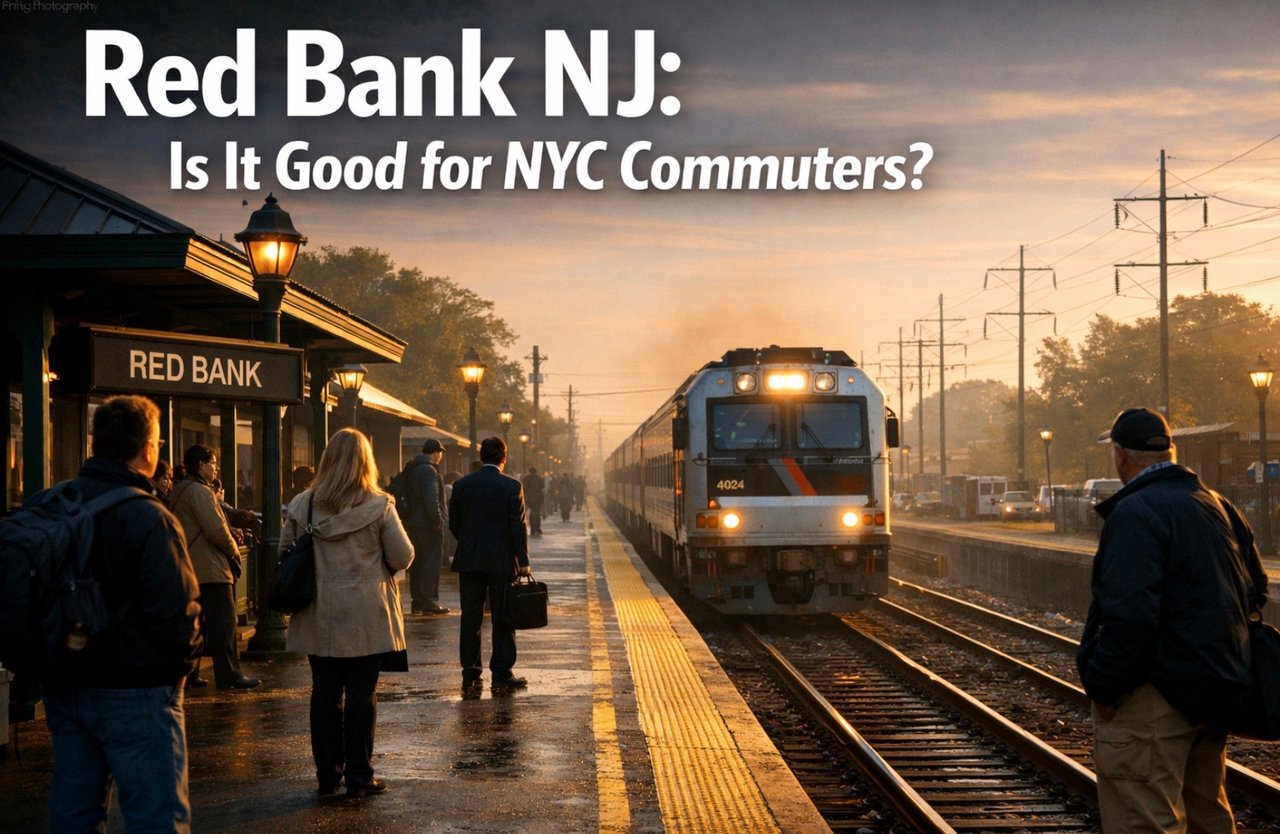
Red Bank gets recommended to NYC commuters constantly, and it deserves most of that reputation. The NJ Transit station sits near downtown, express trains reach Penn Station in about 65 minutes, and a fast ferry in Highlands reaches Wall Street in 40 minutes flat. For a buyer whose office is in Midtown or the Financial District and who wants to walk to dinner after work, Red Bank is legitimately one of the best commuter towns in Monmouth County.
But commutes are personal. Whether Red Bank works specifically for you depends on where in the city you're going, how many days a week you're making the trip, whether you're driving to the platform or walking, and how much the monthly cost fits into the full picture of housing expenses. This post works through all of it — factually, without glossing over the parts that require honest calculation. For context on what Red Bank housing actually costs before you run the commuter math, see our Red Bank property tax guide and the current market update.
If you're weighing whether Red Bank fits your NYC lifestyle, this video covers exactly why so many New Yorkers are making the move — and what they're finding when they get here.
The Train
The Red Bank station sits on NJ Transit's North Jersey Coast Line, a direct rail connection from Monmouth County to Penn Station in New York. Express trains cover the 45-mile route in approximately 65 to 75 minutes. Local trains — which make more intermediate stops — run 80 to 90 minutes. Service is roughly hourly throughout the weekday and into the evening, with reduced frequency on weekends.
The station itself is one of Red Bank's infrastructure assets. It sits near the downtown core and is walkable from the West Side, the waterfront corridor, and the blocks immediately surrounding Broad Street. Buyers in those zones can reach the platform on foot — which eliminates a car trip and the daily parking question. Station parking and bike racks are also available for residents who prefer to drive or cycle in. In April 2026, NJ Transit received the first delivery of more than 300 new rail cars intended to replace older equipment that has contributed to mechanical delays — a meaningful reliability improvement worth noting for buyers evaluating the commuter experience.
NJ Transit uses a zone-based pricing structure and adjusts fares periodically. As a directional benchmark, the Red Bank to Penn Station monthly pass has historically run in the $370 to $420 range. Verify the current fare at njtransit.com before building your housing budget — fares are subject to change and monthly passes must be purchased between the 19th of the prior month and the 10th of the current one. They're available via the NJ Transit Mobile app, ticket vending machines at the station, or station ticket offices.
Monthly passes can also be used on NJ Transit bus routes, which matters for buyers who occasionally need to connect within New Jersey rather than always going into the city. Pre-tax commuter benefit programs through employers can cover transit costs with pre-tax dollars — worth setting up before your first month if your company offers it.
The Ferry
About 10 minutes south of Red Bank, the Seastreak ferry terminal in Highlands operates weekday commuter service directly to Wall Street and East 34th Street in Manhattan. During morning rush hour, the crossing takes approximately 40 minutes — considerably faster than the train, and arriving at a part of Manhattan that the train doesn't reach at all. For buyers headed to the Financial District, the East Side, or anywhere more accessible from Pier 11 or East Midtown than Penn Station, the ferry changes the commuter math dramatically.
The ferry is a weekday commuter service, not a round-the-clock option. Parking is available at the Highlands terminal. The total door-to-desk time from Red Bank to the Financial District via Seastreak — including the drive to Highlands and the walk from Pier 11 — can be competitive with express train times to destinations near Penn Station, and faster than the train for lower Manhattan offices.
| Route | Transit Time | Arrives At | Best For |
|---|---|---|---|
| NJ Transit Express | ~65–75 min | Penn Station (Midtown West) | Midtown, West Side, offices near Penn |
| NJ Transit Local | ~80–90 min | Penn Station (Midtown West) | Off-peak travel, flexible schedule |
| Seastreak Ferry | ~40 min crossing | Wall St. / East 34th St. | FiDi, East Side, lower Manhattan offices |
| Academy Bus | ~80 min | Port Authority (Midtown West) | Once-daily service, limited flexibility |
| Drive (GSP Exit 109) | ~60–90 min (varies) | Anywhere in city | Irregular schedules, outer borough offices |
The Honest Tradeoffs
The train works well when it runs on time. NJ Transit's reliability record has historically been mixed, and the North Jersey Coast Line is no exception. Mechanical delays, weather events, and equipment failures affect commuters here as they do on every NJ Transit line. The new fleet rollout in 2026 should help over time, but buyers entering this market with zero tolerance for occasional delays should factor that into their decision. The commute is manageable — it is not immune to the realities of commuter rail in New Jersey.
The distance also matters in a way that doesn't show up in transit times alone. At 45 miles from Midtown, Red Bank sits at the outer end of the conventional NYC commuter zone. Buyers who were commuting five days a week from Brooklyn or Jersey City are adding real time and cost. For hybrid workers doing two or three days a week in the city, the trade is easy. For five-day-a-week commuters who haven't modeled the full-year cost — monthly pass, parking if needed, time — it's worth doing the math before you commit.
Red Bank's commuter profile shifted meaningfully post-2020. The borough's young professional population skews heavily toward hybrid work arrangements, and many Red Bank residents now commute two to three days a week rather than five. At that frequency, the math changes substantially — monthly pass value versus ten-trip tickets, parking costs, and total time on train per week all look different. Buyers in hybrid roles often find Red Bank far more practical than the raw distance suggests, because they're not grinding out that 65-minute trip every single day.
Where You Live Inside Red Bank Matters
The Red Bank station sits near the downtown core and the West Side — those zones are walkable to the platform for most buyers. The East Side and Tower Hill sections require a short drive or bike ride to reach the station. In a borough this compact, nothing is truly far, but if walking to the train is a priority, it should be one of the filters you apply to your property search from the start. Our Red Bank neighborhood guide maps the zone-by-zone proximity picture.
For ferry commuters specifically, Highlands is a 10-minute drive south from most of Red Bank via Route 35. A car is required for that leg — there's no transit connection from Red Bank to the Highlands terminal. Buyers who want to use the ferry as their primary route should budget for the drive and confirm parking availability at the terminal before assuming it's always open.
NYC commuters whose office is between 23rd and 42nd Streets near the West Side have the cleanest commute equation from Red Bank. Penn Station puts you within walking distance of much of that corridor. Buyers going to the East Side, downtown, or outer boroughs should model their full door-to-desk time before assuming the advertised train time translates directly to their workday.
The Lifestyle Side of the Equation
Closer towns exist. Matawan, Aberdeen, Hazlet — all on the North Jersey Coast Line, all with shorter train rides to Penn Station, all with lower housing costs than Red Bank. Commuters who choose Red Bank anyway are trading some of that transit efficiency for what Red Bank specifically offers when they get off the train: more than 60 restaurants within walking distance, a walkable downtown that stays active year-round, the Navesink River, the Count Basie Center, Two River Theater, and a lifestyle that doesn't require getting in a car for everything outside of work.
That trade makes sense for a specific buyer: someone who values what they come home to as much as how long it takes to get there. For buyers who are primarily optimizing for shortest commute at lowest housing cost, Red Bank is not the right answer. For buyers who want to live well inside a commutable distance from the city — and who will actually use what Red Bank offers — the extra minutes on the train are consistently worth it to the people who make this choice.
Train transit times: NJ Transit North Jersey Coast Line schedule / Rome2Rio verified timetable data. Seastreak ferry crossing time: Seastreak official route information. Monthly pass pricing: directional estimate based on published NJ Transit fare zone data — verify current pricing at njtransit.com before budgeting. NJ Transit fleet update: Wikipedia NJ Transit Rail Operations, April 2026. Station facilities: Monmouth County transportation map.
Common Questions
How long is the train commute from Red Bank NJ to NYC?
Express trains on the North Jersey Coast Line reach Penn Station in approximately 65 to 75 minutes. Local trains take 80 to 90 minutes depending on stops. Service runs roughly hourly throughout the day. The station sits near downtown Red Bank and is walkable from the West Side and downtown core zones.
Is there a ferry from Red Bank NJ to NYC?
Not directly, but the Seastreak ferry terminal in Highlands is about a 10-minute drive from Red Bank. During morning rush hour, the crossing to Wall Street and East 34th Street takes approximately 40 minutes — faster than the train and ideal for buyers working in the Financial District or East Midtown. The ferry operates on weekdays with parking available at the terminal.
What is the monthly commuter train pass cost from Red Bank to NYC?
As a directional benchmark the Red Bank to Penn Station monthly pass has historically run in the $370 to $420 range, though NJ Transit adjusts fares periodically. Always verify current pricing at njtransit.com before budgeting. Employer pre-tax commuter benefit programs can offset this cost meaningfully for buyers whose companies offer them.
Do NYC commuters need a car if they live in Red Bank NJ?
For buyers working near Penn Station or Midtown West, a car is genuinely optional day-to-day in Red Bank. The station is walkable from much of the borough, and downtown dining, errands, and entertainment are all on foot. Buyers going to outer boroughs or locations poorly served from Penn Station will likely need a car for the city-side leg. For the Seastreak ferry option, a car is required to reach the Highlands terminal.
Questions about buying in Red Bank as a commuter? Contact Anthony Licciardello at the Prodigy Team: (718) 873-7345.
Prodigy Real Estate is an innovative real estate company offering high-end video production, home valuation services, purchasing, and home sales. Serving New York and New Jersey.