
A deep dive into the zoning reforms, affordable-housing mandates, and capital projects reshaping one of Monmouth County’s most dynamic boroughs.
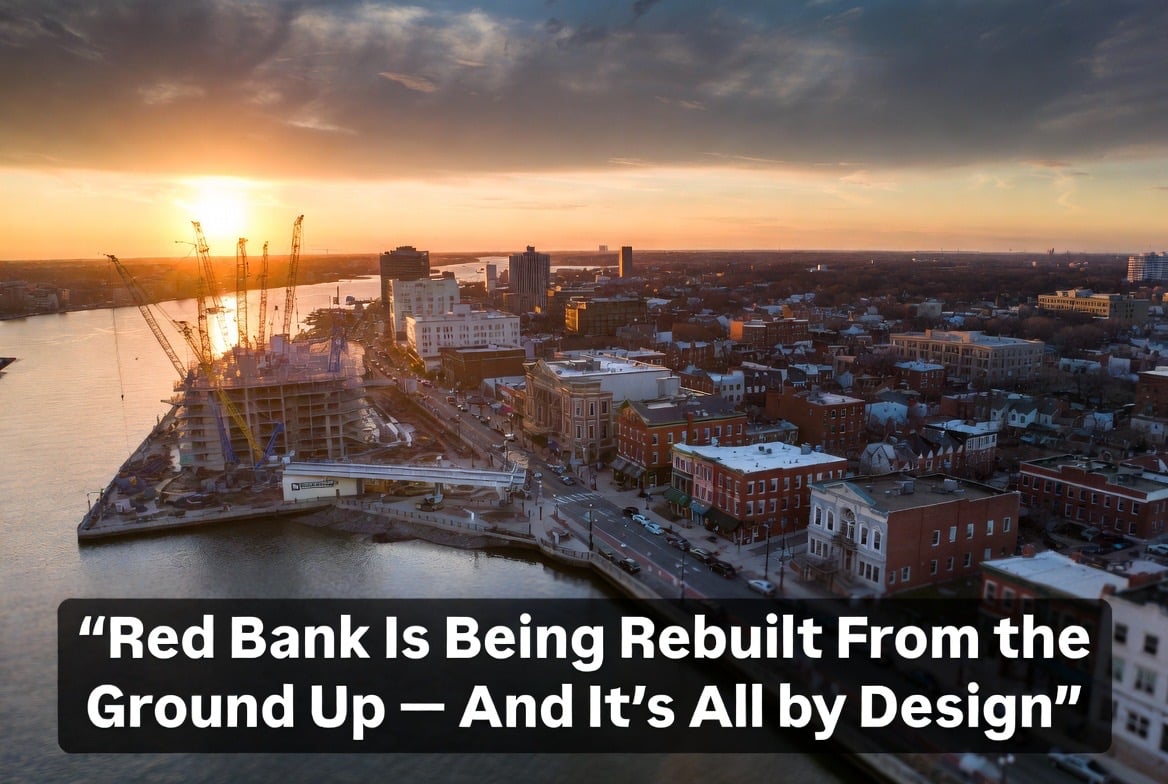
If you’ve driven through Red Bank lately and noticed a crane, a construction fence, or a freshly demolished block you barely recognized — you’re not imagining things. The borough is in the middle of one of the most deliberate, wide-ranging reinventions in its modern history. And it’s not happening by accident. Behind every building permit and rezoning ordinance is a carefully constructed strategy years in the making, built around state planning frameworks, federal transit investments, and a hard-nosed reckoning with affordable-housing law.
We spent time combing through planning documents, state commission reports, and borough resolutions to give you the clearest picture available of what’s changing, what’s being built, and — most importantly — why.
Red Bank is executing a coordinated, multi-year reinvention. It is chasing renewed State Planning Commission endorsement, absorbing a 153-unit affordable-housing mandate and new four-foot flood-elevation rules, and rezoning a 25-acre Train Station district for up to 400 apartments at a 20% affordable set-aside. Active construction — the 212-unit Commodore, Southbank’s sold-out condos, One Globe Court — is matched by public investment in a reimagined Marine Park and, crucially, by federal transit upgrades that make the transit-village density bet rational. The throughline is deliberate, publicly documented planning aimed squarely at what Red Bank wants to be by 2030.
Red Bank Is Chasing a State Designation — and It’s a Bigger Deal Than It Sounds
Here’s where a lot of the strategy originates. Red Bank held “Regional Center” status under the New Jersey State Planning Commission for nearly three decades — a designation it first received in 1996. That status expired in March 2023, and regaining it has become a central organizing goal for the borough’s planning apparatus.
Why does a planning designation matter to homebuyers or real estate investors? Because Regional Center status unlocks state technical assistance, prioritized infrastructure funding, and regulatory alignment — meaning projects that might otherwise get bogged down in approval limbo get a cleaner runway. It’s essentially the state’s stamp of approval that says: “this town is planning well, support it.”
The borough has been methodically working through the Plan Endorsement petition process, which includes a Municipal Self-Assessment, an Opportunities & Constraints Report issued by state partners, and a Draft Plan Implementation Agreement — the last of which was approved by the Borough Council in October 2025. Final endorsement from the State Planning Commission is expected in early 2026.
Milestone | Date | Resolution |
|---|---|---|
Pre-Petition Meeting with OPA | December 12, 2023 | — |
Municipal Self-Assessment Submission | August 14, 2024 | Resolution 24-153 |
Opportunities & Constraints Report | January 16, 2025 | OPA / State Partners |
Community Visioning Waiver Approved | March 17, 2025 | OPA Acting Director |
Draft Plan Implementation Agreement | October 9, 2025 | Resolution 25-212 |
Estimated Plan Endorsement Finalization | Early 2026 | SPC Goal |
“The borough’s 2023 Master Plan isn’t just a land-use document — it’s the foundation for everything from flood mitigation to affordable-housing density. Every rezoning ordinance traces back to it.”
Affordable Housing and Rising Seas: The Two Forces Driving Zoning Reform
If Plan Endorsement is the carrot, the affordable-housing legislation passed in March 2024 is very much the stick. Senate Bill S50 and Assembly Bill A4 rewrote how New Jersey calculates municipal fair-share obligations — and Red Bank came out of that recalculation with a mandate to facilitate 153 affordable housing units within two years.
That’s not a soft target. Municipalities that miss these quotas open themselves up to “builder’s remedy” lawsuits — litigation where developers essentially get to bypass local zoning controls entirely. For a town like Red Bank, which has a finite amount of developable land and a strong sense of architectural identity, losing that local control would be a serious problem. The borough has responded proactively, baking higher affordable-housing set-asides directly into new redevelopment-district standards rather than scrambling to catch up later.
On the environmental side, the NJDEP’s new Resilient Environments and Landscapes (REAL) rules — part of the NJ PACT climate initiative — are adding another layer of complexity to development near the water. The rules took effect in January 2026, requiring new and rebuilt structures to be elevated four feet higher than previous flood standards to account for sea-level rise and more intense storm events.
You can see this playing out concretely in the rehabilitation plans for riverfront properties along the Shrewsbury Avenue corridor and near Marine Park, where structural elevation is now a baseline requirement — not an optional upgrade. It’s the same cost dynamic now reshaping waterfront teardowns up the Navesink in towns like Fair Haven, and it’s changing how architects and developers think about every project near the water in Red Bank.
The Train Station Redevelopment Area: 25 Acres, 400 Apartments, a New West Side
This is the one. If any single project defines the direction Red Bank is heading over the next decade, it’s the Train Station Redevelopment Area — a 25-acre zone on the borough’s west side that has been fundamentally rezoned to enable a scale of development that would have been unimaginable here not long ago.
Ordinances 2025-15 and 2025-17, adopted in July 2025, converted this area from the traditional “TS Train Station District” into a formally designated Non-Condemnation Area in Need of Redevelopment. That’s a legal classification that gives the borough significantly more leverage in negotiations with private developers — and it’s how they were able to push the affordable-housing set-aside to 20%, well above what standard zoning would typically yield.
The concept is a classic transit village: residential density concentrated within walking distance of the NJ Transit station, supported by enough commercial space to create street life without tipping the balance away from the residential mission. The final building height was dialed back from six stories to five — a concession to neighborhood sightlines and architectural scale that locals pushed for — but the density remains substantial.
One detail worth highlighting: the requirement for 20,000 square feet of “maker spaces” — affordable workspaces designed for artists, craftspeople, and small-scale producers. That’s the borough protecting its creative-economy character even as it significantly increases residential density. It’s a signal that planners are thinking about the kind of community that gets built here, not just the number of units.
“By designating the train station area as a redevelopment zone, the borough gained the leverage to negotiate a 20% affordable-housing requirement — well above what standard zoning would typically produce.”
Shrewsbury Avenue: Turning a Parking Lot Into a Riverfront Asset
While the train station project gets most of the headlines, the 26–28 Shrewsbury Avenue Rehabilitation Plan is a quieter but equally interesting story. This is a 1.275-acre site — currently an underutilized parking lot overlooking the Swimming River — that was designated an area in need of rehabilitation through Borough Resolutions 25-202 and 26-27 in early 2026.
The plan calls for 40 apartments in a five-story building with two very specific public benefits baked in: a mandatory publicly accessible waterfront walkway and a requirement that architectural materials reflect the borough’s brick vernacular. The goal is to reduce the current impervious-surface coverage — described in planning documents as “substantial” — while adding residential units that have genuine civic value.
This is a pattern you’ll see throughout Red Bank’s current planning cycle: greyfields (underused parking lots, vacant lots, surface-level commercial parcels) being converted into mixed-use assets that enhance the public realm rather than just adding building mass. It’s smart urbanism, and it’s the kind of thing that tends to make surrounding properties more valuable over time.
What’s Actually Being Built Right Now
All of the above is policy and planning. Here’s where things get tangible. Red Bank is currently in what borough officials have openly called a “construction boom” — with projects at virtually every stage of the development pipeline, and ranking among the busiest corners of the Monmouth County new-construction cycle in over a decade. Let’s run through the major ones.
The Commodore — 176 Riverside Avenue
This is the biggest active construction site in the borough right now. The project at 176 Riverside Avenue — now branded “The Commodore” — involves the transformation of the former Visiting Nurse Association (VNA) headquarters, a 2.7-acre site that sat stagnant for years. Demolition of the VNA building began in March 2025, and Saxum Real Estate is now building out a 212-unit luxury multifamily complex on the property.
The project density — 77.5 units per acre — was actually reduced from an earlier 88-units-per-acre concept, with the design revised to create a continuous façade along Bodman Place rather than leaving an awkward “horseshoe void” in the building footprint. There’s also an ongoing negotiation with the NJDOT around a traffic signal at the notoriously difficult Bodman/Riverside intersection, which is considered a prerequisite for the project achieving full functionality.
The unit mix breaks down to 119 two-bedrooms and 93 one-bedrooms — a composition that suggests an appeal to young families and remote professionals over single renters, which tracks with what the borough needs from a long-term household-formation perspective.
Southbank at the Navesink — 4 Boat Club Court
Not everything is still under construction. Southbank at the Navesink — the Denholtz Properties–developed condominium project at 4 Boat Club Court — has already transitioned from construction to active occupancy. The four-story, 10-unit luxury condo building topped off in April 2023 and saw units move for as much as $1.6 million by mid-2024. That number tells you something important about the ceiling on Red Bank waterfront luxury product.
The architectural choices — Corten steel, brick, floor-to-ceiling glass, private terraces with Navesink River views — were specifically calibrated to blend with Red Bank’s historic industrial-maritime character rather than impose a generic luxury aesthetic. It’s a small project by unit count, but its successful sellout validates the demand for high-end for-sale product in the downtown core.
One Globe Court — Mechanic & Globe
Developer Patrick Kalian’s 40-unit apartment building at the corner of Globe Court and Mechanic Street is currently under construction as of early 2025. The project was scaled back from a five-story to four-story design to comply with height limits and eliminate the need for a parking variance — a practical design evolution that kept the project moving without a prolonged approval battle.
One Globe Court will include 73 parking spaces and 6 affordable units. There’s an interesting design detail here: the ground-level parking garage originally featured standard louver façades that drew complaints for looking “prison-like.” The revised design uses geometric-patterned grilles, which the community responded to far more favorably. It’s a small thing, but it illustrates how much aesthetic scrutiny attaches to urban infill in a community that cares about its streetscape. The project also sits adjacent to the historic Globe Hotel, linking the Broad Street commercial corridor with the developing Mechanic Street residential cluster.
Marine Park, Complete Streets, and the Infrastructure Behind the Boom
Private development only works if the public infrastructure keeps pace. Red Bank’s 2025 End-of-Year Report is explicit about this: as population density increases, the borough needs parks, streets, and utilities that can absorb it without degrading the quality of life that makes the town attractive in the first place.
The flagship public project right now is the Re-Imagined Marine Park, which is on track to open in spring 2026. Major components — site remediation, drainage improvements, and electrical upgrades — are already complete. The most dramatic change is the relocation of municipal parking away from the river’s edge, which frees up 28,000 square feet of new green space fronting the Navesink. The project secured over $1 million in grant funding — a direct payoff from the borough’s sustained engagement with state planning frameworks.
“Relocating municipal parking away from the riverfront reclaims 28,000 square feet of green space — land that has been hidden behind asphalt for decades.”
On the streetscape side, Red Bank’s “Complete Streets” policy is currently producing several active construction projects focused on pedestrian safety and mobility. The policy, embedded in the 2023 Master Plan, requires that street redesigns accommodate cyclists and pedestrians rather than defaulting to car-first configurations. For residents concerned about traffic as new density arrives, this is the answer the borough is giving: redesign the streets, don’t just widen them.
Why Federal Transit Investment Justifies the Density
Here’s the question that skeptics of the train station redevelopment are right to ask: why bet 400 apartments on proximity to a transit line that has historically been unreliable? The answer is that the reliability picture is fundamentally changing, driven by multibillion-dollar federal infrastructure investments that are already underway.
The Portal North Bridge reached its defining milestone in early 2026. The old swing bridge over the Hackensack River — the single greatest source of delay on the Northeast Corridor for decades — has been replaced by a new high-level fixed-span bridge, rising 50 feet above the water and engineered to eliminate the bridge-opening delays that plagued NJ Transit commuters for generations. The new bridge opened in March 2026.
Simultaneously, the Hudson Tunnel Project (HTP) resumed construction in February 2026 after a federal funding freeze was resolved. When complete — the new tunnels are targeted for 2035 — the HTP will double trans-Hudson rail capacity. Combined with the Portal Bridge, this represents the biggest structural improvement to the Northeast Corridor in a generation.
Project | Completion | Impact on Red Bank |
|---|---|---|
Portal North Bridge | Opened March 2026 | Eliminates chronic bridge-opening delays |
Hudson Tunnel Project | 2035 (new tunnels) | Doubles trans-Hudson rail capacity |
Raritan River Drawbridge | 2029 | Improved reliability on NJ Coast Line |
Lead Service Line Replacement | Ongoing (2026) | Local water-infrastructure modernization |
For Red Bank’s planning team, these aren’t background details — they’re the entire rationale for the transit-village density at the train station. A 400-unit residential district anchored to a reliably fast rail connection to New York is a fundamentally different value proposition than one tied to an unreliable, delay-prone service. It also positions the borough squarely in the path of the New York buyers now fanning out across New Jersey in search of exactly this combination of walkability and commute.
What This Means for Red Bank’s Real Estate Market
Taken together, what’s happening in Red Bank right now is genuinely unusual — a small borough executing a sophisticated, multi-year planning strategy that coordinates state planning frameworks, transit-investment timelines, environmental regulations, and affordable-housing mandates into a coherent vision for what the community looks like in 2030 and beyond. Set against the broader Monmouth County development wave, that level of coordination stands out.
For buyers and investors, the signal is reasonably clear: this is a town that has bet on density, walkability, and transit access — and is backing that bet with real capital and regulatory commitment. On the market side, the closings tell the same story — supply-constrained pricing strength and seller’s-market mechanics. The risk, as always with development-heavy markets, is the execution gap: whether the parking supply actually gets built, whether the affordable units get delivered, whether the transit improvements arrive on schedule.
But the fundamentals are as well-documented as we’ve seen in any local market. The planning infrastructure — the state endorsement process, the master plan, the redevelopment ordinances — is real, detailed, and publicly verifiable. That’s not nothing.
Red Bank is building for what it wants to be. Whether you’re buying, selling, or just watching — it’s worth paying attention.

Thinking about buying or selling in Red Bank? The Prodigy Team works across Monmouth County and knows every corridor and project discussed in this report — from the train station district to the Navesink riverfront. We pair that hyperlocal read with 4K cinematic drone marketing and a direct pipeline of motivated New York buyers. Let’s talk before you list or tour.