
Anthony Licciardello | May 18, 2026
Red Bank, NJ
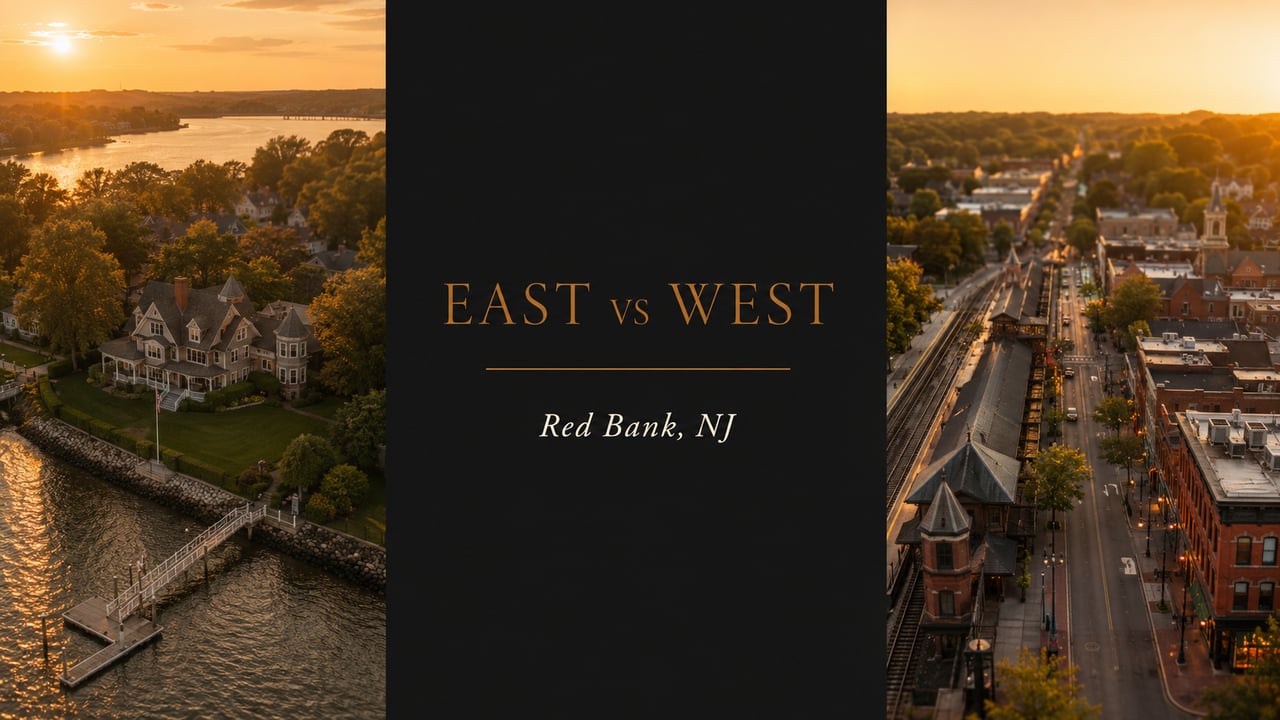
Red Bank covers just 1.75 square miles. You can walk the entire borough in under an hour. And yet, depending on which side of Broad Street a buyer is shopping, that walk crosses one of the sharpest price gradients in Monmouth County. A renovated colonial near Marine Park can close for $1.2 million while a comparable cottage three-quarters of a mile west, on a block off Shrewsbury Avenue, trades for under $550,000. Same school district. Same commute. Same downtown. The spread is not noise — it is the single most important fact about pricing a home in this market, and it is the variable that drives nearly every misread of the borough's headline numbers.
This is the first installment of the Red Bank Intelligence Series, which goes beneath the borough's aggregate market data to map the micro-markets, infrastructure premiums, and regulatory factors that actually move pricing. We start with the East–West divide because every other valuation question in Red Bank's broader redevelopment story — waterfront premiums, condo HOA mechanics, transit-oriented appreciation — sits downstream of it.
|
West Side Median · SFH
$525K–$575K
$375–$475 per sq ft
|
East Side Median · SFH
$1.05M–$1.2M
$500–$650+ per sq ft
|
|
Borough Footprint
1.75 sq mi
~12,830 residents
|
Q1 2026 Aggregate Median
$848K
Skewed by waterfront closings
|
The dividing line is functionally Broad Street and the rail corridor that runs parallel to it. Everything east of that spine slopes down toward the Navesink River. Everything west of it climbs toward the train station, the Shrewsbury Avenue commercial strip, and the redevelopment zone that is about to redraw the borough's gravity. The two halves have different housing stock, different buyer profiles, different turnover velocities, and — most importantly — different relationships to the infrastructure that creates value in this borough.
The east half is older money, larger lots, deeper architectural pedigree, and direct or near-direct access to the river and the marine recreation economy that comes with it. The west half is more eclectic, more diverse, more affordable, and structurally positioned to absorb the largest share of the borough's near-term appreciation as the market velocity documented across the borough this spring concentrates around the transit hub.
The West Side runs roughly from the rail corridor out to the Shrewsbury Avenue commercial spine, with residential blocks radiating north toward Count Basie Park and Mohawk Pond Park. Housing stock here is a mix: turn-of-the-century cottages on tight lots, post-war single-families, an aging but functional duplex inventory that drives a meaningful share of the borough's small multi-family transactions, and a growing wave of infill new construction as builders push townhome enclaves into rehabilitation parcels.
Pricing in this corridor breaks down into three reasonably clean bands. Unrenovated, smaller cottages — generally pre-1940 stock with deferred mechanicals — still trade in the $400,000s when they come up, which makes them the closest thing the borough has to a true entry-level single-family product. Renovated mid-grade homes in the 1,400 to 1,800 square foot range cluster between $525,000 and $625,000. Newer builds and fully gut-renovated properties push toward and occasionally past $700,000. The per-square-foot range is meaningfully tighter than the East Side: most West Side trades land between $375 and $475 per square foot, which is roughly 25% to 35% below comparable East Side product.
The buyer profile here is bifurcated. Primary residence purchasers are dominated by first-time buyers and younger move-up buyers from the wider Monmouth County market who want the downtown lifestyle but can't underwrite an East Side carrying cost. The investor segment is more interesting: value-add buyers are aggressively targeting older duplexes and tired single-families for rehab, both for resale and for the rental yield that the borough's $3,200/month median rent supports. The next post in this series will go deeper on the multi-family math — but the headline is that West Side acquisition basis still pencils against the rent roll, where East Side basis generally does not.
 |
Anthony Licciardello
Broker, The Prodigy Team
|
|
West Side
Shrewsbury Ave corridor
|
$375
$475
|
|
~30% PREMIUM
|
|
|
East Side
Marine Park / Navesink
|
$500
$650
|
|
$300
$400
$500
$600
$700
|
East of Broad Street, the architectural character shifts immediately. The streets are quieter, the lots are larger, the tree canopy is denser, and the housing stock leans heavily toward stately Victorians, restored colonials, and the kind of carriage-house-and-gingerbread-trim properties that draw photographers more often than buyers. Residents are within a short walk of Marine Park, Riverside Gardens Park, and the Navesink riverfront promenade — which is the actual mechanism that drives the East Side premium, not just the housing stock itself.
Pricing here operates on a different scale. Mid-tier East Side single-families — homes that are off the water but within four or five blocks of it — cluster in the high-$900,000s to low-$1.1 million range. Fully renovated historic properties with serious architectural credentials trade between $1.05 million and $1.2 million. Per-square-foot pricing routinely lands between $500 and $650, and frequently above that ceiling for waterfront-adjacent product. Anyone underwriting an East Side purchase should be modeling closer to $600 per square foot than the borough-wide average, because borough-wide averages in a 10-to-16-transaction-per-month market are statistically thin and easily distorted.
At the absolute top of the market, the numbers leave normal real estate territory entirely. In December 2025, a 6,500-square-foot custom waterfront estate on Blossom Cove Road — five bedrooms, eight bathrooms, sitting on more than 2.5 acres directly on the Navesink — closed at $6.2 million. That single transaction reset the comparable baseline for every luxury waterfront appraisal in the borough, and it is one of a small handful of closings that explains the headline data Q1 surprised so many people with.
In March 2026, the borough's median sale price was reported at $848,000 — an 86.3% year-over-year increase. That number got picked up by every Monmouth County real estate aggregator and a fair number of national outlets, and it created exactly the wrong impression of what is actually happening in Red Bank's housing market. The borough's homes did not appreciate 86% in twelve months. What happened is far more interesting, and more useful to understand.
Red Bank closes between 10 and 16 single-family transactions in a typical month. In a transaction set that small, a cluster of three or four East Side waterfront closings at $2 million-plus pulls the median violently upward. The Blossom Cove closing alone would distort the median in any month it landed. When several waterfront estates close in the same quarter, the aggregate number becomes effectively unusable as a guide to what a typical Red Bank home is doing.
The honest read on the data is that the borough's five-year cumulative appreciation sits near 57% — an annualized rate around 9.4% — and that this rate is real, durable, and meaningfully above the New Jersey state average. But the 86% number is a statistical artifact of a thin market with extreme price dispersion across two distinct micro-markets. Treat it as evidence that the luxury East Side is hot, not as a benchmark for what a West Side cottage will appreciate next year.
|
Anthony Licciardello
Broker, The Prodigy Team
|
|
$1.5M
$1.2M
$900K
$600K
$300K
$0
|
$450K
$925K
$550K
$1.10M
$675K
$1.50M
|
|
Entry
Unrenovated / starter
Mid-Market
Renovated mid-grade
Premium
Top-of-market non-waterfront
|
The most useful way to compare the two halves of the borough is per-square-foot, because it strips out the lot size and architectural pedigree variables that distort the absolute price comparison. The spread between West Side and East Side per-square-foot pricing has held remarkably consistent at roughly $125 to $175 per square foot across the last five years, which translates to about a 30% premium for crossing Broad Street eastbound.
What that premium actually buys is three things, in order of contribution. First, water proximity — even without a direct waterfront parcel, an East Side address sits inside the walking shed of the river, which is the borough's primary recreational and aesthetic amenity. Second, historic architectural inventory that cannot be replicated under current zoning. Third, a quieter, more established residential character that the West Side, with its commercial proximity and infill activity, simply does not replicate.
What that premium does not buy, and this is where buyers occasionally miscalculate, is meaningfully better commute access, school placement, or downtown walkability. A West Side address on the right block is actually closer to the train station and the Broad Street commercial core than most East Side residential streets. The premium is for the river and the architecture, not the infrastructure — which matters for resale planning because the West Side is the half of the borough where the infrastructure is about to materially change.
The variable that the East–West divide does not currently price in is the Red Bank Train Station Redevelopment Plan. The borough and NJ Transit have approved a 25.87-acre transit-oriented redevelopment, led by Denholtz Properties, that converts the underutilized parking infrastructure around the station into a mixed-use residential and commercial node. The original proposal called for 400 units in six-story massing; community pushback reduced that to roughly 350 units capped at five stories and 60 feet, with 20% — roughly 70 units — dedicated to affordable housing.
For West Side property owners, this is a structural revaluation event. National transit-oriented development research consistently shows a measurable price premium — typically around 6%, or roughly $34,000 on a comparable home — for residential properties inside a half-mile walking radius of an active commuter rail station, anchored in Red Bank's case by a roughly 65-to-75-minute express commute into New York Penn Station. That premium has historically been suppressed in Red Bank because the station area itself was a low-value surface parking environment. Replacing the asphalt with 350 occupied units, ground-floor retail, and a modernized station footprint activates the latent value that the transit shed already carried on paper.
The practical implication is that the West Side's per-square-foot pricing has the most room to move over the next 36 to 60 months, and the East–West premium spread is likely to compress meaningfully. This does not mean the East Side stops appreciating — the river is the river, and the luxury waterfront tier is structurally insulated. It means that West Side basis purchases made in 2025 and 2026 are positioned to capture a disproportionate share of the borough's next appreciation cycle, which is precisely why West Side off-market acquisition activity has picked up sharply over the past two quarters.
|
Anthony Licciardello
Broker, The Prodigy Team
|
For buyers, the East–West split is the most important conversation to have before writing an offer in this borough, and almost no out-of-area agent will walk a client through it. If the priority is long-term appreciation per dollar of basis, the West Side currently offers the better forward-looking risk/reward, particularly in the half-mile transit shed. If the priority is lifestyle, architectural quality, and exposure to the river, the East Side carries that premium for reasons that are durable and unlikely to compress.
For sellers, the implication is that pricing strategy needs to be set against the right comparable set, not the borough-wide aggregate. East Side homes priced against borough-wide medians leave significant money on the table; West Side homes priced against East Side comparables sit on the market and trade stale. The reliable approach is a per-square-foot analysis run against the specific micro-market — and ideally against the specific corridor inside that micro-market — that the property actually competes in. The Q1 headline numbers are a useful conversation starter with buyers, not a pricing benchmark.
The next installment of the Red Bank Intelligence Series goes deeper on the demographic side of this story — specifically, the wave of downsizing buyers from Rumson, Fair Haven, and Little Silver who are reshaping the borough's condo market and putting unusual pressure on the downtown luxury attached-housing inventory. After that, we move into the technical posts on Tidelands grants, FEMA flood insurance under Risk Rating 2.0, condo HOA reserve mechanics, and the multi-family yield environment that institutional buyers are currently navigating in this market.
The Prodigy Team prices Red Bank properties against the actual micro-market they compete in — not the distorted borough-wide aggregate. Request a pricing audit with corridor-specific comparables, per-square-foot analysis, and a strategy framework built around the transit redevelopment timeline.
Request Your Pricing Audit › |
About Anthony Licciardello
Anthony is Broker at The Prodigy Team, an independent brokerage covering Staten Island and Monmouth, Union, Essex, and Ocean counties in New Jersey. The Prodigy Team produces 4K aerial and cinematic listing media in-house through its Above the Streets drone series and operates one of the region's largest hyperlocal SEO content engines. Direct: 718-873-7345.
|
Prodigy Real Estate is an innovative real estate company offering high-end video production, home valuation services, purchasing, and home sales. Serving New York and New Jersey.