
Anthony Licciardello | May 19, 2026
Westfield, NJ
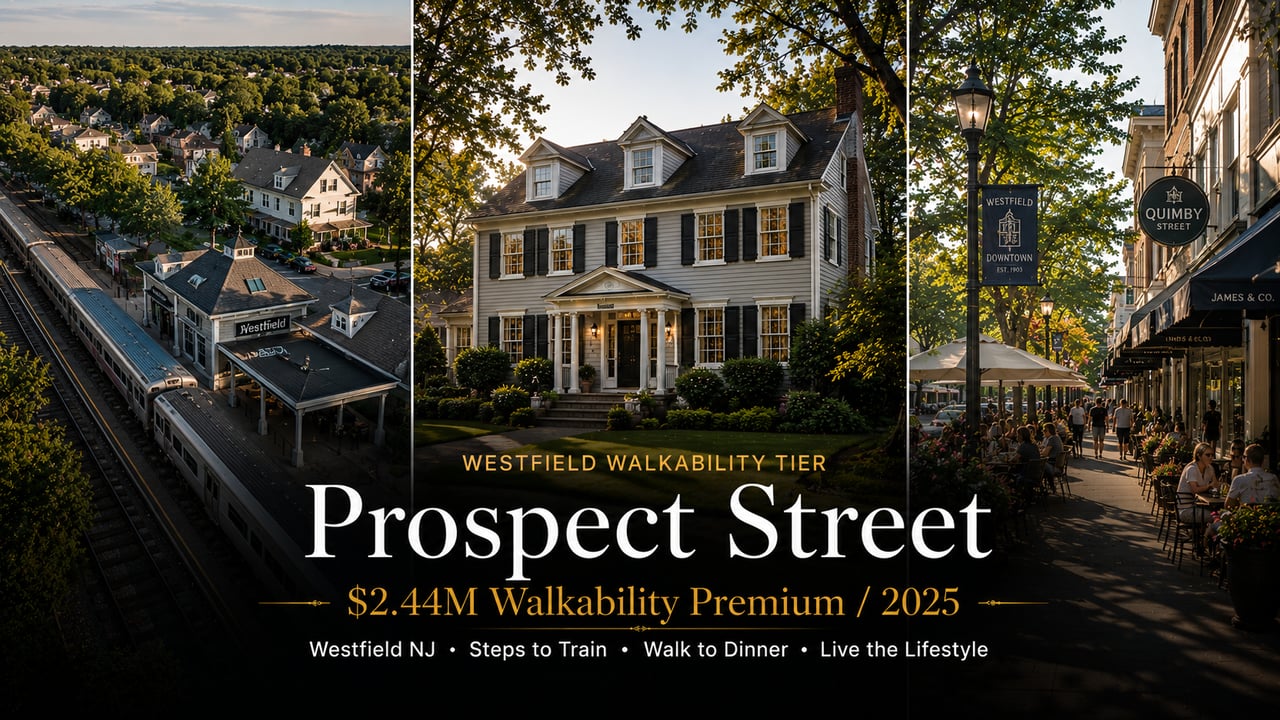
Prospect Street is where Westfield's "no-compromise walkability" trade plays out. Per public records, 934 Prospect Street closed at $2.44 million on January 31, 2025 — a six-bedroom home that traded primarily on its commute math, not its acreage. The buyer pool driving these sales is functionally different from what shows up on Westfield's estate corridors: relocating urban households who refuse to surrender daily-life walkability for suburban scale.
Prospect Street ranks #8 in our verified ranking of Westfield NJ's ten most expensive streets. What distinguishes the corridor isn't lot scale or architectural pedigree — it's structural location. Prospect Street runs north-south through Westfield's geographic center, intersecting North Avenue directly across from the NJ Transit Westfield train station. Properties along the lower-numbered end of the corridor sit within half a mile of both the station and downtown's restaurant and retail core. This is functionally rare in suburban New Jersey at the $2M+ tier.
This profile is assembled exclusively from publicly available sources: Garden State Multiple Listing Service records, Union County deed filings, public property-record aggregators, Westfield Patch reporting, and publicly available Westfield Master Plan and Prospect-Ferris Redevelopment documentation. For broader context on how Prospect Street fits within Westfield's residential geography, our Westfield neighborhood overview situates the corridor within the town's full residential framework.
Sale data verified against Garden State Multiple Listing Service record #3944401 (934 Prospect Street, $2,440,000, closed January 31, 2025) and Union County public deed filings. Long-arc comparable data drawn from public-record sales history (934 Prospect Street prior sale: $1,640,000 in June 2008). Street-level data, lot sizes, build years, and property tax records sourced from PropertyShark, NJPropertyRecords, and Clustrmaps public-record aggregations. Town-level transit and zoning context drawn from publicly available Westfield Master Plan, Prospect-Ferris Redevelopment Plan, and Town of Westfield government documentation. For broader Westfield regulatory framework context, our Westfield zoning map guide walks through the town's residential and mixed-use overlays.
934 Prospect Street's transaction history demonstrates how the walkability premium has compounded over the past seventeen years. The property previously sold in June 2008 for $1,640,000 — a price that, at the time, was already among the higher end of Westfield's transit-adjacent inventory. The 2025 close at $2,440,000 represents 49% appreciation across the hold period, or approximately 2.4% compounded annually — a more modest trajectory than the 7.6% annual rate documented for Lenape Trail's estate-tier inventory over a similar window.
Six-bedroom, 4.2-bath single-family home totaling 4,844 finished square feet on a 13,752-square-foot parcel (Block 306, Lot 55.01). The property previously sold in June 2008 for $1,640,000 per public deed records, and again on January 31, 2025 at $2,440,000. The 2.4% compounded annual appreciation reflects the relative stability of Westfield's walkability-tier inventory: lower volatility than the estate or new-construction corridors, but durable demand from a buyer pool with structurally different priorities.
Five-bedroom, seven-bath Colonial completed by Premier Design Custom Homes in August 2019, situated on a 1.2-acre parcel in the Indian Forest section of Westfield — the same builder portfolio profiled in our Orenda Circle new construction analysis. 1260 Prospect Street illustrates Prospect Street's geographic dual-character: the lower-numbered end of the corridor sits within walking distance of downtown and the train station, while the higher-numbered end transitions into Westfield's wooded north-side residential zones with full-acre estate lots.
“Prospect closings tell you who's actually moving to Westfield right now. The 934 Prospect buyer wasn't a young family chasing yard space — that was someone trading a Brooklyn brownstone for the same walkability with better schools. $2.4 million for half-mile-to-train is the new Westfield trade. And the buyer pool keeps growing because every time a Manhattan or Hoboken renter does the math, the math keeps working in Westfield's favor.
Prospect Street is one of the most internally varied corridors in Westfield's residential geography. The corridor runs north-south for nearly two miles, and its character changes substantially along the route. Buyers and sellers transacting on Prospect Street need to understand which segment they are actually in, because pricing dynamics differ meaningfully between the two.
The northern, lower-numbered end of Prospect Street sits in Westfield's geographic and commercial heart. Properties here are within half a mile of the NJ Transit Westfield station, the Quimby Street and Elm Street restaurant cores, and the town's primary retail district. The 10 Prospect Street commercial building at the intersection with North Avenue West — currently listed at $1,699,000 as freestanding retail and office space directly across from the train station — illustrates how the commercial and residential markets compress in this section. Residential buyers on this end of the corridor are paying explicitly for the ability to live without a daily-life car dependency.
As Prospect Street runs south, the corridor transitions from a downtown-adjacent walkability corridor into Westfield's wooded southern residential zones. The 1260 Prospect Street custom build sits in this segment — a 1.2-acre parcel in the Indian Forest section that has more in common with the lot-scale dynamics covered in our Breeze Knoll Drive hillside analysis than with the walkability-driven half-mile-to-train trade. Buyers paying $2.5M+ on this segment are typically not buying walkability — they're buying acreage and seclusion with a Prospect Street address that nominally carries the corridor's prestige.
“The first thing I ask anyone shopping Prospect Street is which Prospect. The walkability end and the estate end might as well be different markets — different buyer pools, different competing inventory, different pricing logic. A 934 Prospect comp doesn't help you price 1260 Prospect, and vice versa. Sellers who confuse the two leave money on the table or sit on the market for months. Getting the segment right is the single most important pricing decision on this corridor.
Prospect Street's walkability premium is not a passive market dynamic — it is actively reinforced by Westfield's town-level redevelopment planning. The Prospect-Ferris Redevelopment Plan, currently advancing through the Westfield Town Council planning process per publicly available Westfield government documentation, will transform the area immediately adjacent to the train station and the northern end of Prospect Street into a mixed-use, transit-oriented development district.
The plan, as outlined in public Westfield Master Plan documentation, includes mixed-use residential and commercial development at the Prospect-Ferris intersection. The Westfield Master Plan's transportation consultant has modeled the redevelopment using a recommended parking ratio of 1.35 spaces per residential unit, based on analysis of transit-oriented development communities in similar New Jersey towns and benchmarking against existing nearby buildings like Westfield Arms (which operates at approximately 90 apartments per acre, demonstrating the density New Jersey transit corridors can support).
For Prospect Street residential buyers and sellers, the Prospect-Ferris redevelopment carries two practical implications. First, the corridor's walkability character will likely be further reinforced as additional residential density concentrates near the station and as commercial activity expands along the immediate adjacent area. Second, the redevelopment may shift the relative valuation of properties at different distances from the station — those within walking radius gain proximity advantage, while those further south may see less direct benefit. For full context on how Westfield's master plan and zoning framework relate to the broader residential market, our Westfield zoning map guide walks through the regulatory layers and their pricing implications.
“The Prospect-Ferris redevelopment is the most important pricing variable nobody's talking about on this corridor. When that plan executes, the half-mile walkability radius around the train station becomes Westfield's most concentrated mixed-use district. Properties within that radius will see structural tailwinds for years. Sellers thinking about listing in 2026 should be paying close attention to where their property sits relative to the redevelopment footprint — it's the difference between riding the trend and being adjacent to it.
Prospect Street's buyer pool is structurally different from Westfield's estate-tier corridors. The buyer paying $2.44 million for 934 Prospect Street in 2025 is not the same buyer who paid $3.5 million for an estate property on Lenape Trail in 2024, or $2.85 million for new construction on Orenda Circle the same year. These are functionally separate cohorts with different priorities and revealed preferences.
The dominant Prospect Street walkability-segment buyer profile is a relocating Manhattan, Hoboken, or Jersey City household trading urban density for suburban scale — but refusing to surrender daily-life walkability in the trade. These buyers typically maintain Manhattan workplace commutes via the NJ Transit Raritan Valley Line (approximately 50 minutes to Penn Station via Newark transfer) and place a structural premium on being able to walk to restaurants, retail, and transit. The Westfield restaurant scene that draws this buyer pool is itself part of the corridor's value proposition.
Walkability-segment Prospect Street buyers tend toward dual-income households in finance, law, technology, medical, and professional services — sectors where daily commute time directly compounds against billable or productive hours. For these households, the structural ability to walk to the train rather than drive to a parking garage represents 15–30 minutes of recovered daily time, which compounds across years into substantial life-quality gains. The premium they pay over comparable square-footage inventory on Westfield's car-dependent corridors reflects this calculus directly.
Westfield Public School District ranking — #19 in New Jersey per U.S. News & World Report — is the additional filter that makes Westfield specifically competitive against alternative walkable suburbs. Buyers comparing Prospect Street to similarly walkable Maplewood, Montclair, or Summit Hill inventory are running a four-variable optimization: walkability, school district, commute time, and price. Our Westfield schools deep-dive covers the catchment-specific data that buyers reference when running this optimization.
“The Prospect Street buyer I see most often has been renting in Brooklyn or Jersey City for a decade, finally has kids approaching school age, and refuses to give up walking to dinner. They're not interested in a four-acre Lenape Trail estate. They want a beautiful home, top-rated schools, and the ability to grab a coffee on Elm Street without getting in the car. The 934 Prospect closing tells me the upper end of that buyer pool is now writing $2.4 million checks routinely. That's a fundamental shift from where this corridor was even three years ago.
Sellers on Prospect Street need pricing strategy that explicitly identifies which segment of the corridor the property occupies. Properties within the walkability segment should be compared to other half-mile-to-train Westfield inventory and to walkable transit-adjacent properties in adjacent towns, not to estate-tier inventory on Lenape Trail or hillside premium properties on Breeze Knoll. The 934 Prospect $2.44M comp is the cleanest 2025 walkability-segment benchmark; sellers in the estate segment have a different comp universe to reference.
Buyers entering the Prospect Street walkability segment should understand that the Prospect-Ferris Redevelopment Plan, if executed substantially as currently described in public planning documentation, will further concentrate Westfield's walkable amenity density near the train station. Properties within walking radius of the redevelopment area are likely to see continued upward pricing pressure as the area's mixed-use character matures. The comparable framework for this thesis is documented across our 2026 Westfield market update.
Prospect Street's pricing confirms that Westfield's $2M+ tier supports walkability as a fully distinct product category — separate from ultra-luxury new construction on Woodland Avenue, discreet off-market estates on Watchung Fork, hillside premiums on Breeze Knoll Drive, old-money pedigree on Lenape Trail, builder turnkey product on Orenda Circle, restored historic stock on East Dudley Avenue, and officially protected inventory on Kimball Avenue. Buyers can credibly choose any of these paths into Westfield's upper tier, and each path carries distinct compounding return characteristics.
Prospect Street's dual-segment geography makes segment-aware pricing strategy essential. Whether you're a walkability-segment seller benchmarking against the 934 Prospect comp or an estate-segment buyer evaluating 1.2-acre inventory on the south end of the corridor, your pricing framework needs to incorporate which Prospect Street you're actually in. The Prodigy Team provides confidential pricing audits with segment-aware comparable analysis for the full Prospect Street corridor. Contact The Prodigy Team directly or reach us at 718-873-7345.
934 Prospect Street closed at $2,440,000 on January 31, 2025 (GSMLS #3944401) — a six-bedroom, 4.2-bath single-family home totaling 4,844 finished square feet. The property previously sold for $1,640,000 in June 2008, representing 49% appreciation across a 17-year hold period, or approximately 2.4% compounded annually.
Prospect Street runs north-south through Westfield's geographic center for nearly two miles. The northern (lower-numbered) end intersects North Avenue West directly across from the NJ Transit Westfield train station and within half a mile of the downtown restaurant and retail core. The southern (higher-numbered) end transitions through Westfield's wooded residential zones into the Indian Forest section with full-acre lots.
The northern end of Prospect Street intersects North Avenue West directly opposite the NJ Transit Westfield station. Lower-numbered Prospect Street properties typically sit within a half-mile walking distance of the station. The NJ Transit Raritan Valley Line provides service to Penn Station NY via Newark transfer, with typical peak-hour commute times of approximately 50 minutes.
The Prospect-Ferris Redevelopment Plan is a Town of Westfield-led initiative to transform the area immediately adjacent to the train station at the Prospect-Ferris intersection into a mixed-use, transit-oriented development district. The plan is documented in publicly available Westfield Master Plan and Town Council materials. Implementation would add residential density and commercial activity along the northern end of Prospect Street, reinforcing the corridor's existing walkability premium.
Prospect Street's walkability segment commands a premium because it is one of the few Westfield corridors where buyers can credibly live without daily-life car dependency — under half a mile to the NJ Transit station, downtown restaurants, and retail. This combination is structurally rare in Union County suburban inventory at the $2M+ tier and attracts a buyer pool relocating from Manhattan, Hoboken, and Jersey City who specifically value walkable urban-style amenities alongside Westfield Public School District access.
Prospect Street homes fall within the Westfield Public School District, which ranks #19 in New Jersey and 38th of 411 NJ public high schools per U.S. News & World Report's 2025 rankings. Catchment varies along the corridor; northern-segment properties generally feed into different elementary school assignments than southern-segment properties. Specific catchment assignments should be confirmed property-by-property.
Sale data verified against Garden State Multiple Listing Service record #3944401 (934 Prospect Street, $2,440,000, closed January 31, 2025) and Union County public deed filings (Block 306, Lot 55.01, Deed Book 5864 Page 273). Long-arc comparable data drawn from public-record sales history (934 Prospect prior sale: $1,640,000 in June 2008, per Clustrmaps public-record imports). 1260 Prospect Street details sourced from Premier Design Custom Homes' published project archive. Street-level data, lot sizes, build years, and assessment records sourced from PropertyShark, NJPropertyRecords, and Clustrmaps. Prospect-Ferris Redevelopment Plan context drawn from publicly available Town of Westfield government documentation and Westfield Master Plan materials. 10 Prospect Street commercial listing details from active GSMLS public records.
For comprehensive Westfield luxury market context, see our companion analyses: the pillar ranking of Westfield's ten most expensive streets, our profile of the $5.275M record sale at 128 Woodland Avenue, the $7.5M+ discreet luxury corridor on Watchung Fork, the hillside elevation premium on Breeze Knoll Drive, the Lenape Trail old-money estate corridor, the Orenda Circle new-construction luxury tier, the East Dudley Avenue historic district corridor, and the Kimball Avenue officially designated historic district.
For broader Westfield lifestyle and regulatory context, our additional reporting covers Westfield's restaurant and dining scene, the Westfield Public Schools academic deep-dive, the Westfield zoning map and master plan framework, and the 2026 Westfield price trend update. For neighborhood-level orientation, explore the Westfield neighborhood overview. To discuss a Prospect Street property, learn more about working with The Prodigy Team.
Prodigy Real Estate is an innovative real estate company offering high-end video production, home valuation services, purchasing, and home sales. Serving New York and New Jersey.