
Anthony Licciardello | May 20, 2026
Westfield, NJ
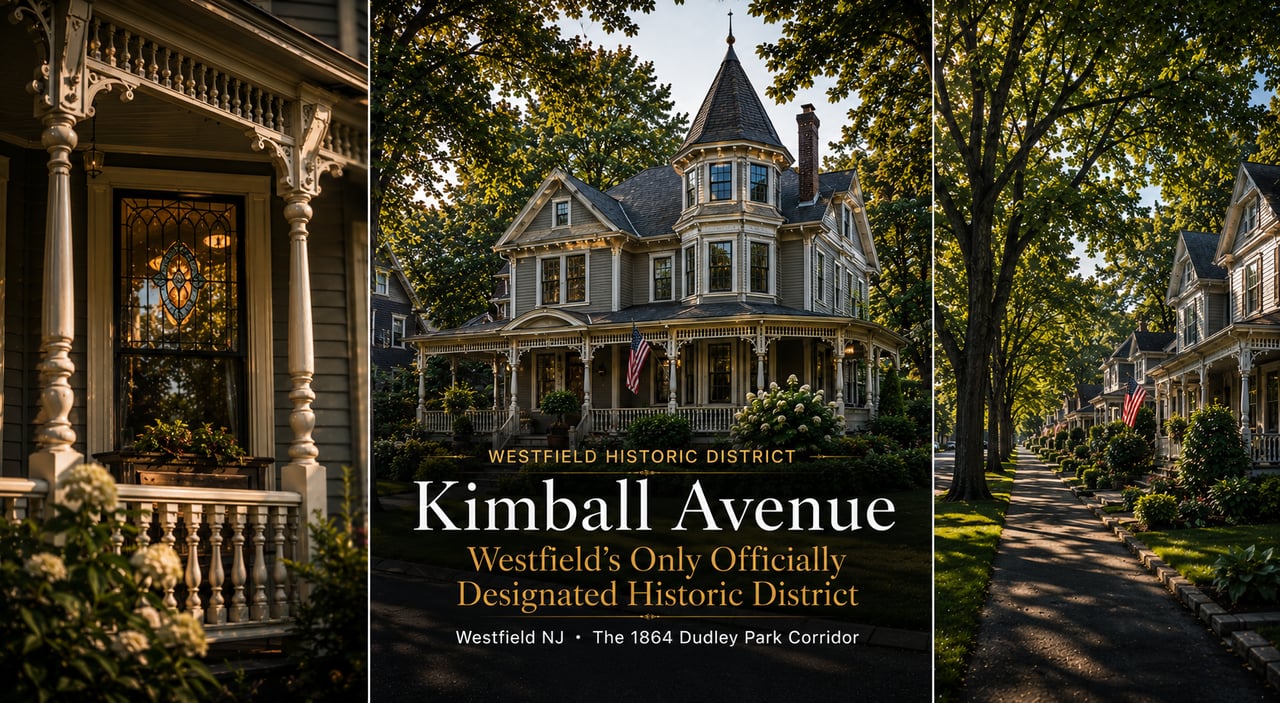
Kimball Avenue is the only officially designated historic district in Westfield — and that designation is not a marketing line. It is a regulatory framework with concrete implications for what can and cannot happen on this corridor. Per public records, the block of Kimball Avenue between Lawrence Avenue and Elm Street represents the architectural heart of the town's 1864 Dudley Park subdivision, with current pricing that reflects the structurally finite supply of officially protected historic stock.
Kimball Avenue ranks #7 in our verified ranking of Westfield NJ's ten most expensive streets, but its position in Westfield's residential hierarchy is structurally unique. Where East Dudley Avenue trades within the broader Dudley Park district, Kimball Avenue carries the actual formal historic designation — the only one in Westfield. This regulatory distinction is what shapes everything from architectural protection requirements to long-term comp trajectory.
This profile is assembled exclusively from publicly available sources: Garden State Multiple Listing Service records, Union County deed filings, PropertyShark and NJPropertyRecords aggregations, Westfield Patch reporting, and publicly available Westfield Historic Preservation Commission documentation. For broader Westfield context, our Westfield neighborhood overview situates Kimball Avenue within the town's full residential geography.
Sale data verified against Garden State Multiple Listing Service record #3873031 (515 Kimball Avenue, $2,150,000, closed February 1, 2024), MLS #3954932 (242 Kimball Avenue, listed April 2025), and Union County public deed filings. Street-level assessment data, lot sizes, build years, and property tax records sourced from PropertyShark and NJPropertyRecords public-record aggregations. Kimball Avenue Historic District designation, boundary, and architectural context drawn from publicly available Westfield Historic Preservation Commission documentation. Historical comparable sales sourced from contemporaneous PropertyShark public records. For comprehensive Westfield Historic Preservation framework context, our Westfield zoning map guide explains the regulatory overlay that distinguishes Kimball Avenue's protections from the broader Westfield zoning framework.
Kimball Avenue's strongest verified luxury comp in the 2024–2026 window is 515 Kimball Avenue — and the property's specifications illustrate a counterintuitive feature of how the Historic District actually functions. The corridor's regulatory framework primarily protects exterior architectural character within the designated boundary; it does not prohibit modern construction on Kimball Avenue parcels outside the protected block, nor does it freeze interior modernization on any property in the district. This nuance shapes the comp set.
Five-bedroom, 5.5-bath custom Colonial built in 2014, situated on a 0.32-acre Kimball Avenue parcel. The property closed at $2,150,000 in February 2024, establishing the corridor's most recent confirmed $2M+ benchmark. The home illustrates a key feature of Kimball Avenue pricing: a 2014 custom build commands strong luxury pricing on the corridor specifically because Kimball Avenue's address carries pedigree even outside the protected historic block boundary. The street's social and economic character extends across the broader corridor, not just within the regulatory designation.
Elegant Victorian listed in April 2025 within the formally protected Historic District boundary. Property specifications include wood-beam ceilings, oversized leaded glass windows, custom trim and pocket doors, a private office with French doors, a grand formal dining room with dry bar, a gourmet kitchen with center island and granite countertops, and a third-floor primary suite with custom walk-in closet, clawfoot tub, and dual vanities. The home represents the kind of restored historic Kimball Avenue inventory that competes directly with new construction at the same price point — a 2025 buyer choosing 242 Kimball is choosing architectural authenticity over the Hardie-plank-and-Andersen-windows specification of comparable new builds elsewhere in town.
“The Kimball Avenue address carries weight that extends beyond the district boundary. A 2014 custom build closing at $2.15 million tells you the corridor's social and architectural pedigree is doing real work in the comp set, even on properties that aren't themselves protected. Buyers paying that number are paying for the neighborhood, not just the house. That's a different value driver than what you see on streets where the address is interchangeable.
The Kimball Avenue Historic District covers the block of Kimball Avenue between Lawrence Avenue and Elm Street — a finite geographic boundary that contains some of Westfield's most architecturally significant homes. Per publicly available Westfield Historic Preservation Commission documentation, this is the only officially designated historic district in the town. The Dudley Park district referenced in our analysis of East Dudley Avenue's historic stock is a broader local-character designation that surrounds the Kimball Avenue District, but Kimball Avenue is the only corridor with the formal regulatory protection.
The district's architectural inventory includes notable concentrations of Colonial Revivals (with classic steep gambrel roofs and stucco facades typical of Dutch Colonial heritage), Georgian-style homes with symmetrical massing and central entries, Queen Anne Victorians with wraparound porches and turret features, and Federal-style residences with formal proportions and refined detailing. The 242 Kimball Avenue Victorian currently listed at $2.095 million illustrates the architectural standard the district preserves: wood-beam ceilings, leaded glass windows, original pocket doors and custom trim, period staircases, and the kind of architectural soul that newer Westfield construction simply cannot replicate.
The district's origin traces to October 1864, when John Q. and Helen M. Dudley purchased approximately 70 acres of Westfield land centered on what is today Dudley Avenue. The Dudleys' plan for "Dudley Park" was to parcel lots for investment and residential development. The 1873 financial depression halted construction for several years, but the 1892 opening of Westfield's north side railroad station — combined with the Central Railroad's publicity campaign to draw Manhattan commuters to Westfield — triggered a major construction surge through the turn of the century, filling out the remaining Dudley Park lots. The district's architectural character today reflects that 1892–1925 building era.
“What's fascinating about the Kimball District is that the original buyer pool — Manhattan commuters drawn by the 1892 north side railroad — is functionally the same buyer pool today. Different century, same commute math. The corridor was built for buyers who valued access to Penn Station and traded urban living for architectural permanence, and 134 years later, the buyers writing $2M+ offers here are making the same trade. That kind of historical continuity is rare in any luxury market.
Buyers and sellers transacting on Kimball Avenue should understand the practical implications of the Historic District designation. The regulatory framework is more nuanced than buyers sometimes assume.
Properties within the formal district boundary are subject to Westfield Historic Preservation Commission review for exterior alterations, additions, demolitions, and new construction. This means buyers planning major exterior modifications need to be prepared for an additional review layer beyond standard Westfield zoning permits. For full context on how the Historic Preservation Commission overlay relates to the broader Westfield zoning framework, our Westfield zoning map guide walks through the regulatory layers and what they mean for buyers, sellers, and existing homeowners.
The Historic District designation does not freeze interior systems, kitchens, bathrooms, or mechanical updates. Buyers acquiring a Kimball Avenue Victorian can modernize the kitchen, install central air conditioning, upgrade electrical and plumbing systems, and renovate primary bathrooms without district approval — as long as exterior architectural integrity is preserved. This is why the 242 Kimball Avenue Victorian can offer "historic charm with modern amenities" without regulatory conflict: original leaded glass windows and pocket doors coexist with granite countertops and stainless appliances.
Demolitions within the designated district require Commission approval, and that approval is rarely granted for contributing properties. This creates a fundamentally different supply dynamic than Orenda Circle's tear-down-friendly inventory, where builders actively acquire older homes for demolition and new construction. On the Kimball Avenue corridor's protected block, the supply of historic stock is structurally capped — the only path to inventory is acquiring an existing protected home.
“Kimball Avenue is the only address in Westfield where the historic designation isn't a marketing claim — it's a regulatory framework that physically constrains supply. Buyers paying $2 million-plus on Kimball aren't just paying for restored architecture; they're paying for the structural certainty that the property six doors down can't be torn down and replaced with a 7,000-square-foot custom Colonial. That kind of supply protection is rare in any Northeast luxury market, and it's the single most underdiscussed driver of Kimball Avenue's pricing trajectory.
Kimball Avenue's location amplifies the regulatory advantages of the Historic District designation. The corridor sits within easy walking distance of downtown Westfield's restaurant and retail core, the Westfield train station, and the town's primary parks and public spaces. This is not a corridor where downtown access requires a car. Walkability is structural, and the dining scene that anchors that walkability has become one of the more distinctive suburban food landscapes in the New York metro.
For Kimball Avenue buyers specifically — particularly relocating Manhattan, Hoboken, and Jersey City households accustomed to a daily life lived on foot — the combination of walkable downtown access and architecturally protected residential character is functionally unique within Union County. Our profile of Westfield's restaurant scene walks through the dining establishments that make this walkable lifestyle worth the trade — from Maize in the 1890s North Avenue Train Station (a building that traces its architectural origins to the same 1892 railroad development surge that built much of Kimball Avenue's stock) to the Georgian bakery on Elm Street, the long-running Italian institutions, and the maturity of culinary diversity now visible on Quimby Street.
The school district context matters equally. Kimball Avenue catchment falls within the Westfield Public School District's strongest-performing elementary attendance areas. For families weighing the Historic District trade-off against new-construction options elsewhere in Westfield, our Westfield schools deep-dive covers the catchment-by-catchment academic data and within-Westfield school premium dynamics.
“I tell buyers thinking about Kimball Avenue to walk it. Park downtown, get a coffee on Elm, walk to the train station, then walk up Kimball at five in the afternoon when the light hits the gambrel roofs and the leaded glass. Do that walk before you make an offer. The properties trade on something that doesn't show up in the MLS photos or the appraisal comps — and you either feel it or you don't. The buyers who feel it write the strongest offers.
If you own within the formal Kimball Avenue Historic District boundary, your property carries something that no amount of new construction can replicate — the regulatory protection of an officially designated historic district. Pricing strategy should explicitly reference this protected status, not treat the property as just another older Westfield home. The $2.095M list on 242 Kimball Avenue reflects what restored, well-maintained historic inventory can credibly ask in the 2026 market. Sellers preparing inventory at this tier need a comp framework that incorporates both within-district protected sales and the broader Westfield $2M+ tier captured in our verified ranking of Westfield's ten most expensive streets.
The Kimball Avenue Historic District contains a fixed number of contributing properties. New supply cannot be created by builder activity, and the broader Westfield 2026 market context — covered in our 2026 Westfield market update — suggests continued buyer demand for protected historic inventory. Buyers committed to this corridor should be financially pre-positioned to move quickly when properties list. Substitute inventory exists in the broader Dudley Park district (East Dudley Avenue's recent $3.647M sale is the strongest example), but only Kimball Avenue carries the formal regulatory designation.
Kimball Avenue's pricing dynamics confirm that Westfield's $2M+ tier now supports a genuinely diversified product mix: ultra-luxury new construction on Woodland Avenue, discreet off-market estates on Watchung Fork, hillside elevation premiums on Breeze Knoll Drive, old-money pedigree on Lenape Trail, builder-developed turnkey new construction on Orenda Circle, restored historic stock in the broader Dudley Park district on East Dudley Avenue, and now formally protected Historic District inventory on Kimball Avenue. Buyers can credibly choose any of these paths.
If you own on Kimball Avenue or anywhere within the formally designated Kimball Avenue Historic District, pricing strategy should explicitly account for the regulatory protections that make your inventory structurally unique within Westfield. The Prodigy Team provides confidential pricing audits for Westfield's Historic District properties — including district-boundary analysis, Historic Preservation Commission overlay context, and comparable framework that incorporates both within-district and adjacent-corridor sales. Contact The Prodigy Team directly or reach us at 718-873-7345.
The Kimball Avenue Historic District is the only officially designated historic district in Westfield, NJ, per Westfield Historic Preservation Commission documentation. It covers the block of Kimball Avenue between Lawrence Avenue and Elm Street. The broader Dudley Park district that surrounds the Kimball corridor is a separate, less formal local-character designation that does not carry the same regulatory protections.
515 Kimball Avenue closed at $2,150,000 on February 1, 2024 (GSMLS #3873031) — a five-bedroom, 5.5-bath custom Colonial built in 2014. 242 Kimball Avenue, an elegant Victorian within the formally protected Historic District boundary, was listed at $2,095,000 in April 2025 (GSMLS #3954932).
The Kimball Avenue Historic District contains notable concentrations of Colonial Revivals (with classic gambrel roofs and stucco facades from Dutch Colonial heritage), Georgian-style homes, Queen Anne Victorians with wraparound porches and turret features, and Federal-style residences. The architectural character primarily reflects the 1892–1925 construction era that followed the opening of Westfield's north side railroad station.
Interior renovations within the Kimball Avenue Historic District — including kitchen and bathroom updates, mechanical system upgrades, and central air installation — generally do not require Historic Preservation Commission review. Exterior alterations, additions, demolitions, and new construction within the formal district boundary do require Commission approval to preserve architectural integrity. Property buyers should consult current Westfield Historic Preservation Commission guidelines before planning major exterior work.
The district's architectural and historical context traces to the original 1864 Dudley Park subdivision, when John Q. and Helen M. Dudley purchased approximately 70 acres of Westfield land. The 1892 opening of Westfield's north side railroad station and the Central Railroad's publicity campaign to attract Manhattan commuters triggered the main construction surge that built out most of the district's housing stock. The formal Historic District designation was established later by the Westfield Historic Preservation Commission to protect this architectural legacy.
Kimball Avenue homes fall within the Westfield Public School District, generally catchment-mapped into Wilson Elementary School, Roosevelt Intermediate School, and Westfield Senior High School. The Westfield Public School District ranks #19 in New Jersey and 38th of 411 NJ public high schools per U.S. News & World Report's 2025 rankings.
Sale data verified against Garden State Multiple Listing Service records #3873031 (515 Kimball Avenue, $2,150,000, closed February 1, 2024) and #3954932 (242 Kimball Avenue, listed $2,095,000 in April 2025). Recent comparable district sales sourced from PropertyShark public-record aggregations (Kimball Avenue Historic District sales recorded through January 2026). Historical district context, boundary description, and architectural inventory drawn from publicly available Westfield Historic Preservation Commission documentation and the 1864 Dudley Park subdivision history. No private listing data, confidential broker communications, or proprietary transaction information is referenced.
For comprehensive Westfield luxury market context, see our companion analyses: the pillar ranking of Westfield's ten most expensive streets, our profile of the $5.275M record sale at 128 Woodland Avenue, the $7.5M+ discreet luxury corridor on Watchung Fork, the hillside elevation premium on Breeze Knoll Drive, the Lenape Trail old-money estate corridor, the Orenda Circle new-construction luxury tier, and the East Dudley Avenue historic district corridor.
For broader Westfield lifestyle and regulatory context, our additional reporting covers Westfield's restaurant and dining scene, the Westfield Public Schools academic deep-dive, the Westfield zoning map and Historic Preservation framework, and the 2026 Westfield price trend update. For neighborhood-level orientation, explore the Westfield neighborhood overview. To discuss a specific Historic District property, learn more about working with The Prodigy Team.
Prodigy Real Estate is an innovative real estate company offering high-end video production, home valuation services, purchasing, and home sales. Serving New York and New Jersey.