
Anthony Licciardello | May 27, 2026
Long Beach Island
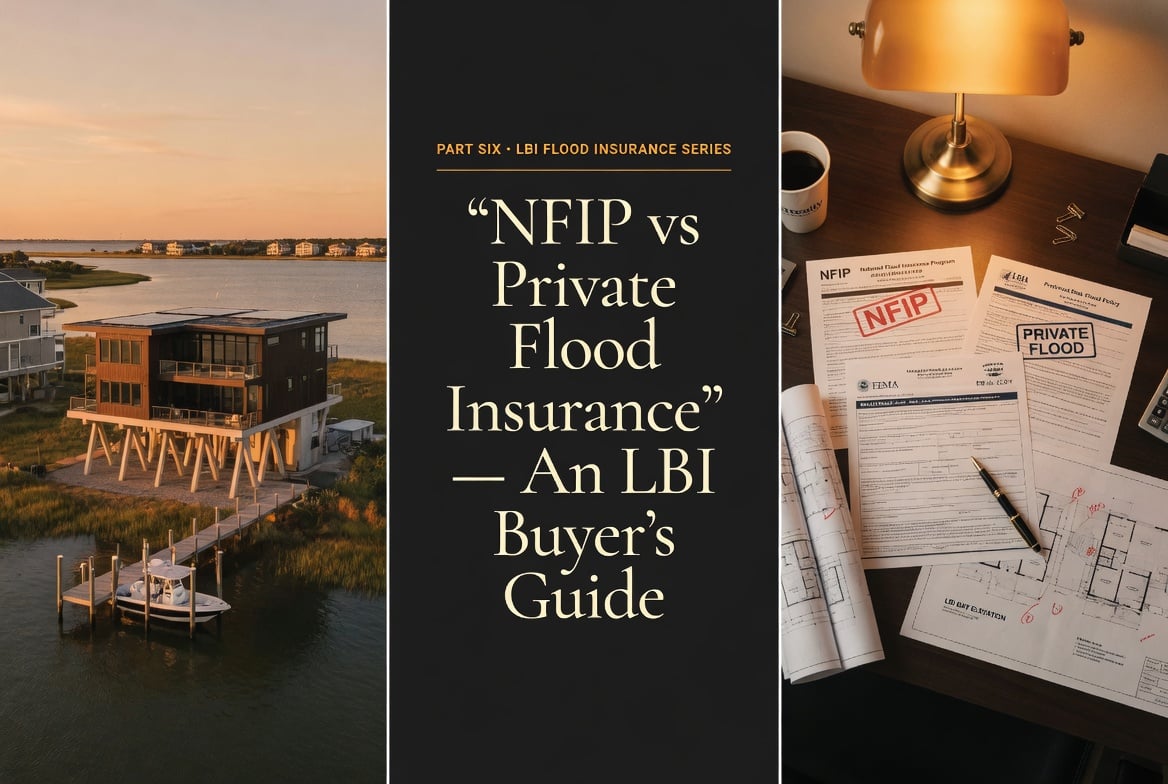
The federal program has to insure you. The private market gets to decide whether to. That single asymmetry shapes every meaningful difference between the two — and it's the reason most well-built LBI homes should be shopping both.
The NFIP and private flood market are not interchangeable products. The NFIP is a federally backed program with universal access, standardized rating under Risk Rating 2.0, and hard coverage caps at $250K building / $100K contents. Private carriers underwrite individually using proprietary models, can decline risks they don't like, frequently require an Elevation Certificate, and offer coverage limits high enough to fully insure even the largest LBI oceanfront builds. For well-built modern LBI homes, private carriers frequently beat NFIP pricing by 20–40% — sometimes more. For older homes, ground-level construction, or homes with structural compliance issues, private carriers often decline coverage entirely, and the NFIP becomes the only path. The right answer for any specific LBI property is to shop both, document the structural profile thoroughly, and let the carriers compete.
For most of the last fifty years, the flood insurance question on LBI had a single answer: the NFIP. Private flood carriers existed, but they were marginal players targeting a narrow slice of high-end primary residences. The National Flood Insurance Program was effectively a monopoly — the only way to get a federally backed mortgage on a coastal home was to buy the federal product.
That changed over the last decade. Federal legislation in 2014 and subsequent regulatory updates expanded mortgage lenders' ability to accept private flood policies as satisfying federal coverage requirements. Private carriers — particularly Lloyd's syndicates and a handful of US-based specialty insurers — entered the coastal flood market aggressively, building proprietary catastrophe models and writing policies at prices the NFIP often cannot match. For LBI owners, the practical result is that "flood insurance" is no longer a single product. It is a category, and the answer for any specific home is the result of a competitive shopping process. This article — the closer of the series — covers what's actually different between the two, who each one is for, and how to run the comparison properly.
The NFIP and the private flood market do the same job — they pay claims when your home is damaged by rising flood water — but they are structurally different products underwritten by structurally different organizations with structurally different priorities.
The NFIP. A federal program created in 1968 and administered by FEMA. Premiums are calculated by FEMA's Risk Rating 2.0 algorithm (covered in detail in Part Two of this series), policies are sold by approved Write Your Own (WYO) insurance carriers and direct through FEMA, and claims are ultimately paid by the federal government. The NFIP is mandated to offer coverage to any property in a participating community, regardless of how high-risk the structure is. The trade-off for that universal access is rigid coverage limits, standardized policy language, and pricing that cannot be negotiated.
Private flood insurance. Coverage written by private insurance carriers — primarily Lloyd's syndicates, specialty US carriers like Neptune and Wright Flood, and an increasing number of admitted carriers in coastal states. Premiums are calculated by each carrier's proprietary catastrophe model, policies are negotiated and customizable, and claims are paid from the carrier's own capital. Private carriers can decline to quote any property they consider too risky, and they can structure coverage well beyond NFIP limits. The trade-off for that flexibility is selectivity — and the consequence is that not every LBI home is eligible.
Understanding the distinction shapes every other conversation in this article. When private carriers and NFIP appear to offer "the same thing at a different price," they are not. They are offering different versions of flood coverage, with different rules, different gaps, and different post-claim experiences. The pricing comparison is real and meaningful — but it should never be the only comparison.
The single most important practical difference between the NFIP and the private market is who they will insure. The federal program has to write the policy. The private market gets to choose.
NFIP must insure. If your community participates in the NFIP — every LBI municipality does — the program is statutorily required to offer coverage on any eligible structure in the community. A 1950s slab-on-grade ranch with no flood vents, no elevation, and a finished basement will still receive an NFIP policy. The premium will be punitive, but the policy will exist. This is the safety net function of the federal program: it ensures that flood insurance remains available to every coastal homeowner, regardless of how the home was built.
Private carriers can decline. Each private flood carrier maintains its own underwriting criteria. Carriers commonly decline to quote properties with: ground-level construction in flood zones, finished living space below Base Flood Elevation, missing or inadequate flood vents on enclosed lower spaces, prior repetitive loss history, lack of an Elevation Certificate documenting key structural facts, or properties that fall outside the carrier's preferred geographic or RCV range. The decline itself is not a judgment of the home's value — it's a judgment of the carrier's risk appetite.
The practical implication. For modern, well-built LBI homes — elevated on pilings, properly vented, with M&E above BFE — multiple private carriers will compete for the business, and the NFIP is rarely the price winner. For older or non-compliant homes, private carriers will not write the coverage at any price, and the NFIP is the only available product. The retrofit work covered in Part Four of this series is often the variable that determines which side of this divide a given LBI home falls on.
This dynamic mirrors what we see in other shore markets where private flood capacity has expanded into the post-Sandy rebuild zones — including the patterns we documented in our Monmouth Beach broker pillar guide. Where homes have been rebuilt to modern code, the private market is aggressive. Where they haven't, it isn't.
Both the NFIP and private carriers use multi-variable algorithms to set premiums. Both consider location, building characteristics, and replacement cost. But the algorithms themselves differ in important ways that produce real pricing variance.
The NFIP is one algorithm, universally applied. Risk Rating 2.0 is a single methodology applied to every property in the country. Two homes with identical inputs receive identical premiums regardless of where they're located, which carrier they choose, or how the market is performing. The benefits are transparency and predictability — you know that improving any specific variable will produce a calculable premium response. The cost is that the algorithm cannot reward characteristics outside its variable set.
Private carriers use proprietary catastrophe models. Each private carrier builds and maintains its own model using a mixture of public hazard data, proprietary loss history, advanced terrain modeling, and increasingly sophisticated machine-learning inputs. The result is that different carriers can produce materially different premiums on the same home. One carrier may weigh oceanfront exposure heavily and produce a high quote; another may weight the specific dune protection and street-level topography and produce a lower quote on the same property. The variance between private quotes on the same home is frequently 15–30%, and occasionally larger.
The 18% annual increase cap. The NFIP is subject to a statutory cap of 18% per year on most premium increases — a legacy of the political response to early Risk Rating 2.0 sticker shock. Private carriers are not subject to that cap; they can move pricing year-to-year as their cat models update. In stable markets, this typically benefits owners on private policies (better year-to-year predictability). In hardening markets after major loss events, the dynamic can reverse — private renewals can spike sharply while NFIP renewals stay within the cap. The cap is one of the underrated advantages of NFIP coverage during reinsurance market hardening.
The practical pricing pattern on LBI. For modern elevated homes, private carriers frequently beat NFIP pricing by 20–40%. For older or borderline-compliant homes, NFIP often wins on price after the better private carriers decline to quote. For oceanfront homes with high replacement cost values, the answer is usually a layered structure: NFIP up to its caps, plus a private excess flood policy bridging the gap to the home's full RCV. The right structure is property-specific.
The single most important coverage difference between the NFIP and the private market is the federal program's hard cap on residential coverage limits. The NFIP will write up to $250,000 in building coverage and $100,000 in contents coverage for residential properties. Those are the maximums — they have not increased in decades, and they are well below the replacement cost of most modern LBI homes.
The implications scale with home value:
| Home RCV | NFIP Coverage | Coverage Gap |
|---|---|---|
| $200K Small cottage |
Fully covered | None |
| $500K Typical bayside |
$250K of $500K | $250K uninsured |
| $1.2M Modern bayside rebuild |
$250K of $1.2M | $950K uninsured |
| $3M+ Oceanfront contemporary |
$250K of $3M+ | $2.75M+ uninsured |
For any LBI home with RCV above $250K — which is the vast majority of homes on the island — relying on NFIP alone leaves a coverage gap. The standard response is a layered insurance structure: NFIP at its $250K cap as the base layer, plus a private excess flood policy covering the gap to the home's full RCV. Excess policies are widely available and significantly cheaper per dollar of coverage than the underlying NFIP base, because the excess carrier only pays after the NFIP base is exhausted.
Alternatively, owners can replace the NFIP entirely with a primary private flood policy that covers the full RCV in one product. The choice between layered (NFIP + excess) and primary private depends on total premium math, claims-handling preferences, and the carrier appetite for the specific home.
The buyer-side takeaway. For any LBI purchase above $250K RCV — practically every LBI property — the question is not "should I get flood insurance" but "what does the layered coverage structure look like and what does the all-in premium come to." Buyers running carrying-cost math on the NFIP base premium alone are systematically underestimating their actual flood insurance line item.
The NFIP has incredibly rigid rules regarding basements and enclosed areas below ground level — meaning any space where the floor is below grade on all four sides. Even if the rest of the home is perfectly elevated and meticulously compliant, the NFIP provides minimal coverage for anything finished, stored, or installed in a true basement.
What the NFIP will pay for in a basement: structural elements (foundation walls, the basement floor itself), unfinished drywall and ceiling, utility connections, and certain limited mechanical equipment. The list is short and well-defined.
What the NFIP will not pay for in a basement: finished flooring, finished walls, finished ceilings, personal property, appliances not designed to support the building's primary use, furniture, electronics, recreational equipment, finishings of any kind. If a true subgrade basement is finished as a media room, guest suite, or recreation space, the entire build-out value is effectively uninsured under NFIP rules during a flood event.
True subgrade basements are uncommon on LBI given the island's high water table, but where they do exist — typically in older homes predating modern coastal construction practice — the NFIP gap is substantial. This is also one of the most common areas where private flood carriers offer materially better coverage than the federal program.
Private carrier basement coverage. Many private flood carriers offer optional endorsements that cover finished basement contents, basement build-outs, additional living expenses if a flood forces displacement, and other categories the NFIP explicitly excludes. These endorsements add modest premium load and typically come with their own sublimits, but they close a coverage gap that the federal program simply does not address.
For LBI owners with finished lower-level spaces — whether true subgrade basements (rare) or elevated lower enclosures that have been improperly finished as living space (more common, and a separate compliance issue covered in Part Four of this series) — the basement coverage question is not theoretical. It is the difference between full claim recovery and a five-figure out-of-pocket loss.
The documentation each carrier requires to write a policy reflects the deeper structural difference between the two products. The NFIP, with its universal-access mandate, has dramatically simplified its documentation requirements over the last decade. Private carriers, with their proprietary models and selective underwriting, generally have not.
NFIP documentation. Under Risk Rating 2.0, the NFIP no longer requires an Elevation Certificate for most policies — FEMA pulls elevation data from federal LiDAR. The basic policy bind requires the property address, ownership information, intended coverage limits, and deductible selection. Optional supplementary documentation (an EC, photographs of mitigation work, FIRM revision references) can be submitted to refine the rating but is not required to write the policy.
Private carrier documentation. Most private flood carriers require: a current Elevation Certificate (covered in detail in Part Five of this series); photographs of all sides of the structure, the foundation, and any flood vents; documentation of any mitigation work completed; the property's claim history; the current NFIP policy declarations page (if one exists); and replacement cost documentation. Some carriers also require an engineer's report for high-RCV properties or properties with non-standard construction.
The documentation difference is not a bureaucratic inconvenience — it's the operational expression of the carriers' different relationships to risk. The NFIP is statutorily required to write the policy and uses federal data to rate it. Private carriers are putting their own capital on the line and want documented proof of every assumption their model is making.
The practical workflow. For LBI owners shopping flood coverage, the discipline is to pull the full documentation package first — current EC, photographs, mitigation evidence, claim history — and present a clean file to every carrier simultaneously. Brokers working from incomplete files generally cannot get competitive private quotes; brokers working from complete files can run NFIP plus 3–5 private carriers in parallel and produce a comparison that's actually decision-grade.
After six chapters of nuance, the decision framework for most LBI homes resolves into four scenarios:
Scenario 1 — Modern, well-built home with RCV under $250K. Rare on LBI in 2026, but where it exists (small cottages, certain townhome interiors), the layered structure isn't needed — NFIP alone can fully cover the home. Shop NFIP against 2–3 private carriers and pick whichever produces the better premium. The decision is purely price.
Scenario 2 — Modern, well-built home with RCV between $250K and $1.5M. The most common LBI profile. The standard structure is layered: NFIP at its $250K cap as the base, plus a private excess flood policy covering the gap to full RCV. Shop the NFIP base against a primary private alternative; shop the excess layer across 2–3 carriers; pick the combined structure with the best total premium and the cleanest coverage terms. Private carriers will usually compete aggressively for this segment.
Scenario 3 — High-RCV home above $1.5M. Almost always a layered structure with substantial private excess coverage. Some high-end buyers also bring in a high-net-worth specialty carrier (Chubb, AIG Private Client Group, PURE) that can bundle flood with other coverages under a single policy structure. For oceanfront contemporaries with $3M+ RCV, the broker shopping process can take meaningfully longer and may involve carriers most retail brokers don't typically work with.
Scenario 4 — Older or non-compliant home. If the home has ground-level construction, missing flood vents, finished space below BFE, prior repetitive loss history, or any other condition that puts it outside the private market's underwriting appetite, the NFIP is the only path. The premium will be higher than ideal, but the policy will exist. The right adjacent work is often the structural retrofits covered in Part Four — improving the home's "How" pillar profile until it qualifies for private competition.
In all four scenarios, the discipline is the same: pull a complete documentation file, present it to NFIP and multiple private carriers in parallel, and let the market produce the price. The single most expensive mistake LBI owners make on flood insurance is accepting the first quote they receive — typically from the same WYO carrier that wrote their existing policy — without running the comparison.
Six chapters in, the throughline of this series is straightforward: LBI flood insurance is not a fixed cost. It is a calculated cost, and the calculation has inputs you can change. The premium is determined by the algorithm. The algorithm is determined by your home's structural profile, its flood zone designation, its replacement cost, and the documentation in your file. The carrier you choose to underwrite it adds a final layer of competitive pricing on top of all of that.
For LBI buyers, the implication is that flood insurance belongs in the offer construction, not the closing disclosure. For LBI sellers, the implication is that the premium and the documentation that drives it belong in the listing materials, not the inspection contingency. For LBI owners, the implication is that the renewal notice you've been paying for the last five years is probably not the best available structure for your home — and the work to find out is bounded, defined, and almost always worth the time.
The discipline travels across markets. The carrying-cost framework we documented in our Manasquan breakdown, the post-Sandy rebuild dynamics we covered in our Monmouth Beach pillar guide, and the disclosure-rule shifts we tracked in our Long Branch playbook all apply with their own local nuance. LBI is the most extreme expression of the dynamics, not the only expression of them.
If you're considering an LBI purchase or sale and want the full underwriting work — zone confirmation, EC review, rating worksheet read, retrofit ROI math, NFIP-versus-private comparison — that's the pre-transaction audit we run on every LBI engagement. The work pays for itself in tighter offers, faster closings, and premium structures the seller's broker didn't see coming.
Most federally backed mortgage lenders are required to accept private flood policies that meet specific federal coverage standards under the Biggert-Waters Act and subsequent regulatory updates. The policy must provide coverage at least equivalent to what NFIP would offer, must be written by a properly licensed carrier, and must meet specific notice and cancellation provisions. Always confirm with your specific lender before binding a private policy in place of NFIP — some lenders impose additional internal requirements beyond the federal minimum.
Yes. Owners can move from NFIP to a private carrier at any policy renewal, and most NFIP policies provide pro-rated refunds for the unused portion of premium when canceled mid-policy. Moving from private back to NFIP also remains available, though some private carriers impose waiting periods after cancellation. The most important discipline when switching is to confirm continuous coverage with no lapse during the transition — a single uninsured day during a flood event would be financially catastrophic.
A primary private flood policy replaces NFIP entirely — the private carrier becomes the sole flood insurer, providing first-dollar coverage up to the policy limit. A private excess flood policy sits on top of an existing NFIP base policy, providing coverage only above NFIP's $250K building / $100K contents limits. Excess policies are significantly cheaper per dollar of coverage because the excess carrier only pays after NFIP is exhausted. The right structure depends on total premium math, carrier appetite, and claims-handling preferences for the specific home.
The NFIP is backed by the federal government, so its claim-paying ability is functionally guaranteed by federal authority — though Congressional reauthorization cycles have created brief periods of program uncertainty over the years. Private flood carriers vary widely in financial strength; Lloyd's syndicates carry strong ratings backed by global reinsurance, while smaller specialty carriers carry weaker ratings. When evaluating a private flood policy, check the carrier's A.M. Best or Demotech rating, confirm it is admitted or properly authorized in New Jersey, and confirm the policy is backed by adequate reinsurance. Your broker should provide this information; if they cannot, that itself is a meaningful signal.
Annually at renewal, at minimum. The private flood market is dynamic — new carriers enter, existing carriers refine their cat models, and pricing varies year to year. Owners who shopped once and locked into their first quote are routinely overpaying by 20% or more within 2 to 3 renewal cycles. The shopping process itself is bounded (a clean documentation file produces quotes within a few weeks), and the savings compound. For larger LBI properties, the annual review is functionally non-optional financial hygiene.

Anthony Licciardello is the founding broker of The Prodigy Team, an independent brokerage serving Staten Island and the New Jersey shore. He works with buyers and sellers across Long Beach Island, Monmouth County, Ocean County, and Union County markets.
Prodigy Real Estate is an innovative real estate company offering high-end video production, home valuation services, purchasing, and home sales. Serving New York and New Jersey.