
Anthony Licciardello | May 6, 2026
Monmouth Beach, NJ
By Anthony Licciardello, NYS/NJ Licensed Broker · The Prodigy Team · April 24, 2026
Monmouth Beach: Is This Your Next Home? — produced by The Prodigy Team
Monmouth Beach NJ real estate is a small market by every meaningful definition. The borough sits on the barrier strip between Sea Bright to the north and Long Branch to the south, with the Atlantic Ocean on one side and the Shrewsbury River and a network of man-made lagoons on the other. Total land area is roughly one square mile. Permanent population runs around 3,300 residents. Atlantic Ocean frontage extends approximately 1.6 miles, with five public beach access points along Ocean Avenue. The borough operates its own elementary school district and feeds into Shore Regional High School, which serves Monmouth Beach alongside Sea Bright, West Long Branch, and Oceanport.
That scale is the whole story. In a market this finite, a single transaction can move a comparable-sales analysis by ten or fifteen percent. The most recent rolling 12-month median sale price runs $845,000 with average sale price at $1,277,105 (March 2026), but those numbers absorb a transaction mix that ranges from sub-$700K inland cottages to multimillion-dollar oceanfront single-family homes and a $10 million Stanford White estate listing on 1.3 acres of beachfront. Days on market average 35 — faster than the 54-day national average but slower than the 30-day pace seen across broader Monmouth County in early 2026.
For a buyer or seller approaching Monmouth Beach with comp logic borrowed from Long Branch's much larger and more stratified market, the result is consistently mispriced product. The right approach treats Monmouth Beach as a micro-market with five distinct property types and high transaction-by-transaction price variance. For broader regional context on how Monmouth County's coastal corridor is trading in 2026, our Long Branch citywide market report covers the larger neighbor to the south.
Superstorm Sandy made landfall on October 29, 2012 during astronomical high tide and devastated Monmouth Beach. Sustained winds exceeded 80 mph. The tidal surge ran approximately nine feet above the high tide level. Hundreds of borough residents were evacuated; utility services were out for 10 to 45 days depending on location; the public water supply was deemed unsafe for days. The borough's strategic recovery report later documented the cleanup at 26,000 cubic yards of vegetative debris, 4,855 tons of construction and demolition debris, and 5,100 cubic yards of displaced sand removed in the weeks following. Approximately 1,500 linear feet of protective dunes along the borough's coastline were damaged or destroyed.
Fourteen years out, the rebuild is substantially complete. That matters because Monmouth Beach is now what other devastated shore towns will look like five to ten years from now. The barrier-island and barrier-strip footprint along the Monmouth and Ocean County coast is mid-cycle in a structural replacement wave that started after Sandy and is still working through the housing stock. For comparison, our Point Pleasant Beach structural replacement era piece covers a town that is still in the active rebuild phase. Monmouth Beach is past it.
The implication for buyers in 2026: most Monmouth Beach housing stock is now either elevated, modernized, or reconstructed to current standards, with the pricing premium for new-rebuild product already baked into the comparables. The arbitrage opportunity that defined Monmouth Beach in 2014–2018 — buying older damaged stock at land value and elevating — has substantially closed. What remains is a finite inventory of completed properties trading at maturity pricing.
The Sea Bright–Monmouth Beach Seawall runs roughly 4.7 miles along the barrier spit between the Atlantic and the Shrewsbury River, shared by the two boroughs. Built in phases between 1914 and 1962, with significant rebuilds in the late 1940s and again in the early 1990s, the seawall is the engineered backbone of property values along the corridor. Coastal protection along the Jersey Shore is coordinated by the New Jersey Department of Environmental Protection's Division of Coastal Engineering under the 1981 Shore Protection Master Plan, with project execution by the U.S. Army Corps of Engineers New York District.
Sandy exposed the gaps in the seawall with brutal specificity. Where wall existed, it largely held. Where it didn't, the storm surge ran inland with predictable results. The post-Sandy reconstruction project that broke ground in 2017 and completed in 2018 added 3,188 linear feet of new seawall construction in previously open gaps, alongside additional repair work on existing segments. Beach replenishment programs have continued in parallel: a 2020 USACE project added 2.7 million cubic yards of new sand across Long Branch, Monmouth Beach, and Sea Bright at a combined cost of $52 million, federally cost-shared at 65 percent.
For buyers, the seawall is functionally an underwriting input. Lender flood-zone determinations, insurance premium structures, and the new disclosure obligations under New Jersey's regulatory framework all depend on how a specific property sits relative to the wall, the dune line, and FEMA's flood zone designations. The state's recently adopted REAL Rule layers a new +4 foot elevation standard above the FEMA 100-year base flood elevation onto any new construction or substantial improvement project — a framework we cover in detail in our Long Branch 2026 regulatory guide and the broader three rules rewriting NJ Shore real estate piece.
Monmouth Beach pricing organizes around property type and waterfront positioning rather than neighborhood geography. The borough is too small to support distinct neighborhood submarkets the way Long Branch does. What it has instead is a four-tier pricing map driven by what kind of property and how close to which body of water.
| Property Tier | Active 2026 Range* | Dominant Buyer |
|---|---|---|
| Oceanfront single-family | $2.0M – $10M+ | Generational owner / NYC second-home / luxury rebuild |
| Oceanfront condos | $500K – $2.5M | Lock-and-leave / downsizer / amenity-driven |
| Riverfront / lagoon | $1.5M – $3M | Boater / dock-required / waterfront preference |
| Inland cottage streets | $850K – $1.5M | Family / school-driven / year-round resident |
*Ranges reflect active listing data and trailing-12-month closed sales through Q1 2026. Tiers are operational broker categories, not formal zoning designations.
The oceanfront single-family ceiling is currently anchored by a $10 million Stanford White estate listing on 1.3 acres of beachfront with deeded 200-plus feet of seawall and private beach access — a once-in-a-generation parcel that supports a one-or-two-lot subdivision concept. The market median runs significantly below that, but the existence of a $10M comparable matters for how the entire oceanfront single-family tier is underwritten by appraisers and lenders going forward.
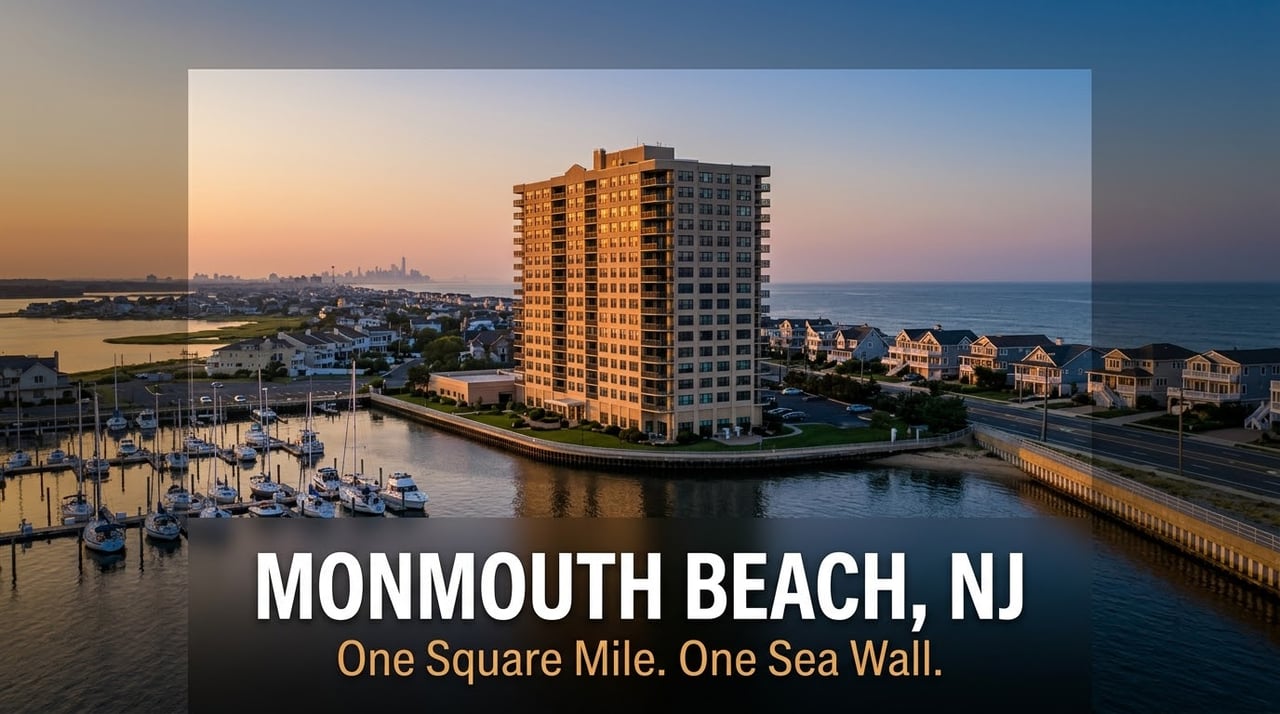
The Channel Club Tower at 1 Channel Drive is the tallest residential structure in Monmouth Beach and the borough's signature condominium product. Completed in the mid-1970s on a seven-acre site with frontage on the Shrewsbury River and walking-distance access to the Atlantic, the tower contains 222 units across 17 stories. Floor plans run from 992-square-foot one-bedroom layouts up to 1,606-square-foot two-bedroom units, with a small set of penthouse and combined units that exceed those footprints. Recent one-bedroom sales have cleared the $492K to $663K range, and the building's median sale price has run roughly $500,000 with price-per-square-foot near $500. Larger and renovated units trade meaningfully higher.
The Admiralty at the intersection of Beach Road and Ocean Avenue is the borough's other major oceanfront tower. At 14 stories and 162 units, it sits south of Channel Club Tower and offers 18 different layouts ranging from approximately 500-square-foot studios to 1,700-square-foot two- and three-bedroom units. The Shores, Wharfside Manor along the Shrewsbury River, and the Sands Point South community on Manhassett Creek round out the borough's structured condominium inventory.
The structural reality of the condo submarket: there is no new construction supply forming in Monmouth Beach. The borough's residential zoning, its small footprint, and the absence of any active redevelopment zone framework mean that the ~600 to 700 condominium units across these existing buildings represent essentially the entire long-term supply. That stands in sharp contrast to Long Branch's Pier Village corridor, where institutional capital is still actively building new oceanfront product. For Monmouth Beach buyers, the question is which existing building, which floor, which view, and which renovation status — not whether to wait for new product.
Monmouth Beach and Long Branch share a barrier-strip oceanfront, a coastal regulatory layer, and a buyer pool that overlaps significantly at the high end. They diverge sharply on almost everything else, and that divergence is what drives the buyer's decision between them.
Long Branch is the institutional-luxury, density-tolerant, walkable-amenity market. Pier Village's master-planned mixed-use ecosystem, the cluster of high-rise condominium towers along Ocean Avenue, the dining and retail density that comes with that scale, and the borough's aggressive deployment of designated Redevelopment Zones with PILOT tax abatements all combine to produce a buyer experience oriented around urban-style luxury at the shore. The buyer who wants to walk from a condo to a restaurant to a boardwalk to retail without using a car — that buyer belongs in Long Branch. The buyer underwriting on PILOT-driven carrying costs, ditto.
Monmouth Beach is the community-scale, residential-zoned, conventional-taxation alternative. There is no Pier Village. There is no PILOT framework. There is no new institutional condominium product forming. There is, instead, a tightly-held ~3,300-resident borough with a top-rated elementary school, a single feeder high school, three or four reliable restaurants centered on the Channel Club Marina, and a housing stock that turns over slowly because the residents who own here tend to stay. The buyer who wants the school district, the small-town governance, the family-anchored continuity, and the privacy that comes with all of those — that buyer belongs in Monmouth Beach.
The 2025 New Jersey Mansion Tax overhaul restructured the supplemental Realty Transfer Fee into five graduated tiers and shifted the obligation from buyer to seller as of July 10, 2025. Each tier rate applies to the entire sale price rather than to the portion above the threshold, which produces sharp cliff effects at $2.0M, $2.5M, $3.0M, and $3.5M sale prices. In Monmouth Beach, oceanfront single-family transactions cluster directly at and around these thresholds — meaning the cliff dynamic is not a theoretical concern but an active pricing-strategy variable on a meaningful share of the borough's annual transaction volume.
A worked example: an oceanfront listing closing at $1,990,000 incurs a 1% Mansion Tax of $19,900 on the seller. The same property closing at $2,010,000 jumps to the 2% tier and incurs $40,200 on the full price. That is a $20,300 swing in seller-paid tax for $20,000 of additional gross proceeds. The seller nets less by selling for more. Modeling net-proceeds outcomes at three or four price points is now standard practice on any Monmouth Beach listing within $50,000 of a tier threshold. The full mechanics of the cliff structure, including how it interacts with PILOT-bearing properties in adjacent markets, are detailed in our Long Branch 2026 regulatory guide and the closing-cost framework in our NJ closing costs guide for 2026.
Twenty years working New York and New Jersey markets gives you a calibrated read on which small markets reward patient buyers and which reward fast ones. My read on Monmouth Beach in 2026 is that it rewards the patient ones. The borough's average 35-day market time understates the actual cycle: waterfront and renovated inventory move quickly when properly priced, but anything mispriced — or mispositioned against the four-tier map — sits. The Rocket Homes data set for early 2025 showed half of Monmouth Beach sales taking more than 90 days to close, against just 25 percent moving within 30. That bimodal distribution is what a small market with high price-tier variance looks like.
The buyer profile that fits Monmouth Beach in 2026 is the multi-generational family that wants the school district and the borough governance, the NYC second-home buyer who wants the Seastreak Ferry option from Highlands without the Pier Village density, and the downsizer trading a single-family in Rumson or Holmdel for a Channel Club Tower or Admiralty unit with concierge service and ocean views. None of those buyers are well-served by treating Monmouth Beach as a smaller version of Long Branch. The borough's value comes precisely from being the thing Long Branch is not.
For sellers, the strategic question is which buyer profile the property maps to and how that profile reads the four-tier pricing structure. An oceanfront single-family listed without modeling the Mansion Tax cliff is a listing leaving net proceeds on the table. A Channel Club Tower one-bedroom positioned against Pier Village condo comparables rather than against in-building comparables is a listing under-marketed by definition. Tight markets reward precision, and Monmouth Beach is one of the tightest markets on the Jersey Shore. For broader regional context on the Monmouth County development pipeline driving demand into the corridor, see our Monmouth County development projects report.
Monmouth Beach suits buyers who want a small-borough governance structure, a top-rated K-8 elementary district feeding into Shore Regional High School, and a barrier-strip oceanfront location without the density of Long Branch. The trade-offs are limited inventory, conventional (non-PILOT) property tax exposure, and slower transaction velocity outside of properly-priced waterfront product. The borough's average 35-day market time hides a bimodal distribution where well-priced inventory moves quickly and mispriced inventory sits.
Monmouth Beach is a conventional-taxation municipality. The borough does not deploy the PILOT (Payment-in-Lieu-of-Taxes) abatement framework that governs most of Long Branch's Pier Village and oceanfront condominium corridor. As a result, two properties at the same purchase price — one in Pier Village under PILOT, one in Monmouth Beach under conventional taxation — can carry annual tax bills that differ by $12,000 or more. Buyers should model the carrying-cost differential as part of any cross-borough comparison.
The trailing 12-month median sale price ran $845,000 as of March 2026, up 7 percent year-over-year, with average sale price at $1,277,105 reflecting the wide transaction-mix variance in a small market. Active listing prices currently range from approximately $949,000 to $10,000,000. Single-month median figures swing significantly because of the small sample size; the rolling 12-month figure is the more reliable indicator.
Sandy's October 29, 2012 landfall damaged or destroyed a substantial share of Monmouth Beach housing stock, with hundreds of residents evacuated and utility outages running 10 to 45 days. Fourteen years out, the rebuild is substantially complete: most properties have been elevated, modernized, or reconstructed to current standards, and the post-Sandy seawall reconstruction added 3,188 feet of new wall in previously open gaps between 2017 and 2018. The arbitrage opportunity that defined the borough's 2014–2018 rebuild cycle has largely closed; what remains is a finite inventory of completed properties trading at maturity pricing.
Prodigy Real Estate is an innovative real estate company offering high-end video production, home valuation services, purchasing, and home sales. Serving New York and New Jersey.