
Anthony Licciardello | May 6, 2026
Long Branch, NJ
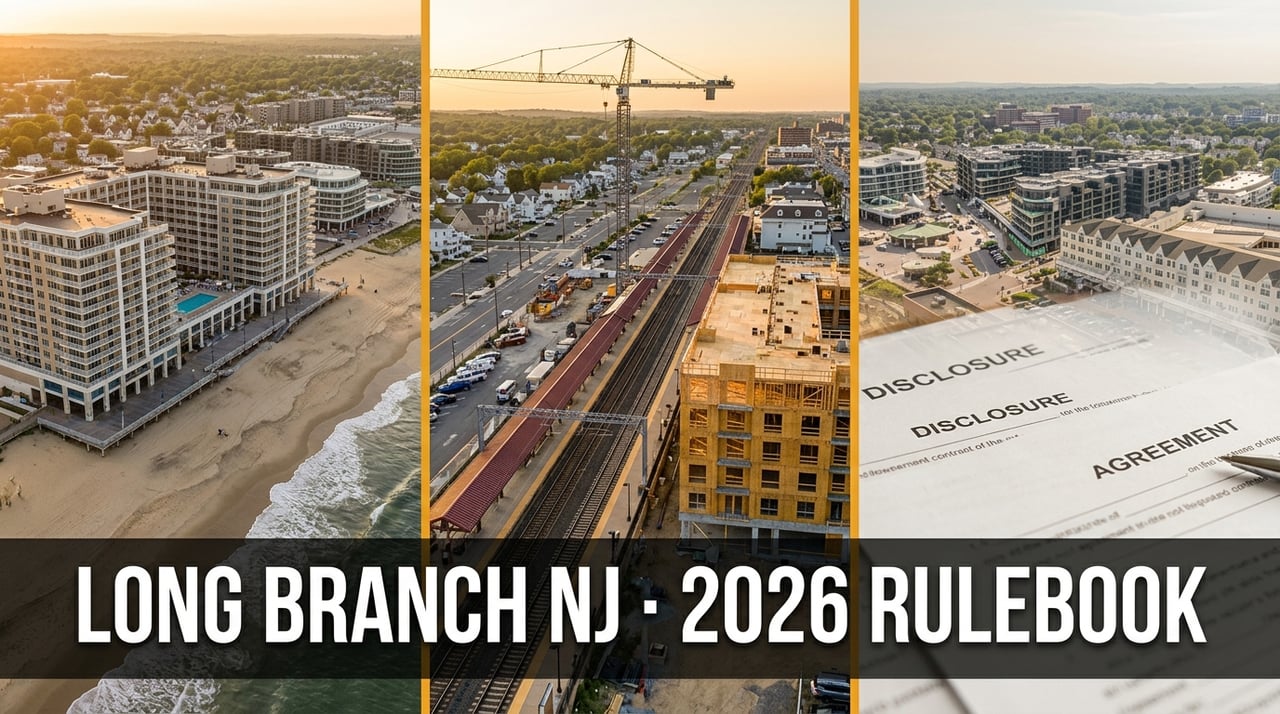
By Anthony Licciardello, NYS/NJ Licensed Broker · The Prodigy Team · April 24, 2026
Above the Streets: Long Branch — produced by The Prodigy Team
Long Branch NJ real estate is being transacted in 2026 under a regulatory framework that did not exist 24 months ago. Three statewide rule changes — the NJDEP REAL Rule effective January 20, 2026, the Mansion Tax overhaul effective July 10, 2025, and the Real Estate Consumer Protection Enhancement Act effective August 1, 2024 — have stacked on top of an older Flood Disclosure Law from March 20, 2024 to produce a buyer-and-seller environment fundamentally different from the one that produced the city's last appreciation cycle. Layered onto that regulatory shift, a 78-unit transit-oriented rental project broke ground in March 2026 near the NJ Transit station downtown, signaling the formal start of a TOD submarket that did not exist five years ago.
If you are buying, selling, or renovating in Long Branch right now, the cost of misunderstanding any one of these four shifts runs into five and six figures. A seller pricing a property at $2.01 million instead of $1.99 million in 2026 will pay roughly $40,000 more in Mansion Tax than a 2024 seller would have on the same transaction. A renovator filing for permits after July 20, 2026 will lose access to the legacy regulatory window the REAL Rule grandfathered in. A buyer who doesn't receive a written flood disclosure now has statutory remedies that did not exist before March 2024.
This is the broker-level guide to all of it. For broader statewide context on the regulatory layer, see our piece on three rules rewriting NJ Shore real estate. For the geographic submarket breakdown of Long Branch, the citywide market report covers neighborhood-by-neighborhood pricing. This pillar covers what changes between you, your contract, and your closing in 2026.
The Resilient Environments and Landscapes rule — the REAL Rule — was adopted by the New Jersey Department of Environmental Protection on January 20, 2026 after two public comment periods and significant industry pushback that pulled the elevation standard down from the original +5 foot proposal to the final +4 foot requirement above FEMA's 100-year base flood elevation. The rule simultaneously amends four separate regulatory frameworks: Coastal Zone Management, Flood Hazard, Freshwater Wetlands, and Stormwater. It also introduces a new mapped designation called Inundation Risk Zones.
For Long Branch specifically, the REAL Rule has three immediate practical effects. First, any new construction or substantial improvement project in the Pier Village corridor, along Ocean Avenue, or in the low-lying inland blocks west of Route 36 must now be designed to the +4 foot elevation standard, with cascading impacts on cost, design, and feasibility. Second, the legacy permitting window closes July 20, 2026 — 180 days from adoption — meaning any project whose application can be filed under the old framework before that date carries a meaningful regulatory and timeline advantage over projects filed afterward. Third, while NJDEP has not yet published a finalized Inundation Risk Zone map, Long Branch's geographic exposure to Atlantic flooding makes IRZ designation likely in some portion of the city, with downstream effects on insurance, mortgageability, and disclosure obligations.
Practical implication for buyers: ask whether the property you're under contract on has active permits filed before July 20, 2026 or whether any planned addition or substantial improvement will fall under the new framework. Practical implication for sellers: a property with grandfathered permits is now a more valuable asset than the same property without them. Practical implication for renovators and developers: the next 12 weeks of 2026 are a strategically important filing window.
The July 10, 2025 New Jersey Mansion Tax overhaul did two things at once. It restructured the supplemental Realty Transfer Fee from a flat 1% above $1 million into five graduated tiers running up to 3.5%, and it shifted the tax obligation from buyer to seller on residential transfers. Both changes took effect on the same day. Both changes hit Long Branch — a market where Pier Village condos routinely close above $2 million and oceanfront towers reach the highest tier — harder than they hit most NJ Shore towns.
| Sale Price Tier | Rate | Tax on Full Sale Price* |
|---|---|---|
| $1.0M – $2.0M | 1.0% | $10K – $20K |
| $2.0M – $2.5M | 2.0% | $40K – $50K |
| $2.5M – $3.0M | 2.5% | $62.5K – $75K |
| $3.0M – $3.5M | 3.0% | $90K – $105K |
| Above $3.5M | 3.5% | $122.5K+ |
*Each tier rate applies to the entire sale price, not just the portion above the threshold. This is the source of the cliff effect. Mansion Tax burden is seller-paid as of July 10, 2025.
The single most important detail in the entire restructuring is also the one most often misunderstood: each tier rate applies to the entire sale price, not just the portion above the threshold. A property selling at $1,990,000 incurs a 1% tax on the full price — $19,900. The same property selling at $2,010,000 jumps to the 2% tier and incurs a tax of $40,200 on the full price. That is a $20,300 swing in seller-paid tax for a $20,000 increase in gross sale price. The seller nets less by selling for more. This is the Mansion Tax cliff.
The cliff exists at all four tier transitions: $2.0M, $2.5M, $3.0M, and $3.5M. In a market like Long Branch where Pier Village pricing concentrates around $2M to $5.5M, the cliffs are operationally significant on a meaningful share of all transactions. Pricing strategy in 2026 means understanding where your property sits relative to the next cliff and whether a small price reduction generates a disproportionately large net-proceeds gain.
Combine the cliff dynamic with the seller-burden shift, and the implication is direct: 2026 sellers in Long Branch are absorbing a Mansion Tax obligation their 2024 counterparts didn't pay, calculated under a structure that creates dangerous round-number thresholds. For a closer breakdown of how this interacts with the rest of NJ closing-cost mechanics, see our NJ closing costs guide for 2026.
The Real Estate Consumer Protection Enhancement Act took effect August 1, 2024 and rewrote the agency relationship between brokers and consumers. Buyer's agent and seller's agent definitions were tightened, and written brokerage agreements became mandatory in residential transactions. For Long Branch transactions specifically, the effect is that every buyer now signs a brokerage agreement before substantive property tours, and every seller signs a listing agreement that conforms to the updated CPEA disclosures. This is procedural rather than financial — but procedural compliance failures are now real grounds for transaction disputes that didn't exist before August 2024.
The Flood Disclosure Law took effect earlier — March 20, 2024 — and is materially more impactful for Long Branch than for most NJ towns. Sellers are required to disclose, in writing, the property's flood history, current FEMA flood zone designation, and prior flood insurance claims. In a coastal city where elevation, flood zone classification, and prior flood events directly affect insurance cost and mortgageability, the written disclosure is not a formality. It's the document that determines whether the buyer's lender funds, what the buyer's flood insurance will cost, and whether the closing actually happens on the scheduled date.
In March 2026, a 78-unit rental development broke ground in downtown Long Branch within walking distance of the NJ Transit station. That groundbreaking matters less for the unit count than for what it represents: the formal start of a Transit-Oriented Development submarket that did not exist in any operational sense five years ago. Long Branch has never had a stabilized TOD rental cluster. It does now — or it will, by mid-2027 when the first phase delivers.
The strategic significance is that the TOD pipeline reroutes the city's growth vector. For two decades Long Branch's growth story has run east toward the Atlantic — Pier Village, Ocean Avenue infill, oceanfront luxury condo towers. The TOD district reverses that. Growth is now also forming inland, around the train station, with rental product targeting NYC commuters who want shore-adjacent housing without the oceanfront price point. The buyer profile is different. The product is different. The price band is different.
For investors, the TOD district is currently the highest-information-asymmetry submarket in Long Branch — most public market reports don't yet track it as a distinct geography. For owner-occupant buyers in the inland corridor west of Route 36, the TOD district is the variable that determines whether the next decade's appreciation runs slow and steady or accelerates sharply. Long Branch's broader development context, including the Monmouth County pipeline driving regional demand, is covered in our Monmouth County development projects report.
The structural reason Long Branch can produce both Pier Village's institutional luxury towers and a 78-unit TOD rental project simultaneously — while Sea Girt, Spring Lake, and Deal cannot — is the city's deployment of designated Redevelopment Zones. Redevelopment Zone designations under New Jersey's Local Redevelopment and Housing Law allow municipalities to establish height, density, and use parameters that exceed underlying zoning, with corresponding flexibility on financial incentives like PILOT agreements. Long Branch has used this framework aggressively since the early 2000s. The neighboring shore towns largely have not.
The practical implication for buyers and investors: Long Branch is the only coastal Monmouth County municipality producing new product type at scale in 2026. If you want to buy a brand-new oceanfront condo on the Jersey Shore, your options are concentrated in Long Branch. If you want to underwrite TOD rental product, again, Long Branch is the operational location. That zoning posture is itself a long-term value driver, because it creates a structural inventory advantage that constrains options elsewhere on the Shore.
Underneath the 2026 regulatory reset sits a tax structure that has been shaping Long Branch buying decisions for nearly two decades: the Payment-In-Lieu-of-Taxes agreement framework that governs most of the Pier Village and oceanfront corridor. PILOT structures replace conventional property taxation with an Annual Service Charge calculated against project revenue, dramatically reducing carrying costs during the abatement term. The mechanics are detailed in our Long Branch PILOT explainer.
The interaction effect that matters in 2026 is between PILOT structures and the new Mansion Tax tier system. A seller exiting a PILOT condo at Pier Village in the $2M to $5M range now absorbs a Mansion Tax obligation on the gross sale price under the 2025 overhaul, on top of any PILOT-specific transfer considerations baked into the original abatement agreement. For a side-by-side breakdown of how PILOT and conventional taxation interact at the property level, see our condos vs. single-family tax breakdown.
Twenty years working New York and New Jersey markets gives you a calibrated read on which regulatory shifts move pricing and which only move paperwork. My read on the 2026 Long Branch rulebook is this. The Mansion Tax tier cliffs are the single most consequential change for sellers in the $1.5M to $4M band — which is the heart of Pier Village, the high end of West End, and most of Elberon. Pricing within $50,000 of any tier threshold without modeling the cliff effect is a meaningful net-proceeds error. The right move on most deals near a threshold is either to price decisively above the next tier with enough premium to absorb the tax differential, or to price intentionally below it.
The REAL Rule's July 20, 2026 legacy window is the most consequential change for renovators and developers. Any planned addition, substantial improvement, or new construction project that can be filed before the deadline carries a regulatory and timeline advantage that does not exist after. Buyers under contract on a property they intend to expand should ask their broker and contractor whether the permit application can be advanced ahead of the deadline. Sellers with active pre-July 20 permits should highlight that asset in their listing materials.
The TOD district is the most consequential change for long-horizon investors. Buying inland corridor inventory in 2026 is partly a bet on whether the TOD pipeline executes — if it does, the inland corridor's $475K to $850K pricing band moves materially within 24 to 36 months. The CPEA and Flood Disclosure Law are the most consequential changes for transaction discipline. Both protect buyers more than sellers, and both create post-closing claim exposure for sellers who don't comply rigorously. None of these are theoretical. All four are live in every Long Branch transaction running through closing in 2026.
The legacy window expires July 20, 2026, which is 180 days after the rule's January 20, 2026 adoption. Permit applications filed under the prior framework before that date generally retain access to the older standards. Applications filed afterward must comply with the new +4 foot above FEMA base flood elevation requirement and the broader REAL Rule framework affecting Coastal Zone Management, Flood Hazard, Freshwater Wetlands, and Stormwater rules.
The four cliff thresholds are at $2.0M, $2.5M, $3.0M, and $3.5M. Each tier rate applies to the entire sale price, so a sale priced just above a threshold can produce significantly lower net proceeds than a sale priced just below it. The strategic move on most listings within $50,000 of a threshold is either to price intentionally below it, or to price decisively above with enough premium to absorb the tax differential. Modeling the net-proceeds outcome at three or four price points before final list-price discussion is standard 2026 practice.
The REAL Rule applies to new construction and to substantial improvement projects. A typical owner-occupant living in an existing Long Branch home with no planned addition or major renovation generally does not face direct REAL Rule compliance obligations. The rule becomes operationally relevant when permits are pulled for new construction, additions, elevations, or substantial improvements. Inundation Risk Zone designation, once finalized by NJDEP, may produce broader downstream effects on insurance and disclosure regardless of whether a project is permitted.
The TOD district is currently the highest-information-asymmetry submarket in Long Branch, which is exactly when local broker representation matters most. The 78-unit groundbreaking in March 2026 is the first signal of a stabilized TOD cluster forming, but the submarket will not be fully priced or comparable-driven until the first phases deliver in 2027. Buyers comfortable with that uncertainty are positioning early; buyers who need stabilized comparables should wait. Inland corridor properties west of Route 36 are the most directly affected by TOD execution risk and reward.
Prodigy Real Estate is an innovative real estate company offering high-end video production, home valuation services, purchasing, and home sales. Serving New York and New Jersey.