
Anthony Licciardello | May 21, 2026
Staten Island
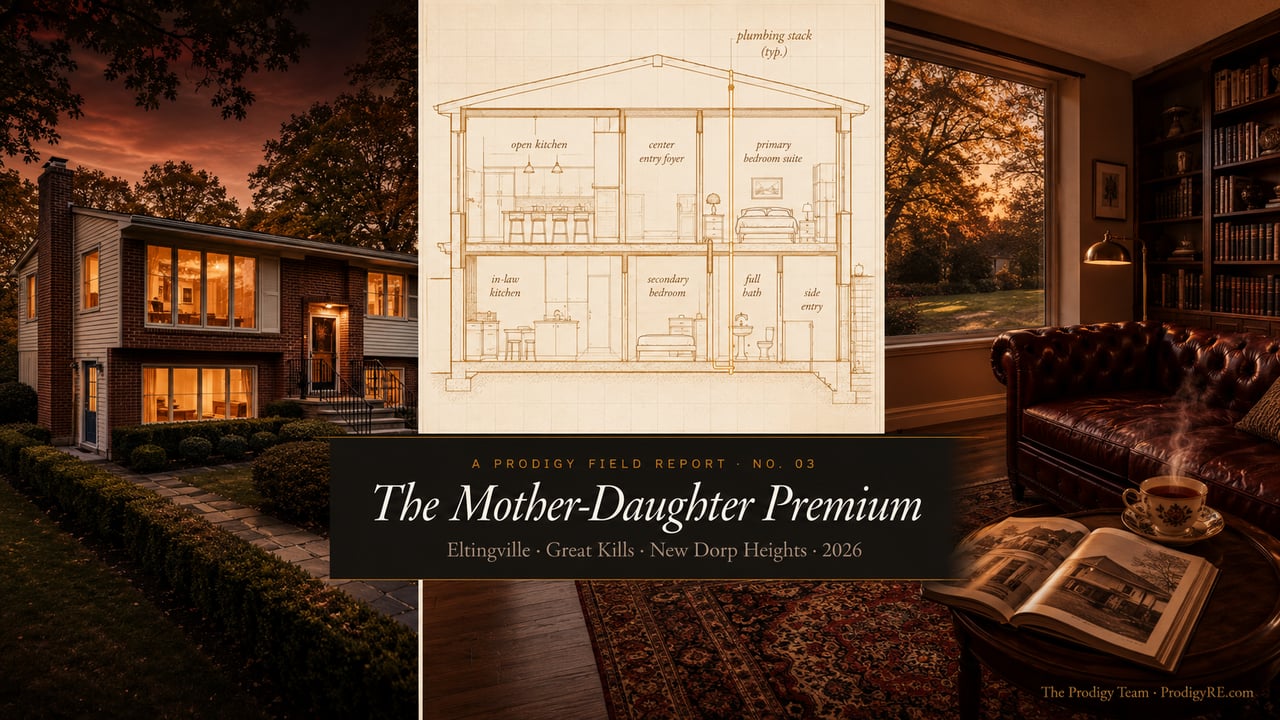
The Staten Island Basement Report · No. 03
How three Staten Island neighborhoods built the highest-margin housing typology in New York City — and why outsiders consistently misread it.
Plate I. 124 St Stephens Place, New Dorp Heights — a high ranch whose lower level demonstrates the multi-generational utility at the heart of the Staten Island premium.
The Argument in Brief
A mother-daughter on Staten Island is a single-family Certificate of Occupancy with an internal layout for multi-generational living — typically a high ranch with a finished lower level, separate entry, and second kitchen. It is not a two-family home, and the lower level cannot be legally rented to non-family.
Despite — or because of — that legal constraint, mother-daughter high ranches in Eltingville, Great Kills, and New Dorp Heights command a $50,000 to $100,000+ premium over comparable single-family ranches. It is the highest absolute basement-related premium anywhere on the island.
The premium is structural, not cyclical. Brooklyn and Queens relocators with aging parents, multi-generational immigrant families, and adult-child-at-home households have produced demand that has held through every market phase since 2020.
The high ranch is the most misunderstood housing type on Staten Island. To a buyer flying in from Manhattan or Long Island, it can look like a 1960s relic — a split-level with a low-slung profile and a finished basement that, on paper, doesn't count as living space. To a buyer flying in from Bay Ridge with elderly parents in Bensonhurst, it looks like exactly what the family has been looking for: a single roof that comfortably houses three generations with enough privacy for everyone.
That second buyer is the one writing the offers. And they are willing to pay materially more for a mother-daughter layout than they would for a comparable single-family ranch without it. In Eltingville, Great Kills, and New Dorp, that premium runs $50,000 to $100,000 or more on top of the standard finished-basement adjustment.
But the premium is built on a layout, not a legal status. Before we look at the comps, the terminology has to be exact — because the most expensive mistake we see Staten Island sellers make in 2026 is conflating mother-daughter with legal two-family. They are not the same product, they do not appraise the same way, and they do not serve the same buyer pool.
Chapter
The Terminology That Matters
An architectural condition. A functional condition. Not a legal classification.
In New York City, the term mother-daughter describes a specific architectural and functional condition — not a legal classification. The home carries a single-family Certificate of Occupancy. The layout supports multi-generational living: typically a primary residence on the main level and a finished lower level with its own entrance, a second kitchen (sometimes called an in-law kitchen or summer kitchen), a bedroom, and a full bath.
The lower level functions as a separate living area for an extended family member — a parent, an adult child, a sibling. What it cannot legally do is operate as a rental unit to a non-family tenant. That distinction is critical, because it is the dividing line between a mother-daughter and an entirely different product class.
The Mother-Daughter
Single-family C of O
One legal dwelling unit. Internal multi-gen layout. Cannot be rented to non-family without changing the C of O. Premium driven by layout utility, not legal status.
The Legal Two-Family
Multi-family C of O
Two separate legal dwelling units. Can be legally rented to non-family. Different mortgage product. Different tax implications. A different — typically higher — sale price band entirely.
Conflating the two is the single most common error in Staten Island listing copy. We have audited dozens of MLS descriptions in 2025–2026 where a mother-daughter is incorrectly marketed as a "legal mother-daughter" or "legal two-family potential." Those listings consistently underperform — either by attracting investor buyers whose financing falls through when the C of O comes back single-family, or by setting an expectation the appraisal cannot validate.
The right framing — and the framing that captures the highest premium — is to market the home accurately: a single-family home with a finished lower level designed for multi-generational living. That language attracts the buyer pool that is actually willing to pay the premium, while protecting the seller from the deal-killing surprise of a C of O mismatch at the closing table.
Chapter
The Architecture
A mid-century solution to a multi-generational problem.
The high ranch — sometimes called a raised ranch or bi-level — was built across mid-century Staten Island specifically because the architecture solves a practical problem: how do you give two living areas reasonable privacy under one roof without building a true two-story house? The answer is to elevate the main level half a story above grade and place a fully-windowed lower level half a story below grade, with a shared entry foyer between them.
That single architectural choice produces five layout features mother-daughter buyers value highly:
Separate-but-shared entry
Family members come and go through one front door, but immediately split to "upstairs" or "downstairs" living areas. Privacy without isolation.
Full-size windows on the lower level
Because the lower level is only half-below-grade, the windows sit at or near full height. The space lives like a primary floor, not a basement.
Plumbing stack proximity
The high ranch architecture stacks upstairs and downstairs bathrooms and kitchens, which keeps the cost of a second downstairs kitchen and bath reasonable.
Yard access from both levels
Most Staten Island high ranches have lower-level walkout access to the rear yard, giving the secondary living area its own outdoor flow.
Single-roof tax efficiency
One C of O. One property tax bill. One mortgage. One roof to maintain. The financial overhead of housing three generations is materially lower than two separate properties.
These features are why Staten Island's high ranches have aged better in market terms than most mid-century housing stock anywhere in the metropolitan area. A 1965 split-level in New Jersey may sell at a discount because the floor plan reads "dated." A 1965 high ranch in Eltingville sells at a premium because the floor plan reads "multi-generational." Same age. Same era. Wildly different value trajectories.
Chapter
The Buyer Pool
Three buyer segments. One layout. Structural — not cyclical — demand.
The mother-daughter premium is built on a specific, identifiable, and remarkably consistent buyer pool. Understanding who is paying it explains why the premium has held through every Staten Island market phase since 2020 — including the 2022–2023 rate-shock period when most other premium product underperformed.
Segment One
Brooklyn and Queens relocators with aging parents
The largest single buyer segment. A family in Bay Ridge or Forest Hills, parents in their 70s, decides the two-household arrangement isn't sustainable. They sell both homes, consolidate into a Staten Island high ranch, and use the equity arbitrage to fund the move. The parents get the lower level. The kids get the main level. The grandkids get the yard. Two outer-borough homes typically equal one nicer Staten Island home with cash left over.
Segment Two
Multi-generational immigrant families
The second-largest segment, and arguably the most consistent. Many of Staten Island's South Shore neighborhoods have established multi-generational housing cultural patterns — Italian-American, Eastern European, Russian, Albanian, Filipino, and South Asian buyer pools all show strong preference for under-one-roof multi-generational housing. The high ranch with mother-daughter layout serves this preference better than any other product on the island.
Segment Three
Adult-child-at-home households
The fastest-growing segment, driven by national demographics. NYC-area young adults living at home into their late 20s and early 30s — combined with parents who want their adult children housed nearby but with meaningful privacy — has produced a third buyer category specifically seeking the mother-daughter layout. Same product, different generation deployed in the lower level.
“
On a standard Staten Island listing, we field a dozen showing requests in the first week. On a properly marketed mother-daughter high ranch, we field forty — and at least ten of them are families coming in from Brooklyn with their parents in the car.
Anthony Licciardello · Broker-Owner · The Prodigy Team
Chapter
The Comps
Where the premium lives, measured in closed dollars.
The premium is best understood through specific sold comparables. The three neighborhoods below — Eltingville, Great Kills, and New Dorp — are the dominant Staten Island markets for mother-daughter high ranch product. Each shows the same pattern: comparable single-family ranches trade in one band, and the same architecture with a mother-daughter layout trades in a meaningfully higher band.
| Neighborhood | Standard SF Ranch | Mother-Daughter HR | Implied Premium |
|---|---|---|---|
|
Eltingville 10312 |
$720K – $780K | $830K – $900K | $80K – $130K |
|
Great Kills 10308 |
$730K – $810K | $835K – $960K | $80K – $150K |
|
New Dorp / Mid-Island 10306 |
$680K – $760K | $780K – $880K | $70K – $120K |
Source: SIBOR closed sales 2025–Q1 2026; The Prodigy Team market adjustments file. Bands reflect typical condition properties; turnkey renovated and original-condition properties sit at the high and low ends, respectively.
998 Arthur Kill Road — an all-brick mother-daughter high ranch — sold for $960,000 in February 2026. The home's premium over comparable non-mother-daughter ranches in the same Mid-Island zip code ran roughly $130,000 to $150,000. The buyer was a Brooklyn family with parents relocating from Bensonhurst. The lower level — with separate side entrance, full kitchen, and primary bedroom suite — sold the home before the upstairs photos had loaded.
Cortelyou Avenue, Eltingville — a semi-detached high ranch with a fully finished lower level marketed for mother-daughter use — sold for $850,000. The same architectural envelope without the mother-daughter layout would have traded in the $720,000–$770,000 band. The premium captured by the multi-gen layout was approximately $80,000 to $130,000.
Abingdon Avenue and Fieldway Avenue, Great Kills — modernized high ranches with full mother-daughter layouts — routinely closed above $835,000 in 2025–2026. The Great Kills band is structurally tighter than Eltingville because Great Kills draws an even higher concentration of Brooklyn relocators specifically searching for mother-daughter product. Several properties in this corridor reported multiple offers within the first 14 days of listing.
Chapter
Listing Strategy
Four marketing decisions that show up in every above-asking close.
Capturing the full premium requires the listing strategy to specifically address the buyer pool that pays it. We've refined the approach across dozens of mother-daughter listings in 2025–2026, and the same four marketing decisions show up in every above-asking close.
01
Accurate single-family C of O framing.
The listing copy says "single-family home with mother-daughter layout" — never "legal mother-daughter," never "two-family potential." Honest framing attracts the right buyer pool and protects the deal from C of O surprises at appraisal.
02
Lower-level photography that reads as a primary living area.
Standard listing photography treats the basement as an afterthought — three quick shots, often poorly lit. Mother-daughter listings reverse this. The lower-level kitchen, bedroom, and living area get the same photographic budget as the upstairs primary suite. Cinematic 4K video — the kind The Prodigy Team's in-house production team produces for every listing — communicates the multi-gen utility to the relocator buyer pool before they ever schedule a showing.
03
Distribution to the right buyer pool.
The single most underutilized marketing channel for Staten Island mother-daughter product in 2026 is the Brooklyn/Queens/Manhattan relocator community. Our 25,000-member NY/NJ/FL Facebook relocation community plus targeted distribution to multi-generational housing search platforms reaches buyers who, by definition, don't yet know about the property because they aren't browsing Staten Island MLS feeds daily.
04
Pricing strategy aligned to the right comps.
The most expensive listing mistake on Staten Island mother-daughter product is pricing against the standard ranch comp set. The right comp set is the local mother-daughter band — typically $80K–$150K above the standard ranch median. Listing at the standard ranch number triggers a multiple-offer escalation, but each over-asking dollar passes through the lender appraisal where the underlying comps determine the final supportable price. Listing at the right comp band from the start captures the full premium directly.
A Private Consultation
The families paying the mother-daughter premium are coming from Brooklyn, Queens, and Manhattan. They aren't searching Staten Island listings on their own. The right listing strategy puts the property in front of them.
Anthony Licciardello · The Prodigy Team · Conversations are confidential.
Appendix
Reader Questions
The questions Staten Island sellers ask most.
Question One
Is a mother-daughter the same as a legal two-family in NYC?
No. A mother-daughter home is a single-family Certificate of Occupancy with an internal layout designed for multi-generational living — typically a high ranch with a finished lower level, separate entry, second kitchen, and in-law bedroom. A legal two-family has a different C of O class entirely (multi-family) and operates as two legal dwelling units. The two products serve different buyer pools, carry different mortgage products, and trade in different price bands. Marketing a mother-daughter as a "legal two-family" is one of the most common — and most expensive — errors in Staten Island listing copy.
Question Two
Can I rent the lower level to a tenant?
Not legally — not to a non-family tenant. A mother-daughter carries a single-family C of O, which means the home is legally classified as one dwelling unit. The lower level can house extended family members, but renting it to a non-family tenant turns the home into an illegal two-family. Owners who want to legally rent the second living area must apply to the NYC Department of Buildings for a new Certificate of Occupancy reclassifying the home as a legal two-family — a separate, more involved process that changes the home's product class. Always consult an attorney before assuming any rental arrangement is permitted.
Question Three
How much more does a mother-daughter high ranch sell for?
In Eltingville, Great Kills, and New Dorp Heights — the dominant Staten Island markets for this product — the mother-daughter layout commands a $50,000 to $100,000+ premium over a comparable single-family ranch without the multi-gen layout. Eltingville and Great Kills bands run $80K–$150K. Mid-Island runs $70K–$120K. The premium has held through every market phase since 2020 because the underlying buyer demand is structural — driven by Brooklyn/Queens relocators with aging parents, multi-generational immigrant families, and adult-child-at-home households — rather than cyclical.
Question Four
Which neighborhoods show the strongest demand?
Eltingville (10312), Great Kills (10308), and New Dorp / Mid-Island (10306) are the dominant markets. All three have heavy concentrations of high ranch and raised ranch architecture from the 1960s–1980s build cycle, established multi-generational housing cultural patterns, and strong commuter access to Brooklyn and Manhattan. Annadale and Dongan Hills also show meaningful mother-daughter demand at slightly different price bands. North Shore neighborhoods carry lower absolute premiums due to lower median prices, but the percentage lift over standard ranches is comparable.
Question Five
Should I convert my home before selling?
It depends. The conversion math typically only works when the existing architecture already supports the layout — primarily on high ranches, raised ranches, and bi-level homes with full-height lower levels, separate or potential side entry, and plumbing stack proximity for a second kitchen. The conversion budget on a workable candidate runs $60,000–$110,000 (full bath, second kitchen, finished living area, separate entry where needed, permits, Letter of Completion). Against the $50,000–$100,000+ premium captured at resale, the recoup ratio is typically 70–95% on a candidate property. Converting a colonial or split-level into a mother-daughter rarely pencils. A pre-listing audit identifies whether your home is a workable candidate or whether the budget is better deployed elsewhere.
Sources & Methodology
SIBOR closed sales 2025–Q1 2026; The Prodigy Team market adjustments file; NYC Department of Buildings Certificate of Occupancy classifications; ANSI Z765-2021 regulatory framework per Fannie Mae Single Family Standardized Property Measuring Guidelines (effective April 1, 2022). Neighborhood price bands reflect typical-condition single-family ranches versus mother-daughter high ranches in matched zip codes; turnkey renovated and original-condition properties sit at the high and low ends of each band, respectively. Individual home results vary based on neighborhood, structural condition, finish quality, and market timing. Nothing in this article constitutes legal advice; consult a New York City real estate attorney for any specific question about Certificate of Occupancy classification or permitted use.
Prodigy Real Estate is an innovative real estate company offering high-end video production, home valuation services, purchasing, and home sales. Serving New York and New Jersey.