
An average bill of $10,674 — nearly exactly the Monmouth County average. A school district that just averted closing three schools by accepting a 10.1 percent levy increase. A 67,000-resident township where the 2026 tax bill is being shaped right now by decisions made in budget hearings last April.
Middletown is the largest municipality in Monmouth County by both population and geographic area — 67,106 residents per the 2020 Census, spread across 41.4 square miles encompassing distinct neighborhoods from the Lincroft horse-country interior to the Belford ferry hub on Sandy Hook Bay. That scale is the first thing every Middletown tax conversation has to account for. The 2024 average residential tax bill of $10,674, certified by the New Jersey Department of Community Affairs, sits within one half of one percent of the Monmouth County average bill of $10,930. For a township of this size, with this many distinct submarkets, that average masks substantial variation by neighborhood — and the 2026 tax bill landing in your mailbox will reflect a series of specific decisions made over the past twelve months that materially reshaped the math.
The dominant 2026 story is the school tax levy. In April 2025, the Middletown Township Board of Education voted 7-2 to adopt a 10.1 percent school tax levy increase for the 2025–26 school year — the largest single-year levy increase the district has ever certified. That decision averted the closure of three schools (Leonardo Elementary, Navesink Elementary, and Bayshore Middle School) and shapes the school portion of every Middletown tax bill issued in 2025 and 2026. This post walks through how that math affects you, how the township-side reassessment math interacts with it, and what every Middletown homeowner should be watching for the rest of 2026.
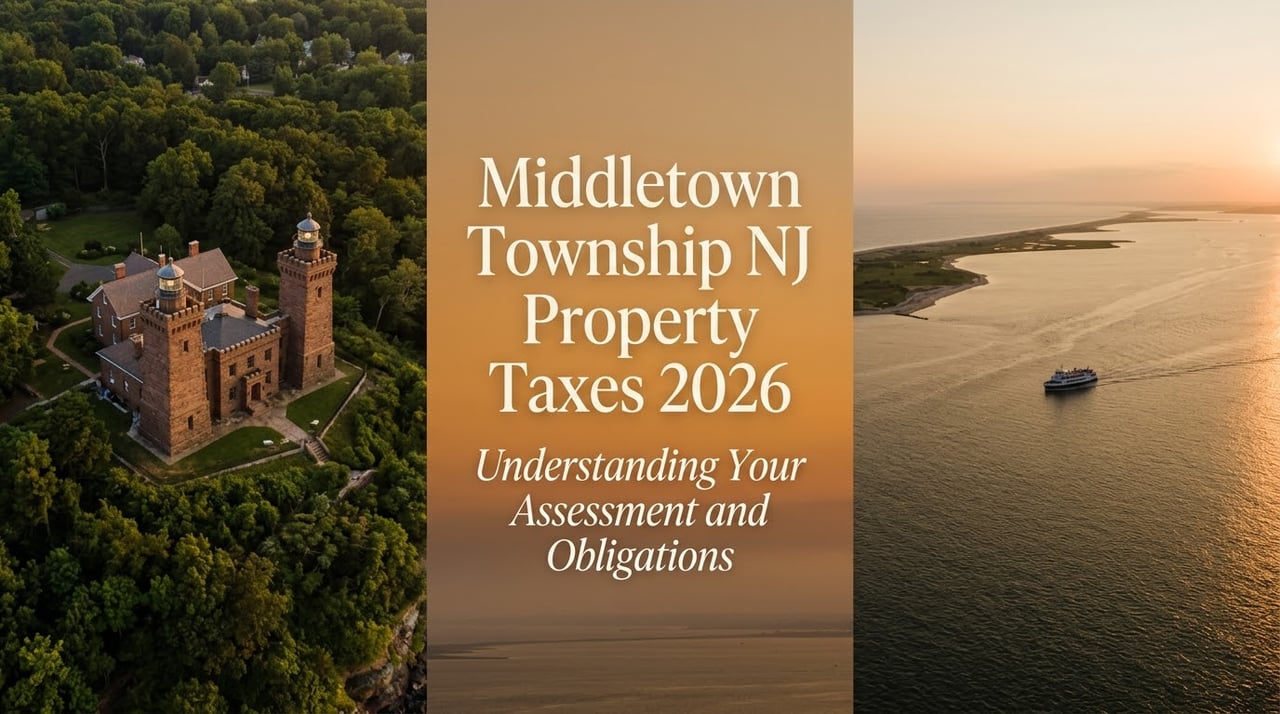
A drone tour of Middletown’s neighborhoods — Port Monmouth and Belford on the Bayshore, Lincroft in the inland core, the Navesink Highlands hilltop estates, and the Kings Highway historic corridor. Visual context for the tax math that follows.
The Township’s own assessment communication confirms that the aggregate preliminary net value for tax year 2026 is 7.94% higher than 2025. The Mayor’s office and Township assessor expect the 2026 township tax rate to decrease versus 2025 as a result — but only homeowners whose individual assessment increased by less than 7.94% will see a smaller proportionate share of the levy. Owners whose assessment increased more than the township baseline will pay more in absolute dollars even with a lower rate. This is the entire mechanical reason annual reassessment exists.
The Middletown Tax Snapshot
The numbers below come from the New Jersey Treasury 2025 General Tax Rates table, the NJ Division of Taxation 2026 Chapter 123 Table, and the New Jersey Department of Community Affairs MOD-IV Average Residential Tax Report for tax year 2024. They are the certified figures — not estimates, not modeled projections, and not Zillow numbers.
| Middletown 2025 Tax Snapshot | Value | Where It Ranks |
|---|---|---|
| General Tax Rate | $1.614 per $100 | 23rd of 53 Monmouth municipalities |
| Effective Tax Rate | 1.735% | 26th of 53 (middle of the county) |
| 2024 Average Residential Bill | $10,674 | 2.3% below county average ($10,930) |
| 2026 Director’s Ratio | 98.35% | Annual reassessment under ADP |
| Aggregate Value Change 2025 → 2026 | +7.94% | Township assessor preliminary |
| Population (2020 Census) | 67,106 | Largest in Monmouth County |
Middletown’s average bill landing essentially on the county average is the right frame for the value proposition. You are paying close to the median Monmouth bill while accessing the largest school district in the county, multi-modal NYC commute infrastructure (rail, ferry, drive), and substantial inventory diversity from $500K starter homes in River Plaza to $4M+ Navesink River waterfront. The $10,674 average bill is the ticket price for that optionality.

“The Middletown buyer pool is the broadest in Monmouth. I’ve closed deals here with first-time buyers under $600K and luxury buyers north of $4M in the same six-month window. The single number that doesn’t tell you anything useful in Middletown is the average. The neighborhood you’re buying in is what matters — and that’s where the tax math gets interesting.”
How Your Middletown Tax Bill Is Built
A Middletown property tax bill combines five distinct levies. Each is set independently by a different governing body, and each shows up as a separate line on your annual bill issued by the Township:
Township Municipal Levy. Funds Middletown government operations — police (the largest municipal police force in Monmouth County, with 112 sworn officers), fire and EMS, public works, recreation, planning, and administration. Set by the Township Committee under Mayor Tony Perry through the annual municipal budget process.
Middletown Township Public Schools (K–12) Levy. Funds the comprehensive K–12 district, which operates 18 schools across the township. Unlike Rumson and a number of other Monmouth municipalities that operate K–8 districts feeding regional high schools, Middletown is a single-district K–12 jurisdiction — meaning the entire education levy from elementary through senior year sits on the Middletown tax base.
Monmouth County Levy. Apportioned to Middletown by the Monmouth County Board of Taxation based on the township’s share of total equalized property value across all 53 county municipalities.
Library Levy. Funds the Middletown Township Public Library system. Set at a statutory minimum tied to township equalized value.
Open Space Tax. A dedicated levy funding open-space preservation, recreation property acquisition, and farmland preservation across Middletown’s 800-plus acres of parks and green space.
The Waterfront Area of Naval Weapons Station Earle, located in the Leonardo section of Middletown, is federal property and therefore exempt from local property taxation. The base’s 2.9-mile pier complex sits on what would otherwise be premium Sandy Hook Bay waterfront. That exempt acreage is not in the ratable base, which means Middletown residents collectively absorb the cost of services to the surrounding area without the corresponding tax revenue from that land. This is a structural feature of Middletown’s tax math worth understanding.
The 10.1% School Tax Levy: The Story That Defines Your 2026 Bill
On April 30, 2025, the Middletown Township Board of Education voted 7-2 to adopt a 10.1 percent school tax levy increase for the 2025–26 school year. The district’s total school tax levy rose from $160,435,093 to $176,634,681 — a $16.2 million increase that flows directly to the school component of every Middletown property tax bill.
The mechanics behind that decision are worth understanding. The district faced a $9.8 million budget gap heading into 2025–26 driven by state aid losses under Senate Bill S2 (the seven-year state aid reallocation that ended with the 2024–25 budget year) plus mandatory contractual increases. Mayor Tony Perry had proposed an alternative 5.88 percent levy increase — combined with the sale of a 10-acre district-owned parcel off Sleepy Hollow Road for $1.9 million and shared municipal funding of armed Class-3 officers in schools. The proposal would have closed three buildings — Leonardo Elementary, Navesink Elementary, and Bayshore Middle School — and accepted some administrative layoffs.
The Board majority rejected that proposal. Board member Joe Fitzgerald introduced the alternative 10.1 percent levy proposal during the April 7, 2025 meeting, framing it as protecting all schools and securing the district’s funding base “for decades to come.” The final 7-2 vote on April 30 adopted the higher levy. All three schools remained open.
| 2025–26 School Levy Decision Tree | Mayor Perry Proposal | Adopted Plan |
|---|---|---|
| Levy Increase | 5.88% | 10.1% |
| Schools Closed | 3 (Leonardo, Navesink, Bayshore Middle) | 0 |
| Sleepy Hollow Parcel Sale | $1.9M one-time revenue | Retained |
| Class-3 Officer Funding | Shared with Township | District-funded |
| Tax Impact on Average Bill | Lower increase | Larger increase |
The practical takeaway: every Middletown homeowner receiving a 2025 or 2026 tax bill is paying the school component of that 10.1 percent levy increase. For an average homeowner whose total bill is $10,674, the school component dominates — school taxes are typically the largest single line item on a New Jersey property tax bill, often running 50 percent or more of the total. A 10.1 percent increase on that component, all else equal, produces a meaningful absolute-dollar increase even when the township municipal rate goes down due to the 7.94 percent aggregate assessment growth.
“Every Middletown buyer in late 2025 and 2026 should be asked one question before signing: have you modeled your monthly carrying cost against the post-levy school tax, not the seller’s prior-year bill? Sellers who are listing today are showing buyers their 2024 tax bills. The 2025 and 2026 bills are materially higher because of the school decision. Budget accordingly.”
Annual Reassessment and the 7.94% Aggregate Value Story
Middletown is one of 46 of 53 Monmouth County municipalities participating in the Assessment Demonstration Program (ADP). Annual reassessment notices for tax year 2026 were mailed on November 18, 2025. The Township is under contract with Realty Data Systems (RDS) to inspect a designated portion of all properties each year, the data flowing into the annual reassessment cycle.
Per the Township assessor’s 2026 communication: the aggregate preliminary net value of Middletown for tax year 2026 is 7.94 percent higher than it was in 2025. Mayor Perry confirmed at the February 18, 2025 Township Committee meeting that the average assessed value in Middletown rose 11.4 percent in 2025 alone. Over the five years from 2019 to 2024, Middletown CFO Colleen Lapp reported that the average assessed value of a Middletown home rose 47 percent.
The mechanical implication: with valuation growing 7.94 percent at the aggregate township level, the township tax rate is expected to drop in 2026 even with municipal spending growth. Only homeowners whose individual assessment rose more than the 7.94 percent baseline will see their proportionate share of the municipal levy increase. Those whose assessment rose less than the baseline see their proportionate share decrease — even if the absolute number is higher than last year. This is exactly the granular, neighborhood-by-neighborhood redistribution that the ADP annual reassessment system is designed to produce.
Most Middletown homeowners look at the 7.94% aggregate increase and the 10.1% school levy and conclude their tax bill is going up by something in that range. The actual math is more complicated. The municipal rate will likely drop. The school levy increase applies on a rate basis to your new assessment. The county and library levies move on their own. Your final 2026 bill depends on where your specific neighborhood’s reassessment lands relative to the township baseline. Pull your November 2025 reassessment postcard and compare against the 7.94% benchmark before drawing any conclusions about your individual bill.
Neighborhood Variation: Why the Township Average Is Almost Useless
Middletown spans 41.4 square miles and contains roughly a dozen distinct neighborhoods, each with its own price ceiling, property type mix, and reassessment trajectory. The township average bill of $10,674 reflects an arithmetic mean across all of them — which means it accurately describes essentially no one’s actual bill. A more useful framework groups the neighborhoods by character:
The Premium Inland Core. Lincroft, parts of Navesink, and the Middletown Village Historic District contain the bulk of Middletown’s higher-priced inventory — older estates, custom homes, and a mix of architecture from the colonial period forward. Bills here run materially above the township average, often crossing into the $14,000–$20,000 range for larger homes. The Middletown Village Historic District is an 80-acre historic area listed on the National Register since May 1974.
The Waterfront Corridor. The Navesink River frontage on the township’s western boundary contains some of Monmouth County’s most valuable single-family inventory. Tax bills on Navesink waterfront properties routinely exceed $25,000 and approach $40,000+ for the largest estates.
The Bayshore Communities. Belford (the NY Waterway ferry hub), Port Monmouth, Leonardo, and New Monmouth on Sandy Hook Bay run lower price points, with bills generally in the $7,000–$11,000 range. Belford specifically benefits from the direct ferry service to Manhattan’s West Midtown Ferry Terminal (roughly 50 minutes).
The Inland Working Submarkets. River Plaza, parts of New Monmouth, and the township’s commercial corridors along Route 35 contain Middletown’s most accessible price-point inventory — including condominiums and townhouses where attached residence ownership is the entry point to township residency.
Condos, Townhouses, and Multi-Family in Middletown
Middletown’s housing stock is predominantly detached single-family, but the township has more condo and townhouse inventory than the smaller Two River boroughs like Rumson, Fair Haven, or Little Silver. Three points every buyer of an attached residence in Middletown should understand:
Each condo unit is taxed individually. Whether you’re buying in a Route 35 corridor townhouse community, a Lincroft-adjacent condo development, or a Bayshore-area attached residence, each unit carries its own assessed value and its own tax bill against the township’s general rate of $1.614 per $100. HOA fees are entirely separate from the tax bill — they fund common-area maintenance and reserves controlled by your association, not municipal services.
Townhouses follow the same model in most cases. The vast majority of Middletown townhouses are condominium-form ownership where the unit is taxed individually. A small number of fee-simple townhouse developments (each unit on a deeded lot) are taxed identically to detached single-family homes on similar lot sizes.
Middletown has no PILOT or tax abatement structures in effect. Unlike Long Branch, where Pier Village condos pay dramatically reduced effective tax rates under a Payment in Lieu of Taxes agreement, Middletown has not designated any active redevelopment zones under N.J.S.A. 40A:20. Every residential property in the township pays the standard general tax rate. For a deep dive on how PILOTs reshape effective rates in a neighboring Monmouth municipality, see how Long Branch PILOT agreements work and the case for and against them.
The January 15 / April 1 Appeal Deadlines
Middletown uses Monmouth County’s alternative appeal calendar under the ADP. For why Monmouth runs differently from the rest of New Jersey, see our complete explainer on the ADP framework, the January 15 deadline, and the seven non-ADP towns. The Township assessor confirms two distinct deadlines on the official Middletown.gov tax assessment page:
January 15 — for properties assessed under $1 million in true value. Appeals are filed with the Monmouth County Board of Taxation. Assessment notices arrive in November of the pre-tax year (November 18, 2025 for the 2026 tax year), giving owners approximately eight weeks to evaluate the new assessment and file.
April 1 — for properties assessed over $1 million in true value. These owners have the option to file directly with the New Jersey Tax Court rather than the county board. The Tax Court process involves different evidentiary standards, different procedural rules, and different fee structures, but offers strategic advantages for higher-value properties.
Per the Township assessor’s own language: “After these dates, no changes can be made to your assessment or taxes for the current year. Any changes discussed with the Assessor’s Office after May 15, 2026, will apply to tax year 2027.” This is a hard cutoff — not a soft guideline.
For Middletown homes carrying tax bills above $18,000 — which is meaningful inventory in Lincroft, Navesink, and the Middletown Village Historic District — the premium-market appeal playbook walks through direct Tax Court filing, contingency-fee attorney economics, the appraiser ROI threshold, and the Freeze Act. Despite being framed around Union and Essex County peer towns, the mechanics apply directly to high-end Middletown properties. For appeal mechanics at the county-board level, see the full NJ appeal playbook.
The Realty Transfer Fee and Closing-Table Math for Middletown Sales
For Middletown sellers above $1 million — which covers a substantial share of inventory in Lincroft, Navesink, and the waterfront corridor — the New Jersey Realty Transfer Fee changes adopted under the FY2026 Appropriations Act on July 10, 2025 are now in effect. The historical 1% Mansion Tax was replaced with a graduated rate that applies to the entire sale price, not just the portion above each threshold. A $2.5 million Middletown sale now lands in a higher tier than it would have pre-2025, with material additional closing-table cost.
For sellers, that affects net proceeds modeling. For buyers, it affects offer strategy — sellers may reprice expectations to offset the change. The full breakdown of the 2025–2026 Realty Transfer Fee structure walks through the new graduated tiers and the pricing-cliff effects near each threshold boundary.
For the complete closing-process walkthrough — attorney review, municipal compliance certifications, tax prorations, and lender escrow setup — see the 2026 NJ real estate closing process timeline.
Tax Relief Programs Available to Middletown Homeowners
Middletown administers the standard New Jersey property tax relief framework:
$250 Senior Citizen / Disabled Persons Deduction. Income and residency requirements set under state statute. Applied directly to the annual tax bill.
$250 Veteran Deduction. Qualifying veterans of specified service periods. Surviving spouses may also qualify.
100% Disabled Veteran Property Tax Exemption. Full exemption on the primary residence for honorably discharged veterans with 100% service-connected permanent disability. Among the most valuable single relief programs in New Jersey.
Active Military Service Property Tax Deferment. Defers payment for active-duty service members during deployment.
At the state level, three programs apply for FY2026: ANCHOR, Senior Freeze, and Stay NJ. The Stay NJ program reimburses 50 percent of property taxes for eligible homeowners aged 65+, capped at $13,000 with a 2024 cap of $6,500. Eligibility requires owner-occupied residency for all of 2024 and income under $500,000. Benefits are calculated after ANCHOR and Senior Freeze with payments expected in early 2026. All three programs are now administered through a single combined PAS-1 application.
The 2026 Budget Watch: What to Track Through Year-End
Three items worth monitoring on the 2026 Middletown budget cycle:
Builder’s remedy litigation. Middletown has dedicated municipal budget appropriations to legal defense against high-density housing requirements driven by Mt. Laurel Fourth Round affordable housing obligations. The outcome of these cases will shape Middletown’s residential development trajectory — and over a multi-year horizon, will affect the ratable composition of the township’s tax base.
NJDEP-mandated environmental compliance. A 2023 NJDEP ruling required Middletown to adopt a tree removal and replacement ordinance, plus stormwater runoff and composting-site pollutant testing. Township CFO Lapp identified $225,000 in testing costs alone in the 2024 budget cycle. These mandatory expenses continue to flow through to the municipal levy.
School district 2026–27 budget. With state aid stabilization protections now in place (capping cuts at 3% and increases at 6%), the 2026–27 district budget should see less pressure than the prior cycle — but the underlying mandatory cost growth in salaries, benefits, and special education has not gone away. The district will adopt its 2026–27 budget in the spring 2026 cycle.
For broader context on what new construction looks like across Monmouth County in 2026 — including the developments most likely to reshape municipal ratable bases over the next three to five years — see our 2026 Monmouth County new construction inventory.
“The biggest mistake I see Middletown buyers make is using a township-wide average to evaluate the tax bill on a specific neighborhood. The Lincroft buyer and the Belford buyer are looking at completely different math — same general tax rate, very different assessed values, very different absolute bills. Get the neighborhood-specific number before you make an offer, not after.”
Middletown’s 2026 tax bill is being shaped by two forces pulling in opposite directions: a township-side reassessment cycle pushing aggregate value up 7.94 percent (which generally lowers the municipal rate), and a school-side levy increase of 10.1 percent (which generally raises the school component). Your specific bill depends on how your individual assessment moved relative to the township baseline — and on which neighborhood you are buying or selling in. The headline average bill of $10,674 hides more than it reveals in a township of 67,000 residents and 18 schools across 41 square miles. Pull your reassessment postcard, model the school levy impact, and compare to the comparable sales in your specific submarket before drawing any conclusions.
Frequently Asked Questions
What is the 2025 property tax rate in Middletown Township, NJ?
The 2025 general tax rate in Middletown Township is $1.614 per $100 of assessed value, certified by the New Jersey Treasury. The 2025 effective tax rate is 1.735%.
What is the average property tax bill in Middletown?
The 2024 average residential property tax bill in Middletown Township was $10,674 per the New Jersey Department of Community Affairs MOD-IV Average Residential Tax Report. That number sits 2.3% below the Monmouth County average of $10,930. Bills vary significantly by neighborhood — ranging from roughly $7,000 in some Bayshore communities to $25,000+ on Navesink River waterfront.
Why did Middletown school taxes increase 10.1 percent for 2025–26?
The Middletown Township Board of Education voted 7-2 on April 30, 2025 to adopt a 10.1 percent school tax levy increase — an alternative to Mayor Tony Perry’s proposed 5.88 percent increase that would have closed Leonardo Elementary, Navesink Elementary, and Bayshore Middle School. The higher levy kept all schools open and replaced state aid lost under Senate Bill S2’s seven-year reallocation. The district’s total levy rose from $160,435,093 to $176,634,681.
When is the Middletown tax appeal deadline?
January 15 of the tax year for properties assessed under $1 million in true value (filed with the Monmouth County Board of Taxation). April 1 of the tax year for properties assessed over $1 million in true value (filed directly with the New Jersey Tax Court). Assessment postcards are mailed in November of the pre-tax year — November 18, 2025 for tax year 2026.
Does Middletown have any PILOT properties or tax-abated condos?
No active PILOTs. Middletown has not designated any current redevelopment zones under N.J.S.A. 40A:20. Every residential property in the township, including all condos and townhouses, pays the standard general tax rate against its full assessed value.
How does Naval Weapons Station Earle affect Middletown property taxes?
The Waterfront site of Naval Weapons Station Earle in the Leonardo section of Middletown is federal property and exempt from local property taxation. That land sits on premium Sandy Hook Bay frontage that would otherwise be in the township’s ratable base. Middletown residents collectively absorb the cost of services to the surrounding area without the corresponding tax revenue from that exempt acreage.
Will the 7.94 percent aggregate value increase raise my 2026 tax bill?
Not automatically. The 7.94 percent figure is the township-wide aggregate increase. The Township assessor expects the municipal tax rate to decrease in 2026 as a result. Only homeowners whose individual assessment increased by more than 7.94 percent will pay a larger proportionate share of the municipal levy. Owners whose assessment increased less than 7.94 percent will pay a smaller proportionate share — though the school levy increase and other component changes can still produce a higher absolute bill regardless.
Find Out Where Your 2026 Middletown Assessment Should Actually Land
With the township running a 7.94 percent aggregate value increase and the school levy up 10.1 percent, the math on every Middletown bill is moving in 2026. If your November 18 assessment postcard came back with a number that doesn’t match your neighborhood comp set, the January 15 appeal window is the moment to act. We’ll pull the comparable sales, model the appeal economics, and tell you whether the case is worth bringing.
Request Your AuditPost 1 · Rumson · Post 2 of 53 · Middletown Township · Coming next: Holmdel, Colts Neck, Fair Haven, Little Silver, Spring Lake, Sea Girt, Deal, Allenhurst, Long Branch, and 42 more municipalities — one comprehensive tax guide per town, every certified rate, every equalization ratio, every 2026 budget signal.