
Anthony Licciardello | April 16, 2026
closing
The Big Picture
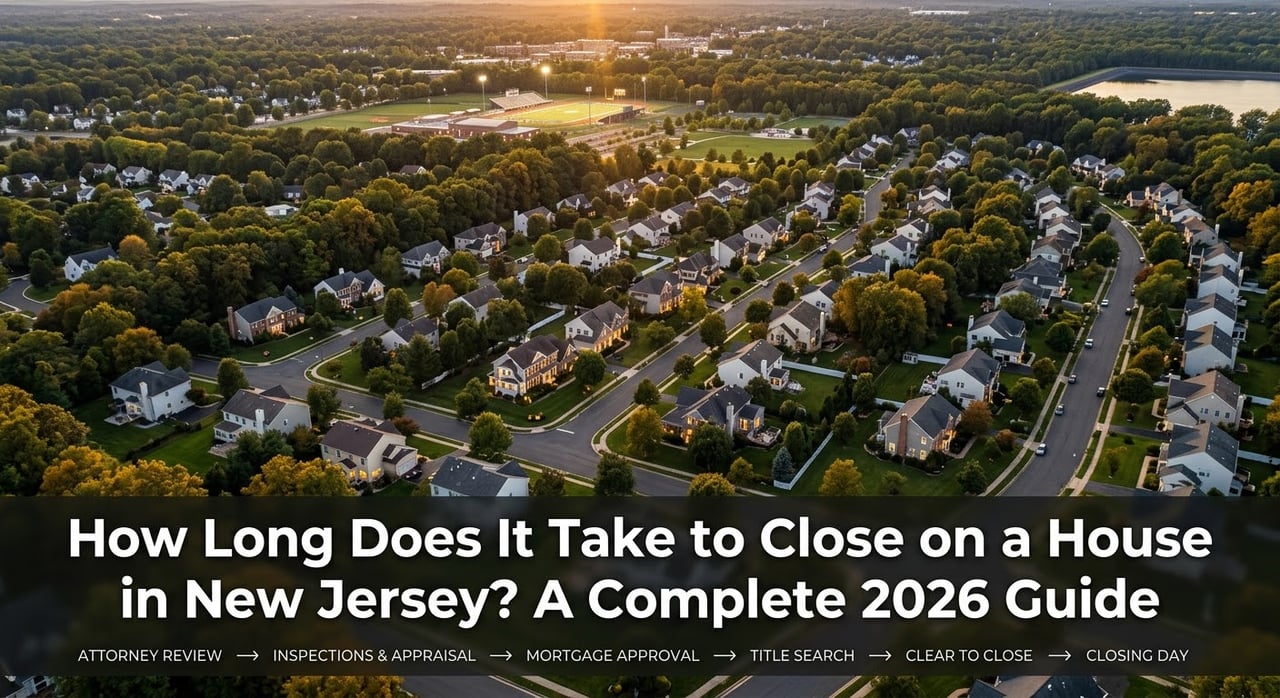
The national average to close on a home purchase is 42 days, according to ICE Mortgage Technology's June 2025 origination data. In New Jersey, that number is a starting point, not a target. Layer in a mandatory three-day attorney review, municipal occupancy inspections, environmental testing requirements, and a closing process that varies significantly depending on which county you're in, and a financed transaction in this state routinely runs 60 to 75 days — sometimes longer.
That's not a problem. It's the price of one of the most consumer-protective real estate frameworks in the country. New Jersey gives buyers and sellers more legal safeguards than nearly any other state. But those safeguards come with procedural obligations, and missing any one of them can stall a closing by days or weeks. This guide breaks down every phase — from the moment an offer is accepted to the moment keys change hands — along with the 2025 legislative changes that are reshaping what sellers in high-value markets pay at the table.
42
Days Avg. to Close*
60–75
Days, NJ Financed
80%+
Towns Require CCO
Jul 10
Mansion Tax Shift, 2025
Timelines
Financing is the single most consequential variable in the closing timeline. Cash buyers sidestep the two most time-intensive phases of any transaction — lender underwriting and the appraisal — which compresses the process dramatically. In optimal conditions, an all-cash deal on a single-family home with clean title can close in as little as 7 to 10 days. More realistically, accounting for title searches, municipal inspections, and attorney review, cash transactions run 30 to 45 days.
Financed purchases in New Jersey take considerably longer. The lender's underwriting process — during which your financial profile is verified, an appraisal is ordered, and a formal mortgage commitment is issued — accounts for most of the timeline. Add in the mandatory attorney review period, inspections, and municipal compliance, and 60 to 75 days is the realistic range for a conventional mortgage on a standard home. FHA and VA loans can stretch beyond 70 days on their own, before any NJ-specific requirements enter the picture.
Co-operative housing — concentrated primarily in Hudson and Bergen counties — adds another layer entirely. Board approval processes require extensive financial disclosures, formal interviews, and review timelines set entirely by the co-op's board of directors. That third-party governance mechanism pushes co-op closings into the 75 to 120-day range. New construction is the longest timeline of all, frequently running 90 to 180 days or more depending on construction schedules and the issuance of the initial certificate of occupancy.
| Property Type | Financing | Expected Timeline | Primary Drivers |
|---|---|---|---|
| Single-Family / Condo | All-Cash | 30 – 45 days | Title clearance, municipal inspection, attorney review |
| Single-Family / Condo | Conventional Mortgage | 60 – 75 days | Underwriting, appraisal, mortgage commitment |
| Single-Family / Condo | FHA / VA | 70 – 90 days | Extended government underwriting, additional property standards |
| Co-operative Unit | Cash or Financed | 75 – 120 days | Board approval, extensive financial disclosures, formal interviews |
| New Construction | Financed | 90 – 180+ days | Construction schedule, certificate of occupancy issuance |
The NJ market moves fastest in late spring. Homes listed in May historically spend an average of 61 days from listing to closing — 16 days faster than the 77-day annual average — driven by buyers who need to relocate before the fall school calendar. That competitive pressure forces faster underwriting turnarounds and less negotiation slack. June listings in the New York/New Jersey metro have commanded listing prices up to $27,000 above the annual average in recent years.
Heading into 2026, the inventory picture remains constrained. Homeowners who locked in rates in the low twos or high twos have little financial incentive to sell into a high-sixes rate environment. That dynamic has kept available supply thin across Monmouth, Union, and Middlesex counties, sustaining seller-favorable conditions even as buyer demand has moderated slightly at the margins.*
Attorney Review
No feature of New Jersey real estate law is more misunderstood — or more important — than the mandatory attorney review period. Every standard Realtor-prepared contract of sale in this state is automatically subject to a three-business-day review window that begins the moment both the buyer and the seller have physically or digitally received the fully executed agreement.
During those three days, each party's attorney has the absolute authority to review, modify, or cancel the contract — for any reason — without penalty. If neither attorney acts, the original standard contract becomes binding as-is. That almost never happens.
Standard practice is for the buyer's or seller's attorney to issue a formal disapproval letter before the three-day clock expires. This letter doesn't kill the deal — it stops the statutory countdown and opens an indefinite negotiation window during which both attorneys customize the contract through riders and addenda. Those riders can address nearly anything: home sale contingencies that give the buyer time to sell their existing property, replacement home contingencies that protect the seller, use-and-occupancy agreements that allow the seller to hold over after closing while paying the buyer's carrying costs, inspection timelines, deposit structure, and more.
Once the riders are finalized, signed by both sides, and exchanged, attorney review is officially "concluded" — and the parties are formally under contract. This phase typically takes anywhere from a few days to a couple of weeks depending on the complexity of the negotiation. Neither side is bound to anything before that conclusion. That distinction matters: an accepted offer in NJ is not the same as a binding contract.
Due Diligence
The conclusion of attorney review triggers two parallel tracks simultaneously. The buyer initiates the inspection contingency, and the active mortgage application phase begins in earnest.
Buyers typically have a 7 to 14-day inspection window — negotiated in the riders during attorney review — during which licensed inspectors evaluate the home's structural integrity, mechanical systems, roof condition, and environmental safety. Surveyors often accompany inspectors to delineate exact property borders. If material defects surface, the buyer's attorney submits a formal written repair request to the seller's counsel. That negotiation — physical repairs before closing or a credit applied at the table — is one of the more common friction points in any NJ transaction.
Concurrent with inspections, the lender orders an independent appraisal to confirm the property's market value supports the agreed purchase price. When the appraisal comes in below the contract price — a scenario more common in rapidly appreciating submarkets — the buyer faces a decision: renegotiate the price with the seller, bring additional cash to the table to cover the gap, or invoke their mortgage contingency and walk. NJ's attorney-mediated structure handles this better than most states because both sides have legal representation at the table when the number comes in.
Pre-approval and mortgage commitment are not the same thing. Pre-approval is a lender's preliminary assessment based on stated information. Commitment is the binding milestone — issued after full underwriting review — that confirms the loan will fund. Most NJ contracts give buyers 30 to 45 days from the conclusion of attorney review to secure a commitment. Missing that window can allow the seller to declare the buyer in default of the mortgage contingency.
BUYER NOTE
Do not open new credit accounts, take on a car loan, or change employers between attorney review and closing day. Lenders re-verify your debt-to-income ratio and employment status in the days immediately before funding. Any change to either can stall or kill final loan approval at the worst possible moment.
Title & Closing
While inspections are underway, the closing agent or attorney orders a comprehensive title search — a review of county and municipal records going back decades to identify any liens, encumbrances, court judgments, unrecorded mortgage discharges, or tax arrears against the property or the seller. A clear title is non-negotiable. Any discovered defect must be satisfied and cleared from the public record before the title company will issue an insurance policy and permit the transfer to proceed.
Clouded title histories are more common than most buyers expect, particularly in densely recorded counties like Hudson, Essex, and Bergen, where deed histories can stretch back generations and paperwork errors compound over decades. A missed mortgage discharge from a refinance twenty years ago, a boundary encroachment that was never formally resolved, or a contractor's mechanics lien from an unpermitted renovation — any of these requires immediate legal intervention. That's a significant part of why the attorney-driven model that dominates North Jersey exists.
Federal law requires buyers using a mortgage to receive the Closing Disclosure exactly three business days before their scheduled closing. This document itemizes the final loan terms, interest rate, projected monthly payment, and all associated costs. If the lender delivers it late, or if significant changes to the loan structure occur after delivery, the three-day clock resets by law — and the closing date moves. Buyers should review the CD carefully against the original Loan Estimate they received when they applied; unexpected fee changes or rate discrepancies should be flagged immediately with the attorney.
The final walkthrough happens 24 to 48 hours before closing. It's not a second inspection — it's a confirmation that agreed-upon repairs have been completed, the seller has vacated, and the property is in the condition specified in the contract. If something is wrong at walkthrough, the buyer's attorney typically negotiates a monetary holdback at closing rather than delaying the transfer. At the closing table itself — or in the pre-signing arrangements that have become standard practice for sellers — the deed transfers, funds clear, and the buyer receives the keys.
Regional Custom
New Jersey is geographically divided by something more consequential than the Turnpike. The closing process looks fundamentally different depending on which part of the state the property sits in, and buyers and sellers relocating from out of state frequently discover this distinction at the worst possible time.
In North and Central Jersey — covering Bergen, Hudson, Essex, Passaic, Morris, Union, and Middlesex counties — the transaction is attorney-driven from start to finish. Both buyer and seller retain individual real estate attorneys the moment an offer is accepted. Those attorneys don't just review documents; they architect the entire transaction. They draft the riders during attorney review, negotiate inspection repair requests, resolve title defects, prepare settlement statements, and conduct the closing meeting itself. The rationale is deeply embedded in the region's density, the complexity of its property histories, and the litigation intensity of the New York metropolitan market. Attorney fees typically run $1,000 to $2,000 — a negligible fraction of a $600,000 purchase that provides critical legal coverage across every phase.
South Jersey is a different world. In Gloucester, Camden, Burlington, Salem, and Cape May counties, the process mirrors neighboring Pennsylvania and the Philadelphia metro. There are typically no attorneys at the closing table, and it's common for the entire transaction to proceed without dedicated legal representation for either party. Instead, the title company serves as the primary settlement agent — holding escrow, preparing statements, coordinating with the lender, and executing the closing. Buyers and sellers retain the right to hire an attorney, but the title company carries the administrative weight of the transaction. The result is a marginally lower cost profile and a process that moves somewhat differently through the closing phases, though it relies heavily on the diligence and neutrality of the title representative to catch problems that an attorney would otherwise flag.
IMPORTANT
If you're buying or selling in Monmouth, Union, Ocean, or Middlesex counties — Prodigy's core market — you're in attorney-driven territory. Retain legal counsel immediately when an offer is accepted. Do not wait until attorney review begins. The attorney review clock starts without your attorney if you haven't engaged one yet.
Municipal Compliance
While the buyer runs inspections and pursues mortgage commitment, the seller is running a parallel track that many underestimate: municipal compliance. New Jersey requires sellers to prove their property adheres to local safety, zoning, and maintenance codes before any transfer of ownership can legally occur. This is not optional, and it is not fast.
Over 80 percent of NJ municipalities require some form of occupancy certification before a sale closes. This typically manifests as a Certificate of Continued Occupancy (CCO) or a Municipal Certificate of Continued Use and Occupancy (MCCUO), which verifies that no unpermitted work has been done to the property and that it meets fundamental municipal standards. Separately, state law universally requires a smoke detector, carbon monoxide alarm, and fire extinguisher inspection prior to any sale.
That smoke detector inspection trips more sellers than almost anything else in the process. Many municipalities now explicitly require 10-year sealed battery units. Properties with older replaceable-battery models automatically fail. A failed inspection means the seller must replace the detectors, schedule a re-inspection, and wait for availability — which during peak summer selling season in Monmouth or Union County can mean a two- to three-week delay that cascades across the entire closing calendar. The CCO certificate itself carries a 90-day validity window; sellers must apply early enough that the certificate doesn't expire before the closing date.
Properties in dense urban markets — Newark, Jersey City, Paterson — face additional layers of oversight. Under P.L. 2021, C.182, rental properties built before 1978 must be inspected via dust wipe sampling or visual assessment and certified as lead-safe. A September 2024 amendment established that Lead Safe Certificates are now valid for three years and extended the inspection scope to include detached garages and tenant common areas. A multi-unit building that passes interior inspection but fails on a common hallway cannot receive its certificate until full remediation is complete. Buyers of tenant-occupied properties in these markets must verify certificate status during due diligence — non-compliance doesn't disappear at closing.
SELLER NOTE
Apply for your municipal inspection the same week attorney review concludes. In towns with summer backlogs — which includes most of Monmouth and Union County during May through August — a two-week delay at application can turn into a six-week closing push by the time re-inspections are factored in.
Disclosures & Environmental
New Jersey enforces some of the strictest seller disclosure law in the country, and the penalties for non-compliance are severe. The state's Consumer Fraud Act allows for treble damages — effectively tripling the financial penalty for intentional violations — plus forced rescission of the sale, which gives buyers the right to cancel and recover their deposit. Sellers who omit known material defects, leave required sections blank, or misrepresent property conditions face significant legal exposure that survives the closing table.
The framework governing those obligations was substantially updated in mid-2024 and has continued to evolve since.
The Real Estate Consumer Protection Enhancement Act (CPEA), signed by Governor Murphy in July 2024 and effective August 1, 2024, made the fully completed and signed Property Condition Disclosure Statement mandatory for all sellers of all residential property in New Jersey — banks, estate administrators, and private sellers included. Sellers must provide this document to the buyer before the buyer becomes contractually obligated. It cannot be delivered at attorney review or at the closing table. It goes first.
The disclosure covers structural integrity, mechanical systems, roof age, water intrusion history, pest damage, permit and license status, and environmental hazards. Multi-unit sellers must disclose separately for each unit. "Unknown" is available as a response only where the seller genuinely lacks knowledge — deliberately selecting it when the answer is known is a statutory violation. Additional disclosures are required for pending litigation affecting the property, HOA rules, deaths on property within the prior 12 months, and — for condominiums — the NJ Condominium Act's resale certificate covering the association's financial condition and bylaws.
New Jersey's Flood Risk Notification Law, effective March 20, 2024, requires all sellers of residential and commercial real property to answer flood-specific questions (Questions 109–117) on the Property Condition Disclosure Statement before a buyer becomes obligated under contract. Sellers must disclose actual knowledge of a property's flood history, inherent flood risk, and whether the property falls within a FEMA Special or Moderate Risk Flood Hazard Area. Non-compliance empowers buyers to terminate without penalty and recover costs — a meaningful consequence in shore-area markets where flood zone designation carries significant insurance implications. For properties along the Jersey Shore, in barrier island communities, and in inland floodplain zones across Ocean and Monmouth counties, this disclosure is one of the most consequential documents in the transaction.
The Off-Site Conditions Disclosure Act requires municipalities to maintain public lists of potentially hazardous nearby sites — Superfund locations, overhead transmission lines operating at 240,000 volts or more, underground gas pipelines, landfills, sewer pump stations, and airport safety zones. A seller's legal obligation is fully discharged by providing the buyer with written notice that these lists exist and are available at the municipal clerk's office. That written notice serves as an absolute legal defense for the seller against any subsequent claim of non-disclosure.
New Jersey's geography creates a series of regulatory overlays that impose specialized due diligence requirements depending on where the property sits. Buyers must identify which, if any, of these apply before the inspection contingency window closes.
The Highlands Water Protection and Planning Act governs approximately 1,250 square miles across 88 municipalities in Bergen, Hunterdon, Morris, Passaic, Somerset, Sussex, and Warren counties. Within the Preservation Area specifically, development is severely restricted — a 300-foot buffer prohibits construction near open waters, and impervious coverage is capped at 3% per lot. Buyers purchasing in the Highlands Preservation Area who plan to expand, subdivide, or perform significant exterior work need land-use attorneys and extended due diligence periods to assess what's legally possible.
The Pinelands Comprehensive Management Plan covers 56 municipalities across Atlantic, Burlington, Camden, Cape May, Cumberland, Gloucester, and Ocean counties. Large-tract transactions and planned expansions in the Pinelands require interaction with the Pinelands Commission, adding substantial time to pre-closing diligence for anything beyond standard residential resales.
Along the Jersey Shore, the Coastal Area Facility Review Act (CAFRA) governs any development within 150 feet of the mean high water line of tidal waters — including bulkhead work. A failing bulkhead on a waterfront property in Ocean or Monmouth County is not simply a contractor problem. It requires NJDEP permits, and in some cases an Individual Permit that can take months to secure. Buyers of waterfront properties should verify that existing bulkheads are legally permitted and that there are no unresolved CAFRA violations, which can halt a closing entirely or expose the new owner to remediation costs they didn't anticipate. For a deeper look at the regulatory forces reshaping shore-area real estate, see Three New Rules Rewriting the Playbook for NJ Shore Real Estate.
Radon is a legitimate concern across a broad swath of the state. New Jersey uses a tiered classification system based on testing prevalence data. Tier 1 counties — where at least 25 percent of tested homes show radon concentrations at or above the 4 picocuries per liter (pCi/L) action threshold — include Atlantic, Hunterdon, Mercer, Middlesex, Monmouth, Passaic, Salem, Somerset, Sussex, Union, and Warren. Transactions in these counties almost universally include a radon testing contingency during inspections. When levels exceed the action limit, the EPA and NJDEP recommend immediate mitigation via sub-slab depressurization, typically negotiated at the seller's expense and verified via follow-up testing before closing.
| Radon Risk Level | Tier Designation | Key NJ Counties Affected |
|---|---|---|
| High Potential | Tier 1 | Atlantic, Hunterdon, Mercer, Middlesex, Monmouth, Passaic, Salem, Somerset, Sussex, Union, Warren |
| Moderate Potential | Tier 2 | Varies by municipality in non-Tier 1 regions |
| Low Potential | Tier 3 | Coastal and extreme southern municipalities |
Properties on private wells are subject to the Private Well Testing Act (PWTA), which mandates pre-closing laboratory testing for an extensive list of contaminants. Testing results must be shared at least 30 days before the closing date — meaning the clock on this starts well before most buyers realize it. The required panel covers total coliforms, nitrates, pH, iron, manganese, lead, uranium, volatile organic compounds, and PFAS compounds (PFNA, PFOS, PFOA) per a December 2021 expansion. Testing typically costs $1,200 to $1,500. If contamination levels exceed safe thresholds, the seller must install a treatment system or negotiate a financial resolution — and system installation can itself take weeks. PWTA compliance is particularly prevalent in Atlantic, Burlington, Camden, Cape May, Cumberland, Mercer, Middlesex, Monmouth, and Morris counties.
Taxes & Fees
Closing costs in New Jersey generally run 2 to 4 percent of the purchase price for buyers — covering lender origination fees, title insurance, prepaid property taxes, attorney representation, and recording fees. Sellers face a broader cost structure: real estate commissions, attorney fees, municipal compliance costs, and the Realty Transfer Fee, which is historically the most significant line item on the seller's closing statement. For sellers of properties over $1 million, one more figure now dominates the net sheet in ways that didn't exist before July 2025.
Established in 1968, the Realty Transfer Fee (RTF) is the seller's baseline transfer tax, assessed at closing using a multi-tiered schedule based on the total consideration recited in the deed. For standard transactions above $350,000, rates increment across several price brackets — from $2.90 per $500 on the first portion of the consideration up through higher per-increment rates as the sale price rises. The funds flow jointly to the state and the counties, allocated to neighborhood revitalization, shore protection, and the general fund. For a complete breakdown of the current RTF schedule and how it affects sellers across different price points, see New Jersey Closing Costs: What Buyers and Sellers Are Really Paying in 2026.
Governor Murphy signed Bill S4666/A5804 on June 30, 2025. The law took effect July 10, 2025, and it fundamentally altered the financial landscape for sellers of high-value New Jersey property in two ways: it shifted the entire tax burden from buyer to seller, and it replaced the old flat 1% rate with a progressive structure for properties above $2 million.
Under the old law, a buyer of any property over $1 million paid a flat 1% of the total consideration at closing — a predictable, linear cost. Under the new law, the seller pays, and the rate escalates with the sale price.
| Sale Price | Mansion Tax Rate (Seller) | Tax on Full Consideration |
|---|---|---|
| $1,000,001 – $2,000,000 | 1.0% | Up to $20,000 |
| $2,000,001 – $2,500,000 | 2.0% | Up to $50,000 |
| $2,500,001 – $3,000,000 | 2.5% | Up to $75,000 |
| $3,000,001 – $3,500,000 | 3.0% | Up to $105,000 |
| Over $3,500,000 | 3.5% | $122,500+ (e.g., $140,000 at $4M) |
Here is the critical detail most sellers don't fully absorb: this is not a marginal bracket system like income tax, where you pay 1% on the first $2 million and 2% only on the next $500,000. It is a cliff tax. The applicable rate applies to the entire consideration once you cross a threshold. A property that sells for exactly $2,000,000 generates a Mansion Tax bill of $20,000 (1% × $2M). A property that sells for $2,000,001 generates a bill of $40,000.02 (2% × $2,000,001). Crossing that line by one dollar costs the seller an additional $20,000.
These pricing dead zones — the bands just above $2M, $2.5M, $3M, and $3.5M — have real consequences for how luxury properties in markets like Spring Lake, Holmdel, Rumson, and Westfield are priced and negotiated. A seller who lists at $2.1M when the market would accept $1.95M is effectively spending $22,000 to net the same figure, because the 2% rate on all $2.1M ($42,000) versus 1% on $1.95M ($19,500) represents a $22,500 swing in tax alone. Work through the math with your attorney before you set your list price. For more on seller-side cost strategy in Union County, see What It Really Costs to Sell a Home in Westfield, NJ.
The law also applies to commercial properties, co-operative units, and certain farm property transfers over $1 million. The grace period — which allowed contracts fully executed before July 10, 2025 and recorded by November 15, 2025 to seek a refund for taxes above the legacy 1% rate — has passed. All qualifying transactions from July 10, 2025 forward are subject to the new structure.
Delay Risk
Despite averaging 42 to 60 days, New Jersey closings are highly susceptible to delay. The state's layered regulatory environment means there are more potential friction points than in most jurisdictions. Understanding where they tend to appear gives buyers and sellers the ability to get ahead of them.
Late-stage mortgage complications are the most common cause of a delayed closing. Lenders continuously re-underwrite through the day of funding. A new car loan, a new credit card, or a job change during the escrow period alters the buyer's debt-to-income ratio and can stall final loan approval with no warning. Appraisal shortfalls — when the lender's appraiser values the property below the contract price — require immediate renegotiation or force the buyer to source additional capital at the worst possible time. In a market where prices are outpacing comparable data by months, this happens more than buyers expect.
CCO inspection failures — nearly always tied to outdated smoke detectors — introduce unpredictable delays during peak selling season when re-inspection calendars are backed up. Clouded title histories, particularly common in Hudson, Essex, and Bergen counties, require legal intervention to clear and can take weeks to resolve if the defect involves an unrecorded discharge from a prior mortgage or a boundary dispute that was never formally adjudicated. Closing Disclosure delivery delays from lenders are more common than they should be; any significant change to loan terms after the CD is delivered resets the mandatory three-business-day waiting period.
Radon and well test delays are uniquely consequential because of the 30-day pre-closing requirement under the PWTA. If testing is ordered too late, or if a mitigation system needs to be installed and re-tested, the closing date cannot move forward until results come back clean. CAFRA and environmental compliance gaps — particularly on waterfront properties in Ocean and Monmouth counties — can halt a closing entirely if a bulkhead violation or an unpermitted structure surfaces in due diligence. Finally, protracted attorney review negotiations — which by design have no defined end date — occasionally run longer than expected when the transaction involves complex contingencies, daisy-chain dependency on other closings, or a seller who needs a replacement property before they can commit to a closing date. This is by design, and the legal flexibility it provides usually serves both parties — but it contributes to NJ's extended average timeline relative to the national figure.
For a broader look at what's moving the statewide market in 2026 and how these dynamics are playing out across different counties, see New Jersey Closing Costs: What Buyers and Sellers Are Really Paying in 2026 and The Closing Cost Update.
FAQ
Q
How long does it take to close on a house in New Jersey?
The national average for closing a conventional mortgage is 42 days from accepted offer, according to ICE Mortgage Technology. In New Jersey specifically, financed transactions typically run 60 to 75 days once the mandatory attorney review period, inspections, and municipal compliance requirements are factored in. Cash buyers can close in 30 to 45 days under most circumstances. Co-ops run 75 to 120 days, and new construction can stretch 90 to 180 days or more.
Q
What is attorney review in NJ real estate?
Attorney review is a mandatory three-business-day period in every New Jersey real estate contract during which the buyer's and seller's attorneys can review, modify, or cancel the agreement without penalty. It begins when both parties receive the fully executed contract. In practice, attorneys almost always issue a formal disapproval letter to stop the statutory clock and open a negotiation window for customized riders — covering contingencies, inspection windows, holdover terms, and other deal-specific protections — before the contract becomes binding.
Q
What is a Certificate of Continued Occupancy in NJ?
A Certificate of Continued Occupancy (CCO) is a municipal document certifying that a property complies with local safety, zoning, and maintenance codes before ownership can legally transfer. More than 80 percent of New Jersey municipalities require some form of occupancy certification prior to sale. Sellers must apply immediately after attorney review concludes — inspection backlogs during peak selling season can delay closings by two to three weeks, and certificates carry a 90-day validity window that must not expire before the closing date.
Q
How much are closing costs for sellers in New Jersey?
Seller closing costs in New Jersey include the Realty Transfer Fee, real estate commissions, attorney fees, and municipal compliance costs. For properties over $1 million sold on or after July 10, 2025, sellers now also owe the restructured Mansion Tax — a cliff-style tax ranging from 1% to 3.5% applied to the entire sale price once a threshold is crossed, not just the amount above it. Buyers in financed transactions typically pay 2% to 4% of the purchase price in closing costs covering lender fees, title insurance, prepaid taxes, and attorney representation.
* National average closing time of 42 days reflects ICE Mortgage Technology origination data for conventional purchase mortgages, June 2025. NJ-specific timelines of 60–75 days for financed transactions reflect attorney review, municipal inspection, and compliance requirements beyond the national baseline. NJ median sale price and year-over-year figures sourced from NJAR/10K Research data at time of publication. Seasonality data (61-day May average, $27,000 June premium) sourced from closed-sale and listing-side tracker data for the NY/NJ metropolitan area. Radon tier designations sourced from NJDEP. Mansion Tax brackets and effective dates sourced from Bill S4666/A5804 (P.L. 2025) and NJ Division of Taxation guidance, July 2025. CPEA effective date August 1, 2024 (P.L. 2024, c.32). Flood Disclosure Law effective March 20, 2024 (P.L. 2023, c.93). All figures subject to change; consult a licensed NJ real estate attorney for transaction-specific guidance.
Prodigy Real Estate is an innovative real estate company offering high-end video production, home valuation services, purchasing, and home sales. Serving New York and New Jersey.