
Anthony Licciardello | April 28, 2026
Property Tax
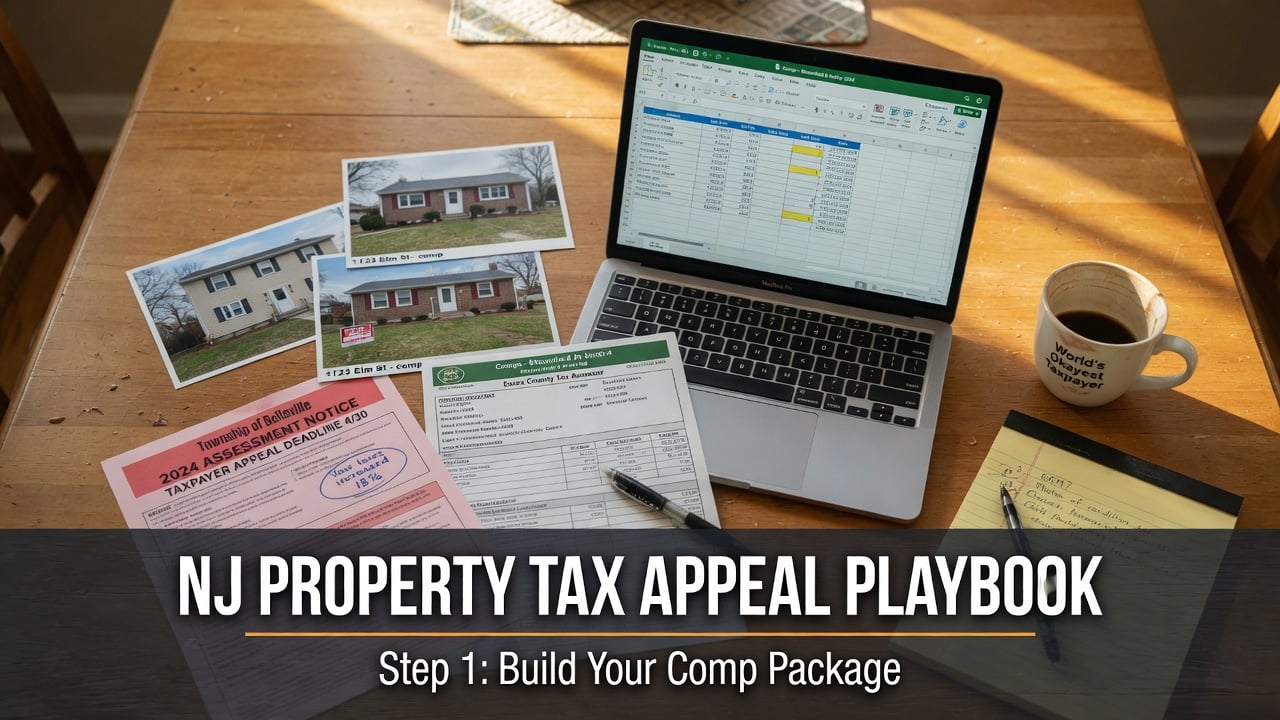
An NJ property tax appeal is one of the highest-ROI pieces of paperwork a homeowner will ever file. Filing fees run $5 to $150 depending on assessment. A successful appeal typically reduces your assessed value by 8 to 20 percent, which produces annual tax savings of $400 to $1,200 — often more in Essex, Union, and Bergen County premium markets — and those savings compound every year until the next revaluation or major market shift. Nationally, property tax appeals succeed 40 to 60 percent of the time. In New Jersey, homeowners who file with real evidence see reductions 50 to 65 percent of the time.
The other half of appeals lose. They lose for specific, consistent reasons: weak comparable sales, evidence submitted late, appraisals submitted without the appraiser present to testify, homeowners who show up arguing fairness instead of market value. This playbook covers what actually wins — the evidence hierarchy boards weight, the comparable sales rules that matter, the property record card moves that often win cases before a hearing even happens, and the procedural details that end cases before they begin when ignored.
Before assembling the evidence, it helps to understand what success actually looks like at the end of the process, because the definition changes the strategy. An NJ property tax appeal does not typically produce a catastrophic reduction — boards rarely cut an assessment by 30 or 40 percent. They reduce it by a defensible amount supported by specific evidence. The typical successful appeal moves assessed value by 8 to 20 percent, which translates to meaningful but not transformative annual tax savings.
| Home Value | 10% Reduction | Annual Savings* | 10-Year Compound |
|---|---|---|---|
| $400,000 | $40,000 less AV | ~$900 | ~$9,000 |
| $700,000 | $70,000 less AV | ~$1,560 | ~$15,600 |
| $1,000,000 | $100,000 less AV | ~$2,230 | ~$22,300 |
| $1,500,000 | $150,000 less AV | ~$3,345 | ~$33,450 |
A win is worth the effort. A $700,000 home that sees a 10 percent reduction in assessed value at NJ's average effective tax rate saves the homeowner about $1,560 per year, and that savings compounds annually until the next revaluation — potentially 10 to 20 years in towns outside the current reval cycle. For higher-value properties in Summit, Westfield, Montclair, Millburn, and Cranford, the absolute dollars climb into the thousands per year. Over a typical NJ homeownership period, a single successful appeal is often worth more than tens of thousands of dollars.
Appeals that seek 40+ percent reductions almost always lose. Boards view disproportionate asks as unserious. Target what your evidence actually supports — typically 8 to 20 percent — and let the data carry the argument.
Every County Board of Taxation in New Jersey applies the same legal standard: your assessment is presumed correct, and you bear the burden of proving it is unreasonable, excessive, or discriminatory compared to true market value as of October 1 of the pre-tax year. What moves the needle toward overcoming that presumption falls into a specific hierarchy — and what does not move the needle consists of a predictable list of arguments that homeowners make and boards dismiss every hearing season.
Two legal rules are worth internalizing at the evidence stage. First, under NJ law, assessments of other properties — your neighbor's, for example — are explicitly not acceptable as evidence of your property's value. A board will dismiss that argument on sight. Second, the land and improvement components of your assessment cannot be appealed separately. You are appealing the total assessed value. Evidence focused on one component while leaving the other unchallenged is rarely successful.
Comparable sales are the evidence that wins the majority of NJ property tax appeals that go to hearing. Three to five well-selected comps from your immediate neighborhood, closed within the appropriate time window, presented clearly, will do more to move a County Board than almost any other evidence short of a licensed appraiser's report. The rules for selecting and presenting comps are specific.
NJ statute requires that comparable sales used in an appeal must be dated prior to October 1 of the year preceding the appeal year, or within a reasonable period after October 1 but no later than December 31. For a 2026 tax year appeal, this means sales closed before October 1, 2025 are the primary evidence pool, with limited usability for sales closing between October 1 and December 31, 2025. Sales closed in 2026 are generally not admissible for a 2026 appeal — they become evidence for 2027.
Every strong NJ appeal packet includes a simple piece of arithmetic: your current assessment divided by your municipality's Director's Ratio equals the state's implied market value for your property. If the average of your three to five comparable sales lands meaningfully below that implied value, you have a prima facie case. For a property assessed at $425,000 in a town with a 92% Director's Ratio, the implied market value is $461,957. If comparable homes sold for $400,000 to $430,000, your assessment has drifted outside the Common Level Range's upper limit and the County Board is required to reduce it under Chapter 123.
One critical exception: in a revaluation year, Chapter 123 does not apply. The assessment is presumed to equal 100 percent of market value. Any demonstrated over-assessment, however modest, can be the basis for a successful appeal. For the mechanics of reval-year appeals specifically, see our NJ revaluation letter guide.
The most frequently overlooked move in NJ property tax appeals is the property record card review. The card is the municipal assessor's internal documentation of what your house actually is — square footage, bed/bath count, basement finish status, garage type, condition grade, improvements, year built, and material notes. Errors on the card directly inflate your assessment. They also produce the most immediately persuasive appeal argument: not a value dispute, which is subjective, but a factual correction, which is not.
Property record cards are public records. You are entitled to request yours from your municipal assessor's office — and you should, at least seven days before your hearing. County Boards of Taxation explicitly require that municipalities provide copies of the property record card to the property owner at least seven calendar days before the hearing when requested. Use this right.
A property record card correction often resolves the appeal before a hearing even happens. Many NJ municipalities will settle administratively when the assessor is presented with clear, documented errors on the card — particularly on square footage. The assessor has an incentive to fix the record quietly rather than defend bad data at a hearing where it will be exposed anyway. If your appeal is resolvable at the card level, you may receive a pre-hearing settlement offer that avoids the hearing entirely.
A licensed NJ appraiser's written report is the highest-weight evidence a homeowner can bring to a tax appeal. It is also the evidence most frequently mishandled by homeowners who retain an appraiser but do not understand the legal requirement around testimony. Under N.J.S.A. 45:14F-21, any appraisal submitted as evidence in a tax appeal must be performed by a State-licensed or certified appraiser. Under the NJ Administrative Code, if the property owner relies on an appraiser's report as evidence, the appraiser must be present at the hearing to testify and be cross-examined. If the appraiser does not appear, the municipality can object and the County Board will not consider the report.
Pay for an appraisal and your appraiser must show up at the hearing. If they don't, the report is inadmissible. Confirm testimony availability in the appraiser's engagement letter before signing.
A licensed residential appraisal for NJ tax appeal purposes typically costs $450 to $1,200 depending on property complexity, with commercial and high-value properties running higher. The appraiser's hearing testimony adds additional cost — expect several hundred dollars per hour. The decision to retain an appraiser should be driven by the expected tax reduction. If a 10 to 15 percent assessment reduction would save $2,000 to $3,500 annually — common for properties above $700,000 in Essex, Union, and Bergen County premium markets — the appraiser cost amortizes in the first year and compounds for years afterward.
| Home Value | Typical Appraiser Cost | Worth It? |
|---|---|---|
| Under $500,000 | $450–$650 | Usually not — rely on comps |
| $500,000–$750,000 | $550–$850 | Depends on complexity |
| $750,000–$1.5M | $700–$1,200 | Often yes — ROI is clear |
| Over $1.5M | $1,000–$3,000+ | Almost always yes |
For properties above $1,000,000 in assessed value, the direct-to-Tax-Court option also becomes relevant. NJ law permits owners of high-value properties to bypass the County Board and file directly with the State Tax Court. The Tax Court has stricter evidence rules and longer timelines, but it also tends to produce larger reductions when the case is strong — it's the appropriate venue for significant disputes where the math justifies the legal cost.
County Board hearings in New Jersey follow consistent procedural rules that reward preparation and penalize improvisation. Understanding how the room works before you walk in changes the quality of your case dramatically.
Under N.J.A.C. 18:12A-1.9(h), any evidence you intend to present at the hearing — comparable sales, photographs, contractor estimates, appraisal reports — must be submitted to the County Board, the municipal assessor, and the municipal clerk at least seven full calendar days before the hearing if not included with the original petition. Evidence brought to the hearing for the first time may be excluded at the municipality's objection. Get your complete evidence package in with your Form A-1 petition when possible, and always at least seven days before your scheduled hearing date.
Arrive at the hearing with five clean copies of your complete evidence packet: one for each of the three Commissioners on the Board panel, one for the municipal assessor who will be present, and one for yourself. Bind them professionally. Number the pages. Include a one-page summary at the front that states your current assessment, the implied market value (current assessment divided by Director's Ratio), the average of your comparable sales, and the reduction you are seeking. Boards that can pick up a clean packet and follow your argument in two minutes settle more appeals at the hearing than boards that have to reconstruct the math themselves.
Before your hearing, your municipal assessor may contact you to negotiate. This is the moment where strong preparation pays its highest dividend: if your comps, your record card corrections, and your math clearly support a reduction, the assessor has every incentive to offer a pre-hearing settlement. Settlements typically reach 60 to 85 percent of the reduction a hearing might produce. That is often the correct outcome — it avoids the hearing time and eliminates the small risk of a counterclaim.
The practical rule: if the assessor's offer is within 10 to 15 percent of your target reduction, take it. If the offer is materially below what your evidence supports, decline and go to the hearing. Never accept a settlement offer at the first request without reviewing your own math first.
A winning appeal is not the end of the analysis. Two post-hearing considerations affect what a successful reduction is actually worth and how long the savings hold.
Under the NJ Freeze Act (N.J.S.A. 54:51A-8 and 54:3-26), a reduction obtained through a successful County Board or Tax Court appeal generally "freezes" the reduced assessment for the tax year of the appeal and the two following tax years. The municipality cannot increase the assessment during that freeze window unless the property undergoes a material change — new construction, significant improvement, or a municipal-wide revaluation. The freeze is the feature that makes a successful appeal genuinely valuable: one year of effort produces three years of locked-in savings.
A completed revaluation or reassessment terminates the Freeze Act protection. If your town revalues during your freeze period, the new assessment applies regardless of your prior reduction. In counties where multiple revals are active — Union, Essex, and Ocean — this matters. See our Union County reval landscape for town-by-town timelines.
NJ County Boards have legal authority to increase an assessment if the evidence shows the property is under-assessed, and municipalities can file counterclaims seeking exactly that outcome. Counterclaims are rare in practice — they are the municipality's last line of defense, generally filed when the homeowner's appeal is weak and the assessor sees an opportunity to move the number the other way. The risk is minimized by filing with solid comparable sales evidence that genuinely supports the reduction you seek. If your comps cleanly demonstrate your property is over-assessed, a counterclaim that tries to go the other way will not survive the same evidence.
If the County Board's decision is unsatisfactory, you have 45 days from the date the judgment was mailed to file a complaint with the NJ Tax Court. Tax Court filing fees are $250. Cases typically take 12 to 24 months to resolve, with many settling before trial. For high-value properties where the gap between the County Board's decision and the homeowner's evidence is significant, Tax Court can be the correct venue. For most residential appeals, the County Board decision is the end of the road — a partial win produces savings that compound for years until the next revaluation or successful re-appeal.
For the county-specific reval context that determines whether your town's current assessment environment is stable or shifting, see our Ocean County, Essex County, and Union County revaluation landscape reports.
Homeowners who file with documented evidence — three to five comparable sales, a property record card review, and clear presentation — win reductions roughly 50 to 65 percent of the time in New Jersey. Nationally, the success rate for property tax appeals is 40 to 60 percent. The single largest predictor of winning is the quality of comparable sales evidence. Appeals filed without comps or with comps that fail the time-window and similarity tests lose most of the time regardless of how valid the underlying argument seems.
County Board filing fees are minimal: $5 for assessments under $150,000, $25 for $150,000–$499,999, $100 for $500,000–$999,999, and $150 for assessments over $1 million. Tax Court filings are $250. Those are the only legally required costs. Optional costs vary: a licensed appraiser typically runs $450 to $1,200 for residential properties; a tax appeal attorney typically charges 25 to 50 percent of first-year savings on contingency. DIY services providing comparable sales packets are available for flat fees under $100. For most residential appeals under $750,000 in assessed value, DIY filing with solid comps is cost-effective. For higher-value properties, professional representation often pays for itself.
Yes. NJ law requires that first-quarter taxes be paid before your appeal can be heard. Failure to stay current on property taxes during the appeal process is grounds for dismissal. If you win a reduction, the difference between what you paid and what you owe under the reduced assessment is refunded or credited against future tax payments. Your mortgage escrow is typically unaffected by the appeal during the pending period — the lender continues collecting based on the current assessment — and the escrow is reconciled after the judgment.
Yes. Every NJ homeowner has the right to file an appeal annually by April 1 (May 1 in revaluation years, January 15 in Monmouth, Burlington, and Gloucester counties). Successful appeals typically invoke the Freeze Act's 2-year protection, during which a new appeal isn't necessary unless the property materially changes. After the freeze lapses or if your town revalues, a fresh appeal may be worthwhile if market conditions have continued to move and your current assessment has drifted outside the Common Level Range again. Many NJ homeowners file successful appeals every few years, particularly in towns with low Director's Ratios.
Anthony leads Prodigy Real Estate across New York and New Jersey. The most common questions Prodigy fields from clients are not about listing or buying — they're about assessment appeals, reval timing, and whether the comps support a filing. The hyperlocal MLS data and municipal assessor relationships Prodigy uses daily in transactions are the same data that win tax appeals.
*Appeal success rates, typical reduction ranges, and average savings figures are drawn from the International Association of Assessing Officers (IAAO) national data, Lincoln Institute of Land Policy research, and NJ-specific estimates from AppealDesk, Ownwell, and published county-level County Board of Taxation data. Filing fee amounts, the 7-day evidence rule, and appraiser cross-examination requirements are sourced from the NJ Division of Taxation, N.J.A.C. 18:12A-1.9, N.J.S.A. 45:14F-21, and county-specific tax appeal handbooks (Union, Essex, Ocean, Hudson, Somerset, Passaic). Freeze Act provisions are sourced from N.J.S.A. 54:51A-8 and 54:3-26. This guide provides general information about NJ property tax appeals and is not legal advice. Individual property situations vary, and homeowners considering an appeal should consult with a licensed NJ attorney for advice specific to their circumstances.
Prodigy Real Estate is an innovative real estate company offering high-end video production, home valuation services, purchasing, and home sales. Serving New York and New Jersey.