
Anthony Licciardello | April 24, 2026
Long Branch, NJ
Why This Matters
A one-bedroom condo at Pier Village with a true market value north of $600,000 can carry an annual property tax bill under $1,000. A single-family home two blocks inland at the same price pays $9,000. That gap is not an accident, a loophole, or an error. It is the intended result of a legal structure the City of Long Branch built deliberately — one that has reshaped the oceanfront, supercharged city revenue, and created a class of real estate that plays by entirely different fiscal rules than everything else in Monmouth County.
The instrument is the Payment in Lieu of Taxes agreement — PILOT — authorized under the Long Term Tax Exemption Law (N.J.S.A. 40A:20-1 et seq.). Most buyers who purchase inside a PILOT building know they have a "tax abatement." Far fewer understand precisely how the mechanism works, who benefits, who absorbs the cost, what the Annual Service Charge actually is, and — critically — what happens the day the abatement expires.
This post builds the full picture from the statute up — using Pier Village and The Lofts as the primary case study, with real numbers from the 2025 tax cycle.
Step One
A PILOT does not happen automatically. It is negotiated, approved by City Council ordinance, and filed with the state — a formal financial agreement between the municipality and a specially formed legal entity. Understanding the creation process explains why not all Long Branch condos have PILOTs and why the terms of each agreement can vary significantly.
The Annual Service Charge
The Annual Service Charge (ASC) is the payment a PILOT property makes instead of conventional property taxes on the building improvements. It is not a property tax. It is not based on the assessed value of the unit. It is calculated from the project's revenue or cost, as set in the financial agreement negotiated before the building opened — which is why PILOT condos at Pier Village can have multi-million-dollar market values and tax bills in the hundreds of dollars.
The PILOT decouples the tax obligation from the market value of the property. That's not a benefit of owning in Long Branch — it's a product of when and where the developer broke ground, and it has a hard end date.
The Primary Case Study
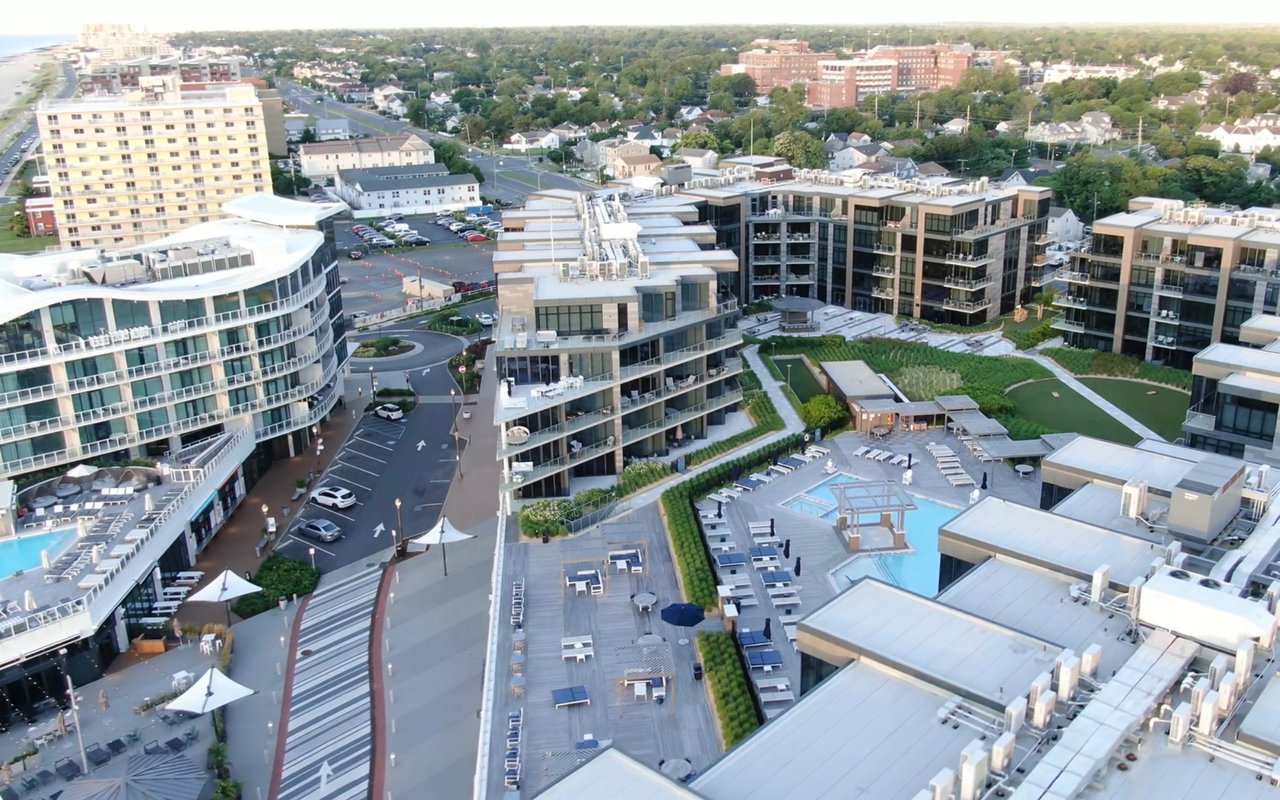
Pier Village is the clearest illustration in Monmouth County of how PILOT agreements reshape an entire waterfront market. Understanding the development timeline is essential for any buyer evaluating a unit there today — because the abatement clock started at different points across the three phases, and the expiration dates are not the same for every building.
The Revenue Question
The most consequential feature of a long-term PILOT agreement is not the size of the tax reduction. It is where the money goes — or more precisely, where it does not go. Under New Jersey statute (N.J.S.A. 40A:20-12), the Annual Service Charge is distributed through a formula that benefits the municipality dramatically while cutting the school district out entirely.
This distribution formula creates a structural tension that plays out in Long Branch's municipal politics on a near-annual basis. As Pier Village and its successor developments have grown — more units, more residents, more children potentially entering the school system — the school district's operational budget has expanded alongside them. But the district captures nothing from the ASC payments flowing out of those buildings.
The school budget must be funded through the conventional tax base: primarily legacy single-family homeowners, older non-abated condominiums, and commercial properties. If the district's costs increase, the rate on those non-abated properties rises. Owners of fully taxed properties end up partially subsidizing the educational infrastructure required by a growing population that arrived in buildings paying nominal service charges.
Proponents of the PILOT structure make a legitimate point: oceanfront luxury condos at Pier Village primarily attract upper-income buyers, retirees, and second-home owners — demographics with low rates of children entering the public school system. If the population growth generated by abated buildings produces minimal enrollment pressure on Long Branch public schools, the school funding diversion is less impactful than it appears on paper. The city also argues that PILOT-driven development creates downstream tax ratables — retail, hospitality, commercial — that eventually benefit the broader base. Both arguments have supporting evidence and limits.
The Purchase Price Trap
The PILOT abatement creates a carrying cost advantage that sophisticated developers price directly into the acquisition cost. This is not speculation — it is observable in the Long Branch market data and explainable through basic financial mechanics.
A buyer with a firm total monthly housing budget has a maximum supportable mortgage. Every dollar reduction in the monthly tax obligation increases the maximum mortgage that fits inside that budget. A buyer can borrow — and therefore spend — substantially more on a PILOT unit while keeping total monthly costs identical to a non-abated property. Developers understand this and price accordingly.
Illustrative only. Actual purchase power varies with rate, down payment, and ASC tier. This example shows the structural dynamic — not a specific property calculation.
That additional purchase power gets bid back into the acquisition price. When every buyer competing for a PILOT unit can afford to spend $200,000 to $300,000 more than they could for a comparable non-abated property, the market price of the PILOT unit rises to absorb it. The $2.75M record penthouse at The Lofts at Pier Village is partially explainable through this mechanism — buyers supporting that price point were underwriting it against a carrying cost structure that made it financially comparable to a far less expensive non-abated property.
For buyers, this means two things. First: the tax savings are real, but they are partially offset by a higher purchase price. Second: when the abatement expires and the carrying cost surges, the price premium that was supported by the PILOT may compress. The expiration is not just a tax event — it is a market event.
Before You Buy
Most buyers in PILOT buildings receive a disclosure at closing that the building has a tax abatement. That is the beginning of due diligence, not the end of it. These nine questions — answered before you remove contingencies — protect you from the most common and most expensive surprises in PILOT ownership.
For the complete comparison of annual tax bills, HOA costs, and total carrying cost across all three Long Branch property profiles, see the companion piece: Long Branch NJ Property Taxes — Condos vs. Single-Family Homes Compared. For the broader development pipeline reshaping the waterfront and Monmouth County, see the Monmouth County major development projects report.
Common Questions
What is a PILOT agreement in New Jersey real estate?
A PILOT — Payment in Lieu of Taxes — is a long-term tax exemption agreement authorized under the New Jersey Long Term Tax Exemption Law (N.J.S.A. 40A:20-1 et seq.). Under a PILOT, the improvements on a designated redevelopment property are exempt from conventional property taxes for up to 30 years. In place of those taxes, the developer pays an Annual Service Charge negotiated with the municipality. The land beneath the property continues to be taxed conventionally. The result is that a PILOT property's annual tax obligation can be 75–96% lower than a conventionally taxed property at the same market value.
Does Pier Village in Long Branch have a tax abatement?
Yes. Pier Village was developed under the Oceanfront-Broadway Redevelopment Plan with PILOT agreements structured into the financing of each phase. The original Ironstate-developed phases opened in 2005 with PILOT protection. The Lofts at Pier Village — 245 condos built by Extell Development at an estimated $238 million total cost and topped out in 2019 — operates under its own financial agreement with the City of Long Branch. Because phases were completed at different times, PILOT expiration dates vary by building. Buyers should confirm the specific expiration date in the financial agreement before closing.
Do Long Branch schools receive any money from PILOT condo buildings?
No — and this is one of the most consequential and controversial aspects of the PILOT structure. Under N.J.S.A. 40A:20-12, the Annual Service Charge paid by PILOT properties is distributed as follows: 95% is retained by the municipality and 5% is remitted to the county. The school district receives nothing. Under standard property taxation, the Long Branch school district would receive approximately 47.7% of every property tax dollar. That entire share is absent from PILOT buildings. As development has expanded the city's population, the school district has had to fund its operational growth through the conventional tax base — primarily legacy single-family homes and older non-abated condominiums.
Why do PILOT condos in Long Branch cost more per square foot than non-abated properties?
The tax abatement unlocks additional purchase power for every buyer competing for the unit. Because the monthly tax obligation is dramatically lower, a buyer with a fixed total monthly housing budget can support a substantially larger mortgage — and therefore bid a substantially higher price — on a PILOT property versus a non-abated one. When all buyers in the market can bid more, prices rise to absorb the advantage. Developers price this premium deliberately: the tax savings are real, but they are partially pre-paid to the developer at closing through a higher acquisition cost. The $2.75 million record penthouse sale at The Lofts at Pier Village reflects this dynamic — the carrying cost structure supported a valuation that the conventional market would not have sustained independently.
What happens to a Long Branch PILOT condo's taxes and value when the abatement expires?
When the PILOT term expires, the property returns to full conventional assessment under the standard Long Branch General Tax Rate — currently 1.500 per $100 of assessed value. The assessor values the land and improvements together at current market value. For a unit currently worth $1 million, that means a tax bill in the range of $15,000 per year going forward, compared to hundreds of dollars under the PILOT. Two market consequences typically follow: the carrying cost advantage that supported a premium acquisition price disappears, which may compress resale values near the expiration date; and the pool of buyers who can afford the unit shrinks, since the previously suppressed tax no longer subsidizes purchase power. Buyers in PILOT buildings should model the post-expiration scenario as part of their purchase decision, not as an afterthought.
Prodigy Real Estate is an innovative real estate company offering high-end video production, home valuation services, purchasing, and home sales. Serving New York and New Jersey.