
Anthony Licciardello | May 16, 2026
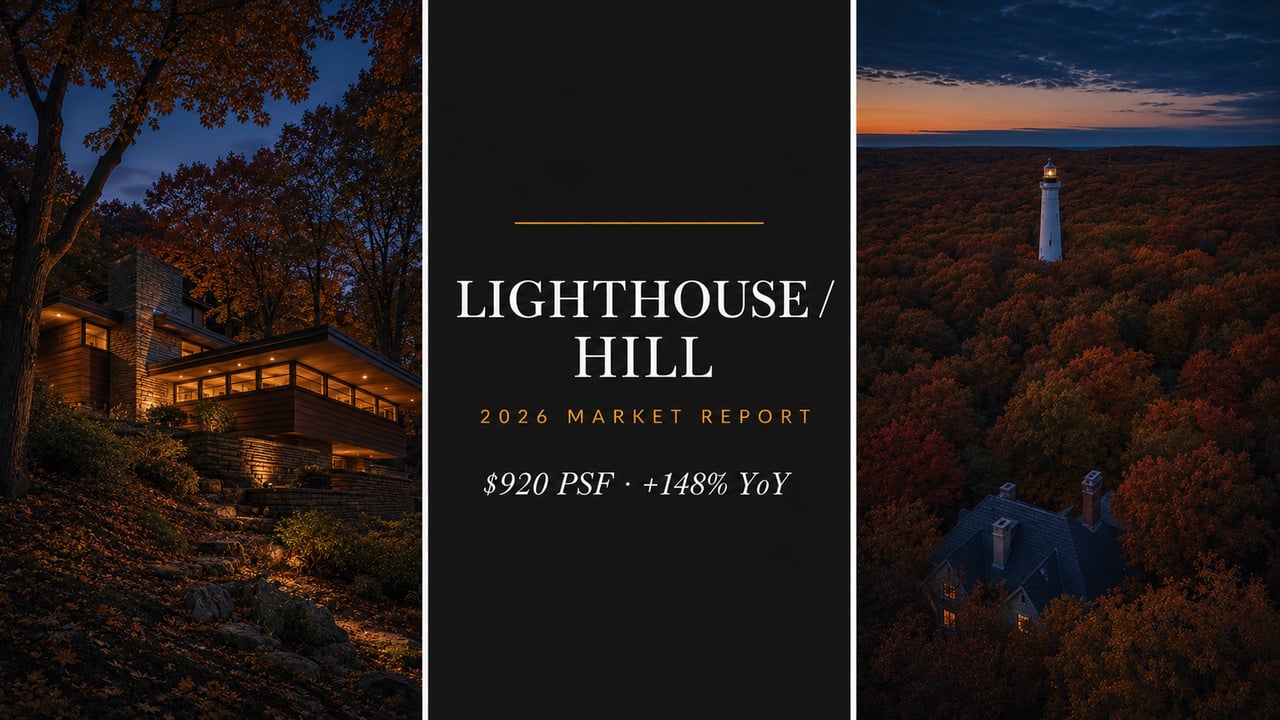
Lighthouse Hill closed the first quarter of 2026 at a median price per square foot of $920 — the highest unit price recorded on any Staten Island luxury enclave, ahead of Emerson Hill's $731 PSF and roughly 67% above the Todt Hill median of $549. The 148.6% year-over-year surge in that number is the kind of move that, in most markets, would signal either a data error or a speculative bubble. On Lighthouse Hill, it signals neither. It signals that the smallest, lowest-volume luxury market on the borough is now being priced for what it actually is: a cultural-capital scarcity asset adjacent to 2,800 protected acres of the Staten Island Greenbelt, with housing stock that cannot be replicated anywhere else in New York City.
The post that follows breaks down the structural reasons behind the $920 PSF, the unique role of the Crimson Beech and the Greenbelt in establishing Lighthouse Hill's value floor, and why the 112-day average days-on-market — more than double the borough norm of 57 — is a feature of this market rather than a weakness. Sellers and buyers approaching Lighthouse Hill in 2026 need to understand all three.
Lighthouse Hill is Staten Island's architectural scarcity luxury market — the smallest, least liquid, and highest-PSF of the five hill enclaves. Its $920 median PSF reflects extreme housing-stock rarity, Greenbelt adjacency, and the cultural-capital premium attached to addresses near the only Frank Lloyd Wright-designed residence in New York City. Volatility is structural, not pathological: a single trophy sale resets the entire local comp set.
For broader context across all five hill enclaves, the 2026 comparative analysis of Staten Island's luxury hills includes a multi-hill aerial video tour and the full prestige-versus-view-versus-scarcity framework that organizes the borough's luxury market.
Lighthouse Hill occupies a fraction of the geographic footprint of the borough's other luxury enclaves. Bounded by LaTourette Park of the Staten Island Greenbelt to the north, Rockland Avenue to the east, the LaTourette Golf Course to the west, and Richmond Road to the south, the neighborhood is effectively a single ridge with a handful of internal streets — Lighthouse Avenue, Edinboro Road, Manor Court, Windsor Avenue. Total housing inventory is small enough that in any given quarter, the active listings can typically be counted on two hands.
That structural smallness is the mechanism behind the volatility. In a market with hundreds of comparable listings, a single sale moves the median by basis points. In a market with eight or ten active properties at any moment, a single trophy sale at $1,200 per square foot can pull the entire local comp set upward for the following 12 to 18 months. The 148.6% year-over-year PSF surge is not the result of a sudden buyer flood. It's the result of a handful of high-end transactions that re-anchored the market at a higher band than the previous cycle had ever established.
This is fundamentally different from the Grymes Hill or Ward Hill dynamic. Grymes Hill has the volume to sustain a stable comp set across both view-corridor and interior properties. Lighthouse Hill does not. A single Crimson Beech-adjacent estate trading hands resets the entire conversation.
The two physical anchors of Lighthouse Hill's premium are the Crimson Beech and the Greenbelt. The Crimson Beech is the only Frank Lloyd Wright-designed residence in New York City — a Usonian prefab completed in 1959 on Manor Court, sitting on a sloped Lighthouse Hill parcel that Wright himself reportedly selected for the topography. The home is not just a tourist landmark. It functions, in real estate terms, as a permanent anchor on the neighborhood's architectural premium. The simple fact that an FLW residence sits on Manor Court extends a halo across every nearby property: addresses within walking distance of the Crimson Beech carry a cultural-capital premium that no marketing strategy can manufacture and no other Staten Island neighborhood can replicate.
Frank Lloyd Wright's only completed New York City residence, a 1959 Usonian prefab built on a sloped Lighthouse Hill parcel. Its presence anchors the neighborhood's cultural-capital premium and is the single most-cited reason buyers cite for paying Lighthouse Hill PSF over comparable Staten Island alternatives.

"Algorithmic CMAs underprice Lighthouse Hill every single time. The model doesn't know what cultural-capital adjacency is. It sees square footage, lot size, year built — and it spits out a number that's typically 20 to 30% below what the property will actually clear at. On this hill, you have to comp by hand or you leave money on the table."
The Greenbelt is the second anchor and the more durable of the two. Lighthouse Hill is the only luxury enclave on Staten Island that sits directly adjacent to 2,800 contiguous acres of permanently protected parkland. This is the structural feature that makes the neighborhood's seclusion non-negotiable: no future development can densify the buffer to the north. The view from Lighthouse Hill is not a harbor view or a Manhattan skyline view. It's an inland view across mature forest canopy, and that geometry is essentially extinct elsewhere on the borough.
A secondary cultural amenity reinforces the premium: the Jacques Marchais Museum of Tibetan Art on Lighthouse Avenue — the oldest Himalayan-style structure in the United States, with its fieldstone terraced gardens and rotating cultural programming. Combined with the Staten Island Range Light itself, still operational under the US Coast Guard, Lighthouse Hill carries a density of unique cultural assets per acre that no other Staten Island neighborhood approaches.
A 112-day average days-on-market reading would, in most luxury markets, signal a weak market. On Lighthouse Hill, it signals the opposite — a market dominated by patient holders who treat their homes as long-term cultural assets rather than tradeable real estate. The 57-day borough median reflects standard owner-occupied turnover; the 112-day Lighthouse Hill figure reflects sellers who are willing to wait for the right buyer at the right price rather than discount into a quicker close.
This patient-hold dynamic has two consequences worth understanding. First, it suppresses inventory: properties that might list elsewhere stay off the market because the carrying cost of waiting is acceptable to the owner. Second, it inflates realized prices: when properties do trade, they typically trade at or near asking, with limited concession activity. The combination is a market where transaction volume is low, time on market is high, and realized PSF is the highest in the borough — exactly the data shape that the 2026 numbers show.
On Lighthouse Hill, low volume and long days-on-market are the mechanism producing the $920 PSF, not the symptom of weakness.
The right pricing approach for a Lighthouse Hill listing in 2026 is meaningfully different from what works on the borough's other luxury hills. Three principles matter most.
First, anchor the listing to the most recent trophy comp in the immediate sub-area, not to the blended neighborhood median. A property within walking distance of the Crimson Beech is not a Staten Island home; it's an architectural-scarcity asset, and the comp set is correspondingly narrow. A standard CMA pulled from MLS averages will systematically underprice this kind of listing because the algorithm does not weight cultural-capital adjacency. Manual comping by an experienced local broker is essential.
Second, plan for the longer time horizon. A Lighthouse Hill listing is not selling on a 45-day cycle. Sellers who price aggressively and expect a fast close will discount into the wrong buyer pool. Sellers who price at the cultural-capital premium and budget 120-plus days on market will typically close at or near asking — which is the strategy the realized data supports.
Third, the listing media must do work that the address alone cannot. Cinematic drone footage that captures the Greenbelt canopy, twilight stills that establish the architectural distinction of the home itself, and editorial copy that frames the property as a cultural asset rather than a tradeable commodity are not luxury enhancements on Lighthouse Hill — they're the price of entry. The Prodigy Team's in-house 4K drone and cinematic listing production was built specifically for this category of property, where the media has to carry the story.
For buyers actively looking at the neighborhood, current inventory is visible on the Lighthouse Hill homes for sale page, though active listings at any moment typically number in the single digits.
Lighthouse Hill's $920 median PSF reflects three converging factors: extreme housing-stock rarity (the neighborhood occupies a small geographic footprint with a single-digit active inventory at any time), permanent adjacency to the 2,800-acre Staten Island Greenbelt that prevents densification of the buffer, and the cultural-capital premium attached to addresses near the only Frank Lloyd Wright residence in New York City. Together, these produce a per-square-foot price band the borough's larger luxury markets cannot match.
The Crimson Beech, at 48 Manor Court, is the only Frank Lloyd Wright-designed residence in New York City — a Usonian prefab completed in 1959. Its presence anchors a cultural-capital halo across the surrounding addresses. Properties within walking distance carry a measurable premium that has no equivalent elsewhere on Staten Island. The Crimson Beech functions, in real estate terms, as a permanent architectural anchor on Lighthouse Hill's pricing.
The 112-day average days-on-market reflects a market dominated by patient, owner-occupied holders who treat their homes as long-term cultural assets rather than tradeable real estate. Sellers wait for the right buyer at the right price rather than discount into a quicker close. The combination of low volume, long time-on-market, and high realized PSF is the structural data shape of a scarcity-driven luxury market — it's a feature of the neighborhood, not a sign of weakness.
All three are luxury enclaves but serve different value drivers. Todt Hill commands its premium through acreage and brand prestige — absolute prices are the highest on the borough, anchored by the $8.5M Benedict Road record. Emerson Hill commands its premium through Tudor architectural concentration. Lighthouse Hill commands its premium through cultural-capital scarcity and Greenbelt adjacency. The three markets are not substitutes; they price separate value categories.
Lighthouse Hill housing stock skews toward custom-built single-family homes — Victorian manors, colonials, mid-century ranches, and a small number of contemporary builds. None of the homes are identical; each was effectively custom for its lot, often with multi-level terraced yards descending the slope of the hill. Median sale price in early 2026 sits at approximately $1.32 million, with trophy properties trading well above that figure.
The Prodigy Team specializes in cultural-capital luxury marketing for Lighthouse Hill's architectural-scarcity properties — with in-house 4K drone production, Greenbelt-canopy cinematography, and editorial listing strategy built around what scarcity assets actually reward.
See Why Sellers Choose UsOr call directly: 718-873-7345
Prodigy Real Estate is an innovative real estate company offering high-end video production, home valuation services, purchasing, and home sales. Serving New York and New Jersey.