
Anthony Licciardello | May 16, 2026
Staten Island
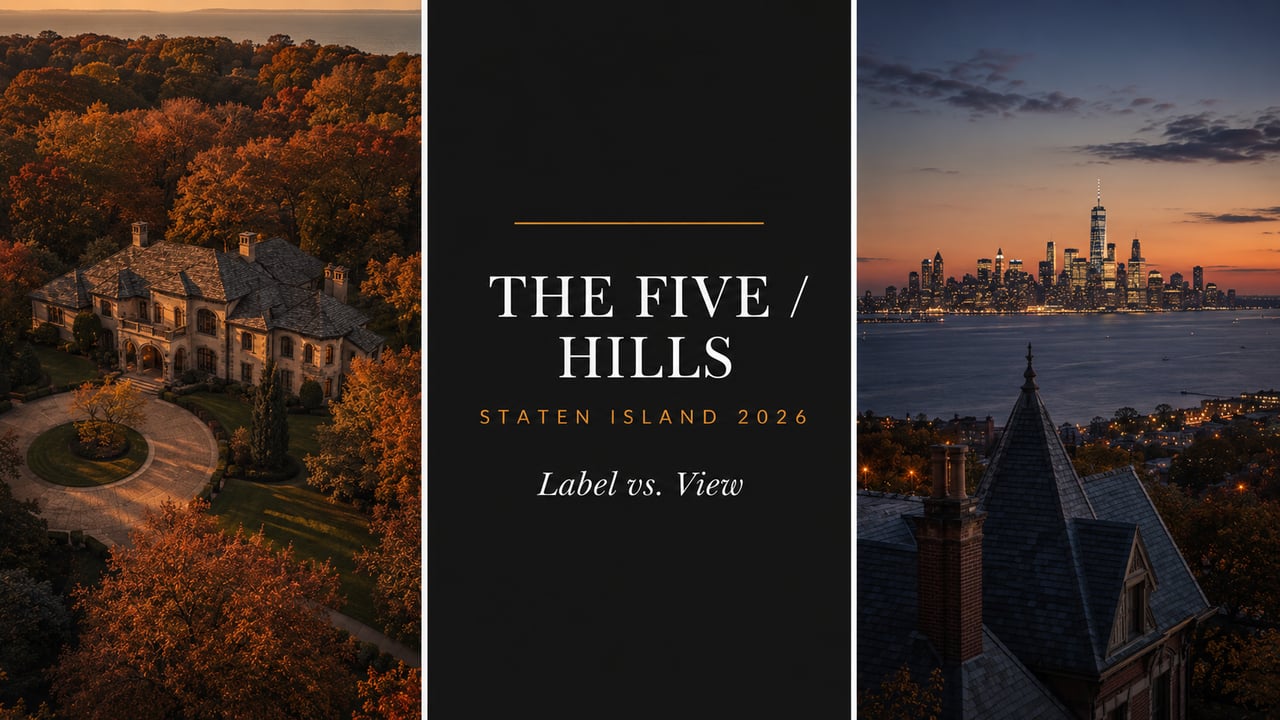
Staten Island's luxury market is not a single market. It is a stratified set of five distinct hillside enclaves — Todt Hill, Emerson Hill, Grymes Hill, Lighthouse Hill, and Ward Hill — each operating under its own pricing logic, buyer profile, and architectural vocabulary. Treating them as interchangeable is the most common mistake a buyer, seller, or out-of-borough agent can make in 2026.
The central question that organizes this analysis is simple: when buyers pay a premium on Staten Island's hills, what exactly are they paying for? The data through Q1 2026 produces a counterintuitive answer. The "label" — the prestige of a specific address — consistently outweighs the "view" as a pricing catalyst on a per-property basis, but on a per-square-foot basis, scarcity premiums in smaller enclaves now routinely exceed the borough's most storied address. Understanding which premium applies to which property is the difference between a correctly priced listing and one that lingers on the market.
In 2026, Staten Island's luxury hills price along three distinct premium categories — brand prestige (Todt Hill), architectural scarcity (Emerson Hill, Lighthouse Hill), and view corridors (Grymes Hill, Ward Hill). Todt Hill leads on absolute price at $2.05M average. Lighthouse Hill leads on price-per-square-foot at $920. Pricing a luxury listing correctly begins with identifying which category the property belongs to, then comping within that category — not across the entire segment.
The video below provides a high-altitude survey of all five hills, the topography that produced them, and the lifestyle character that distinguishes each from the others.
Most of New York City sits on a coastal plain. Staten Island is the exception, and the reason is glacial. The five hills are remnants of the Wisconsin Glacier's terminal moraine — the ridge of rock and till deposited when the last ice sheet stopped advancing roughly 18,000 years ago. The result is a north-south spine of high ground running through the borough's center, with Todt Hill reaching 410 feet above sea level. That makes it the highest natural point on the Atlantic coastal plain south of Maine.
This isn't trivia. The elevation is the foundation of the borough's luxury market because it produces three structural advantages no other Staten Island neighborhood can replicate. It places homes above the coastal flood zones that increasingly affect lower-lying parts of the borough. It creates natural acoustic insulation from highway and airport noise corridors. And it generates the view geometry — across the harbor toward Manhattan, across the Narrows toward Brooklyn, or inland across the Greenbelt — that underpins the premium pricing on three of the five hills.
Each hill sits at a slightly different elevation, faces a different compass direction, and was developed in a different architectural era. Those three variables — elevation, orientation, and build period — explain almost every meaningful pricing difference between them.
The table below synthesizes Q1 2026 market data across all five hills. Read it carefully — the per-square-foot ranking does not match the absolute-price ranking, and that disconnect is the entire story of the borough's luxury market this year.
| Hill | Avg Property Price | Median PSF (2026) | Typical Lot Size | Primary Value Driver |
|---|---|---|---|---|
| Todt Hill | $2,050,000 | $549 (median) / $773 (trophy) | 0.5 – 1.5 acres | Brand prestige & acreage |
| Emerson Hill | $1,110,614 | $731 | 0.25 – 0.5 acre | Tudor architectural scarcity |
| Grymes Hill | $770,000 | $303 (blended) / $711 (premium) | 0.25 acre | Harbor & skyline view corridors |
| Lighthouse Hill | $1,320,000 | $920 | 0.5 acre | Seclusion & architectural scarcity |
| Ward Hill | $1,150,000 | $424 (avg) / $758 (premium) | 0.2 acre | Manhattan views & ferry proximity |
The headline observation: Todt Hill leads on absolute property price ($2.05M average) but ranks third on median PSF. Lighthouse Hill leads on PSF at $920 — a number that exceeds the Todt Hill trophy tier — but its absolute prices are a fraction of Todt Hill's because the parcels and houses are smaller. Emerson Hill and Ward Hill sit between, with Grymes Hill showing the widest internal spread because its housing stock is the most mixed.
The most consequential pricing question in Staten Island's luxury market is whether the "Todt Hill" address itself is worth more than a comparable house with a better view in a different hill. The 2026 data answers it clearly: yes, the label wins on absolute terms, but only on absolute terms.
Comparing properties of identical internal square footage, a Todt Hill home with an internal-facing lot and no view typically outprices a Ward Hill home with unobstructed Manhattan views by approximately 50%. The buyer is not paying for what they can see from the windows. They are paying for the address on the deed, the school district association, the perceived safety, and the social signal that Todt Hill carries — what the market has spent six decades constructing as the borough's pinnacle wealth label.
Within Todt Hill itself, view corridors do matter — ridge properties with panoramic views command 20% to 30% premiums over internal lots in the same neighborhood. But that premium is layered on top of an already-elevated baseline. The view doesn't create the value; the label does. The view amplifies it.
The view doesn't create the value. The label does. The view amplifies it.
This is the most important pricing principle a Staten Island luxury seller can internalize. The Benedict Road $8.5 million sale would not have happened on Grymes Hill at any price, regardless of how dramatic the harbor view from the lot might have been. The reverse is also true: a Grymes Hill property with a perfect Manhattan view does not automatically reprice itself toward Todt Hill levels just because the view is objectively comparable or superior.
The label dominates on absolute price. But on a per-square-foot basis, scarcity inverts the relationship.
Lighthouse Hill's $920 median PSF — driven by a 148.6% year-over-year surge — reflects the extreme rarity of housing stock adjacent to the 2,800-acre Greenbelt and the cultural-capital premium attached to addresses near the only Frank Lloyd Wright-designed residence in New York City. Emerson Hill's $731 PSF surge reflects the inability of buyers to find comparable Tudor architectural inventory elsewhere on the borough. Both numbers exceed the Todt Hill median.
What this tells us is that the Staten Island luxury market in 2026 has matured to the point where it now prices three distinct premium categories: brand prestige (Todt Hill), architectural scarcity (Emerson Hill, Lighthouse Hill), and view corridors (Grymes Hill, Ward Hill). A correctly priced listing requires identifying which premium category the specific property belongs to, then comping it within that category rather than across the entire luxury segment.
Todt Hill commands prices 2.6 to 2.7 times the borough median and is anchored by the recent $8.5 million Benedict Road trophy benchmark. Its premium is built on acreage (0.5 to 1.5 acres is standard, with several 2+ acre estates), the P.S. 48 school district association, and six decades of cultural identification as the borough's wealth address.
Emerson Hill closed Q1 2026 at $731 PSF after a 48% year-over-year surge, with the premium driven by an unmatched concentration of 1920s–1950s Tudor Revival estates. The buyer pool skews toward design-conscious Manhattan and Brooklyn refugees underwriting against $4M+ Westchester Tudor alternatives.
Grymes Hill has the widest internal pricing spread on the borough — a blended median PSF of $303 reflects a high concentration of condominiums and smaller units, while front-row harbor-view properties on Bertha Place are trading at $711 PSF. Home to Wagner College and consistently ranked among the safest neighborhoods in New York City, Grymes Hill is the borough's primary view-corridor luxury market.
Lighthouse Hill is the smallest and lowest-volume of the five luxury markets, which is precisely what produces its $920 PSF. The neighborhood contains the Crimson Beech — the only Frank Lloyd Wright-designed residence in New York City — and sits adjacent to the 2,800-acre Staten Island Greenbelt. Days on market average 112, more than double the borough norm, reflecting the patient hold patterns of owners who treat their homes as long-term cultural assets rather than tradeable real estate.
Ward Hill is the premier high-elevation market of the North Shore and the most urban-accessible of the five luxury hills, with the Staten Island Ferry's Manhattan-bound terminal a short drive away. The market is currently bifurcating between standard early-20th-century Victorian stock at $419 PSF and relisted premium assets leveraging Manhattan view corridors at $758 PSF. The ferry-proximity premium has accelerated in 2026 as commuter buyers reassess proximity to the Whitehall Street terminal.
Across the five hills, the trajectory through late 2026 points toward an additional 3% to 4% appreciation on aggregate, but the distribution will be uneven. Todt Hill's pricing floor remains structurally anchored by the lock-in effect and the borough's chronic luxury inventory deficit — roughly 78% of current Staten Island homeowners hold mortgage rates below 5%, which suppresses resale volume and creates an effective price floor in the most established address.
The scarcity-driven markets — Lighthouse Hill and Emerson Hill — face a different dynamic. With days on market doubled in Lighthouse Hill and inventory in the low single digits across both, additional PSF appreciation is likely but volume-constrained. A single trophy sale in either neighborhood can reset the entire local comp set for 12 to 18 months.
Grymes Hill and Ward Hill, with their view-corridor premiums tied to harbor and Manhattan vistas respectively, will continue to bifurcate. Standard housing stock will track the borough median. View-corridor premium properties will continue pulling away as the design-conscious and commuter buyer pools deepen.
A listing strategy that treats Staten Island's five hills as a single luxury segment will mis-price. The correct approach identifies which of the three premium categories the property belongs to — label, scarcity, or view — and builds the marketing, pricing, and media production around that specific value driver.
A Todt Hill estate sells on prestige, acreage, and the address itself. The listing media should emphasize the parcel, the privacy, the school district context, and the broader Todt Hill brand. A Lighthouse Hill or Emerson Hill property sells on character — the cinematography matters as much as the price, because the buyer is paying for what cannot be replicated elsewhere on the borough. A Grymes Hill or Ward Hill view-corridor property sells on geometry: the height of the lot, the angle of the windows, the time of day when the Manhattan skyline lights up across the harbor.
Mis-categorization is the single most common cause of mis-pricing in the borough's luxury market.
These are three different marketing playbooks. The Prodigy Team's in-house 4K drone and cinematic listing production was built specifically to deliver the right playbook for the right property — not a one-size template applied across the borough.
On absolute property price, Todt Hill is the most expensive — average price of $2.05 million and the borough record sale of $8.5 million on Benedict Road in 2025. On a per-square-foot basis, however, Lighthouse Hill leads at $920 PSF, followed by Emerson Hill at $731 PSF. The answer depends on whether you measure by total property value or by unit price.
The hills are remnants of the Wisconsin Glacier's terminal moraine and sit at elevations no other Staten Island neighborhood can match — Todt Hill reaches 410 feet, the highest natural point on the Atlantic coastal plain south of Maine. That elevation places homes above coastal flood zones and major noise corridors, creates view geometry across the harbor and Greenbelt, and supports parcel sizes that allow privacy and architectural ambition not feasible on the lower-lying portions of the borough.
It adds measurable value. Comparable properties in adjacent neighborhoods like Dongan Hills trade at 15% to 20% discounts for lacking the Todt Hill designation, and Todt Hill properties with no view often outprice Ward Hill properties with unobstructed Manhattan views by nearly 50% at identical square footage. The label functions as a structural pricing premium, not a marketing label.
Grymes Hill and Ward Hill are the two view-corridor markets. Grymes Hill faces predominantly the Upper New York Bay and lower Manhattan harbor, with premium properties on Bertha Place and Longview Road. Ward Hill faces Manhattan and the Narrows from the North Shore, with the additional benefit of ferry-terminal proximity. Lighthouse Hill offers inland Greenbelt vistas rather than harbor views — a different aesthetic for a different buyer.
Identify which of three premium categories the property belongs to — brand prestige, architectural scarcity, or view corridor — and comp the property within that category rather than across the entire luxury segment. A Tudor on Emerson Hill should not be comped against a Mediterranean on Todt Hill, and a harbor-view Grymes Hill listing should not be comped against an interior-facing Ward Hill property. Mis-categorization is the single most common cause of mis-pricing in the borough's luxury market.
The Prodigy Team specializes in hyperlocal luxury marketing across Todt Hill, Emerson Hill, Grymes Hill, Lighthouse Hill, and Ward Hill — with in-house 4K drone production and category-specific pricing strategy built around what each hill actually rewards.
See Why Sellers Choose UsOr call directly: 718-873-7345

Prodigy Real Estate is an innovative real estate company offering high-end video production, home valuation services, purchasing, and home sales. Serving New York and New Jersey.