
Anthony Licciardello | May 1, 2026
Long Beach Island
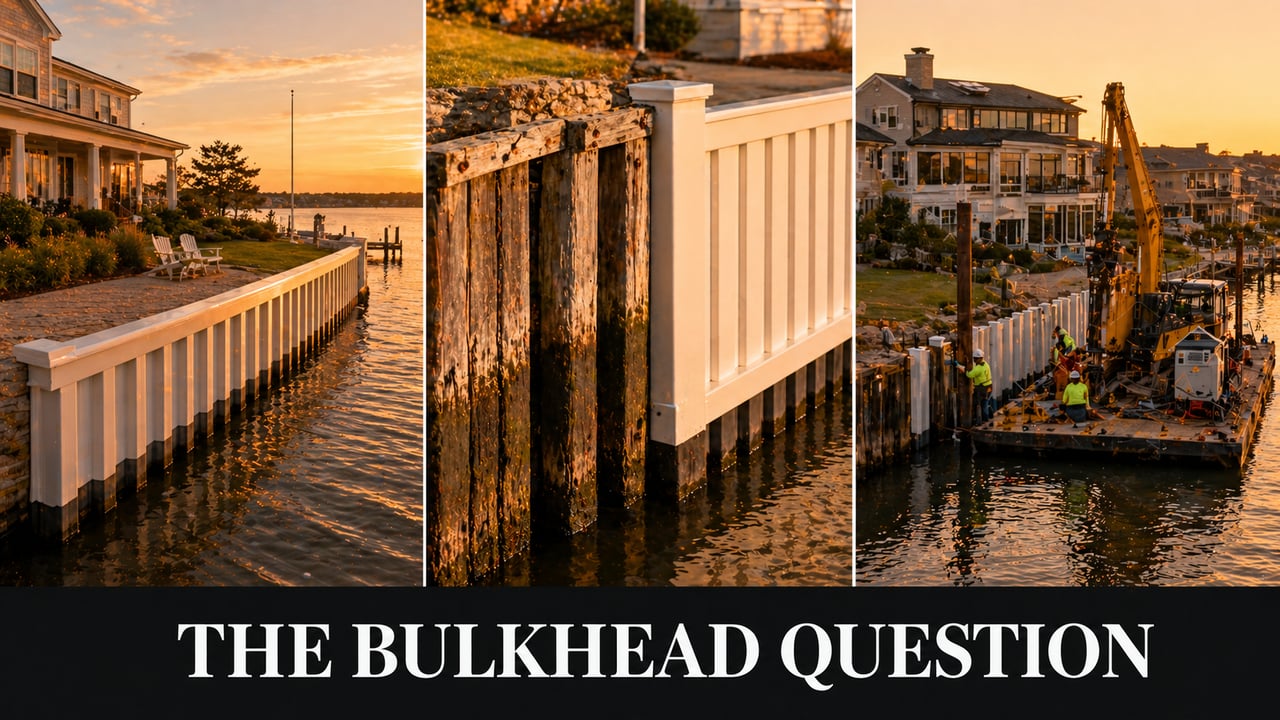

Buyers shopping bayfront on Long Beach Island ask about the dock, the lift, the view, the kitchen. They almost never ask about the bulkhead until the marine engineer's inspection report shows up during attorney review. By that point, the conversation has changed.
A failing or near-failing bulkhead is the single most expensive piece of bayfront infrastructure most buyers don't think about — and the single most reliable way for a seller to leave money on the table at closing. Industry tracking and my own LBI transactions both point to the same number: a bulkhead in declining condition can cost a bayfront sale 10 to 15% of its price. On a $2.5 million property, that's $250,000 to $375,000.
This is the structural literacy a bayfront buyer or seller needs before signing anything in 2026.
A bulkhead is the vertical retaining wall that holds the lot back from the water. It does four jobs at once: it prevents soil erosion behind the wall, it defines the riparian boundary that separates the property from state-owned tidelands, it absorbs tidal action 24/7 year-round, and it anchors the dock structure and any associated lifts. On LBI bayfront, a bulkhead is the single piece of infrastructure that determines whether the lot stays a lot or gradually washes into Barnegat Bay.
The structural components matter when it's time to inspect or replace. Sheet piling — the vertical material driven into the bay floor — is the wall itself. The top cap is the horizontal element that runs along the top, providing finish and structural rigidity. Tieback rods extend from the wall back into the lot to anchor the structure against soil pressure, terminating at deadmen anchors buried in the upland. When a bulkhead fails, it fails in one of those four places: the sheet piling, the cap, the tiebacks, or the deadmen.
Bayfront on LBI is gentler than oceanfront in terms of wave energy, but the tidal cycle never stops. A bulkhead on Barnegat Bay handles two high tides and two low tides every day, every year, for the duration of its service life. Sandy was the structural-stress reference event for almost all current LBI inventory, and bulkheads installed before 2012 either failed during the storm and were replaced, or survived and aged faster afterward. Either way, age and Sandy are the two factors that drive most current condition assessments.
Three materials dominate residential bulkhead construction on LBI. Each one has a different cost, a different service life, and a different maintenance profile.
| MATERIAL | COST / LINEAR FT | SERVICE LIFE | CURRENT LBI USE |
|---|---|---|---|
| Wood (treated timber) | $150–$500 | 10–25 years | Legacy only; rare in new installs |
| Vinyl (PVC sheet pile) | $500–$900 | 50–60+ years | Default for residential replacements |
| Steel | $400–$700 | 30–50 years | Marina and commercial use |
The wood-to-vinyl transition is structural, not stylistic. New Jersey banned the use of CCA-treated wood (chromated copper arsenate) for sheet piling effective January 1, 2004 — the result of environmental concerns about arsenate leaching into tidal waters. Untreated wood is unviable in saltwater. Modern alternatives like Ipe and other tropical hardwoods are cost-prohibitive for most residential applications. The practical result is that almost no new wood bulkheads are installed on LBI today, and the wood bulkheads still in service are aging out of their service life.
Vinyl took over because the math became obvious. Vinyl PVC sheet piling resists rot, marine borers, and UV degradation. It carries a 50-to-60+ year service life. It requires almost no ongoing maintenance beyond inspection. The upfront cost per linear foot is higher than treated wood was, but on a 50-year lifecycle basis, vinyl is cheaper. That's why nearly every bulkhead replacement on LBI in 2026 specifies vinyl unless there's a compelling reason to choose otherwise.
Steel is the workhorse of marinas and commercial bulkhead installations, and shows up occasionally on residential LBI parcels with deep-water frontage or unusual structural demands. Steel's biggest residential limitation is corrosion in saltwater unless properly coated and maintained. Most LBI residential buyers and contractors land on vinyl as the answer.
Visual signals of distress are the first thing any LBI bayfront buyer or seller should learn to recognize. The wall doesn't have to be falling over for the underlying structural picture to be bad.
Watch for: bowing or leaning more than a few inches off vertical, separation between the top cap and the sheet piling, soil washout or sinkholes in the lawn behind the wall, exposed tieback rods, vinyl cracking or chipping at the waterline, rust streaks on metal hardware, and lateral failures at the corners or where the bulkhead meets a neighboring property's wall. A 20-year-old wood bulkhead with all of these signs is functionally a different asset than a 5-year-old vinyl bulkhead that looks pristine. Even if both stand upright at low tide, they are not equivalent property infrastructure.
The single best buyer-side investment is an independent marine engineer or experienced marine contractor inspection during attorney review. Costs run roughly $1,000 to $3,000 for a thorough inspection that includes diver assessment of the structure below the waterline, evaluation of tieback condition, soil analysis behind the wall, and a written report with repair or replacement recommendations. Standard home inspectors are not qualified to assess bulkheads — the consensus across NJ marine contractors is unambiguous on this point. The home inspector covers the house. The bulkhead requires its own specialist.
Contractors and consultants who do this work in the Barnegat Bay region include L. Capurso Building (Monmouth/Ocean), KG Waterfront Consultants (35+ years on Barnegat Bay), SS Bulkheading (Ocean County), Channel Marine Construction (South Jersey), and Pillar to Post Ocean County's bulkhead inspection service. Buyers should get the inspection scheduled the moment attorney review begins, not the week before closing.
The repair-versus-replace question rarely comes down to engineering alone. The permitting layer often forces the answer.
Repair scenarios that make sense: localized rot in older wood bulkheads, minor soil washout behind the wall, top-cap reattachment, individual sheet replacement on vinyl bulkheads under 30 years old, hardware replacement on tiebacks. Costs run from a few thousand dollars for cap repair up to mid-five figures for partial sheet-piling replacement. Industry rule of thumb is that bulkhead repair runs roughly half the cost of a full replacement.
Replacement scenarios that almost always make sense: any wood bulkhead more than 20 years old with visible deterioration, lean exceeding six inches off vertical, tieback failure, age beyond service life, owner planning to upgrade dock or lift system that requires a stable wall to anchor against. The right question for sellers is rarely "repair now" versus "replace now" — it's whether replacement triggers a full Waterfront Development or CAFRA review that resets the project timeline by six to twelve months. That permitting question often makes the engineering decision for you.
For sellers planning a 2026 listing, the calculus comes down to two paths: replace before listing, or credit the buyer at closing. The replace-before-listing path almost always returns more money. A documented new vinyl bulkhead with current permits is a feature in marketing materials. A "bulkhead in current condition, buyer to negotiate" disclosure is a price-killer that gives the buyer leverage to extract a credit larger than the actual replacement cost would have been.
The headline cost-per-linear-foot numbers are only the start. The full project cost on a typical LBI residential bayfront includes several lines that buyers and sellers underestimate.
For a standard 60-foot LBI bayfront parcel with vinyl replacement, the base bulkhead cost runs $30,000 to $54,000. Add dock and lift removal and reinstallation during the work, which typically runs $5,000 to $15,000 depending on dock size and complexity. Add engineering and permitting fees of $2,000 to $10,000 depending on whether the project qualifies for an exemption or general permit (more on that in the next section). Add riprap or scour protection where soil conditions require it. The realistic all-in project cost for a 60-foot vinyl replacement on LBI in 2026 is roughly $50,000 to $75,000.
For a 100-foot bayfront frontage typical of Loveladies-area parcels, the math runs $50,000 to $90,000 for the bulkhead alone, with all-in project costs often exceeding $100,000.
LBI marine contractors are typically booked two to four months out during peak season. Mobilization costs are real — moving a barge, equipment, and crew to LBI is expensive. Buyers who try to schedule a bulkhead project in May or June for that summer almost always find the calendar doesn't work. The contractor consensus is to schedule fall through early spring for the work itself, with planning starting six to nine months ahead of the install date.
This is the single most important regulatory fact for LBI bulkhead replacement, and most buyers and sellers don't know it.
Per N.J.A.C. 7:7-2.4(d)6, a Waterfront Development Permit is not required for the repair, replacement, renovation, or reconstruction — in the same location and the same size — of any bulkhead that legally existed prior to January 1, 1981, provided the bulkhead appears on the applicable Tidelands Map or coastal wetlands map, or that received a Waterfront Development Permit subsequent to those map dates. The exemption applies as long as the structure is used solely for residential purposes or for docking pleasure vessels.
Translation: a vinyl-for-wood replacement on a pre-1981 LBI residential bulkhead, in the exact same location and size as the original, is exempt from full Waterfront Development Permit review. This dramatically simplifies the permitting timeline and cost on a large fraction of LBI bayfront parcels — many of which had bulkheads installed in the 1960s and 1970s when the lagoon communities were originally developed.
For bulkheads that don't qualify for the 1981 exemption, the next-fastest path is the General Permit-by-Certification 10, which covers replacement bulkheads that meet specific NJDEP criteria. Projects that don't qualify for either the exemption or General Permit-by-Certification 10 require a full Waterfront Development Individual Permit, with timelines that can run 6 to 18 months. CAFRA review may also apply to the upland portion of the project.
Even when the 1981 exemption applies, the project still requires alignment with the property's tidelands documentation — riparian grant, lease, or license — and may require a separate municipal bulkhead permit from Long Beach Township, Beach Haven, or whichever LBI municipality the property sits in. The state exemption removes one regulatory layer, not all of them. The full procedural picture for tidelands documentation is covered in the LBI bayfront riparian rights buyer guide.
Here's the part that sellers underestimate. A failing bulkhead doesn't just cost the replacement money. It costs the deal leverage — and on the upper end of LBI bayfront pricing, the lost leverage exceeds the replacement cost by a meaningful multiple.
The buyer-side sequence: marine engineer flags the issue during attorney review, buyer requests a credit equal to or greater than the estimated replacement cost, seller faces the choice of accepting the credit or watching the deal collapse. In the strong LBI market with limited inventory, sellers usually accept the credit. But the buyer's anchor point is "estimated replacement plus contingency for surprises" — and that number is almost always higher than what the seller would have paid to replace the bulkhead proactively before listing.
The seller-side sequence on a property listed with known bulkhead issues: list at full asking, accept a 10% to 15% reduction during negotiation, close at a meaningfully lower number. On a $2.5 million bayfront, that's $250,000 to $375,000 left on the table to avoid a $50,000 to $75,000 replacement cost. The math almost always favors proactive replacement before listing.
The exception is sellers planning to list quickly into a hot inventory window where the inspection-and-credit cycle still produces a higher net than the replacement-and-list cycle would. Those situations exist, but they're less common in 2026 than the data narrative suggests, and they require a sober read on the local market — the kind covered in the 2026 LBI market report and in the oceanfront vs. bayfront analysis.
Sellers who can produce items 1 through 4 within the first week of attorney review tend to close fast and close at full price. Sellers who can't are sellers whose properties either get a price adjustment during negotiation or sit on the market until they accept one. The time to find these gaps is before the listing photos are scheduled, not after a signed contract.
The bulkhead is the part of an LBI bayfront property buyers see least, pay for most, and are most likely to discover problems with too late in the transaction to negotiate effectively. For sellers planning a 2026 listing, the cleanest playbook is to inspect early, replace if needed, document everything, and list with current permits in hand. The replacement cost is almost always less than the discount the market will extract from a property listed with a deteriorating wall.
For buyers, the playbook is to insist on an independent marine inspection during attorney review, verify the wall qualifies for the 1981 exemption or has current permits on file, confirm tidelands documentation matches the bulkhead footprint, and treat any documentation gaps as a structured price adjustment rather than a mystery to be sorted out post-closing.
For broader context on the LBI bayfront market, the oceanfront vs. bayfront 2026 analysis covers the per-foot pricing logic that makes documented bayfront so valuable in 2026. For the riparian rights documentation that pairs with bulkhead infrastructure, the LBI bayfront riparian rights buyer guide covers tidelands instruments in detail. And for buyers comparing different LBI towns and lagoon communities, the LBI town-by-town real estate guide maps how the bayfront product differs across the island's six municipalities.
Regulatory and cost sources: NJDEP Watershed and Land Management Bureau bulkhead permitting page (dep.nj.gov/wlm/lrp/common-projects/bulkheads); New Jersey Coastal Permit Program Rules N.J.A.C. 7:7-2.4(d)6 (1981 bulkhead exemption); General Permit-by-Certification 10 under N.J.A.C. 7:7; Waterfront Development Law N.J.S.A. 12:5-3; Coastal Area Facility Review Act N.J.S.A. 13:19; Township of Ocean (NJ) bulkhead construction code Article IV (50% repair threshold and lagoon-frontage requirements). Cost ranges synthesized from HomeGuide 2026 Seawall Cost data, HomeAdvisor sea wall cost data, Pearce Marine bulkhead cost analysis 2026, Shore Protect bulkhead pricing data, and current NJ marine contractor pricing input. CCA-treated wood prohibition for sheet piling effective January 1, 2004 per NJ Township of Ocean Code §135-36. Sale-price impact percentages and LBI-specific labor scarcity observations reflect industry tracking and observed market patterns rather than published statistics. This article is informational and does not constitute legal or engineering advice; bayfront buyers and sellers should engage a licensed marine contractor and a NJ real estate attorney experienced in waterfront matters for any specific transaction.
Prodigy Real Estate is an innovative real estate company offering high-end video production, home valuation services, purchasing, and home sales. Serving New York and New Jersey.