
Anthony Licciardello | April 30, 2026
Long Beach Island
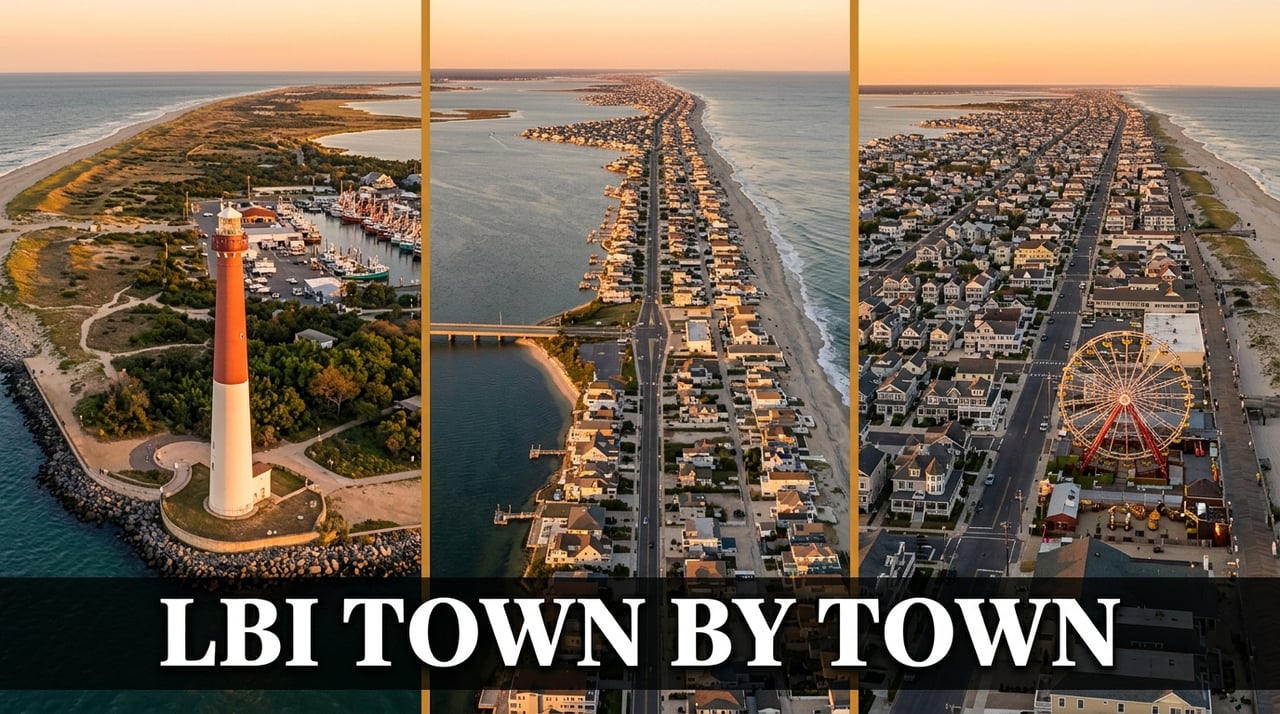

Long Beach Island is one barrier island, one ZIP code (08008 covers most of it), and one MLS region. Buyers who don't know the island treat it as a single market. That's the first mistake.
The 18-mile strip is divided into six separate municipalities — Barnegat Light, Harvey Cedars, Surf City, Ship Bottom, Long Beach Township, and Beach Haven — and each one trades on its own logic. Different price tiers, different buyer pools, different summer rental dynamics, different lot sizes, different commercial density, different distance from the causeway. The decision about which LBI town to buy in matters more than the specific house, because the town determines the lifestyle, the appreciation curve, and how the property functions when the summer crowd leaves in October.
This is the working town map I give every buyer who calls me about Long Beach Island for the first time.
Five of the six LBI municipalities are geographically contiguous boroughs. Long Beach Township is not. LBT is the largest of the six and is split into four non-contiguous land areas — the northern tip enclaves of Loveladies, North Beach, and High Bar Harbor, the long mid-island stretch from Brant Beach south to North Beach Haven, the southern Holgate section past Beach Haven, and other smaller fragments. Within those areas, LBT contains 17 named neighborhoods including Brant Beach, Beach Haven Crest, Beach Haven Gardens, Beach Haven Park, Beach Haven Terrace, Brighton Beach, Haven Beach, North Beach Haven, Peahala Park, South Beach Haven, Spray Beach, and The Dunes.
For real estate purposes, that means LBT is a tax jurisdiction more than a unified market. A Loveladies oceanfront sale at $8.58 million and a Holgate bayside sale at $1.5 million share a township government. They share almost nothing else. Lot sizes, buyer profiles, and price tiers diverge sharply. Treating "Long Beach Township" as a single line item on a market report — which the broader 2026 LBI market report covers in detail — produces a misleading number unless you break it down by sub-neighborhood.
The five borough-style municipalities (Barnegat Light, Harvey Cedars, Surf City, Ship Bottom, Beach Haven) are easier to read. Each is a single contiguous market with a distinct character. Below, each town gets its own breakdown, with the LBT sub-neighborhoods grouped where they fit the geography.
The northernmost town on the island and the structural opposite of the gateway commercial bustle in Ship Bottom. Barnegat Light occupies the north tip past Loveladies, anchored by Old Barney — the 165-foot Barnegat Lighthouse standing in Barnegat Lighthouse State Park since 1859. The town is a maritime working community in a way the rest of LBI no longer is. Viking Village, the active commercial fishing fleet's home base, still anchors the bayside. The scallop boat used in *The Perfect Storm* docks here.
For real estate, Barnegat Light operates on a quieter premium than its ultra-luxury neighbors a few miles south. Industry tracking suggests 2025 average sale prices here ran in the high $1.9 million range — meaningful pricing, but a clear discount to Harvey Cedars, Loveladies, and Beach Haven. The tradeoff is geography. Barnegat Light is a 20-minute drive from the Route 72 causeway down Long Beach Boulevard, the longest "off-island time" on LBI. Its dunes are also among the largest, which means longer walks to the ocean than buyers used to mid-island towns expect.
The right buyer here prioritizes authenticity, quiet, and post-Sandy structural resilience over walkability and proximity. Barnegat Light rebuilt heavily after 2012 — the dune system here held during Sandy, while neighboring Loveladies suffered some of the worst destruction on the island — and that's reflected in current building stock and current insurance underwriting. Full-time residents and retirees buy here. So do second-home owners who want the lighthouse and the fishing village more than they want the boardwalk and the bars.
Loveladies and North Beach are technically sub-neighborhoods of Long Beach Township, but they function as their own market. This is the apex of LBI real estate — the section of the island where ultra-high-net-worth capital has consolidated over the last decade. The 2025 top sale on the island closed in Loveladies: an 8-bedroom oceanfront estate at $8.58 million, roughly $2,000 per square foot.
The structural reason pricing holds here is lot size. Standard residential parcels in Loveladies and North Beach run 100 by 100 feet — double the 50 by 100 footprint that defines the southern municipalities. That single fact, combined with the absence of any commercial zoning and a system of private lanes that prevent public beach parking, makes the area functionally non-replicable. You can't manufacture more 100x100 oceanfront lots on a built-out barrier island.
Industry tracking suggests active listings in Loveladies routinely command per-square-foot pricing well above $1,200, with some marketed parcels above $1,300. Buyers here are national, often out-of-state, and overwhelmingly cash. This is the section of LBI most insulated from mortgage rate movements, because the buyer pool isn't financing in the conventional sense. The tradeoff is what the buyer accepts in exchange for the prestige: no walkable town center, no commercial amenities within the neighborhood, and a drive-everywhere daily reality. For buyers seeking a private trophy asset, that tradeoff is the entire point. For buyers who want to walk to dinner, this isn't the right town.
Just south of Loveladies sits Harvey Cedars — the small, residential-first borough that has quietly run with the highest per-square-foot pricing on standard 50x100 lots anywhere on the island. Harvey Cedars is known for two things: its high-elevation dune system (one of the most aggressive on LBI, and the reason the town fared comparatively well during Sandy) and its concentration of post-2019 modern luxury construction. The town has minimal commercial zoning by design, and it shows in the building stock.
Industry tracking suggests 2025 per-square-foot pricing in Harvey Cedars ran near the top of the island, with averages exceeding $1,170 per foot — competitive with Loveladies on a PPSF basis even though absolute sale prices are lower because of smaller lots. The buyer profile here is the turnkey luxury second-home buyer: someone who wants the modern build but doesn't want to be the one going through CAFRA review and an 18-month construction calendar to get it.
Compared to Loveladies, Harvey Cedars trades on more accessible lot sizes (standard 50x100 instead of 100x100), less prestige value, and a similar PPSF on modern stock. For a buyer who wants new construction at a meaningful but not ultra-luxury price band, Harvey Cedars is often the right match.
Surf City sits immediately north of the Route 72 causeway. It's the first town buyers encounter coming on-island and turning left. Historically, it's also the first LBI municipality to have received federally funded beach replenishment, which is the structural reason its beaches today are among the widest on the island.
The pricing here tracks closer to the islandwide average than any other LBI town. Recent benchmarks include a $6.5 million oceanfront full-price sale in 2025 — a meaningful number, though not at the top tier. Per-square-foot pricing typically lands between $1,000 and $1,100, depending on the parcel's position relative to the ocean and the age of the structure. The town has a walkable commercial district running along the Boulevard (more than Harvey Cedars, less than Beach Haven), a diverse housing stock that mixes original 1960s Cape Cods with modern reverse-living new construction, and a year-round residential character.
The right buyer in Surf City is the multigenerational family or the rental-yield investor who wants walkable amenities and wide beaches without paying the Beach Haven density premium or the Loveladies privacy premium. For first-time LBI buyers who want to be central to the island and have access to mainland conveniences via the causeway, Surf City is often the most balanced answer.
Ship Bottom is the borough that absorbs the Route 72 causeway. Every car arriving on Long Beach Island lands here first. Every car leaving departs from here. That single fact shapes the entire real estate dynamic.
The advantages of being the gateway are real: the highest commercial density per square mile on the island, immediate access to mainland Manahawkin shopping and medical services, and the fastest market liquidity on LBI. Industry tracking suggests Ship Bottom homes typically clear in roughly 30 to 60 days, well below the islandwide 64-day average. The disadvantages are also real: causeway traffic in summer, commercial noise, smaller historical lot footprints, and less residential privacy than the towns further north or south.
Ship Bottom consistently offers the most accessible single-family entry point on the island. Per-square-foot pricing here typically trades below the islandwide average, particularly for properties on or near the Boulevard. The buyer profile is the convenience-first first-time LBI buyer or the investor who values fast resale liquidity over absolute appreciation. For buyers who want to be on LBI without paying the second-home prestige premium, Ship Bottom is the most rational entry.
Long Beach Township is the largest municipality on the island by area and absorbs the most LBI sales by volume in any given year. It's also the hardest to summarize, because it isn't really one market — it's at least four geographic clusters operating on different price points and buyer profiles, all under a single tax umbrella.
The northern LBT sections (Loveladies, North Beach, High Bar Harbor) cover the apex of the island and have already been addressed above. The mid-island stretch — Brant Beach, Beach Haven Crest, Brighton Beach, Peahala Park, Beach Haven Park, Beach Haven Gardens, Spray Beach, The Dunes, Haven Beach, North Beach Haven — is the longest contiguous run of LBT and represents the largest share of transaction volume. This is the residential mid-island, where Brant Beach in particular operates as a quiet anchor with the popular Bayview Park, 68th Street Pavilion, dog park, basketball courts, and pickleball courts. Standard 50x100 lots, mixed building stock from 1960s Cape Cods to 2024 modern builds, per-square-foot pricing tracking near or slightly above the islandwide average.
The southern LBT section is Holgate — its own distinct submarket covered separately below. High Bar Harbor on the bay side near Barnegat Light is technically LBT but functions as a boater's enclave with lagoon access and dock-driven pricing that trades on different logic than the ocean side.
The buyer-side translation: when a property is listed in "Long Beach Township," the first question is which LBT? The pricing, character, and buyer pool depend entirely on the sub-neighborhood. The township itself tells you almost nothing.
Beach Haven is the southern borough — and the only LBI town that operates on a fundamentally different real estate paradigm than the rest of the island. Founded in 1874 and originally a summer destination for the upper class of Philadelphia and Mount Holly, Beach Haven preserves a Victorian-era density that no other LBI town has. Houses sit close together. Streets are walkable. Commercial activity is concentrated around Bay Village, the Fantasy Island Amusement Park (operating since 1984), and a restaurant cluster that's the most active on the island year-round.
The walkability is the entire pricing story. Industry tracking suggests 2025 averages here ran near $2.6 million ASP and per-square-foot pricing in the $1,080 to $1,100 range. Those numbers reflect a structural rental yield premium: tourists who want to park their cars for the week and walk to dinner pay materially more per night for Beach Haven properties than for equivalent square footage in towns where you have to drive to everything. That weekly rental premium translates directly into investor competition for the underlying real estate.
The right buyer here is the rental-yield-focused investor or the second-home owner who wants pedestrian access to restaurants, the boardwalk feel, and amusement park noise as features rather than bugs. The tradeoff is density, summer congestion, and limited residential privacy. Beach Haven is not a quiet town. That's exactly why it commands what it does.
Holgate is the LBT sub-neighborhood at the southernmost end of the island, dead-ending into the Edwin B. Forsythe National Wildlife Refuge. Past Holgate, there's no road, no development, just refuge dunes and Beach Haven Inlet. That geography is the entire character of the neighborhood.
For real estate purposes, Holgate operates as the quiet alternative to Beach Haven density. There's no through-traffic — Holgate is a destination, not a corridor — which gives the area a more residential feel than its immediate neighbor to the north. Pricing is generally more accessible than the northern apex enclaves while still offering oceanfront and bayfront product. Per-square-foot bayside pricing in Holgate has been documented in recent years near the $843 mark, well below islandwide averages and well below comparable bayside in Brant Beach or Beach Haven.
The right buyer for Holgate is someone seeking seclusion at a more accessible basis than Loveladies. The tradeoff is the longest drive to off-island services, more limited commercial within walking distance, and a wildlife refuge boundary that means certain seasonal vehicle restrictions for beach access. For buyers who actually want the wildlife refuge as part of the experience, Holgate is the only town on LBI that delivers it.
| TOWN | CHARACTER | RIGHT FOR |
|---|---|---|
| Barnegat Light | Maritime, lighthouse, Viking Village | Quiet authenticity, retirees, full-time residents |
| Loveladies / N. Beach | 100x100 lots, private lanes, ultra-luxury | Trophy asset, ultra-high-net-worth, cash buyer |
| Harvey Cedars | Modern construction, high dunes, residential | Turnkey luxury second-home buyer |
| Surf City | Wide replenished beaches, walkable commercial | Multigenerational families, balanced buyers |
| Ship Bottom | Gateway commercial density, fastest liquidity | First-time LBI buyers, convenience-first |
| Long Beach Twp (mid) | Brant Beach, mid-island residential | Family-first second homes, mid-tier pricing |
| Beach Haven | Victorian density, walkability, Fantasy Island | Rental-yield investors, walkable lifestyle buyers |
| Holgate | Wildlife refuge boundary, quiet, dead-end | Seclusion at accessible basis, refuge enthusiasts |
Privacy → Loveladies, North Beach, Barnegat Light
Walkability → Beach Haven, Surf City
Convenience → Ship Bottom
Modern luxury → Harvey Cedars
Family value → Brant Beach (LBT mid-island)
Seclusion → Holgate
In a market with the supply constraints LBI is operating under in 2026 — fewer than 100 active single-family listings across the entire 18-mile island for most of the year, sub-3% mortgage lock-in suppressing inventory, and a buyer pool that's increasingly cash-driven at the upper tier — buyers don't have the luxury of waiting for the perfect house. What they have is the choice of which town to commit to.
Get the town right and the right house follows. Beach Haven for walkability. Harvey Cedars for modern luxury. Loveladies if the budget allows. Surf City for balanced family living. Ship Bottom for fastest entry. Holgate or Barnegat Light for quiet at the geographic extremes. Each town is a different product solving a different lifestyle problem, and the buyer who knows which problem they're solving has a meaningful advantage in this market.
The full islandwide picture is in the 2026 LBI market report. For waterfront-specific dynamics, the oceanfront vs. bayfront 2026 analysis drills into the per-foot pricing logic. And for buyers eyeing bayfront in any of these towns, the riparian rights buyer guide covers the documentation due diligence every Barnegat Bay purchase requires.
Sources: islandwide single-family sales data referenced from Sand Dollar Real Estate (LBIRealEstateNews.com) 2025 dataset and The Van Dyk Group 2025 segment analyses. Long Beach Township sub-neighborhood structure verified via Long Beach Township municipal documentation and the LBT Beach Patrol public records. Loveladies $8.58M sale and Surf City $6.5M oceanfront sale verified through 2025 LBI MLS reporting. Lot sizing of 100x100 in Loveladies/North Beach versus 50x100 standard elsewhere on the island verified through municipal zoning records. Town-level price-per-square-foot figures referenced as industry tracking — specific municipal averages drawn from specialty LBI broker reports rather than primary MLS pulls. Fantasy Island Amusement Park status confirmed operating in 2026 (the LBI Beach Haven location, which is unrelated to the closed Grand Island NY park of the same name).
Prodigy Real Estate is an innovative real estate company offering high-end video production, home valuation services, purchasing, and home sales. Serving New York and New Jersey.